

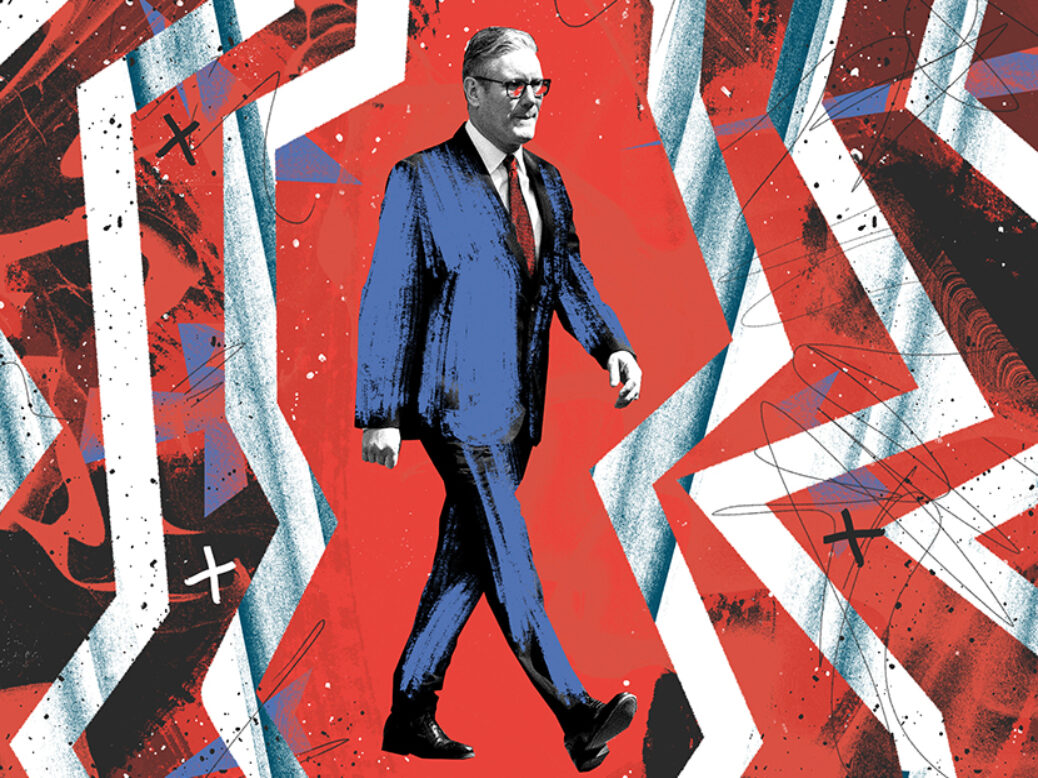
Illustration by Nate Kitch
As Westminster concentrates on the next phase of the political drama, and whether Anas Sarwar, the Scottish Labour leader who has called on Keir Starmer to go, had connections with any leadership contenders in London, we should never forget where this started, or the women’s lives destroyed by Jeffrey Epstein.
Everything connects, because this whole story is about the exercise of predatory power. At the start of her latest novel, Glyph, Ali Smith quotes Margaret Atwood: “Politics, for me, is everything that involves who gets to do what to whom. That’s politics.” If the Labour Party is not a movement in favour of the whom against the who, across a wider range, what’s its point?
Economically, those who get to do the doing are the wealthy tech and corporate interests that are forcing breakneck change on a declining Western civilisation whose citizens feel increasingly worried for the future – and therefore angry. No political plan without the huge disruptive power of AI at its core can be a serious one. If history is any guide, some kind of revolutionary rupture is coming.
For the millions of voters who have been tuning into this scandal, Peter Mandelson has become a symbol of alien interests – the tech moguls and financial fixers leering round Epstein’s poolside. There is a fundamental injustice in Starmer – who never met Epstein and would have despised him if he had – being destroyed, while Donald Trump and politicians of the far right, who were much closer to the sex criminal’s web, remain untouched.

Subscribe to the New Statesman today for only £1 a week.
But Starmer is in the firing line of public fury. Arguing that the PM is now stronger because he has sacrificed his chief of staff, Morgan McSweeney, is like losing a wheel of your bike and arguing that you’ll still cope with the mountain section of the Tour de France.
The likeliest consequence of it all is a Reform government under Nigel Farage – by August 2029, or before that, if Labour crumbles in power. The public is disgusted but has not forgotten the Boris Johnson and Liz Truss years. We must assume that the national instinct will be for a complete clearing out of the political class, which means voting Green or – more likely – Reform.
Which isn’t fair. Members of Reform have had Russian connections. The Epstein web of interest included, through Steve Bannon, support for the European far right. Reform is admired by Elon Musk. Its tax policies include slashing corporation tax and abolishing inheritance tax under a certain threshold. Its victory is not one that, in the end, would please the mutinous millions. But this is where we are heading because of Labour’s failure. It is hard to see a way back for Starmer to be an effective national leader. We can’t pin down the when, or the who, or exactly the how. But the “why” seems impossible to ignore.
Journalists may seem peripheral to the rhythm of what’s about to happen. But – and I’m sorry to share secrets from the sausage factory – so many of us have publicly committed ourselves to the proposition that Starmer is doomed, that the idea takes on its own momentum. We don’t want to be proved wrong. So we – political hacks, broadcasters, commentators of all kinds – find we have a vested interest in pushing the man out.
It would be conspiratorial nonsense to blame Starmer’s plight on journalists. But we are also part of the conversation – or, if you like, the contamination. In the latter months of Johnson’s government, the despair of the commentators was shared by increasingly vocal backbenchers, before spreading to ministers and finally the cabinet, which then finished him off. Johnson still had the support of big chunks of the media, which Starmer does not, but otherwise, the same pattern is playing out today.
Though they are utterly different personalities, they had this in common: they were loner prime ministers without an ideological faction at their backs. Team Starmer is trying to shore up the Prime Minister’s position by warning about the unavoidable chaos of a contest – what would the markets do? What about Ukraine? Where does it leave Britain at this most vulnerable moment on the world stage? This is a powerful argument. It is being made, I’m sure, in conversations with cabinet ministers. But if Labour MPs believe Starmer is leading them to disaster, then that, for them, is a more powerful argument still.
Yet the statement that Starmer is “on his way out” is meaningless unless somebody else is trying to shoulder their way in. I gather he is angry rather than depressed. We know he is stubborn and proud. It’s not impossible that Labour wins the Gorton and Denton by-election on 26 February. His supporters in cabinet – there are some – insist he must not be forced out in a chaotic or humiliating way. The initiative is therefore with those asking themselves whether they have the courage, instinct for risk and self-belief to tell him to go.
Labour factions are already at each other’s throats and briefing in a way that will greatly help the opposition parties. Angela Rayner supporters underline the links between Wes Streeting, McSweeney and Mandelson – links that dog the Health Secretary, who seems the most determined, well-organised and eloquent alternative to Starmer. His side of the party suggests that a Rayner premiership, perhaps with Ed Miliband as her chancellor, would panic the bond markets.
All one can say for sure is that the Mandelson affair has hugely damaged the right of the party. The so-called soft left has never been stronger. This is likely to drive the government further left, whether under Rayner or somebody else. The winner – and it could yet be an entirely different figure, one who tries to unite the different wings: a Bridget Phillipson, Yvette Cooper or John Healey – will have to produce a plausible programme for these wild times.
A Streeting administration would bring in big beasts from outside the Commons, a semi-permanent inner cabinet to take proper political decisions only after proper political conversations. It would mean a brave turn to Europe and public service reform. But what would be its policy for the most disadvantaged? What about job losses and AI? Could it decontaminate itself from the web of corporate interests represented by Mandelson?
A Rayner government would mean a much more robust attitude to those tech and corporate powers. It would feel highly appropriate for a working-class woman to seize the reins after the Epstein/Mandelson scandal.
Those involved talk of a left economic populism, which would bring back millions defecting to the Greens. The cost of living, intergenerational fairness, the pensions triple lock and housing are all essential themes for Labour. But under agonising fiscal constraints, would the Rayner economic policy not default to higher all-round taxes, which an over-burdened electorate would say it never voted for? Could she find a chancellor that reassured the bond markets rather than spooked them further? And is she experienced and calm enough for the international diplomacy these times demand?
Then there is Andy Burnham. If we are to have a proper contest about different forms of social democratic politics in the aftermath of the Mandelson affair, it would seem bizarre to exclude “Manchester-ism”.
I haven’t even mentioned yet other substantial people at the top of the party who could help graft together a programme. Douglas Alexander, the Scottish Secretary, is the best political brain in the cabinet and grossly underused. Shabana Mahmood has the will for leadership, although it is not yet her time.
Is it possible to have a rational debate about all this while Labour is still (theoretically) in charge? To change leaders is a huge risk, which could land us with an even ropier administration than we have today. I keep coming back to “Zugzwang”, the chess term for when, in a weak position, moving in any direction makes the outcome even worse.
This takes us to the possibility of Starmer carrying on, whatever the commentariat and the Parliamentary Labour Party say. If he doesn’t go very soon, ministers who know him well say there’s little prospect of a voluntary exit before May’s elections. They wonder whether, since the Mandelson affair is going to push the government to the left anyway, he might not be better leading that himself – a final throw of the dice?
Everything’s possible, but it seems unconvincing to trudge ahead without the enthusiasm of cabinet, or wide support on his own back benches, in desperate economic circumstances, on the promise of higher taxes and more spending. The anti-Reform “decent Britain” agenda collapses if he himself becomes Reform’s recruiting officer.
Yet staggering on might be the outcome. Theresa May’s authority bled away after the 2017 election, but she survived for two more years of parliamentary crisis and paralysis before her resignation. It was grim, but it could happen again: the Starmer government becoming the stagger-on government. Would that not be preferable to the unpredictability of a Labour campaign to ease out the Prime Minister, a decent man, and to replace him with somebody without a personal electoral mandate? I think the answer is no, although it’s a good question.
So what? Don’t we need a radical turn? What scares me about Reform is racialised politics of a kind that could lead us to communal war. Meanwhile, if things carry on like this, a huge Scottish nationalist victory and lurch towards the break-up of the UK is likely. Anas Sarwar may be unpopular, but he spoke from the best of motives.
Whatever the risk, Labour has to take a different road. It could be under Streeting or Rayner. Could it, even now, be under Starmer himself? One thing we have learned in the past few days is that, with his back against the wall, he can prove a fighter. As it happens, I bumped into him. I told him what I think: he looked me in the eye, quite angrily and he said, “You are wrong. I will prove you wrong. I am going to fight.” Well, I like this new Starmer better. I’d love to be proved wrong. And if I am, you will read it here first.
[Further reading: How Keir Starmer survives]
Content from our partners