
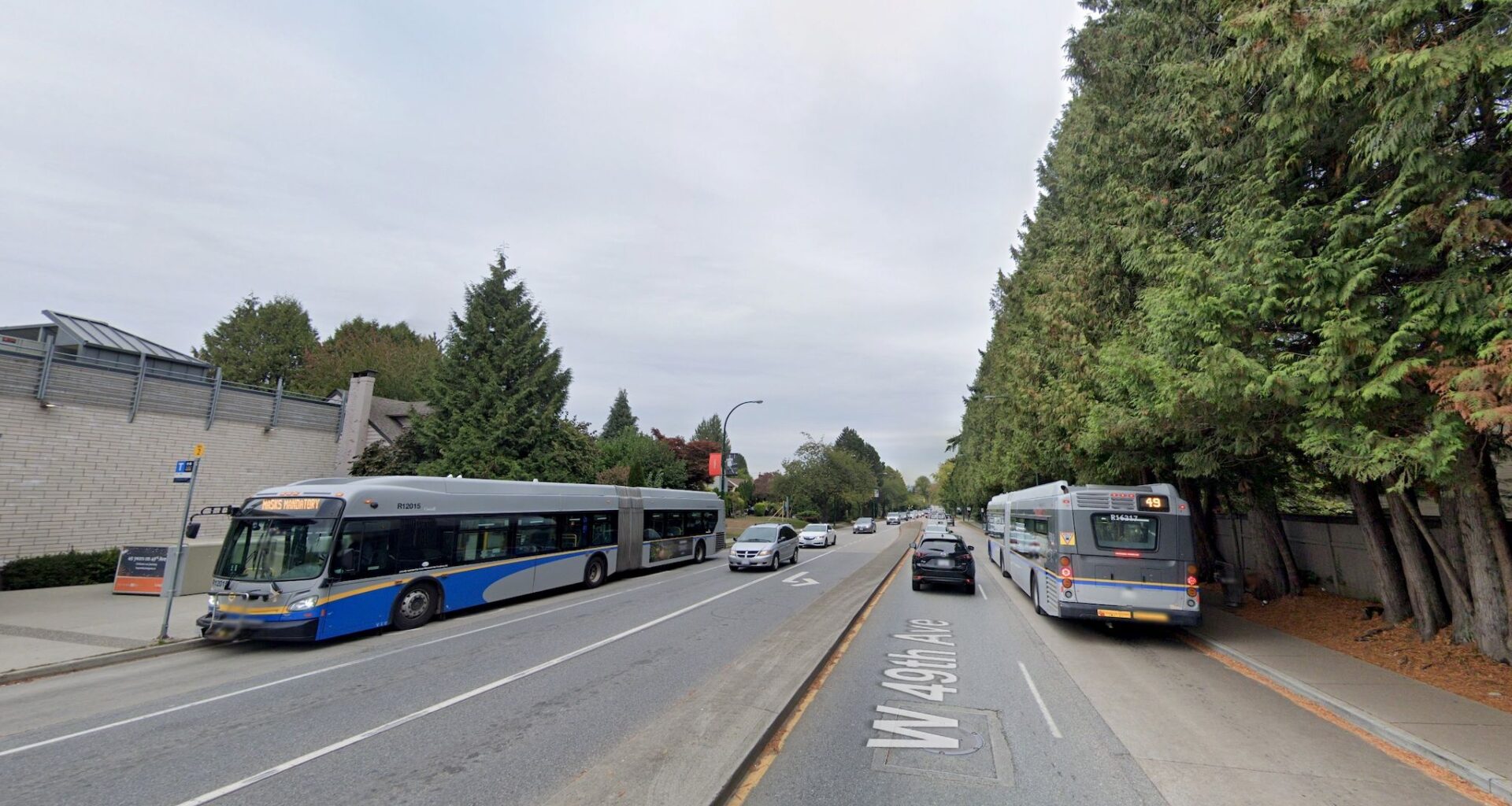
To improve services on Metro Vancouver’s third busiest bus route, the City of Vancouver and TransLink are planning to implement new bus-priority measures along select segments of 49th Avenue.
This includes the creation of new bus lanes along 49th Avenue between Cambie Street and Fraser Street in both the eastbound and westbound directions during all daytime hours — between the morning peak period and late evening — from 7 a.m. to 10 p.m., seven days a week.
The new bus lanes will be accomplished by implementing new curbside vehicle parking and loading/unloading restrictions. General vehicles will still be able to enter the curbside bus lane to make right-turns when approaching an intersection or driveway. Currently, this segment of 49th Avenue generally has one general vehicle travel lane in each direction and curbside vehicle parking on both sides of the street.
This centrally-located segment sees some of the 49th Avenue corridor’s highest vehicle and bus public transit passenger volumes. According to the municipal government, this is a hotspot for bus delays, with vehicles making left-turns and parking blocking buses.
As well, the portion of 49th Avenue between Cambie Street and Main Street is currently experiencing some significant construction activity from new high-density residential developments.
The length of the corridor is served by TransLink’s No. 49 UBC/Metrotown Station local bus route, which saw 8.5 million boardings in 2024, based on the latest available statistics. It averaged 26,900 boardings per weekday, 16,800 per Saturday, and 14,500 per Sunday/holiday.
Using articulated buses that arrive frequently, the No. 49’s passenger volumes are only behind the ridership of the 99 B-Line and R4 41st Avenue RapidBus, and ahead of the No. 25 UBC/Brentwood Station local bus route.
In addition to longer east-west corridor trips, many passengers travel through the area on the No. 49 to reach Langara College and/or connect with SkyTrain’s Langara-49th Avenue Station at Cambie Street.
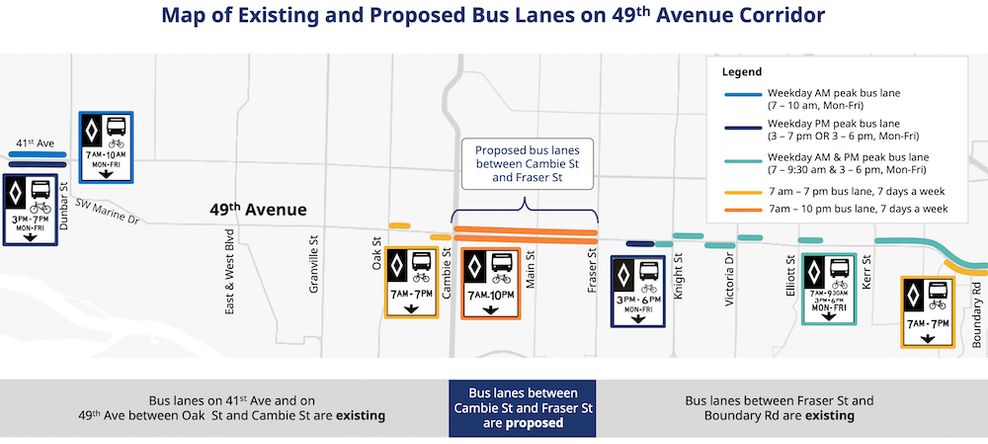
Bus lanes on 49th Avenue in Vancouver. (City of Vancouver)
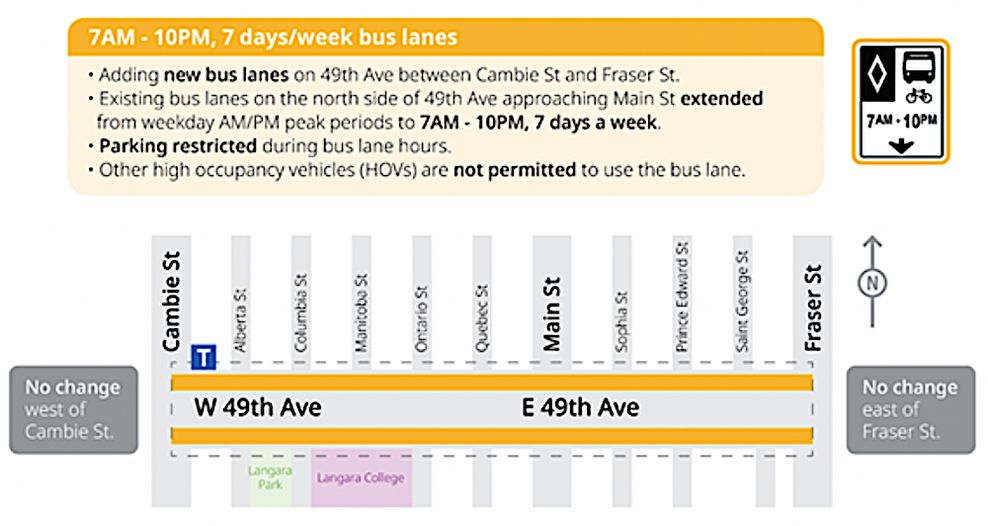
Bus lanes on 49th Avenue in Vancouver. (City of Vancouver)
In addition to the City’s bus lane efforts, TransLink is performing bus-stop balancing — the practice of removing bus stops that are spaced too closely together — for the No. 49. A total of 28 bus stops will be removed, including 15 eastbound stops and 13 stops, while three stops will be added.
The changes to the bus stops are along 49th Avenue between Southwest Marine Drive and Boundary Road, and portions of Dunbar Street and 41st Avenue. Overall, roughly one-in-three stops that are less frequently used or spaced too close together will see changes.
Like past bus-stop balancing efforts on other bus routes, this will improve reliability, increase bus speeds, reduce travel times, and reduce TransLink’s bus operating costs.
The public transit authority notes that over 90 per cent of passengers on the No. 49 will continue to use their existing bus stop. Where a stop is removed, another will be within a short walking distance of about one block away.
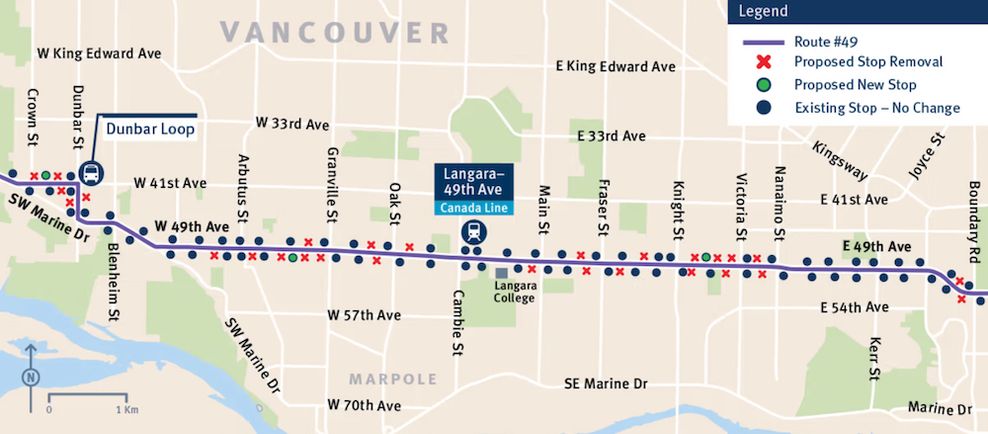
Bus-stop balancing on the No. 49 UBC/Metrotown Station bus route. (TransLink)
Public input is currently being sought on the various changes to the 49th Avenue corridor, with the municipal government’s online survey on bus lanes and TransLink’s separate online survey on bus-stop balancing both closing on March 1, 2026.
The City will implement the bus lanes over the spring and summer months of 2026, which will be coordinated with the restoration of 49th Avenue following a sewer separation project in the area. TransLink’s bus stop changes are expected to take place in June 2026.
The City has indicated that future phases of additional unspecified bus-priority improvements on the 49th Avenue corridor could be implemented in 2027.
On Feb. 13, 2026, at 6 p.m., advocacy organization Movement: Metro Vancouver Transit Riders will host a whimsical rally outside Langara-49th Avenue Station in support of the bus-priority measures, while also celebrating the 25th birthday of Hudson Williams — the breakout local star of the hit television series Heated Rivalry. The connection stems from Williams being a recent alumnus of Langara College, with the presumption that he took the No. 49 bus to campus during his studies.
Most of the No. 49 runs through Vancouver, but parts fall under Burnaby and the University of British Columbia (UBC).
Movement asserts that beyond the currently planned measures, there should be improved signalized intersections on Wesbrook Mall at UBC. The City of Vancouver should add bus lanes along most of 49th Avenue and on the Dunbar Street and 41st Avenue segments this bus route uses, introduce turn restrictions where congestion is worst, and install queue jumps at busy intersections like 49th Avenue and Dunbar Street. The City of Burnaby should add bus lanes on Imperial Drive and Willingdon Avenue.
They also suggest that bus lanes could be implemented more quickly if they are decoupled from other larger roadworks, utility, and sewer and water infrastructure projects.
Across all jurisdictions, Movement argues, traffic-signal priority should be implemented to give buses more green lights. TransLink should upgrade the No. 49 to a RapidBus, add a less-frequent local route to serve quieter stops, and introduce a new local bus route on 54th Avenue/57th Avenue to relieve pressure on the 49 Avenue and fill one of the city’s largest service gaps.
In early 2025, TransLink announced a longer-term strategy that provides a new limited-stop express bus service that mirrors the route of the No. 49 local bus service, and launches brand new east-west local bus routes that serve segments of 54th Avenue and 57th Avenue in Vancouver.
Currently, Vancouver’s municipal government and TransLink are also planning bus lanes and bus-stop balancing for segments of the Main Street/Kingsway corridor and East Hastings Street.