
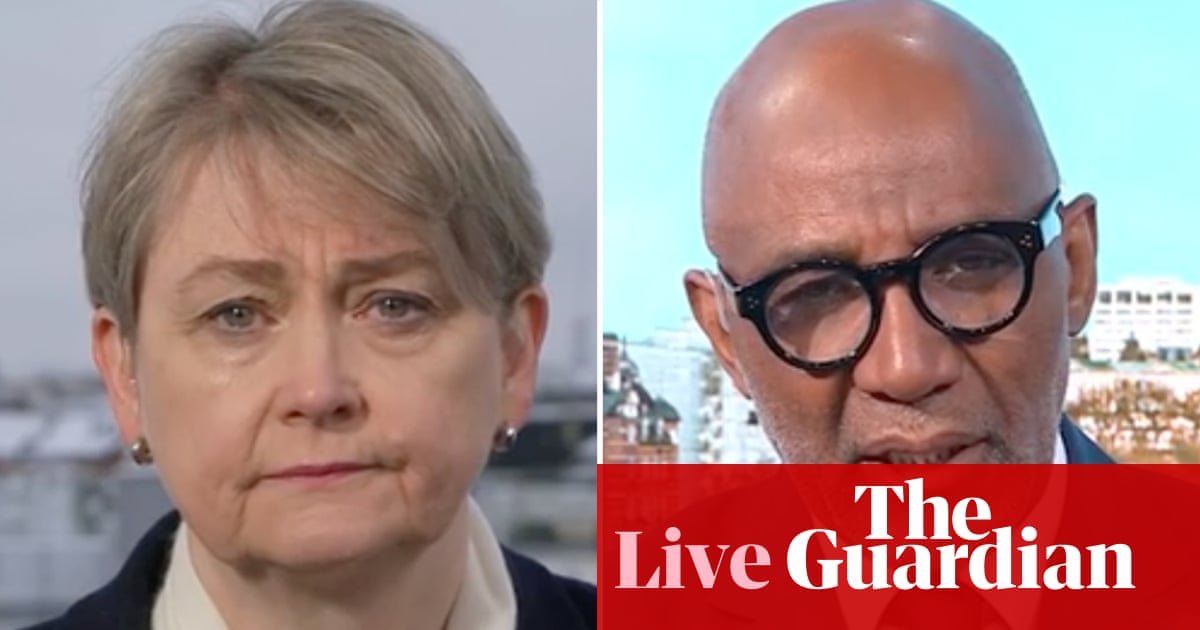
Cooper defends decision to proscribe Palestine Action despite ban being ruled unlawful
Now to some UK news … In a significant blow to the Home Office, the High Court ruled last week that the ban of Palestine Action under terrorism legislation was unlawful and “disproportionate”, with most of their activities having not reached the level, scale and persistence to be defined as terrorism.
The high court said the then home secretary Yvette Cooper had not followed her own policies when bringing in the controversial ban last summer.
When asked about her decision making, Cooper told Sky News:
Well, I followed the clear advice and recommendations, going through a serious process that the Home Office goes through, involving different agencies and police advice as well, which was very clear about the recommendation for proscription of this group.
And the court has also concluded that this is not a normal protest group, that it has found that this group has committed acts of terrorism, that this group is not simply in line with democratic values, and has promoted violence.
Cooper was pressed to reveal the advice she was given that informed her decision to pursue the ban, but did not, instead saying: “So I was given significant evidence and advice around risks of violence and risks from public safety, and that is what you take seriously.” The foreign secretary added:
“If you ignore advice that you are given about risks to public safety then you’re really not taking seriously the responsibilities of home secretary.”
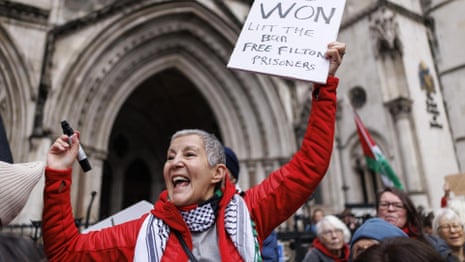 ‘Palestine Action is back’: Terror ban ruled unlawful | The View From – videoShare
Updated at 04.39 EST
Key events
Show key events only
Please turn on JavaScript to use this feature
Yvette Cooper was interviewed by the BBC’s Laura Kuenssberg progamme after the Sky interview.
Kuenssberg underscored the chaos inside Downing Street by listing all of the departures from the prime minisiter’s team since Labour won a landslide general election in July 2024. These included:
Cooper acknowlegded it had been a “difficult week” in which the Scottish Labour leader, Anas Sarwar, called for the prime minister to resign after saying there had been “too many mistakes” under Keir Starmer’s leadership.
Kuenssberg asks the foreign secretary whether Starmer should listen to the women in his government more. “I feel actually quite angry about some of the issues we’ve had,” Cooper said, in reference to the appointment to Peter Mandelson as US ambassador.
She stressed the real focus should be on Jeffrey Epstein’s victims and the work Labour has done around tackling violence against women and girls.
Share‘Significant process failures’ in appointment of Matthew Doyle to Lords, foreign secretary says
The foreign secretary, Yvette Cooper, was asked about the appointment of Keir Starmer’s former spin doctor Matthew Doyle to the House of Lords.
Doyle has been suspended from the Labour whip in his new role in the Lords after it emerged that he had campaigned on behalf of a friend who had been charged with possessing indecent images of children.
Trevor Phillips asked Cooper if she was confident that nobody else in “her administration” campaigned for Sean Morton, a former Labour councillor in Moray who admitted indecent child image offences in 2017. Cooper told Sky News:
I think there has clearly been some significant process failures in this appointment. There is still a review under way on that …
We do take this extremely seriously. Keir Starmer has … talked about the imporatnce of standards in public life. And that is why we take this so seriously …
For me there is just a wider issue here, which is that I personally in opposition made it Labour’s misson to half violence against women and girls in a decade.
And also in the Home Office made that a central mission for the government. And now in the Foreign Office I’m making it a priority as part of our foreign policy across the world.
Starmer has been under intense political pressure since he admitted to appointing Peter Mandelson to the role of US ambassador despite knowing about Mandelson’s friendship with the late sex offender and financier Jeffrey Epstein.
Updated at 05.23 EST
Huda Ammori, a co-founder of Palestine Action, who brought the high court challenge, called it a “monumental victory”. She said on Friday:
We were banned because Palestine Action’s disruption of Israel’s largest weapons manufacturer, Elbit Systems, cost the corporation millions of pounds in profits and to lose out on multibillion-pound contracts.
We’ve used the same tactics as direct action organisations throughout history, including anti-war groups Keir Starmer defended in court, and the government acknowledged in these legal proceedings that this ban was based on property damage, not violence against people.
Banning Palestine Action was always about appeasing pro-Israel lobby groups and weapons manufacturers, and nothing to do with terrorism … Today’s landmark ruling is a victory for freedom for all, and I urge the government to respect the court’s decision and bring this injustice to an end without further delay.
Huda Ammori called for proscription of the group to be lifted after the high court found it to be a very serious interference with protest rights. Photograph: Abdullah Bailey/Alamy
As the Guardian’s legal affairs correspondent Haroon Saddique notes in this story, Ammori said her lawyers would resist Shabana Mahmood’s attempts to retain the ban while the home secretary tried to appeal against the judgment.
The fate of more than 2,500 people arrested for supporting Palestine Action since proscription remains uncertain after the current home secretary, Shabana Mahmood, said she would appeal against the ban.
Proscription makes it a criminal offence to belong to or support Palestine Action, punishable by up to 14 years in prison.
Nearly 700 people have been charged with a terrorism offence and faced preliminary court proceedings although no one has yet been convicted.
The Metropolitan police said it will stop arresting protesters who hold up signs declaring “I support Palestine Action” in the wake of the High Court ruling.
But the force said it will continue to gather evidence of overt support for Palestine Action, because the proscription order remains in place until the government appeal has been dealt with.
ShareCooper defends decision to proscribe Palestine Action despite ban being ruled unlawful
Now to some UK news … In a significant blow to the Home Office, the High Court ruled last week that the ban of Palestine Action under terrorism legislation was unlawful and “disproportionate”, with most of their activities having not reached the level, scale and persistence to be defined as terrorism.
The high court said the then home secretary Yvette Cooper had not followed her own policies when bringing in the controversial ban last summer.
When asked about her decision making, Cooper told Sky News:
Well, I followed the clear advice and recommendations, going through a serious process that the Home Office goes through, involving different agencies and police advice as well, which was very clear about the recommendation for proscription of this group.
And the court has also concluded that this is not a normal protest group, that it has found that this group has committed acts of terrorism, that this group is not simply in line with democratic values, and has promoted violence.
Cooper was pressed to reveal the advice she was given that informed her decision to pursue the ban, but did not, instead saying: “So I was given significant evidence and advice around risks of violence and risks from public safety, and that is what you take seriously.” The foreign secretary added:
“If you ignore advice that you are given about risks to public safety then you’re really not taking seriously the responsibilities of home secretary.”
‘Palestine Action is back’: Terror ban ruled unlawful | The View From – videoShare
Updated at 04.39 EST
Yvette Cooper is asked in her Sky News interview whether she agrees with German Chancellor Friedrich Merz’s assessment that the supposed rules-based world order has collapsed.
The foreign secretary acknowledges huge political instability around the world, economic shifts, driven by the rise of China and protectionism, and marks the Russian aggression as a “persistent” threat that Europe has to face up to.
She also acknowlegded that the US is “changing their focus” and will reduce funding for European security, which means Europe has to “step up to the plate” in defending itself.
You can keep up with the latest lines from Europe in our Munich Security Conference blog helmed by the brilliant Jakub Krupa.
Updated at 04.29 EST
 Patrick Wintour
Patrick Wintour is diplomatic editor for the Guardian
The intelligence agencies claimed laboratory testing found that the deadly toxin in the skin of Ecuador dart frogs (epibatidine) was found in samples from Navalny’s body and probably resulted in his death.
The statement adds: “Only the Russian state had the means, motive and opportunity to deploy this lethal toxin to target Navalny during his imprisonment in a Russian penal colony in Siberia, and we hold it responsible for his death.”
“Epibatidine can be found naturally in dart frogs in the wild in South America. Dart frogs in captivity do not produce this toxin and it is not found naturally in Russia. There is no innocent explanation for its presence in Navalny’s body.”
Alexei Nalvany died in an Arctic penal colony on 16 February 2024. Photograph: Sefa Karacan/Anadolu Agency/Getty Images
Although it had been widely assumed that Navalny had been poisoned by the Russian state, the evidence of the specific poison in his body is a new development.
His wife, Yulia Navalny, posted in September that there was evidence of poison in his body at the time an autopsy was conducted. You can read the full story here:
Updated at 04.17 EST
Cooper says UK and European allies have ‘exposed barbaric Kremlin plot’
Speaking to Sky’s Trevor Phillips from Munich, Yvette Cooper said for the two years since the announcement of Navalny’s death, work has taken place among European partners “on pursuing the evidence and pursuing the truth”. The UK’s foreign secretary said:
And that is why we have together found the evidence of this lethal toxin that was found in Alexei Navalny’s body at time he died.
And only the Russian regime had the motive, the means and the opportunity to administer this lethal posion while he was in prison in Russia.
They wanted to silence him because he was a critic of their regime and that is why we have exposed this barbaric Kremlin plot to do so and made sure that we have done so with evidence as well.
The reason as well that we have done this is was one of the things that Alexei Navalny himself said that. He said ‘tell the truth, spread the truth, that is the most dangerous weapon of all’. The Russian regime tried to stop him doing so, so we have done so instead.
ShareForeign secretary to face questions after UK said Russia killed Navalny with frog toxin
Good morning and welcome to our live coverage of UK politics. The British foreign secretary, Yvette Cooper, is speaking to Sky News this morning, a day after the UK said the late Russian opposition leader Alexei Navalny was killed using a poison developed from a dart frog toxin administered by the Russian state two years ago.
The assessmnet was made from the foreign ministries of the UK, France, Germany, Sweden and the Netherlands after analysis of material samples found on Nalvany’s body.
The European countries said they were reporting Russia to the Organization for the Prohibition of Chemical Weapons for a breach of the Chemical Weapons Convention.
In February 2024, Navalny, who was a fierce critic of Russian President Vladimir Putin, died in a remote Arctic penal colony where he was serving a 19-year sentence on extremism charges that were widely seen as politically motivated.
Speaking from the Munich Security Conference, Cooper said: “Only the Russian government had the means, motive and opportunity to deploy this lethal toxin against Alexei Navalny during his imprisonment in Russia.”
Yvette Cooper said that Russia saw Alexei Navalny as a threat. Photograph: Michaela Stache/AFP/Getty Images
Moscow has reportedly dismissed the assessmnent as “an information campaign”. Stick with us as we give you the latest.