
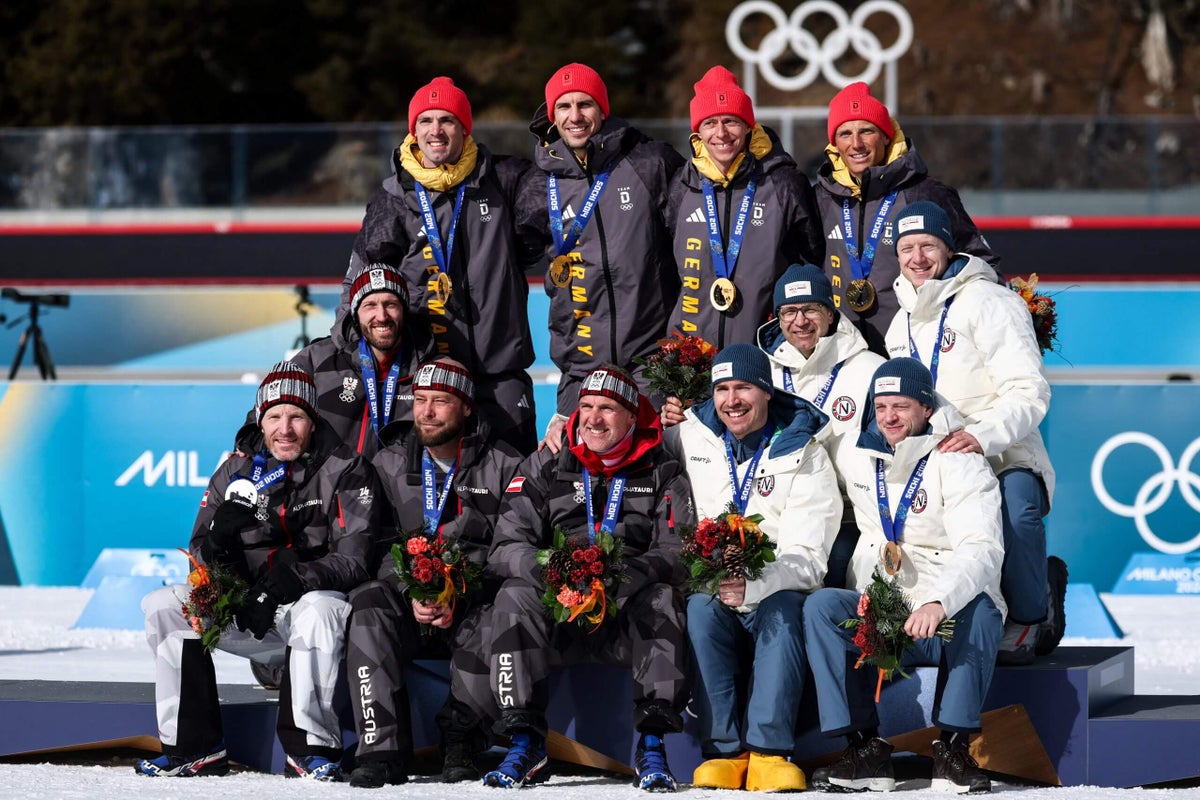
ANTERSELVA, Italy — On the surface, the last thing the biathlon legends Ole Einar Bjørndalen and Martin Fourcade need is another medal ceremony.
Bjørndalen, an undersized and bespectacled 52-year-old, could easily pass for an accountant. He happens to be the second-winningest Winter Olympian with 14 medals, including eight golds. He’s known as the “King of Biathlon.” He’s Novak Djokovic on skis, with a rifle over his shoulder. He could never buy himself another meal in Oslo, but he roams the biathlon venue at the Olympics in a plain black hoodie like he’s just another guy.
Fourcade, a strapping Frenchman, won seven Olympic medals, six of them gold. He’s basically a Dior model who can ski really fast and shoot really well. He’s 37, with three kids, a national hero, a member of the International Olympic Committee (IOC), and a candidate to light the cauldron when France hosts the Winter Games in 2030.
It’s been a good life for these guys, and it just got a little better.
On Sunday, Bjørndalen and Fourcade were among those who received medals that should have been theirs 12 and 16 years ago, respectively. After a series of investigations and a lengthy litigation process over the past 15 years, the IOC is finally able to ride the coattails of the International Biathlon Union (IBU), the sport’s combative world governing body, and deliver those medals to their rightful owners.
“It is very late, many years ago, but it’s nice to get the real facts about the race, so for sure we will be happy to get the medals,” Bjørndalen said in an interview at the Anterselva Biathlon Arena this week.
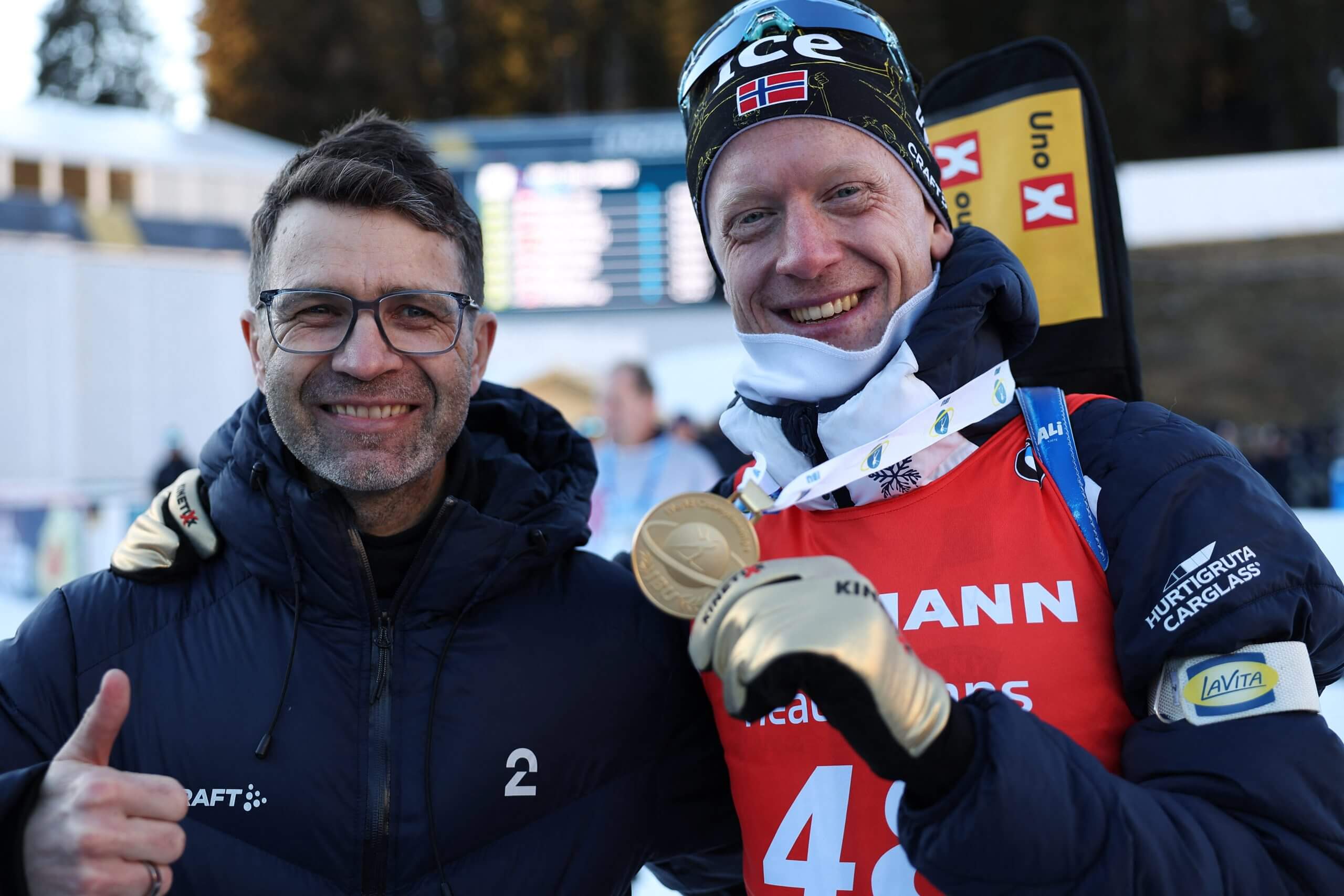
Ole Einar Bjørndalen and Johannes Thingnes Bø, part of the now-bronze-winning Norwegian relay team from 2014. (Franck Fife / AFP via Getty Images)
It’s the latest weirdness during an Olympic biathlon competition that has had a little bit of everything. A two-time bronze medalist confessing his infidelity to the world in an effort to win back an ex-girlfriend; a gold medalist who was recently convicted of stealing a teammate’s credit card and spending some $2,000 with it.
Now comes the old baggage of Russian doping scandals and some of the biggest names in the sport’s history. How did biathlon get to this point?
In a nutshell, Evgeny Ustaguyov of Russia, as well as much of Russia’s biathlon team, was found to have used performance-enhancing substances ahead of both the 2010 Games in Vancouver and then four years later in Sochi.
The second episode was part of a massive, state-sponsored effort to rig the Olympics by swapping dirty urine samples for clean ones through a trap door at the testing lab. It worked, vaulting Russia to the top of the medal table in 2014. Then, Grigory Rodchenkov, a top Russian scientist, spilled the beans.
That revelation, plus the steadfastness of the IBU’s medical director, who had suspicions going back to 2007, eventually led to Sunday’s medal reallocation ceremony.
Bjørndalen and his teammates in the relay will receive the bronze medal from 2014. Fourcade will get a gold for the mass start in 2010. Daniel Böhm, who is now the director of sport for the IBU, and his teammates from the German team will receive a gold medal for their efforts in 2014.
“A nice little reunion,” he called it.
None of them said they thought this day would come. So many delays, so many court hearings, even attempts to cover up the cases by the former president of the IBU, Anders Besseberg.
Besseberg was eventually convicted of corruption in a Norwegian court, which found he accepted bribes and other inducements from Russia, including watches, hunting trips, prostitutes, and a leased car. In exchange, he covered up evidence of doping among Russian athletes. He got a three-year prison sentence.
In an interview this week, Max Cobb, a member of the IBU’s executive board from 2016-22 and its secretary general since then, said not everyone in the international sports hierarchy wanted his organization to continue to pursue the reallocation, especially as Russia continued to file appeals with the Court of Arbitration for Sport.
Other world governing bodies had moved on, not wanting to keep dredging up old, negative stories about their sports. Russia had long been an important nation in Olympic sports. Cobb and biathlon’s new leadership didn’t care about any of that.
“This is something we had to do,” Cobb said, adding that it was a way to send the sports world a message that biathlon was different than it used to be and no one was above the law.
Also, the athletes deserved justice and closure.
Bjørndalen said there is one thing he will never forget about the race that day in 2014: His teammate, Emil Hegle Svendsen, missed on the final target. Had he made that shot, Norway likely would have won the gold medal. Instead, they fell to fourth.
“He was sitting half an hour or an hour in the changing room after the race and crying like a baby,” Bjørndalen said.
When Rodchenkov told the world how Russia had cheated and that biathlon had been involved, Bjørndalen was surprised. The Russian biathletes had not been very good in Sochi. The cross-country skiers had been excellent, but Bjørndalen, who was 40 then, felt like he was still faster than most of the Russian biathletes.
“I thought whatever drugs they were using wasn’t very good,” he said.
Böhm, said he, too, was surprised to learn that the Russians had cheated. All athletes hear rumors, but he always assumed his competition was fighting with the same weapons he was. Also, like Bjørndalen said, the Russians weren’t that good.
“It was quite a strong race from the guy I was racing against on my second leg, but it was nothing extraordinary,” Böhm said earlier this week. “So I don’t know what they did wrong in training, but it was not that everybody was suspecting them.”
Still, something wasn’t right.
Russia, a former Olympic powerhouse, had been terrible at the Vancouver Games, winning just two gold medals and 13 overall. Then, in Sochi, they won 13 gold and 33 overall. That sort of jump is basically impossible. Once Rodchenkov told the real story, everything started to make more sense.
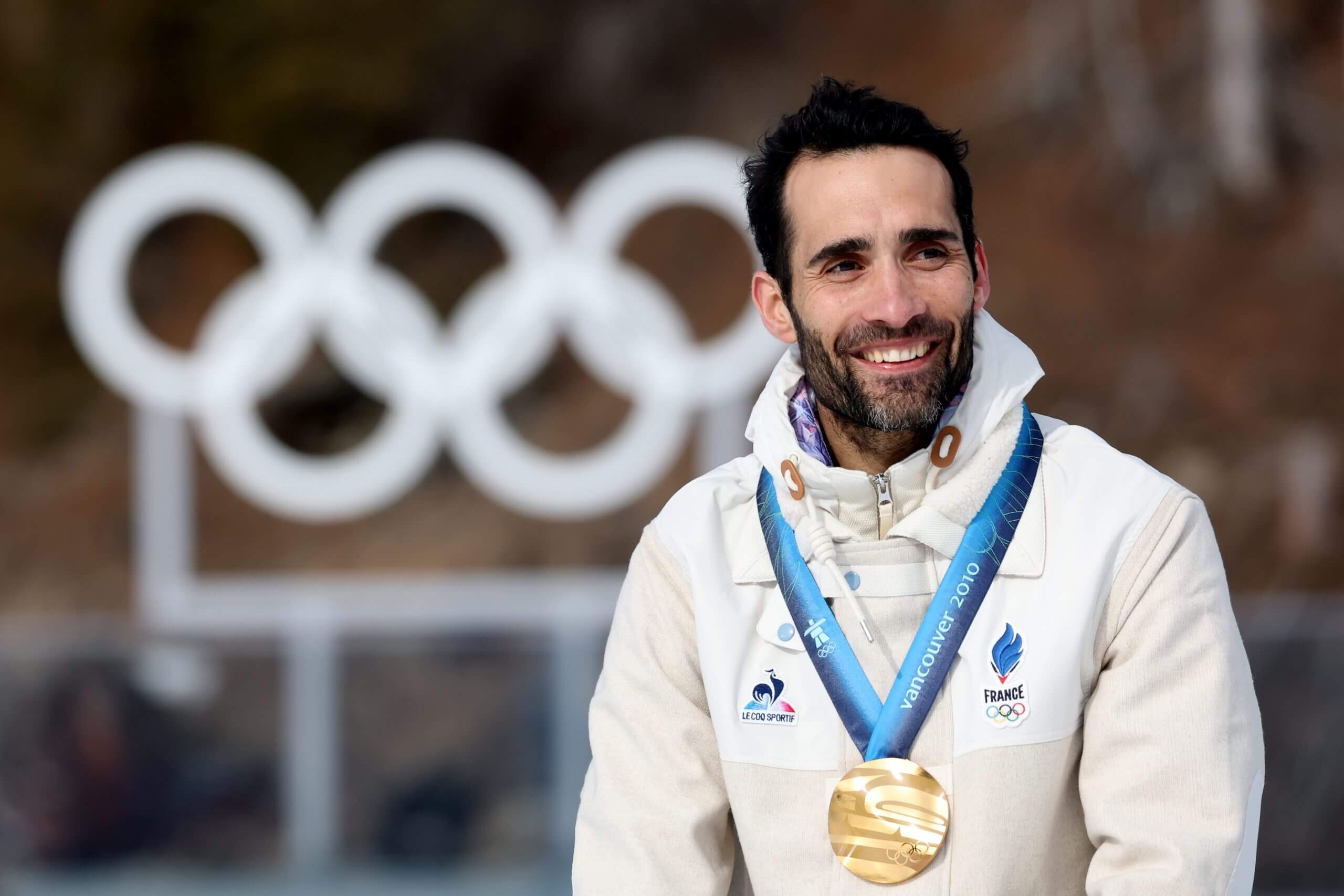
France’s Martin Fourcade said Sunday’s reallocation was about “giving back and justice.” (Alexander Hassenstein / Getty Images)
Jim Carrabre, the longtime medical official with the IBU and an anti-doping expert, was probably less surprised than anyone. In an interview Friday, Carrabre recalled becoming suspicious of Russia’s performance in biathlon as far back as 2007, when the Russians were suddenly skiing faster than nearly everyone else, including the stellar Norwegians.
At a race, Carrabre said he sidled up to a Russian coach and congratulated him on the team’s success. He asked what had made the difference — a new training regimen, altitude workouts?
According to Carrabre, the coach said, “You’ll never figure it out.”
That was enough to send Carrabre on a hunt. He collected urine samples that the Russians submitted and sent them to leading labs to try to find something suspicious.
Eventually, a lab in Austria found a novel substance that anti-doping officials did not know about. The drug spurred the production of hemoglobin, which led to additional oxygen-carrying red blood cells. Carrabre had the samples frozen, sure that eventually the World Anti-Doping Agency (WADA) would ban the substance before the statute of limitations on the violation had run out.
It would get more complicated than that, with Carrabre eventually uncovering evidence of a violation that IBU leaders had hidden. In 2020, just two weeks before the statute of limitations on tests at the Vancouver Games ran out, he got a previous ruling overturned, paving the way for Fourcade to get another gold medal, though it would take another five years of appeals. There were many times when Böhm, Fourcade, and Bjørndalen all doubted that they would ever get their proper medals
Fourcade said this week that he has moved beyond the initial feelings of anger.
“It’s just about giving back justice,” he said.
He was just 21 when he won that race, a young boy, he said. Now his three kids will be able to see him get a gold medal. And now that he is an IOC member, he wants to make sure others who were cheated out of medals get what is rightly theirs
Bjoørndalen wants bigger punishments for cheaters. He believes they should be criminally prosecuted.
“It’s about results and honor like that, but it’s a lot about big business,” he said. “Twelve years is a long time to wait.”