
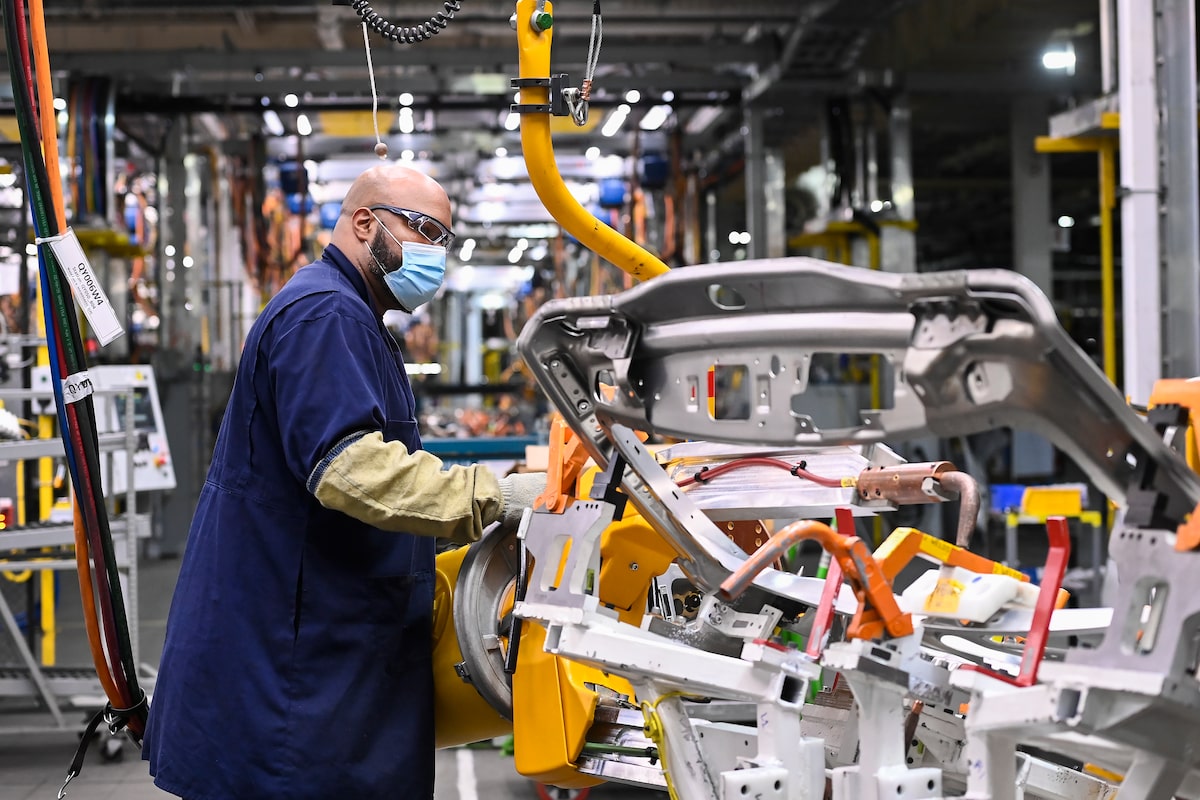
GM workers use human assisted automation to weld vehicle doors at the General Motors assembly plant in Oshawa, Ont., March 19, 2021. The plant made 135,800 pickups in 2025, according to the Canadian Vehicle Manufacturers’ Association, accounting for 11 per cent of Canada’s auto production.Nathan Denette/The Canadian Press
General Motors Co. GM-N is spending $63-million at its plant in Oshawa, Ont., to upgrade the metal-stamping shop ahead of the arrival of the automaker’s next-generation of full-sized pickup trucks.
The announcement of the investment, which will also improve the plant’s parts-making operations, comes just days after Detroit-based GM laid off 700 workers and cut the third shift at the plant east of Toronto.
GM said the work on the stamping plant, which makes body panels, supports preparations for the plant to assemble the new pickup trucks. In 2023, GM said it would spend $280-million refitting the plant for the new trucks, which are built on an updated platform.
Jack Uppal, president of GM Canada, said the life cycle of a new generation of vehicle is typically four to six years, signalling the plant will produce the trucks “for years to come.”
“These are long-term investments, and the next generation truck we anticipate to run well through the end of the decade,” Mr. Uppal said in an interview, declining to say when production will start.
General Motors to stop BrightDrop van production in Ontario
Chris Waugh, Unifor chairperson of truck assembly at the plant, called the investment “good news.” He said he is hopeful it means GM is committed to continuing to build trucks in Oshawa.
“I continue advocating for it,” Mr. Waugh said by phone. “So when they start spending money, it’s a good sign, especially [with] the trade war right now between Canada and the United States.”
The plant made 135,800 pickups in 2025, according to the Canadian Vehicle Manufacturers’ Association, accounting for 11 per cent of Canada’s auto production. GM says the newest investment will bring the total sending at the plant to $1.5-billion since 2020.
The Silverado is the second-best selling vehicle in the U.S., according to Automotive News and Cox Automotive, behind only the Ford F-150 pickup. GM is seeking to keep up with demand for the trucks, which are among its most profitable vehicles.
The Toronto-born Mr. Uppal was appointed to the top Canadian job on Feb. 1, returning home after a decade working for GM in China, India, Singapore and the Middle East.
He said GM views Oshawa and the engine-and-transmission plant in St. Catharines, Ont., as strategic parts of its North American operations.
“Canada brings a highly skilled workforce, bar none, I mean, I’ve worked around the world,” he said. “We have a plant that is world class; it’s got some of the latest technology in it. And if we look at the quality coming out of the offshore plant, it’s always rated amongst the top in North America.”
The Canadian auto sector – based in Ontario – has been hard-hit by tariffs imposed by U.S. President Donald Trump. He has declared he wants to put an end to the Canada’s carmaking, and has laid 25-per-cent tariffs on the non-U.S. content of cars made here.
This has spurred some automakers to shift production to avoid the duties. Last year, GM boosted Silverado production in Fort Wayne, Ind., even as it planned layoffs in Oshawa. It is also set to begin assembling pickups in Orion, Mich. GM also makes pickups in Flint, Mich., and Silao, Mexico.
Stellantis to add third production shift at Windsor plant
GM last year closed its electric delivery-van plant in Ingersoll, Ont., laying off 1,150 workers. The move angered federal politicians, who pointed to the millions of dollars in taxpayer aid the automaker has received.
Industry Minister Melanie Joly said this month she is planning to seek “hundreds of millions” of dollars from GM and Stellantis NV, another Detroit-based automaker that has received public funding but made deep cuts to its Canadian workforce.
Mr. Uppal said Wednesday’s announcement is GM’s response to Ms. Joly’s comments.
“We are fully committed to Canada,” he said, adding the company is “fully engaged” with the government in evaluating the funding it has received. The company is looking at options for the Ingersoll plant, he said, noting the vans sold poorly.
“The manufacturing footprint is primarily based on consumer demand,” Mr. Uppal said. “What we build, how many we build, and where we build, and what mix we bring to a plant, to a particular footprint is truly dictated by consumer demand.”