
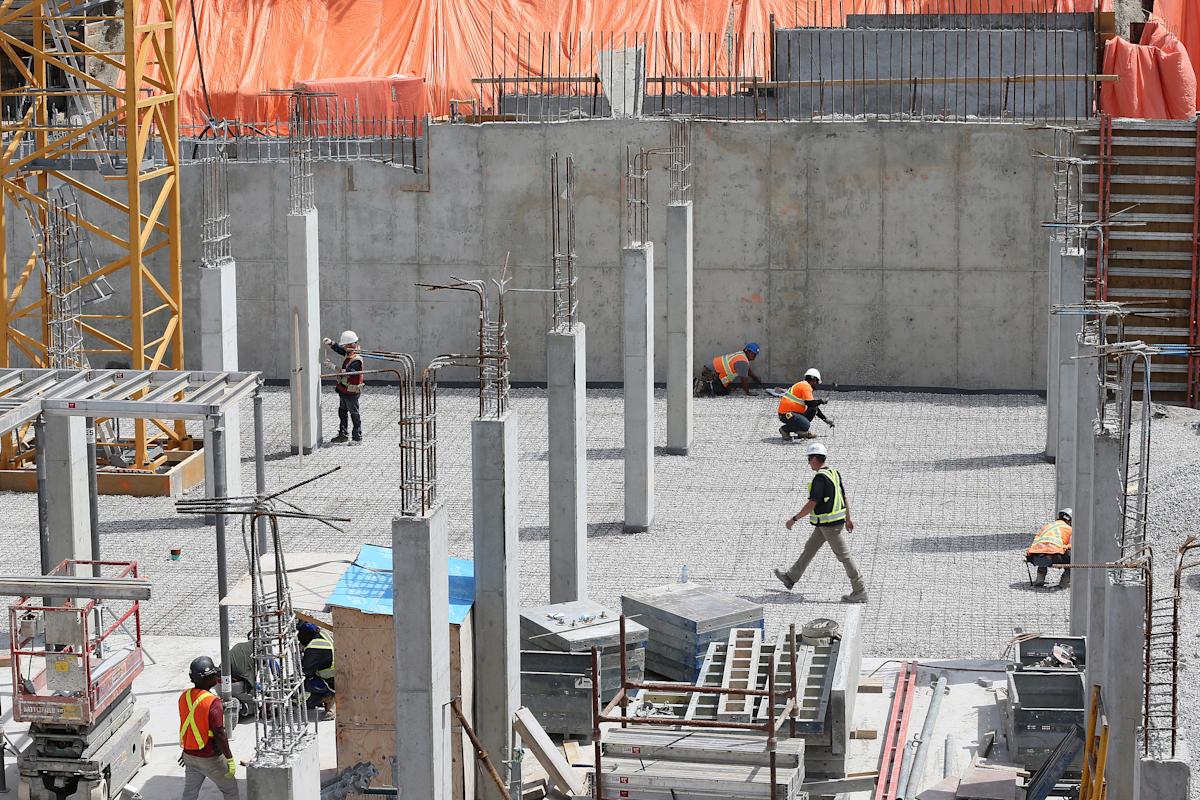
The economics of building new homes in Canada are now “simply broken,” sparking a macroeconomic drag that CIBC economists warn is just beginning to take hold.
The housing market is now in a place where “prices are still too high to buy and not high enough to build,” Benjamin Tal and Katherine Judge write in a report published Wednesday. Unless the cost of building new homes is “significantly” decreased, they say, the situation will get worse.
“Improved affordability due to lower prices is a welcome development, but it is not large enough to offset the negatives nor is it the remedy to the country’s housing affordability crisis,” they wrote. “The current soft patch in housing activity should be viewed as an opportunity to deal with the main reason for high shelter prices in Canada — the unsustainably high cost of homebuilding.”
Home prices surged during the pandemic and have since fallen back to roughly where pre-COVID trends would have placed them nationally — though the national picture masks sharp regional divides, Tal and Judge note. In Ontario, benchmark prices are now about 28 per cent below their pre-pandemic trendline, and roughly 13 per cent below in British Columbia, while prices in much of the rest of the country remain closer to — or slightly above — trend.
The deepest correction has been concentrated in the condo market, where oversupply has pushed prices well below trend. Condo markets in cities outside Toronto and Vancouver are starting to “show early signs of stress,” the economists warn.
Housing starts averaged roughly 260,000 units in 2025, up from a year earlier. But Tal and Judge argue that figure is misleading, with many multi-unit projects counted long after construction decisions were made.
As a result, they cite research suggesting the real level of housing starts in the GTA and GVA is actually 50 per cent and 30 per cent, respectively, below the headline numbers. The economists note that many developers are applying for approvals without plans to act; in Surrey alone, the number of units approved but lacking a building permit has reached 44,300.
This regional strain is echoed by Mike Moffatt of the Missing Middle Initiative, who warns that Ontario’s housing starts are running at barely 30 per cent of the province’s 175,000-unit annual target. While CIBC points to a “broken” building sector, Moffatt highlights a specific collapse in family-sized housing; starts for single-detached, semi-detached, and row homes in Ontario hit a record low this January, the lowest since tracking began in 1990. TD economists have also noted sluggish activity in Ontario.
Tal and Judge note that rising home values had supported consumer spending through wealth effects and home equity borrowing, while also sustaining construction employment. With prices now falling, those supports are fading, and mortgage stress is beginning to rise at the margins.
Construction employment, they say, has flattened nationally, with Ontario and B.C. again feeling most of the strain. While job losses have so far been limited, Tal and Judge say some developers are holding on to core skilled workers despite stalled projects — a dynamic that may mask deeper softness in the sector.
Households are also beginning to feel the shift. Rising home values had supported spending through wealth effects and home equity borrowing. With prices now down from their peak — especially in Ontario and B.C. — that cushion is thinning. CIBC cites research suggesting the negative wealth effect from falling prices is larger than the boost from rising ones. If the Bank of Canada’s models hold, the decline in home prices would imply a hit of roughly $5,000 per household.
CIBC estimates about six per cent of mortgage holders will face a more than 40 per cent jump in payments upon renewal this year. While many borrowers will see lower rates, the economists expect delinquency rates to edge higher as refinancing becomes more difficult for some homeowners.
Lower prices have improved affordability modestly. The average home price nationally has fallen about $110,000 from its 2022 peak, reducing the typical down payment required. But those gains, the economists argue, are not enough to offset the broader economic drag — nor do they fix what they describe as the core problem: the high cost of building new homes.
In several major markets, projects are being approved but delayed because they do not make economic sense at current prices. Without meaningful reductions in construction and development costs, Tal and Judge warn the housing market could remain stuck between weak affordability and weak building activity — prolonging both the correction and Canada’s broader housing challenges.
John MacFarlane is a senior reporter at Yahoo Finance Canada. Follow him on X @jmacf.
Download the Yahoo Finance app, available for Apple and Android.