
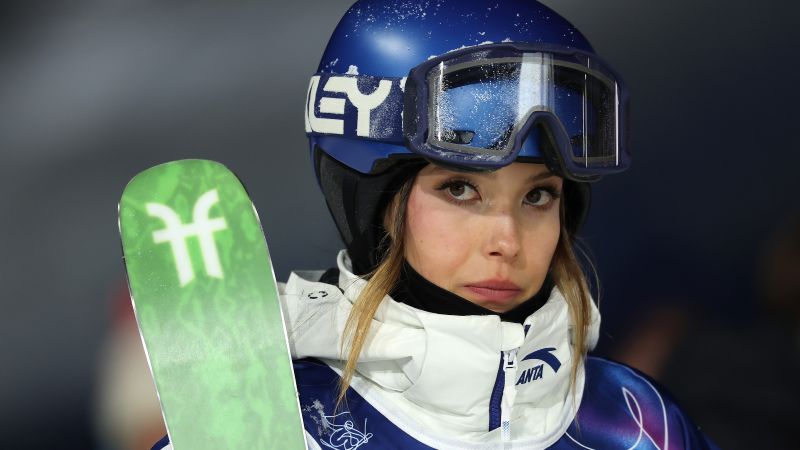
She’s a 22-year-old Stanford undergrad studying quantum physics. She’s a fashion model and one of the world’s highest-earning female athletes, netting more than $23 million last year.
She’s also just won two more Olympic medals in Milan. And yet freestyle skier Eileen Gu has faced more vitriol than ever over her decision to compete for China instead of the United States, where she was born and raised.
This isn’t new territory for Gu, one of the most recognized names in her sport. The San Francisco native has been surrounded by controversy for many years, with global scrutiny and media coverage reaching a fever pitch during her 2022 Olympics debut in Beijing.
At the time, she tried to remain neutral as much as possible – emphasizing her ties to both countries as a child born to a Chinese mother and American father.
This time, however, is different.
The rhetoric against her has been amplified in particular by right-wing platforms, tapping into a fervent “America First” nationalism fueled by the Trump administration and the US president’s MAGA base.
Gu, too, is no longer the 18-year-old in Beijing who became the youngest-ever Olympic freestyle skiing champion. She’s older, more lucrative, more powerful – and, notably, more willing to speak up about the abuse she has faced.
“I’ve been through a lot in the last four years and even beyond that,” she said at a news conference on February 9 after winning silver in the freeski slopestyle competition.
“I’ve gone through things at 22 that I don’t think any person ever should have to deal with, be it threats, vitriol, online hate, physical attacks – you name it, the list goes on,” she added.
“But I get stronger, right? That’s what’s so wonderful about being young. You adapt, you learn and you get stronger and better.”
Critics and defenders
Many dual-nationality American athletes have opted to represent other countries for a variety of reasons, be they personal, emotional, financial, or access to greater opportunities.
But few have attracted as much scrutiny – or commentary – as Gu at a time when the US and China are in an increasingly fractious geopolitical rivalry.
Gu first announced that she would switch to compete for China in 2015, writing at the time that it was an “incredibly tough decision.” She added that she was “proud of my heritage, and equally proud of my American upbringings.”
But that decision rankled many. Critics pointed out China’s many alleged human rights abuses, including the suppression of Uyghur Muslims in China’s western Xinjiang region – which Gu has not publicly addressed. Others argued that she had benefited from an American education, American training facilities and coaches – but she wasn’t giving back to her country of birth.
That debate flared back to life during this ongoing Winter Olympics, especially on popular conservative podcasts and media outlets. Even some Republican politicians like Florida’s Sen. Rick Scott and Tennessee’s Rep. Andy Ogles have weighed in, accusing Gu of supporting American adversaries.
Another such figure is former NBA player Enes Kanter Freedom, a longtime critic of China’s ruling Communist Party – who branded Gu a “traitor” in an X post on Tuesday.

“She was born in America, raised in America, lives in America, and chose to compete against her own country for the worst human rights abuser on the planet, China,” Freedom wrote, accusing Gu of “disappearing” whenever the topic of human rights come up.
In an interview with Fox News, US Vice President JD Vance was asked to comment directly about whether he thought Gu was “treasonous” in choosing to represent China and not speak out about human rights.
Vance’s answer was measured – he said he had “no idea” what Gu’s status “should be” – though he did say he hoped athletes who grew up in the US and benefited from its systems would want to compete for the country.
Still, the fact he was posed the question shows how high-profile the issue has become, especially among conservatives.
Some have drawn comparisons to other Asian American athletes – including Alysa Liu, the figure skating superstar making her Olympic comeback after returning from an early retirement, and snowboarder Chloe Kim, a two-time Olympic women’s halfpipe champion.
Like Gu, both Liu and Kim were born in California to immigrant parents. But Liu and Kim are both competing for the US – a fact that many social media users have pointed out, casting the two women as examples of what they believe a second-generation American should be.
“Chloe Kim isn’t a traitor,” one comment reads under a TikTok video about Gu.
Liu’s personal story also contrasts heavily with Gu’s, which has been seized upon by some social media commentators.
Both were brought up in the Bay Area. But while Gu hailed from a wealthy family that spent time in both the US and China, Liu’s father fled China after helping to lead the Tiananmen democracy protests, which China’s Communist Party cracked down on brutally.
But Gu also has her fair share of supporters – who have also become more vocal this year, with many defending her choices.
“China pays top money for top talent. Yes she’s American and she’s competing for China against us. But would you not do the same?” another TikTok comment read. Some pointed out that Gu is part Chinese – why wouldn’t she compete for China?
Others joked that if given the opportunity, they, too, would take a paycheck over representing America, given its many social ills and controversial policies right now – reflecting a widespread sense of disillusionment in the US.
“USA treats immigrants the way they do then gets mad she didn’t pick them,” another comment read.
‘Attacked and cyberbullied’
Though Gu has never strayed from her core message – that she is proud to be both Chinese and American – she has also become far more assertive in speaking out about what she has endured in the public eye.
“Sometimes it feels like I’m carrying the weight of two countries on my shoulders,” she said after competing last week.
And speaking ahead of the Games, she told the Associated Press that she gets criticism from all corners – ranging from people who “thought I wasn’t Chinese enough” when she dyed her hair blond, to those opposing her decision to represent China.
Some of that pressure has morphed into real-life danger, too.
While on campus at Stanford University, where she was admitted in 2022, she was “physically assaulted on the street,” received death threats, and had her dormitory robbed, she told The Athletic.
Part of her new outspokenness may be because she’s at the top of her game, with nothing left to prove.
“I’ve gone through some tough times. I went to college, grew up a little bit, and now I feel a lot lighter,” she told Reuters ahead of the Games.
“I’ve won more World Cups than any freeskier ever, male or female. I am currently tied for most Olympic medals … Before, I think, I was doing what I knew how to do; now I’m doing what I want to do.”
But it may also have to do with how much her fame and success have skyrocketed over the past four years – along with her earnings.
Gu was the world’s fourth highest-paid female athlete in 2025; but compared to other athletes, far more of Gu’s earnings come from her endorsements than her paychecks on the slopes, according to Forbes.
She’s got a long list of partnerships, including Red Bull, Porsche, IWC Schaffhausen, and more. Outside skiing, she also models – and is signed with IMG Models, the biggest agency in the world, which describes her as “a natural fit for high-end brands, including Louis Vuitton.”

Her fluent Mandarin also gives her access to an enormous market in China, where her face is splashed across billboards and television screens. She is nationally beloved and known as the “snow princess,” in stark contrast to the divided reception she gets back in the US.
In China, fans have no qualms about her dual identity – even celebrating her two silver medals this week and defending her against any criticisms for missing out on gold. That staunch support takes on extra significance in a hyper-competitive country that often only rewards top winners and punishes those who fall short.
“Real champions aren’t just defined by gold medals; Eileen will always deserve all the applause,” commented one user on the Chinese microblogging platform Weibo.
Chinese state broadcaster CCTV Sports Channel hailed Gu as the “pride of China” after she snagged her second silver medal on Tuesday.
In an interview with Chinese state media after competing, Gu said she hoped to inspire other Chinese girls on the slopes. And, speaking in her mother’s native tongue, she was even more candid about what she’s faced – and what she hopes to shield others from.
“It hasn’t become any easier, I’ve just become stronger and can endure more,” she said with a rueful laugh. “I want to protect others, and hope others won’t be attacked and cyberbullied like I have.”