
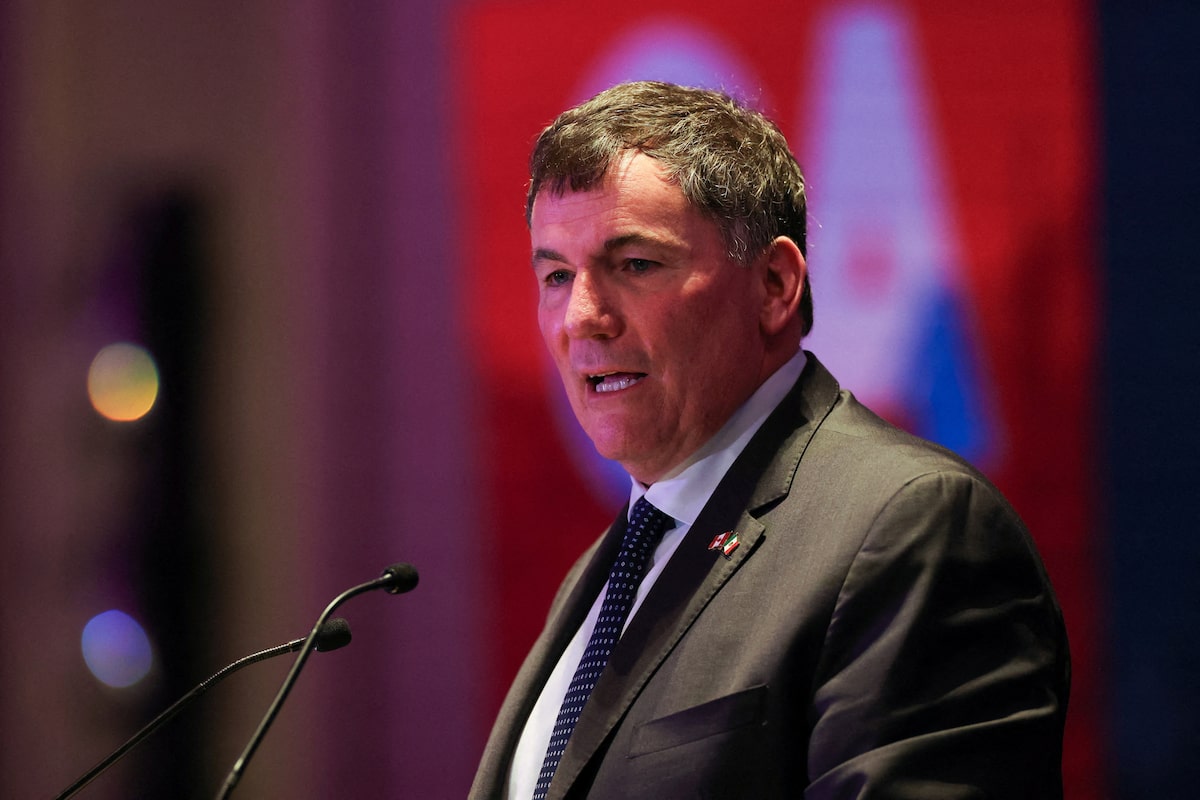
Dominic LeBlanc, the federal minister responsible for Canada-U.S. trade, attends the kickoff of the Team Canada Trade Mission to Mexico at a hotel in Mexico City on Monday.Henry Romero/Reuters
Ottawa and Mexico City remain committed to a trilateral review of the continental free-trade pact, even as the U.S. has floated the idea of replacing it with separate bilateral deals, Dominic LeBlanc, the federal minister responsible for Canada-U.S. trade, said after meeting with his Mexican counterparts this week.
Mr. LeBlanc was in Mexico as the head of a trade delegation made up of approximately 250 Canadian companies. While there, he met with Mexico’s President Claudia Sheinbaum and Economy Secretary Marcelo Ebrard, who is leading the country’s trade team for the review of the United States-Mexico-Canada Agreement.
“The Mexicans are pursuing some bilateral challenges or issues with the United States. So is Canada. But we both remain absolutely committed to the trilateral free-trade agreement and working together as this review process unfolds,” Mr. LeBlanc said in a virtual press conference from the northern Mexican city of Monterrey.
Opinion: Canada will have to accept higher U.S. tariffs and unthinkable concessions
Negotiations over the future of the USMCA are already under way, and will kick into high gear in the coming months. The three countries are working toward a July 1 deadline, at which point they have to decide whether to renew it for another 16 years or enter into annual reviews. They can also withdraw from the agreement with six-months’ notice.
U.S. President Donald Trump has suggested on several occasions that he could pull out of the deal and pursue bilateral agreements with Ottawa and Mexico City instead. The President’s point-person in the negotiations, U.S. Trade Representative Jamieson Greer, said last week that he intends to negotiate separately with Canada and Mexico on a number of issues, and that Canada was the more difficult partner.
Mr. LeBlanc said the three countries would hash out some issues on a bilateral basis, while also working trilaterally on issues such as rules of origin, which define how much of a product must be made in North America to trade without tariffs. The U.S. has said it wants to tighten rules of origin and push Canada and Mexico to align more on external tariffs, investment screening and export controls.
Rita Trichur: Trump’s threat to sign a bilateral deal with Mexico is so 2018
“I’ve said this to Ambassador Greer and to Secretary Lutnick, we’re anxious to sit down with our Mexican counterparts and have those conversations with the United States,” Mr. LeBlanc said, referring to U.S. Commerce Secretary Howard Lutnick.
“I don’t think that – at least in a starting point, as we look at the trilateral issues the United States may raise – Canada and Mexico would not easily find common ground. I’m encouraged by my conversations with the Mexicans. And, to be fair, with the Americans on some of those issues … Canada would probably quite easily find common ground with Mexico and the United States.”
In recent months, Ottawa and Mexico City have taken a different approach to aligning with Washington. Mexico has raised tariffs on China and other countries with which it does not have a free-trade agreement. By contrast, Canada broke step with Washington by lowering tariffs on some Chinese electric vehicles and inviting Chinese companies to invest in the Canadian auto sector.
“I wouldn’t say there’s a divergence between Mexico City and Ottawa. What I would say is that we have, in some cases, different economies, different sectoral challenges,” Mr. LeBlanc said.
While the government delegation – which included Agriculture Minister Heath MacDonald and David Myles, Parliamentary Secretary for Culture – talked to their Mexican counterparts, the focus of the trip was boosting Canada-Mexico business ties.
Opinion: Canada should bet bigger on Mexico
The Canadian Trade Commissioner Service arranged nearly 2,000 business-to-business meetings in Mexico City, Monterrey and Guadalajara.
Canadian Chamber of Commerce chief executive Candace Laing, who was in Mexico alongside the trade delegation this week, hailed the approach, which differed from earlier trade missions. “The exposure to that kind of opportunity and how it was organized was really well received, especially by the small and medium businesses that need that facilitation,” she said.
This was echoed by Dennis Darby, president of Canadian Manufacturers & Exporters, who took part in the trade mission.
“By and large, I think this was more about small companies establishing those relationships. And talking to companies who have been successful there, it may take two or three visits, sometimes two or three conversations, but you have to start somewhere,” he said.