
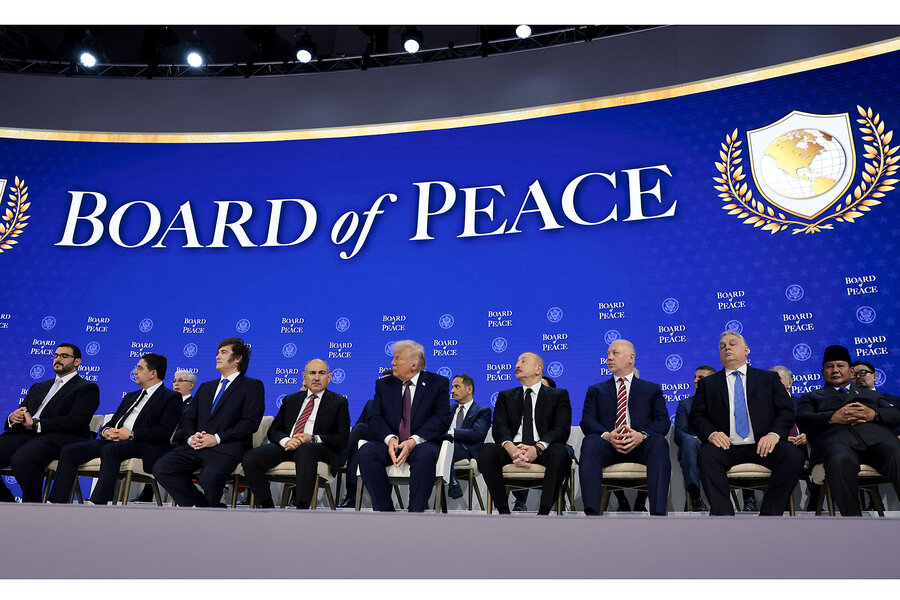
United Nations Security Council, step aside. Make way for Donald Trump’s Board of Peace.
The U.S. president’s version of international conflict resolution holds its inaugural meeting Thursday in Washington. Among its aims: to display to the world a personalized brand of peacemaking and postwar reconstruction that envisions nothing less than becoming the new standard for such undertakings.
Ostensibly, the Board of Peace is gathering to take up Phase 2 of Mr. Trump’s 20-point Gaza peace plan. And the board – a collection of 26 largely Arab and Muslim countries hoping to influence the way forward in Gaza – is set to unveil what Mr. Trump says is already $5 billion in commitments for reconstruction of the war-ravaged Palestinian enclave.
Why We Wrote This
President Donald Trump’s Board of Peace is convening amid doubts about this approach to diplomacy. Muslim and Arab countries, hoping to influence Gaza’s path forward, have signed on. Western democracies, wary of further weakening international institutions, are staying away.
Also on the agenda: humanitarian assistance to the territory’s 2 million Palestinians, most of whom are living precariously in tents and bombed-out structures; governance during a transition period; and the prickly issue of Hamas disarmament.
Yet hanging over the meeting will be global perceptions of Mr. Trump’s broader ambitions for his Board of Peace that range from wariness to outright hostility.
Most of the United States’ traditional partners in international security operations and postconflict reconstruction are staying away from the board, which they see as a presidential vanity project that reflects a disdain for established institutions, including the U.N.
Mr. Trump has done little to assuage those concerns, asserting at the board’s signing ceremony in Davos, Switzerland, last month that the new peace and security institution “might” indeed end up supplanting the U.N. Security Council.
More recently, the president declared on social media that his new board “will prove to be the most consequential International Body in History.”
“Not a replacement for the U.N.”
Secretary of State Marco Rubio addressed widespread concerns about the board’s ambitions at a congressional hearing last month – even as he echoed the Trump administration’s disregard for international institutions generally and the U.N. in particular.
“This is not a replacement for the U.N.,” Mr. Rubio told senators, before adding, “but the U.N. has served very little purpose in the case of Gaza other than the food assistance.”

Tents sheltering displaced Palestinians stand amid the destruction left by the Israeli air and ground offensive in Gaza City, Dec. 5, 2025. U.S. President Donald Trump says countries have committed $5 billion so far to Gaza’s reconstruction.
Still, Mr. Trump has good reason to sidestep the U.N. and other international organizations in his bid to bring peace to the world’s most intractable conflicts, some analysts say.
“We hear all the criticism out there that Trump is getting rid of the old international order, but I don’t believe there ever was an international order. Look at the U.N.’s track record for resolving conflicts,” says Brenda Shaffer, a faculty member specializing in Middle East politics and U.S. security strategy at the U.S. Naval Postgraduate School in Monterey, California.
Under President Trump, she says, the U.S. is finally seeking alternatives to an international system it has largely paid for but that has rarely acted in U.S. interests.
“The U.S. is by far the biggest funder of the U.N.,” Professor Shaffer says, “but what it’s got in return is a very anti-American bias, not to mention an even stronger anti-Israel bias.” The Board of Peace, on the other hand, “will be very Trumpian in that the U.S. won’t pay for it but will nevertheless have tremendous influence.”
To join the Board of Peace, countries must be invited by President Trump, the board’s permanent chairman. Countries seeking permanent membership must make a $1 billion contribution, while others may avoid the steep fee by accepting a three-year term.
Less than half the 62 countries that Mr. Trump invited to join the new board have elected to do so.
Why U.S. allies aren’t on board
Yet while some leaders have criticized the “pay-to-play” membership rules, many analysts say the reasons so many U.S. allies have stayed away from the board go well beyond financial concerns.
“There is clearly a strong undercurrent of unease about the board’s broader project,” says Michael Hanna, U.S. program director at the International Crisis Group in New York. “Most of the United States’ closest allies have real reservations about the effort to expand the mandate beyond Gaza and what they see as the undermining of the multilateral system,” he adds. “All of this creates an aura around [the board] that they are not willing to sign on to at all.”

U.S. Secretary of State Marco Rubio, left, and Hungary’s Prime Minister Viktor Orban depart a news conference in Budapest, Hungary, Feb. 16, 2026.
As an example of what many U.S. partners worry is overreach by the board, President Trump has said this week’s meeting will take up a Sudan peace plan that aims to stop one of the world’s most horrifying wars with a permanent ceasefire by early March.
Mr. Hanna notes that while the Board of Peace did win a two-year mandate from the U.N. Security Council for addressing Gaza – notably with both China and Russia abstaining in the vote – misgivings were already evident among traditional U.S. allies.
A British and French effort’s failure to amend the resolution to address some of the unease about the board “helps explain why neither they nor other Western allies have signed on,” he says.
NATO allies Italy and Romania have said they will attend the inaugural meeting as observers, while Hungary – which Secretary Rubio visited this week – has joined the board.
Other critics have been more strident about the board, calling it a “coalition of the authoritarians.” Human Rights Watch, the international human rights monitor, dubbed the board “a rogues’ gallery of leaders and governments with human rights records ranging from questionable to appalling.”
Not clearly on the board’s agenda Thursday are rising concerns in the Middle East that the U.S., Israel, and Iran are heading toward renewed military conflict, despite U.S.-Iran negotiations.
Yet whatever time the board devotes to Sudan and other conflicts, the main focus Thursday remains Gaza. Even there, many analysts have low expectations for what the board can accomplish.
Under the Trump 20-point plan, “things have improved on the ground, but only slightly from what were truly horrific conditions,” says Mr. Hanna. “Basically, the war has slowed,” he adds, “but it is not over.”

The U.N. Security Council convenes a meeting in New York, Nov. 17, 2025. During the gathering, the members adopted a U.S.-drafted resolution endorsing the peace plan for Gaza.
More than 600 Palestinians have been killed in Israeli airstrikes since the October 2025 ceasefire. Members of the new technocratic Palestinian agency that the peace board has set up to administer humanitarian assistance and provide social services remain stuck in Egypt, unable to win Israel’s approval to enter Gaza.
The board will have to show it can somehow bridge stark differences between opposing members like Israel and Qatar, one of Hamas’ chief bankrollers.
Dealing with nonnegotiables
But probably the most intractable issue the board will try to address is Hamas’ disarmament.
“Trump’s approach is that everything can be traded,” something that worked in Phase 1 of the Gaza ceasefire “because both sides were pretty ripe for it,” says Dan Rothem, a Tel Aviv-based senior policy analyst with the Israel Policy Forum think tank, which supports a two-state solution. “But now in moving to Phase 2, the president runs into some nonnegotiables of both Israel and Hamas.”
Mr. Trump is asking for concessions “that Israel sees as falling short of its security needs,” Mr. Rothem says, while for Hamas, “just the demand for disarmament clashes with the movement’s core identity.”
Professor Shaffer of the Naval Postgraduate School says she holds out little hope for the board’s success in Gaza, in part because members like Indonesia that have pledged to provide troops for a stabilization force seem unlikely to take a tough stand with Hamas.
“It’s very problematic, not least for Israel, when the countries likely to provide troops there seem neither willing nor able to disarm Hamas,” she says. “And it’s hard to imagine any stability in Gaza if Hamas remains the most powerful force there.”
At the same time, Mr. Hanna says few countries are likely to go all in with the new board if they decide its activities represent “little more than a way station before Israel restarts the war.”
He says President Trump is the only leader who has the influence with Israel to get it to take the steps that might allow some progress in Gaza and head off a return to fighting – including allowing in the members of the envisioned technocratic Palestinian governing agency.
“Trump has the leverage with Israel,” Mr. Hanna says. “The question now is whether he’s willing to use it.”