
In August 2021, the Government of British Columbia confirmed it had selected the design for a new eight-lane immersed tunnel to replace the aging and capacity-constrained George Massey Tunnel, opting for a tunnel after cancelling a shovel-ready 10-lane bridge project four years earlier at the time.
At the time, construction on the new tunnel was pegged to begin in 2026 for a completion in 2030.
That previous announcement was based on the details from the finalization of the project’s business case in April 2021, which indicated the tunnel would cost $4.15 billion, the new five-lane Steveston Highway interchange would cost $88 million, and the widened Highway 99 shoulders for bus lanes and upgrades to the existing Highway 17A interchange would cost about $50 million. Together, all of the project components carry a total cost of approximately $4.3 billion.
Over the past five years, ahead of the anticipated 2026 start of tunnel construction, most of the various Highway 99 corridor upgrades have now been completed, including the new Steveston Highway interchange, which fully opened in December 2025.
That now leaves the question of the new tunnel, forming the overwhelming lions’ share of the overall project cost.
Currently, as stated in the the provincial government’s controversial 2026 budget released this week, the official project cost remains at $4.3 billion.
However, the budget document also hints that an updated estimate and implementation timeline on the tunnel project is forthcoming — but only after detailed design and contract negotiations with the selected contractor are completed. In July 2024, the provincial government announced that following a bidding process, it had selected a private consortium called Cross Fraser Partnership to build the tunnel.
The consortium is led by the Canadian division of France-based Bouygues Construction, in partnership with Spanish construction company Fomento de Construcciones y Contratas, Quebec-based Pomerleau, architectural and engineering firm Arcadis (formerly known as IBI Group), and Netherlands-based dredging and marine services firm Boskalis. Bouygues is perhaps best known for its involvement in building the Chunnel between the United Kingdom and France.
“The tunnel project is in design, and the estimated cost of the project is being updated and reviewed as the design and contract negotiations progress,” reads this week’s provincial budget.
“Due to commercial sensitives related to releasing an updated estimate for the project before a contract is executed, the Province will update the project budget and schedule once negotiations with the contractor have concluded,” continues the budget document.
Even in the June 2023 memorandum on an amendment to the 2021 business case, it was stated that “it is recognized that there has been significant market volatility since the 2021 Business Case was approved.”
Apparent delays with the environmental assessment review process
That August 2021 announcement also provided a timeline for completing the critical environmental assessment process, which began later in 2021 and was scheduled to finish as early as late 2024 or by the end of 2025. However, as of the latter half of February 2026, it has still not reached completion, which would be marked by the issuance of an environmental assessment certificate, with the project requiring to meet various conditions.
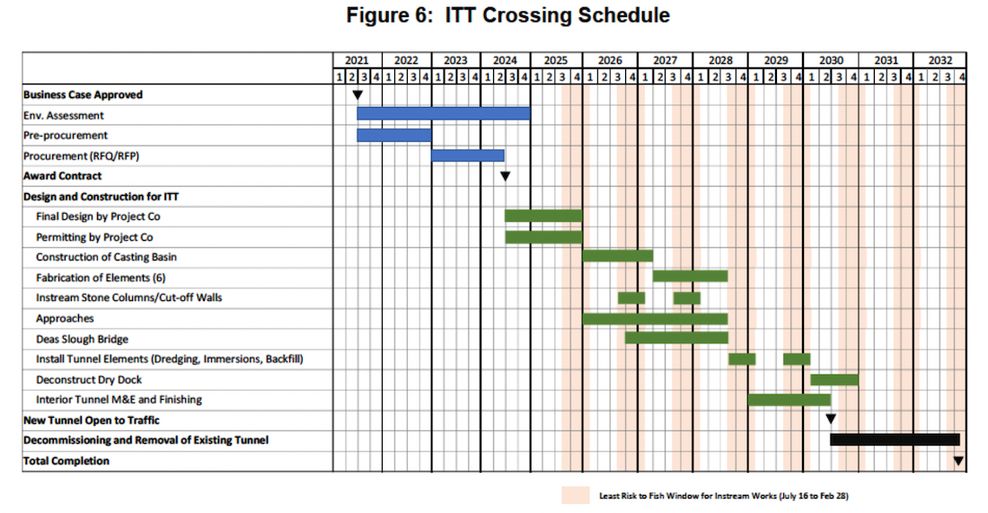
George Massey Crossing Project, April 2021 business case. (Government of BC)
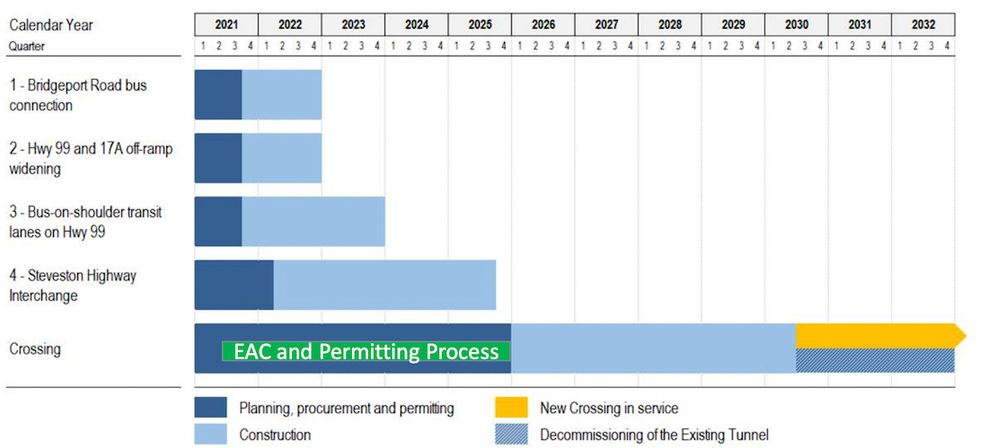
George Massey Crossing Project, April 2021 business case. (Government of BC)
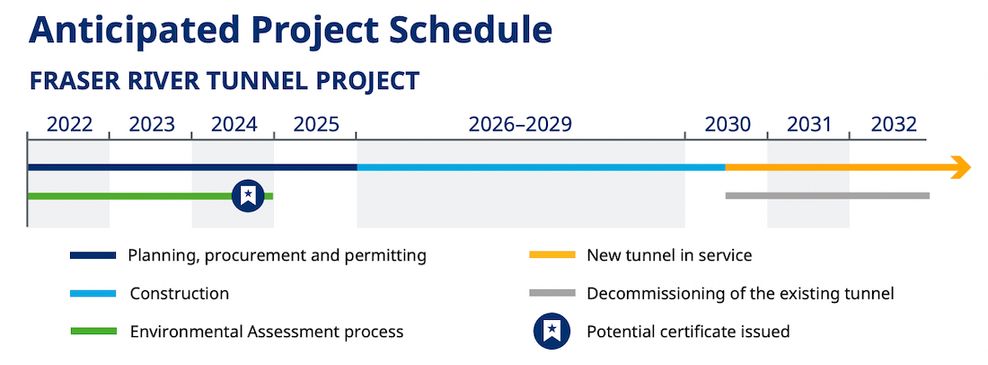
George Massey Tunnel replacement procurement, 2022. (Infrastructure BC/Government of BC)
The latest update by the B.C. Environmental Assessment Office on the project’s environment assessment review was provided in September 2025, which stated that the initial review process had reached completion and the next step was for the provincial government and the contractors to “revise their application to incorporate information required to address matters identified during application review.” Furthermore, after the revised application is received, the office will proceed with the final phase of the assessment process, which involves determining the “potential positive and negative impacts of the project, and the potential mitigation measures for any adverse impacts identified.”
The second last update on the process was made in July 2025, with the office stating at the time that the full completion of the assessment process is targeted for Fall 2026. At that juncture, the office also approved a temporary works certificate to enable the provincial government to begin early-stage site preparation works, including site clearing, some foundation works for both the north and south tunnel portals, construction of the Deas Slough trestle bridge, three temporary jetties, and a railway track diversion.
In January 2026, the provincial government issued construction notices advising the public that crews will begin the early-stage site preparation works of clearing trees and relocating utilities within an area of Deas Island. And over the first half of February 2026, numerous daily navigation notifications have also been issued for the Fraser River area to enable crews to perform in-river geotechnical investigations.
Ultimately, major construction activities cannot begin until sometime after the main environmental assessment is approved in Fall 2026, based on last summer’s update by the office.
Those legally binding conditions outlined in the environmental assessment certificate could also increase the scope and resulting total cost of the project, such as potentially changing the project design and requiring additional measures to mitigate the potential ecological impacts to the Fraser River.
A consultant’s technical analysis in 2020 noted that construction within the Fraser River could be limited to just a six-month or seven-month work window per year, largely performed during periods of the least risk to fish and to also account for peak freshet flows. This limited in-river construction window also greatly increases the risk for delays in completing the project.
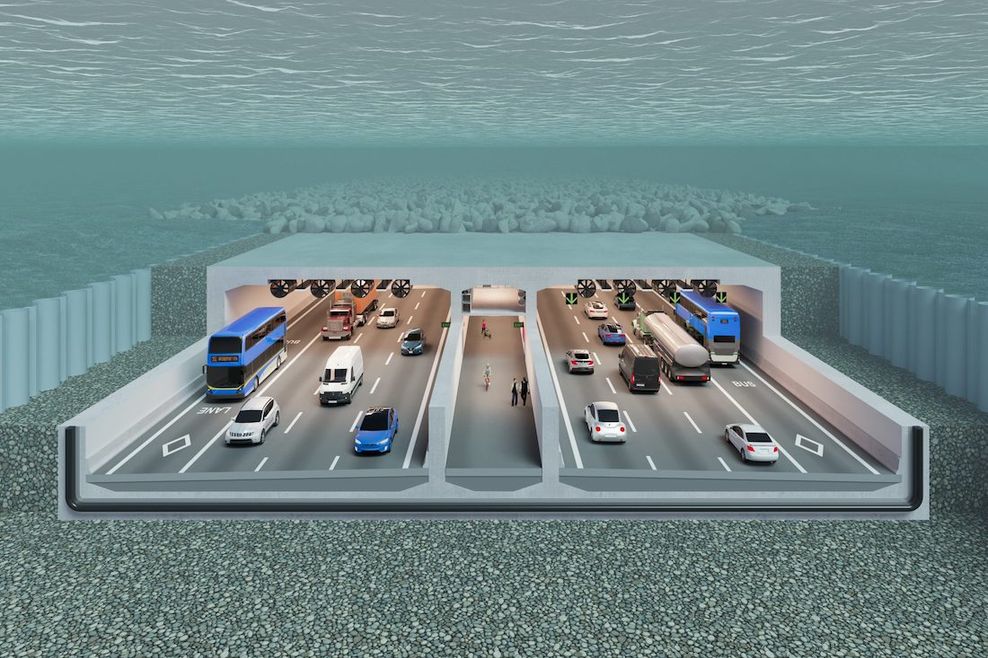
2025 revised concept of the new George Massey Tunnel. (Government of B.C.)
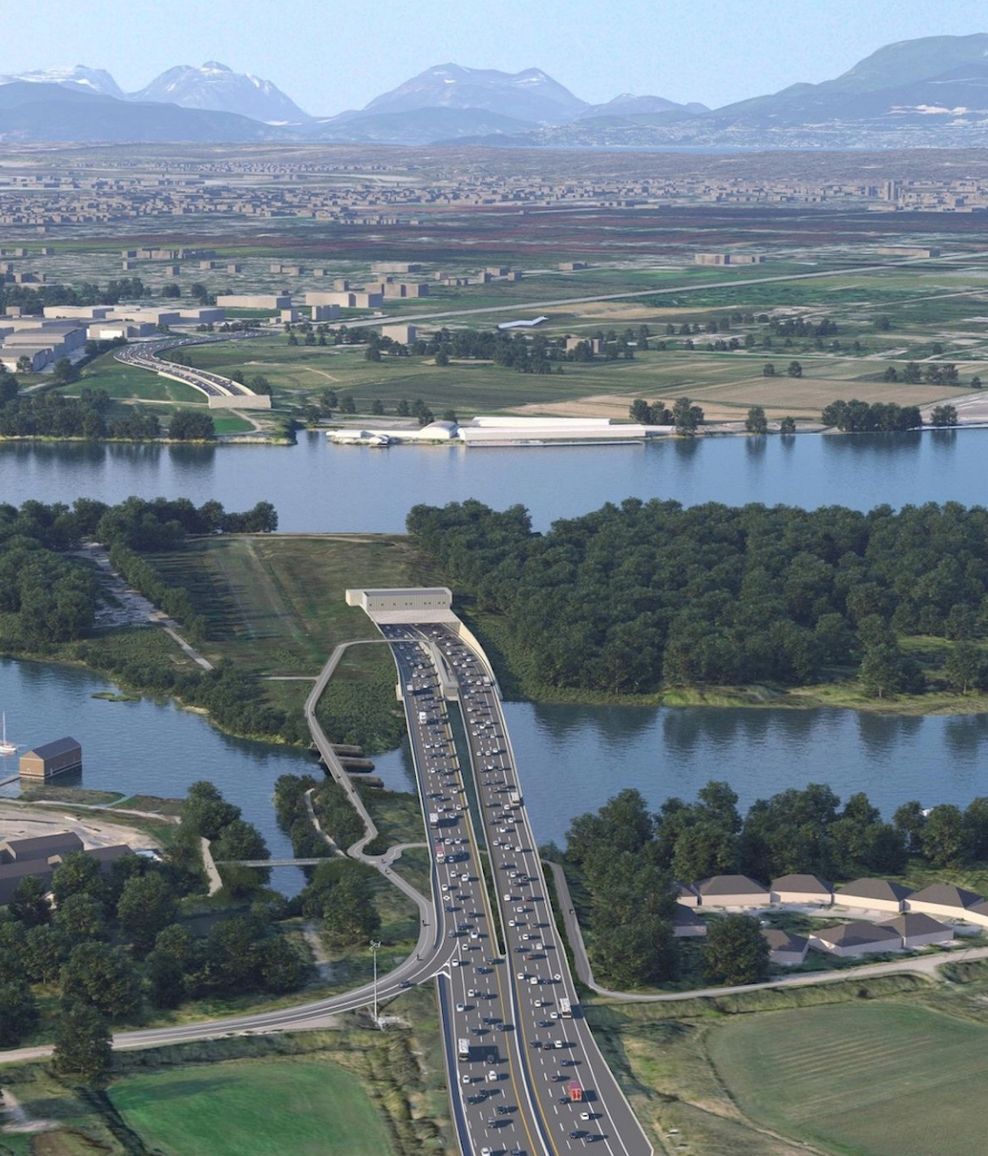
2025 revised concept of the new George Massey Tunnel. (Government of B.C.)
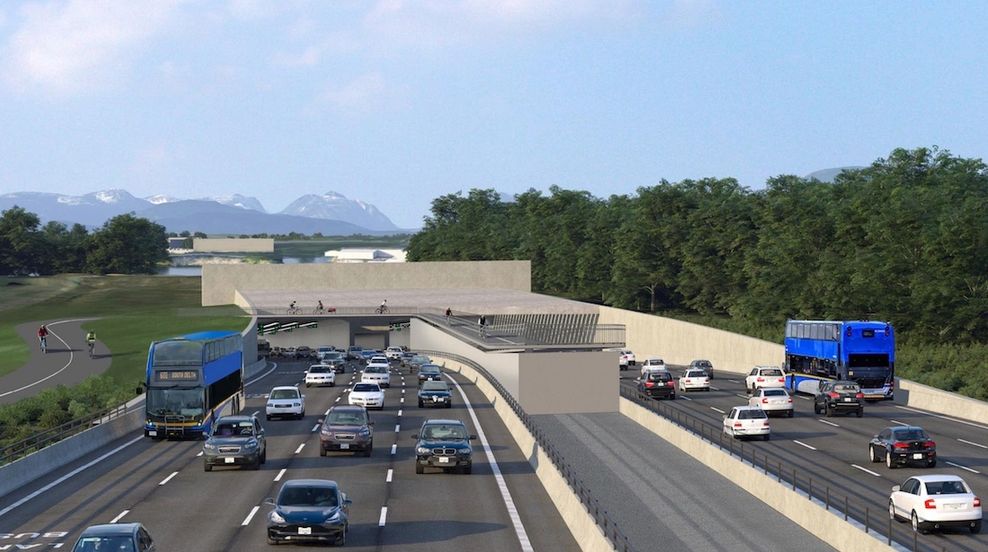
2025 revised concept of the new George Massey Tunnel. (Government of B.C.)
The immersed tunnel construction process is highly complex, involving digging a trench in the bed of the river and then sinking pre-cast, football-field-sized concrete tunnel segments into the trench. After the tunnel segments are sealed and made watertight, the sides of the trench and the top of the tunnel will be covered with a thick layer of boulders to secure the tunnel’s position and protect it from ships.
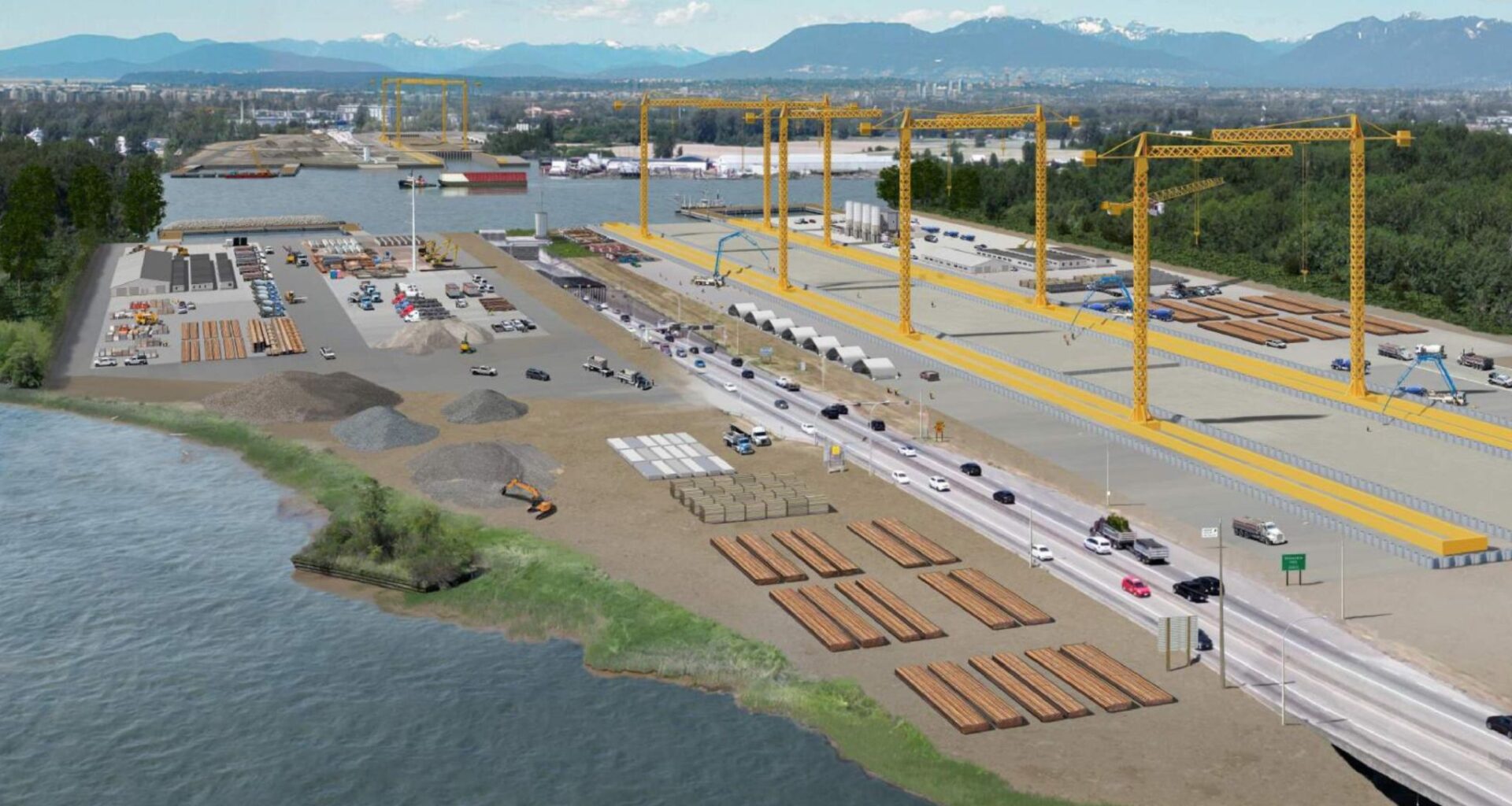
A very substantial area of Deas Island next to the new tunnel’s south portal will be cleared to create a large temporary manufacturing facility for the prefabricated tunnel segments. This will include excavating a dry pit where the segments will be built, then flooding it so they can be floated out and towed by tugboats to be sunk into place in the trench.
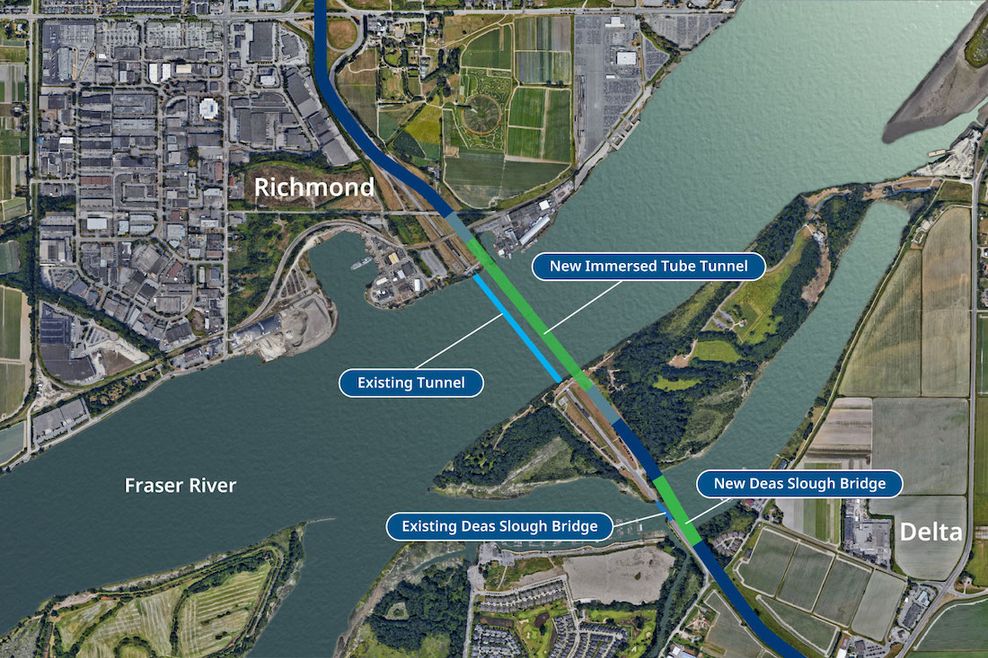
Additionally, the eight-lane immersed tunnel project includes building a new eight-lane, 350-metre-long Deas Slough Bridge across a small channel of the river south of the island, linking the tunnel’s south portal with Highway 99 in Delta. It should also be noted that the immersed tunnel includes a centre tunnel to create a separate crossing for pedestrians and cyclists.
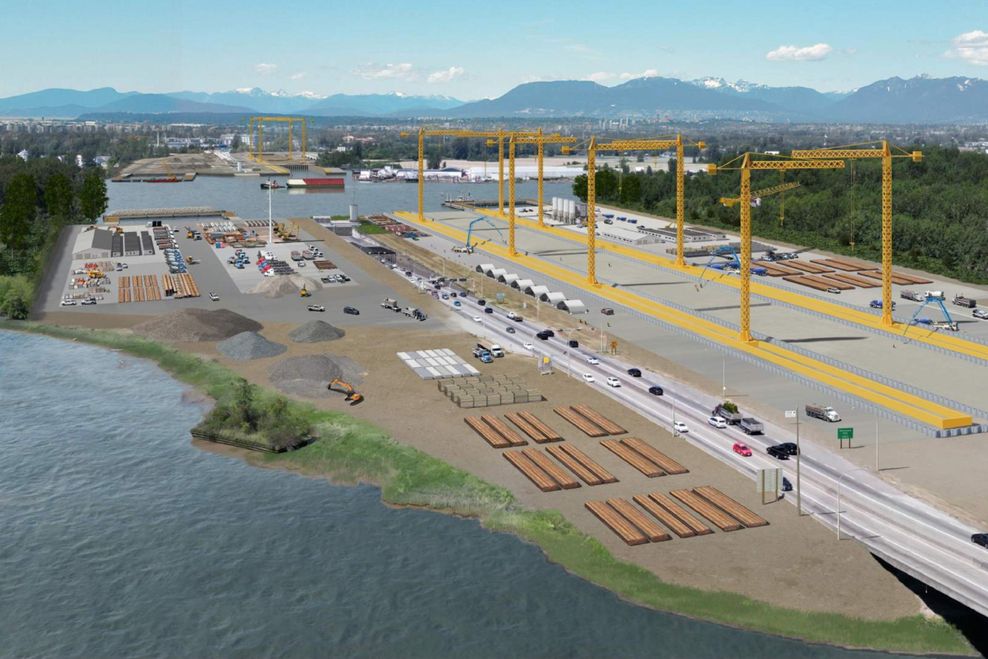
Concept visual of the manufacturing facility on Deas Island for the new George Massey Tunnel segments. (Government of B.C.)
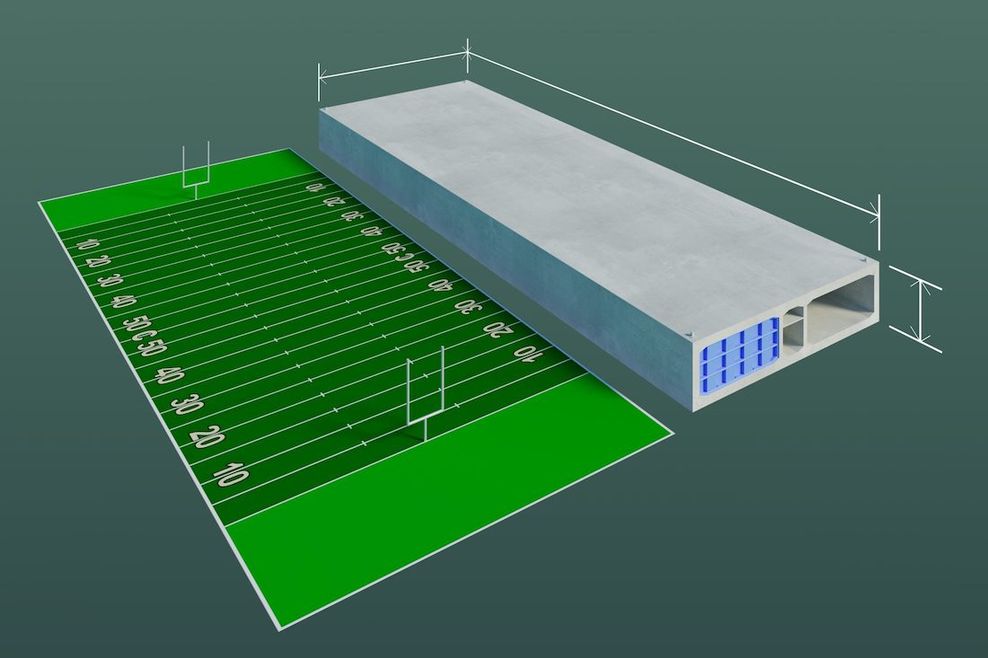
Each of the six new George Massey Tunnel segments on the bed of the Fraser River will be the size of a football field. (Government of B.C.)
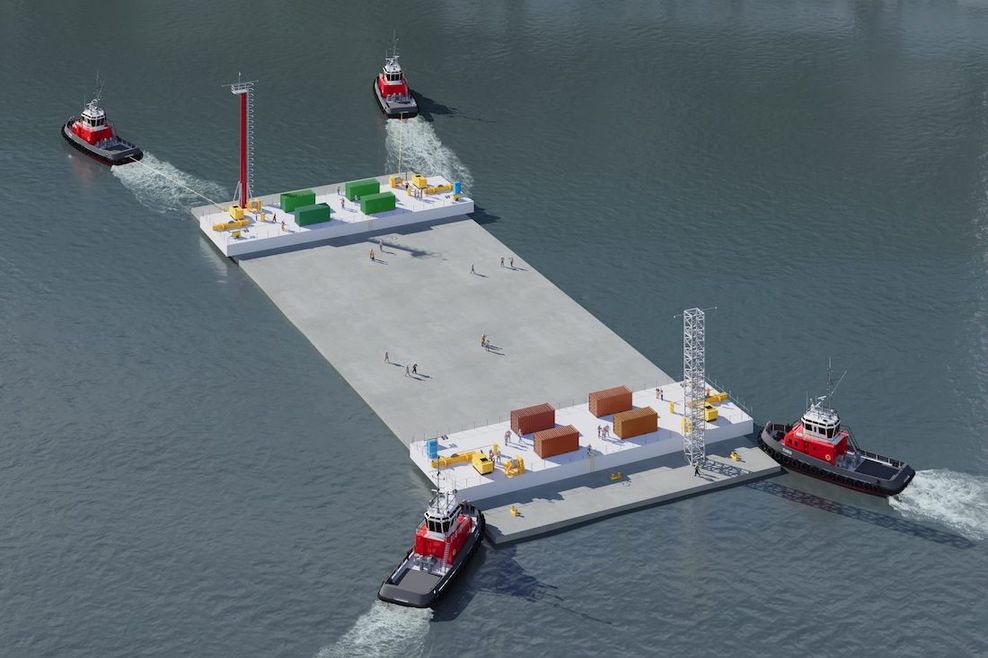
Concept visual of how tugboats will move each of the floating segments of the new George Massey Tunnel. (Government of B.C.)
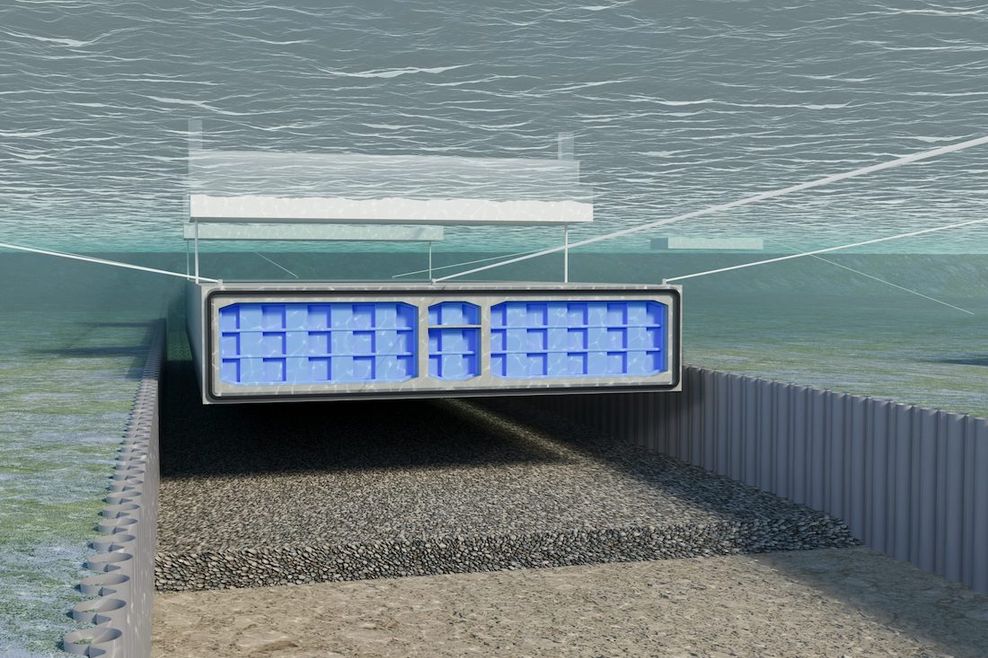
Concept visual of cables being used to position and lower the segments of the new George Massey Tunnel into the trench on the bed of the Fraser River. (Government of B.C.)
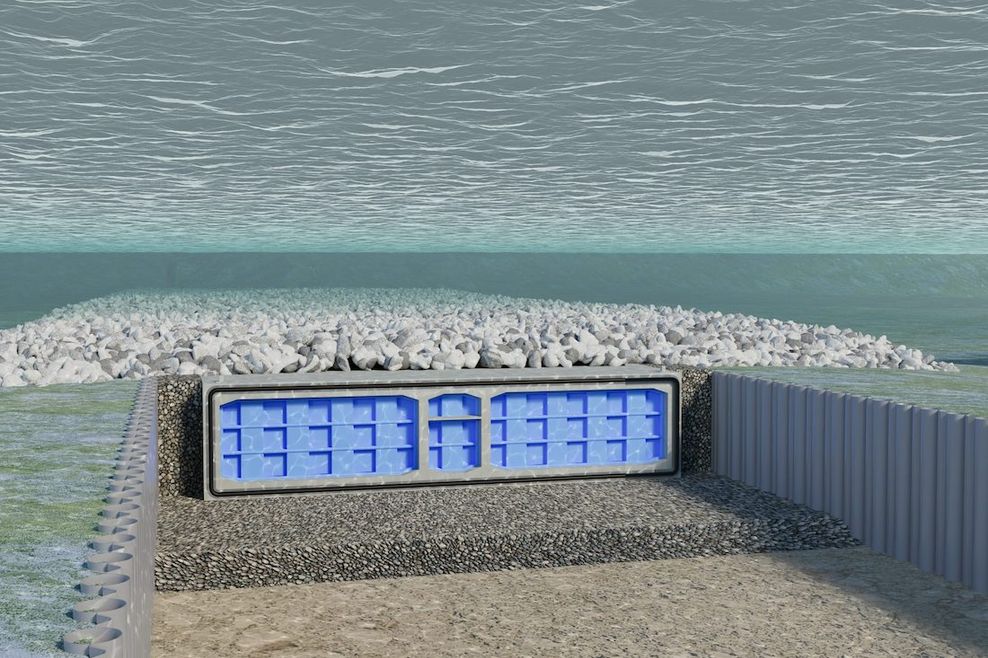
Concept visual of a thick layer of boulders being placed over the segments of the new George Massey Tunnel. (Government of B.C.)
This immersed tunnel option was chosen over both the original 10-lane bridge project cancelled in 2017 and the alternate option explored between 2019 and 2021 of an eight-lane, long-span bridge, which would have cost $4.22 billion according to the 2021 business case that outlined the scenarios explored.
It was also noted at the time that the eight-lane, long-span bridge could have begun construction in 2024 for a completion in 2028, based on the expectation of a comparatively simpler environmental assessment process, with a certificate issued as early as late 2022.
Greater construction costs with each passing month and year
The project’s greatest cost pressures come from not only its more complicated design but also having to wait, with each passing year producing greater inflation. Compared to 2020 and before the pandemic, there have been staggering increases to the market construction prices for materials, equipment, and labour — a trend that began to take shape in the latter half of 2021, and then greatly accelerated in 2022 through 2024. Inflation is currently still relatively high, contributing to higher costs and uncertainties, especially with the disruptions in global trade since early 2025.
Some critics have blamed the provincial government’s policy of requiring contractors to use unionized labour for significantly increasing the cost of recent provincial projects, arguing that it limits the size of the available labour pool. However, the BC NDP-led provincial government argues the higher costs have more to do with general labour shortages and the current inflationary cycle.
Nearly all new housing, hospitals, schools, transportation, and other building and infrastructure projects planned years ago just before the pandemic-induced inflationary cycle have seen their costs skyrocket after construction contract awards.
For example, when construction began in 2023 on the new Cloverdale Hospital in Surrey, it was first revealed that the project’s cost had ballooned by nearly 75 per cent — up by $1.22 billion from $1.66 billion in the 2021 estimate to $2.88 billion. This was blamed on significant cost escalation due to inflation, supply chain disruptions, and labour shortages. The hospital is targeted to reach completion in 2029 for an opening in 2030.
Construction costs for TransLink’s current project of building SkyTrain’s new OMC4 train maintenance and storage facility in Coquitlam have also grown wildly from the previous preliminary estimates of $658 million in 2021 to $1.3 billion as of 2024, as previously reported by Daily Hive Urbanized. The public transit authority similarly attributed this to the market inflation of materials, labour, and equipment prices, and the changing scope of the facility’s design during the planning process. Steel material prices alone went up by 65 per cent over the previous 18-month period at the time. Early site works began in 2021, and the facility is expected to reach completion in 2027.
Steep cost escalation has also been seen with TransLink’s new Marpole Transit Centre — the public transit authority’s first bus depot largely dedicated to battery-electric buses, located on the Fraser River’s shoreline in South Vancouver. Costs went up from $308 million in 2021 to $848 million by 2024. In addition to the market inflation of construction prices, the escalation in the construction costs was also due to the provincial government’s 2023 update to building seismic codes, which necessitated adding over 3,500 steel foundational piles under the two main buildings and drilling over 17,000 concrete columns into the ground.
The provincial government’s cost of building SkyTrain’s Expo Line Surrey-Langley extension also rose by 50 per cent — an increase of $2 billion from the years-long estimate of $3.94 billion to $6 billion in August 2024, following the awarding of its construction contracts. This was also partly attributed to market inflation. In contrast, when the bidding process first began in 2022, it was estimated that the three separate contracts would have a combined contract value of about $2.3 billion — not including the costs already incurred by the provincial government for design, planning, some of the early site preparation works, and land acquisition.
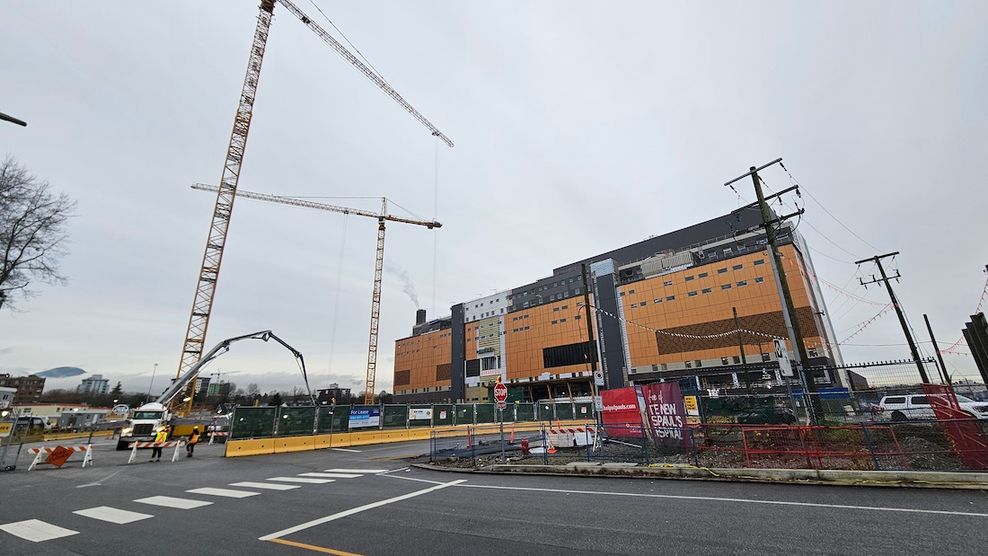
Construction progress on the new St. Paul’s Hospital, as of Dec. 11, 2025. (Kenneth Chan)
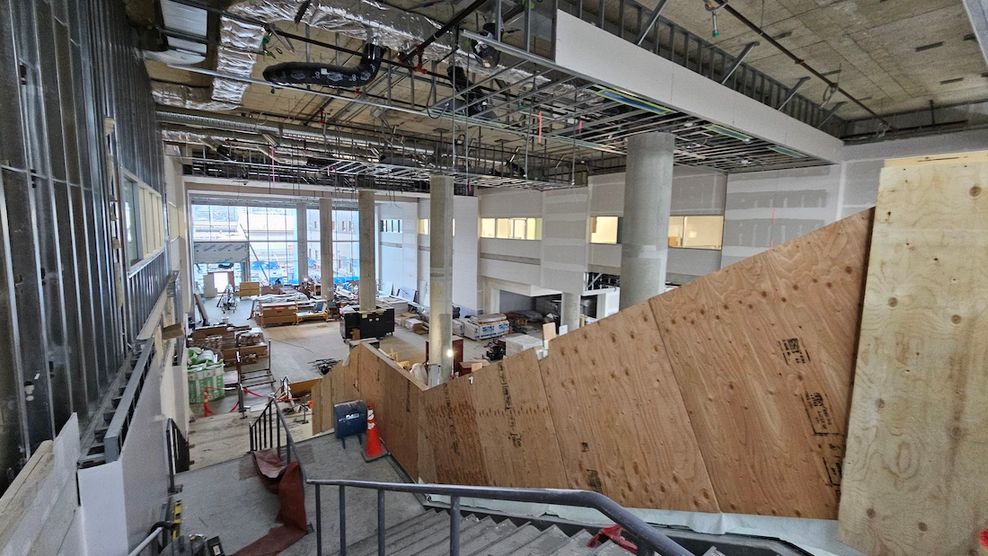
Construction progress on the new St. Paul’s Hospital, as of Dec. 11, 2025. (Kenneth Chan)
But projects that secured their contracts, prices, and began major construction in 2021/2022 at the start of or just before the inflationary cycle have seen comparatively more limited cost creep, if at all.
The $2.18-billion new St. Paul’s Hospital in the False Creek Flats is on budget, as of December 2025. It will reach completion in Summer 2025, and begin operations and accepting patients in Spring 2026 after a transition period. Construction first began in 2021.
SkyTrain’s Millennium Line Broadway extension project saw a relatively minor cost increase of 4.5 per cent, growing from $2.83 billion when construction began in 2021 to $2.95 billion as of Fall 2024, with this figure expected to hold. It will reach completion and open by late 2027, roughly two years behind schedule.
The cost of the new replacement Pattullo Bridge — the new stal̕əw̓asəm Bridge (Riverview Bridge) — increased by 19 per cent from $1.38 billion at the start of construction in 2021 to $1.64 billion as of Fall 2024, with this figure still holding. The new bridge saw all four lanes open to vehicle traffic this past weekend, and it will reach full completion later in 2026 (two years late), with the old bridge will be fully demolished by 2027. The cost increase relates to not only the inflationary cycle, but also technical complications with the steel materials sourced and in-river construction.
At this point, it is increasingly clear that it would take an extraordinary miracle of an outlier for the George Massey Tunnel replacement project to remain anywhere near its original $4.15 billion cost estimate set in around 2020/2021.
In 2024, Premier David Eby formally requested the Government of Canada to provide financial support for several infrastructure projects, with the George Massey Tunnel replacement being deemed the “top transportation infrastructure priority” for federal funding. However, the federal government’s funding offer in the range of a few hundred million dollars was reportedly rejected by the provincial government for essentially being a drop in the bucket.
It is also worth reminding that the original 10-lane, tolled George Massey Bridge project that was set to begin construction in 2017 for a completion and opening in 2022 had a preliminary estimated cost of $3.5 billion, including far more extensive Highway 99 improvements. Competitive bids came in as low as $2.6 billion — $900 million under the budget — and the provincial government was months away from awarding the contract and beginning major construction work before it was scrapped by the newly-elected BC NDP government.
The 2026 provincial budget released this week notes that the provincial government is now slowing the pace of building new housing and infrastructure projects due to its growing debt issues, with many of these projects largely financed by taxpayer-supported debt.