
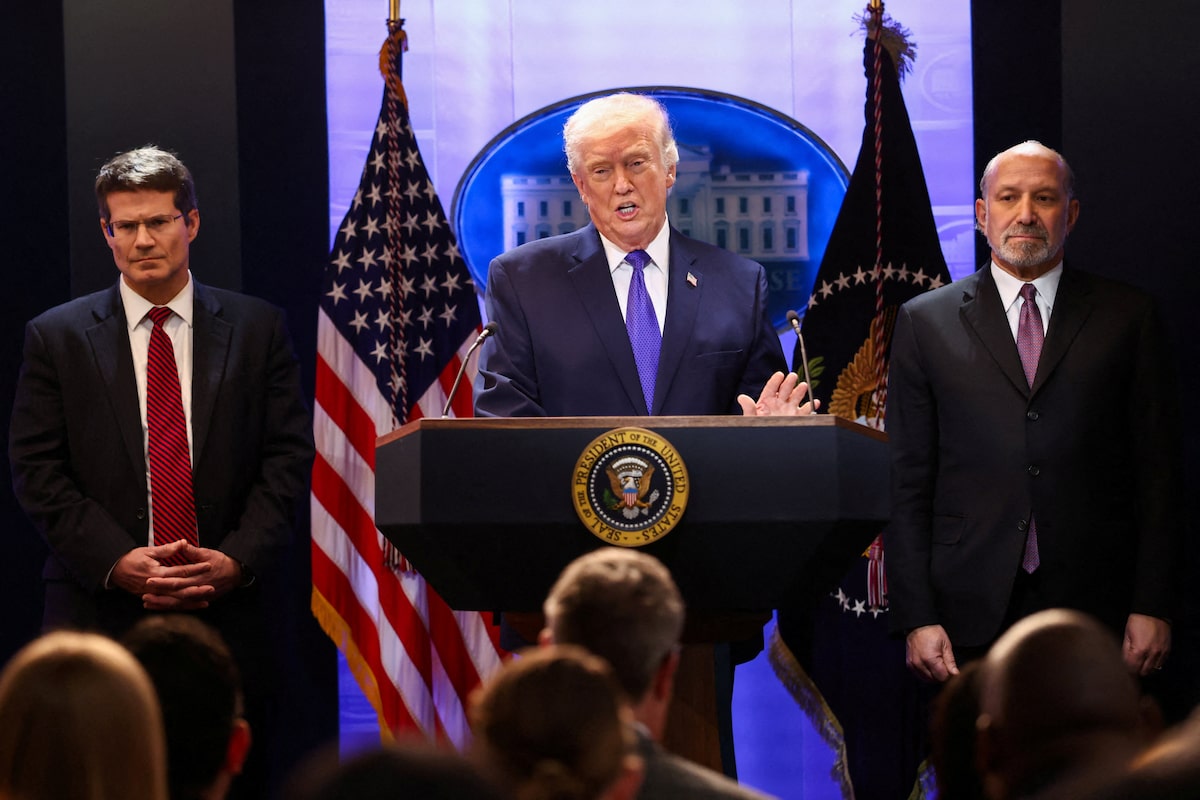
U.S. President Donald Trump, flanked by Secretary of Commerce Howard Lutnick and Solicitor General D. John Sauer, speaks during a press briefing at the White House, following the Supreme Court’s ruling that he had exceeded his authority when he imposed tariffs.Kevin Lamarque/Reuters
U.S. President Donald Trump vowed to ramp up his use of sector-based duties and others after the Supreme Court ruled against a swath of his existing tariffs on Friday, raising new risks for a Canadian economy that’s struggled mightily with duties that target specific industries.
Sectoral tariffs implemented under Section 232 of the U.S. Trade Expansion Act of 1962 – including those on autos, steel and aluminum – have delivered the harshest blow to Canada, because most other products continue to trade tariff-free under a crucial exemption.
And those sector duties are proving to have the most staying power in Mr. Trump’s protectionist trade policies.
U.S. Supreme Court rules against Trump’s use of emergency powers to impose tariffs
After the court shot down his use of tariffs under the International Emergency Economic Powers Act, which have raised more than US$134-billion for government coffers during Mr. Trump’s second term, the U.S. President pledged on Friday that he’ll enact a new 10-per-cent global tariff to rebuild his trade war policies, although those duties will expire in 150 days unless Congress votes to keep them in place. (Most Canadian goods will continue to enter the U.S. tariff-free because a USMCA exemption remains in place.)
That makes sector duties a crucial tool as Mr. Trump looks to rebuild his tariff wall for the long term.
“Canada should prepare for new, blunter mechanisms to be used to reassert trade pressure, potentially with broader and more disruptive effects,” said Candace Laing, president and chief executive officer of the Canadian Chamber of Commerce, in a statement.
The United States currently has Section 232 tariffs on steel and aluminum, automobiles and parts, copper products, lumber and wood products, as well as medium- and heavy-duty trucks and bus parts.
Honda employees at a vehicle assembly line in Alliston, Ont., in 2024. Sectoral tariffs – including those on autos, steel and aluminum – have delivered the harshest blow to Canada.Nathan Denette/The Canadian Press
Before the administration can impose such tariffs, however, the U.S. Commerce Department must conduct a formal investigation and produce a report on its findings.
Nine additional national security investigations have been launched, of which four were scheduled to have been completed, though no final reports or tariff announcements have been issued. They cover the semiconductor, pharmaceutical, critical minerals, and commercial aircraft and jet engine industries.
The remaining investigations, still under way, cover polysilicon (used in the solar industry), drones, wind turbines, medical equipment, and robotics and industrial machinery.
The fact no tariffs have yet been announced from completed Section 232 investigations is likely because the Trump administration was waiting until after the court ruling “to deliver a barrage of new sectoral duties,” wrote Michael Gregory, deputy chief economist at Bank of Montreal, in a note. “There are already reports of other industries seeking the cover of ‘national security’ tariffs.”
Canada lauds U.S. court ruling that strikes down legal justification for some Trump tariffs
Economists say it’s difficult to put a dollar figure on the value of exports that could be hit if all Section 232 investigations do result in tariffs, because the U.S. government has not identified which specific products would face tariffs.
That said, the impact would be significant. The Council on Foreign Relations, a New York-based non-partisan think tank, estimated in a November report that roughly US$160-billion of imports from Canada could be covered by existing or potential 232 tariffs, based on 2024 trade data.
Some sectors being investigated are relatively small in Canada’s case. The country shipped just US$32-million of polysilicon to the U.S. in 2024.
But Canada was the U.S.’s largest source of commercial aircraft and jet engines that year. The Canadian industry has already come under threat. Last month, Mr. Trump threatened to decertify Canadian aircraft unless Transport Canada approved several U.S.-made Gulfstream jets to fly here.
Any disruption to the sector would further damage Canada’s already battered export market. In December, exports of aircraft and other transportation equipment and parts climbed 20.5 per cent to $3.5-billion, led by higher shipments of business jets to the U.S., a major market for Quebec-based Bombardier Inc.
Likewise, the national security probes into robots and industrial machinery would hit Canada’s manufacturing base particularly hard; in 2024, Canada shipped US$4-billion of such products that could face Section 232 tariffs to the U.S., according to the Council on Foreign Relations analysis.
On the pharmaceutical front, the bulk of U.S. drug imports come from China and India. Canadian manufacturers supplied about US$6.75-billion in ingredients and finished products in 2023, according to a submission made by the Canadian embassy in Washington as part of the investigation.
Even without a final report into the sector, Mr. Trump has wielded other pressure tactics to get drug companies to lower prices and pursued “most favoured nation” pricing with pharmaceutical companies to get them to pledge they will lower U.S. prices and raise them in other countries.
In addition to the flat 10-per-cent global tariff, and the likely expansion of Section 232 tariffs, Mr. Trump also highlighted his plan to launch investigations under Section 301 of the Trade Act of 1974 into other countries “to protect our country from unfair trading practices of other countries and companies,” he said Friday.
Section 301 tariffs target countries that engage in anti-competitive trade practices. So far China is the only country hit by Section 301, though Brazil is also under investigation.
The investigations under Section 301 could cover a litany of U.S. trade barrier grievances listed in a report released by the Office of the U.S. Trade Representative last March, said Timothy Keeler, a trade lawyer in Washington, D.C., and former official with the U.S. Trade Representative’s Office under president George W. Bush.
They include Canada’s supply management system for dairy and other products, import restrictions around certain-sized bulk packages of fresh fruits and vegetables, the structure of provincial liquor boards and Quebec’s language law Bill 96, among others.
“The administration is going to try to mimic the IEEPA-based tariffs as much as possible using Sect. 122 in the short term, and then use Sect. 301 in the longer term,” he said. “Whether they’re able to exactly mimic it is a little unclear, but I’m sure it’s something they’ve been studying.”
With reports from Chris Hannay