
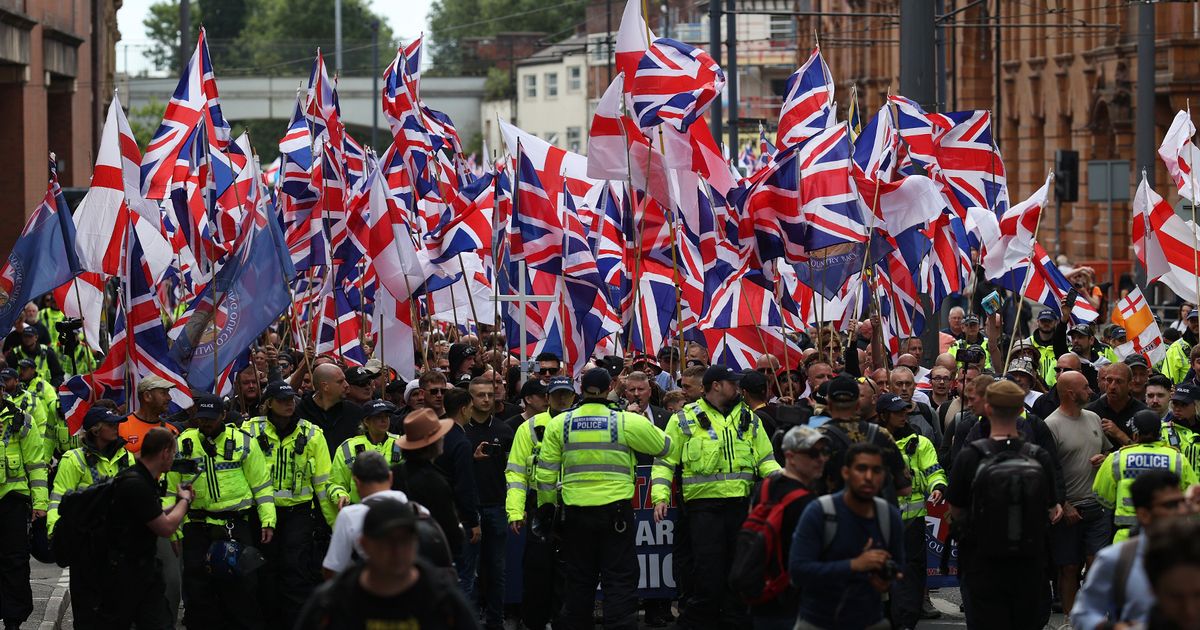
Today, Manchester city centre will become a stage for a confrontation many wish wasn’t happening at all.
Supporters of the far-right political party Britain First are expected to gather in Piccadilly Station – a station currently not operating most rail services – before marching through the heart of the city under the banner of ‘remigration’ – a term used as a euphemism for mass deportation.
Council leader Bev Craig has condemned the group’s presence, while acknowledging authorities have limited legal powers to stop the demonstration.
“Manchester does not welcome Britain First to our city,” Cllr Craig said in a statement, adding that the ‘hate and division’ that Britain First stands for ‘has no place here’.
That sentiment is shared by many of those preparing to fill the streets on Saturday, albeit for very different reasons. A number of counter demonstrations have been organised by anti-racist and anti-fascist campaign groups, with Jeremy Corbyn MP expected to speak in Piccadilly Gardens.
Yet, despite the strength of the opposition, Britain First will march.
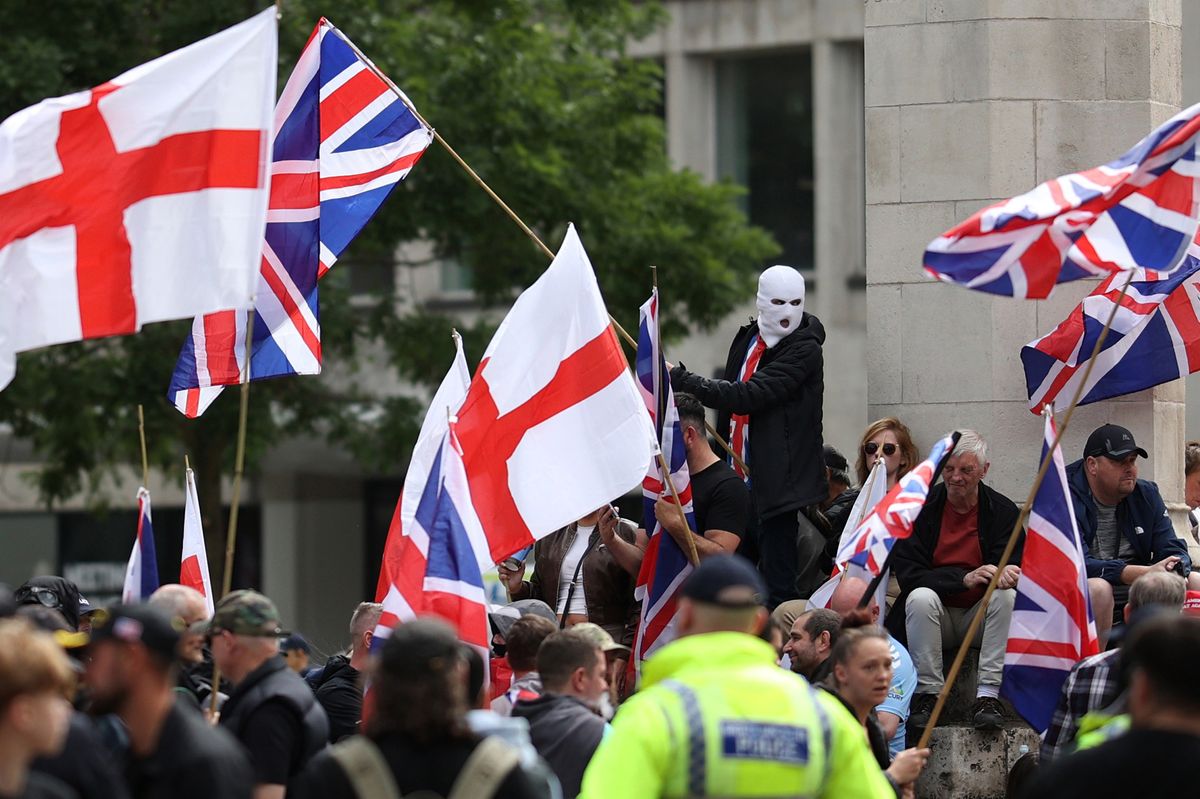
Britain First will stage a ‘remigration’ march through Manchester today(Image: Getty Images)
The reason why speaks to a deeper tension between democratic freedoms and harm to the public – and calls into question who has the right to occupy public spaces in one of Britain’s most multicultural cities.
What Britain First is marching for
Britain First says Saturday’s event is a ‘March for Remigration’. Nowhere on its website does it clearly define the term, but its promotional content invites supporters to ‘Join us as we march for mass deportations’. And the party’s immigration policy makes its intent clear.
It calls for the deportation of ‘all illegal immigrants, no exceptions,’ and proposes ‘rejecting and deporting’ asylum seekers ‘who do not originate from countries bordering the UK’, ‘who travel through a peaceful country’, or ‘who travel back to the country they claim to have been forced to flee’.
It also outlines a system of ‘voluntary repatriation,’ offering financial support for immigrants or citizens of overseas origin to ‘return to their country of origin or a new country of their choice’.
Britain First describes itself as a ‘movement of patriotism, nationalism, conservatism and traditionalism’, rejecting labels such as ‘right-wing’ and insisting it is not racist, with ‘membership encouraged no matter what racial or ethnic origins an individual possesses’.
However, Alex MacKinnon, Researcher for the advocacy group HOPE not hate, says Britain First has become increasingly explicit in its ideology.
“Their racism has become increasingly more overt over the past six months, to the point where even its leaders cannot deny it.”
Britain First was founded in 2011 by Jim Dowson and led by Paul Golding. MacKinnon traces the group’s origins to figures previously associated with the British National Party (BNP).
She says the group have historically framed themselves as civic nationalists, but have ‘always had an ethnonationalist underbelly’. Now, she says that element has become ‘much more overt’.
Despite this, she acknowledges that Britain First has the legal right to protest, but highlights ‘obvious disruption to the local community and wider harms’ she says will be caused by the march.
She added: “Where speakers, organisers or attendees cross legal lines, they must be held to full account immediately. Communities also have a right to defend themselves when extreme groups target the streets they live on trying to stir up hatred and cause division.”
Echoes of the past
In August last year, Britain First supporters marched from Piccadilly Station to the city centre waving England and Union Jack flags. The BBC reported that the group had 1,500 marchers, while Stand Up To Racism said this number was closer to 600, with 400 counter demonstrators attending a ‘unity event’ in Piccadilly Gardens.
Greater Manchester Police (GMP) said the demonstrations passed largely peacefully, though two arrests were made following a confrontation at the start of the march, the BBC reported.
While large-scale disorder has not always materialised, Britain First’s marches are often accompanied by tension and confrontation. Resist Britain First, made up of 12 campaign groups across Greater Manchester, have alleged previous Britain First demonstrations have ‘led to multiple recorded instances of racism, homophobia, and violence by attendees’.
Nahella Ashraf, chair of Stand up To Racism Manchester, recalls Britain First’s previous rally in the city last summer. She says ‘people were shocked’ that the group were able to occupy such ‘a massive stage’ in St Peter’s Square.
“I think it’s disgraceful that they can come into our city and hold their rally, which we know from what happened in August was full of hate speech,” she tells the M.E.N.
“[The rally] shocked everybody, not just the people that were at the counter demonstration, but just passers by when they stopped to listen to what those people were saying.”
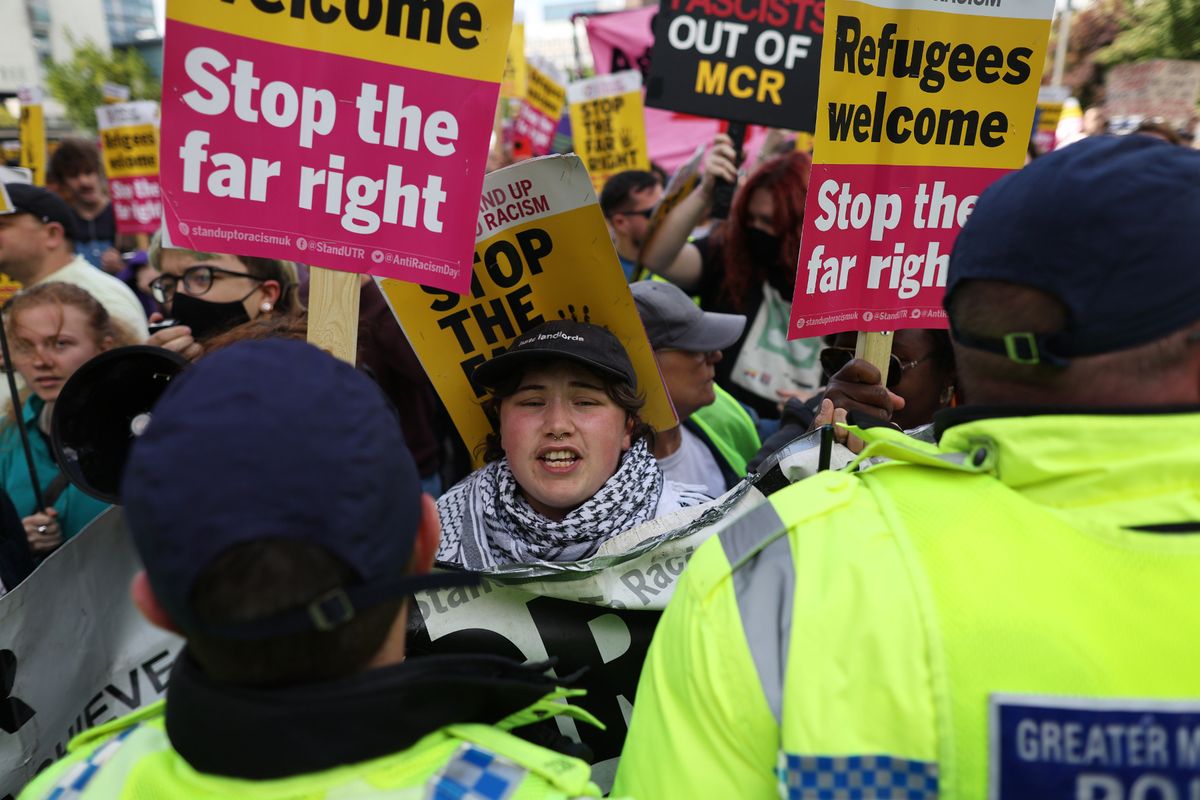
Stand Up to Racism will stage a counter demonstration in Manchester today(Image: Getty Images)
She rejects the Britain First’s claims that it is not racist. “Anyone that hears any of their speeches on Saturday will clearly see just how racist they are,” Ashraf says.
“If they were to say what [remigration] means, people would wake up and say, actually, that’s racist. That’s language that the Nazis used – you’re just sugarcoating it,” she says. “It’s the same ideology of the Nazis, where they had a vision of what Germany should look like.”
She adds: “I don’t think they should be allowed to come. It’s not a question of freedom of speech. It’s a question of, do they have the right to spread hate speech, which we know results in hate crime?”
Why is Britain First allowed to march?
But if the opposition to Britain First is so strong – even from the council itself – why can’t the march simply be stopped? The answer lies in the law. In the UK, the right to protest is protected, and authorities cannot ban demonstrations simply because of their views.
Manchester City Council leader Bev Craig has made it clear where the city stands morally, even if its legal powers are limited. She said: “Manchester does not welcome Britain First to our city.
“We are a welcoming and friendly city, with a proud history of tolerance, fairness and respect. But the hate and division that this group foster has no place here. We have no time for racism or hatred that looks to divide our communities.
“We understand the alarm and distress that comes when a group like Britain First, which is widely regarded as a far-right hate group, chooses to gather in our city. However, UK law protects the right to freedom of expression and assembly. This means that protests are allowed on the condition they engage fully with the local police force.”
Content cannot be displayed without consent
In preparation for the demonstrations, GMP have introduced additional powers, including a section 34 dispersal order covering the city centre. The measure gives police powers to remove people from a specific area for up to 48 hours.
The order runs from 10am to 8pm on Saturday. With a Premier League fixture also taking place and ongoing rail disruption due to the closure of most Piccadilly platforms, police are preparing for a busy day.
Chief Superintendent Danny O’Neil said: “As police officers, we respect and facilitate the right to lawful protest. For the weekend and whenever we have large crowds, appropriate plans, including extra officers, are put in place.
“We also work with organisers and local partners to minimise disruption for those who live, work, and visit our city centre. There will be disruption in the city centre and on the transport network, which will have an impact on travel times so please plan accordingly.”
Cllr Craig added that GMP have ‘given assurances’ that they will be policing the planned protests ‘seriously, robustly and with public safety as their top priority’.
The march comes at a politically charged time in Greater Manchester, just days before voters in Gorton and Denton head to the polls in a closely watched by-election, where immigration has become one of the most contested issues.
Britain First may have the legal right to march about so-called ‘remigration’, but Manchester, its leader says, does not welcome them.