
Why has the Labour government worked so hard for so long to hand over the Chagos Islands to Mauritius? Even as a former Foreign Office special adviser who worked on the deal, I understand how odd this seems. But it was not human rights waffle, or some misguided fantasy about pleasing the global south that brought us to this point.
It is why I want to set the record straight.
Labour arrived in government in the summer of 2024 to find the United States lobbying to do a deal with Mauritius and wrap up negotiations that started in 2022 when Liz Truss was foreign secretary. This was not a low pressure campaign. One day, Kurt Campbell, the deputy secretary of state, took me aside when he was visiting the Foreign Office and said: “The only way the United Kingdom can actually hurt the United States would be by not doing the deal.” I just want to be clear: this is Kurt Campbell, the China hawk, father of Aukus, and not a zealous human rights lawyer from Amnesty International.
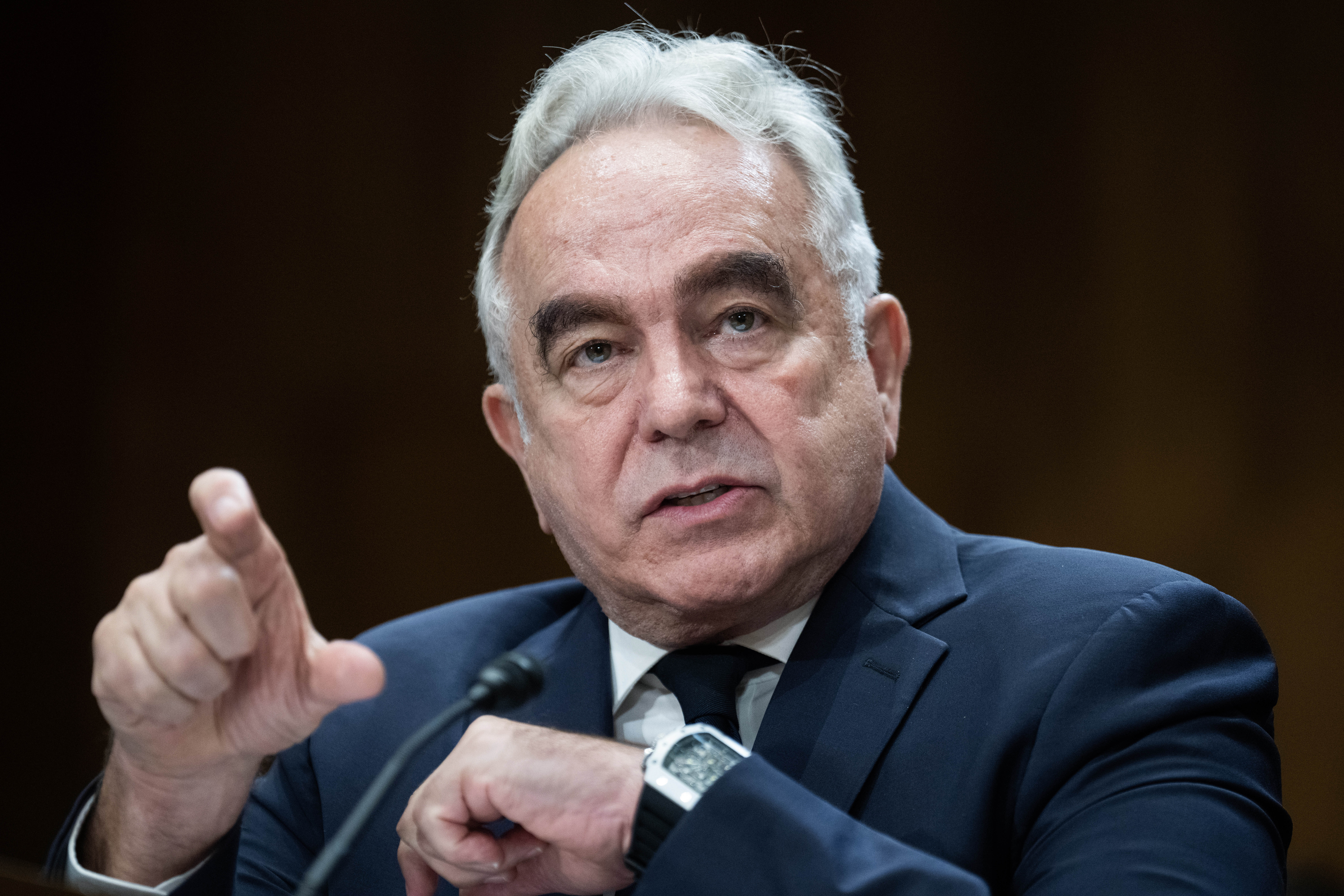
Kurt Campbell
TOM WILLIAMS/GETTY IMAGES
Why would he say that? Let me begin with a brief history.
Diego Garcia’s secrets
The idea that there is a genuine, real, breathing British Indian Ocean Territory, an overseas member of the British family like Bermuda or the Falklands, is in fact a fiction.
There is a base on Diego Garcia and it is an American base, just with a tiny British contingent and a British flag. “BIOT” only exists because the Americans wanted a piece of what was British colonial territory and asked us to carve it off in 1965 and remove the Chagossians, from what was going to be Mauritius, to build a base there.
However, this base is not just any old base. Once you’ve been briefed, even partially, on what it does the information gives you vertigo. Both now, and in government, communicating the details to the public would be violating the Official Secrets Acts.

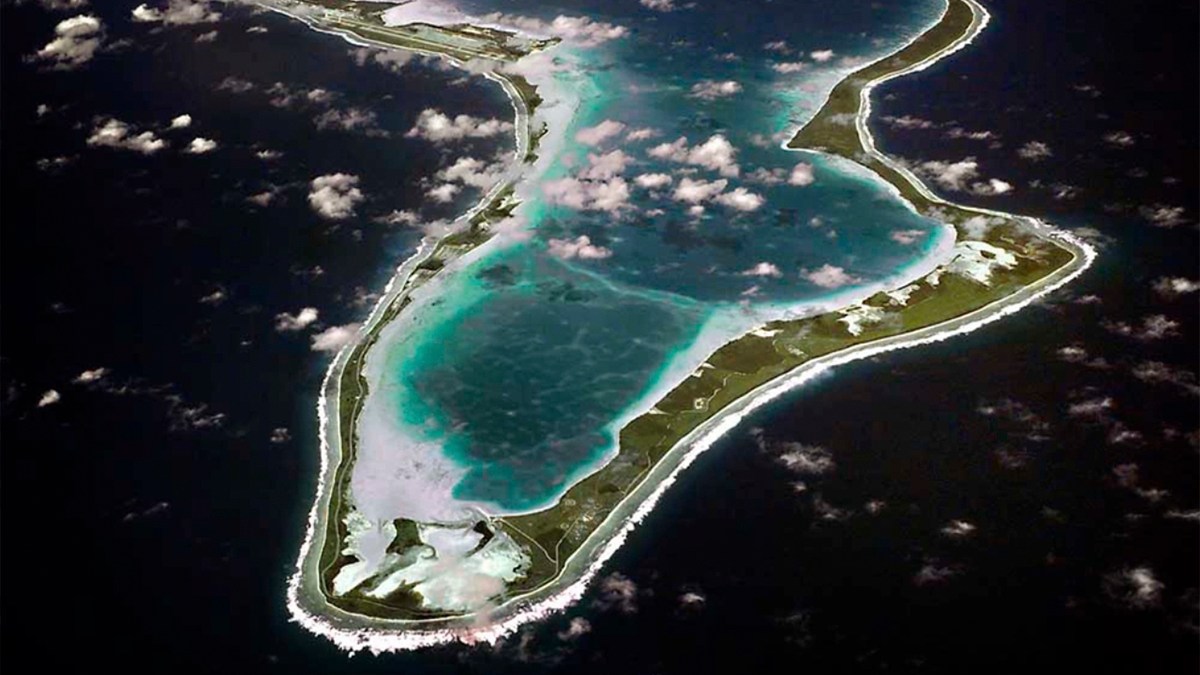
A satellite photo of the Diego Garcia military base
PLANET LABS/AFP VIA GETTY IMAGES
It is frustrating. But I ask you to believe me that once you understand what it does, and how our diminutive presence lets the UK get access to something we would never be able to build or afford ourselves, you enter the British deep state’s logic: we simply must do whatever we have to do to retain access.
The game against China
Which brings me back to the atolls and my exchange with the former US deputy secretary of state. Everything would be simpler if the island called Diego Garcia was just one atoll in the middle of nowhere. In fact there are about a thousand of them spread from the edges of the Maldives deep into the Indian Ocean. The Democrats were looking at the map of the Indian Ocean — and with Britain’s legal position collapsing internationally — they feared a situation where America’s crucial superbase would soon be deemed illegally occupied Mauritian territory by most of the rest of the world.
The International Court of Justice had issued an advisory opinion against Britain in 2019. The US State Department and the Foreign Office now saw all routes leading to a binding judgment. They were certain Britain would lose.
And once that happened, resupplying the base — the endless flights of contractors — would be deemed unlawful. Our enemies could campaign against our suppliers, or the countries they flew from, to shut them down. The result? An even more expensive and challenging base to operate. What offered the US maximum security in 1965 — having the colonial power stay — was now a headache.
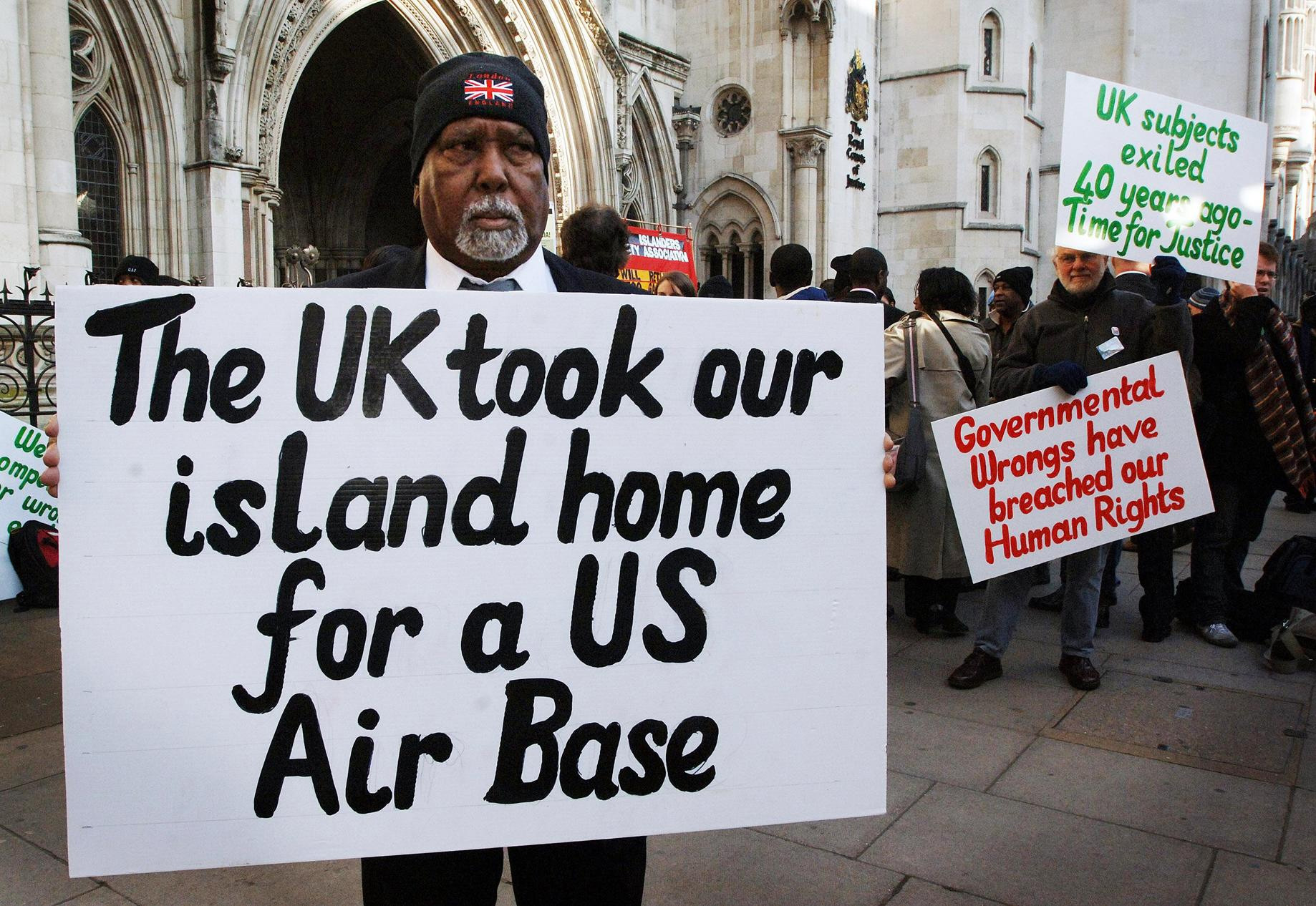
Protesters outside the High Court, London, in 2007
FIONA HANSON/PA
If you understand Mauritius is a swing state in the great game against China the picture becomes clearer. President Biden’s officials saw a big risk opening up. If Britain walked away from a deal, the Mauritians could walk away from the West and with the full force of international law invite China, or anyone else — into any of those thousand atolls, and then how would they get them out? It might begin with the Chinese fishing fleet, then a research station and before you know it there might be a Chinese base within listening and striking distance of Diego Garcia.
This risk was simply unacceptable to the US. And British officials understood this too. How could we guarantee the security of those thousand atolls in no deal? The answer? We can’t. Would you put a British frogman on every atoll? Trying to secure even half of it in what the world would see as an illegal operation would soon suck up the entire Royal Navy. It is, and was, an impossible task.
Britain feared being cut out of deal
Now back to Washington where our embassy is not just a “post” but a mini-Whitehall department on American soil. Under the Democrats it began to fear Mauritius doing a deal over Chagos — with the United States. The spectre of the US handing over British territory, and cutting the UK out of irreplaceable security benefits was too much to bear. An official view emerged: London must make its deal to avoid that deal.
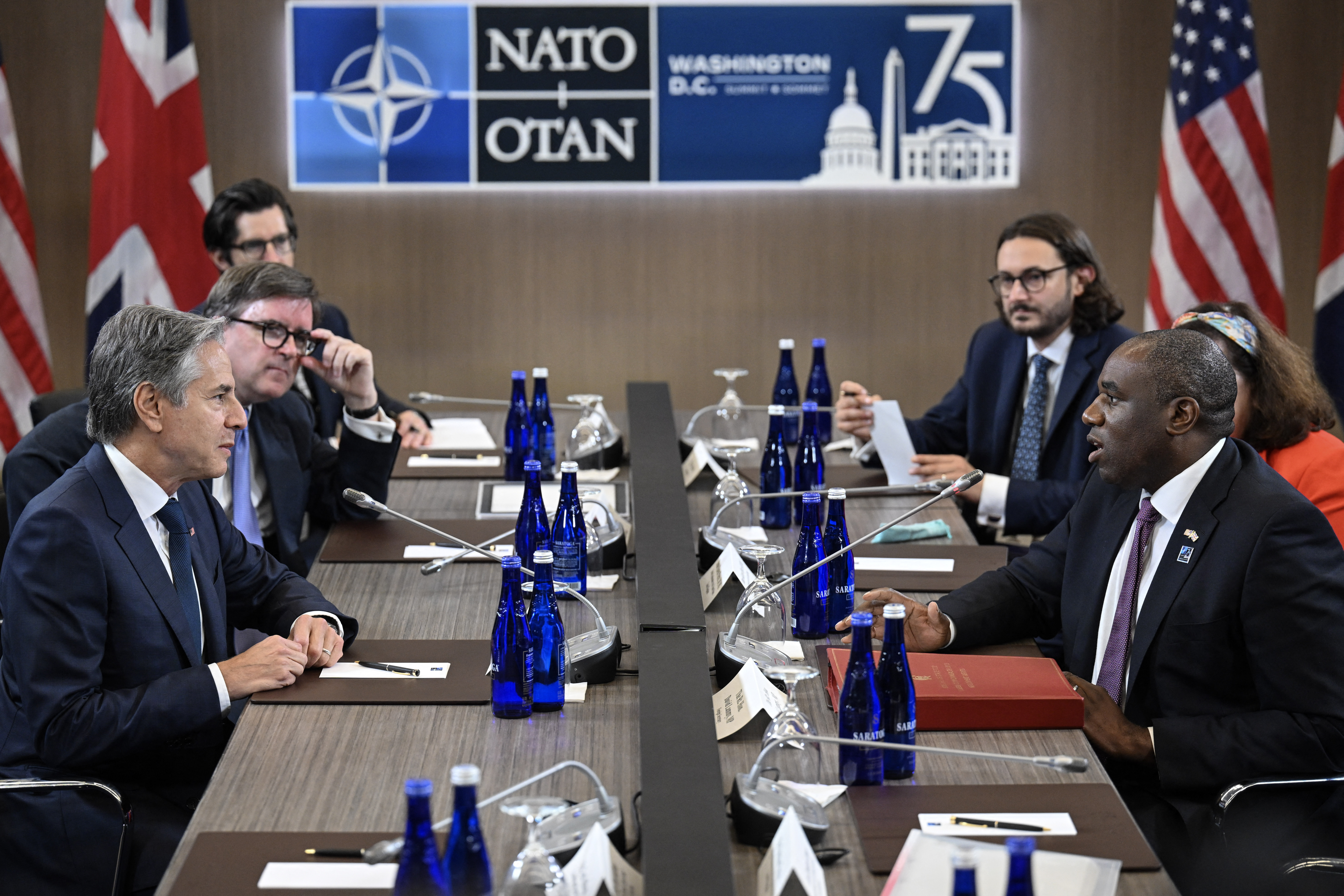
Ben Judah, top right, and David Lammy, right, meet the US secretary of state Antony Blinken on the sidelines of the Nato summit in Washington, July 2024
DREW ANGERER/AFP VIA GETTY IMAGES
Read Le Carré. Read the history of the Cold War. Britain often finds itself in these tight spots. What the British deep state did next was exactly what it has done in these situations before. In the best traditions of perfidious Albion, it would negotiate a deal, where everything would change for everything to remain the same. Mauritius would be able to call itself sovereign over the islands, enjoying the pleasure of it being shaded theirs on a map — but in any way that remotely mattered in military terms, an exclusion and veto zone where Anglo-American authority was complete would endure.
This is classic Cold War tradecraft. And to boot, for market rate rental of the base — 0.2 per cent of Britain’s annual defence budget — a considerable chunk of Mauritius finances would now be dependent on the UK, thereby locking them into the global West in the great China game. Jonathan Powell’s deal as special envoy went through the most rigorous and stress-tested US inter-agency process imaginable. They were more than satisfied. With President Trump’s initial approval Whitehall felt it had figured a way to guarantee British access to the superpowers of Diego Garcia for the rest of the 21st century.
The alternative was to use Trump’s victory to walk away from the deal. The official advice to ministers was to take the bird in hand and not risk the binding judgment, with all the degrading consequences that entailed for the base, before the Democrats returned to power and the problem began again. Starmer proceeded.

President Trump approved the deal put forward by Keir Starmer — then changed his mind
LEON NEAL/GETTY IMAGES
An abusive special relationship
Obviously, this isn’t the end of the story. The unpleasant truth revealed by the Chagos affair is that we no longer live in a world where Britain and America can practise such subtle statecraft. Whereas in the Cold War, the British state could anticipate what the US wanted even 20 years into the future, predicting the American position on Chagos has defied us. The reality is that Britain felt it had a deal with Trump to proceed, only to be thrown off balance by one Truth Social post, before US recommitment, only to be derailed again.
Our Chagos problem is a subset of our much deeper America problem. We are deeply dependent on a superpower that is not the Cold War superpower it once was with its bipartisan foreign policy consensus — but one that has become erratic, internally divided and impulsive. Pushed towards a deal by one administration, played around by another, painfully forced to suck it up because we’re critically dependent on them: this is what an abusive special relationship looks like.
When the United States was officially committed to the rules-based order, Britain’s own loyalty to it did not clash with its allegiance to the United States. The Chagos affair reveals this is no longer the case. Diego Garcia is where a rupture with the United States could begin. The United States is threatening to attack Iran unless it makes a deal over its nuclear programme and wants to use the base as part of that offensive. But Britain’s commitment to international law — there is no credible way to argue such an attack is legal — means it cannot allow that. This, I understand, is why Trump has decided to pull support for the whole Chagos deal. We are tied in contradictions.
Global right is playing politics
If America is not the same, neither is Britain. Time and time again, across the late 20th century, the UK with a stiff upper lip gave up territory to advance its interests and the western cause. If the public was largely indifferent, parliament was always supportive. To be blunt — my time in government has taught me that the Cold War past really is a foreign country, one where you could do complex overseas diplomacy with little political pain. We just no longer live in a Britain with such a deep and instinctive sense of the national interest that issues can be steered through parliament by intelligence briefings alone.
Many in Labour’s political team argued that the costs on the home front were too great, and that Labour should kick the can down the road and play for time like the Tories. The prime minister felt it was in the national interest to proceed.
Starmer’s mistake was that he thought he was operating in a world of foreign policy — of the national interest and western unity — when the global right was playing foreign politics. That world of foreign policy was the consensus of the Cold War senator Arthur Vandenberg, who used to say, “Politics stops at the water’s edge.” Our world of foreign politics is a world where politicians on the right from Boris Johnson to Nigel Farage are running their diplomatic campaign in Washington to stop the prime minister.
This is realpolitik in action
We are in a Catch-22. The three-step logic driving the Chagos deal cannot be expressed in a tweet, or by a government spokesman without causing diplomatic pain and embarrassment, which means it can be attacked from all sides for what it is not: a woke fantasy, a gift to the activist lawyer Philippe Sands, a misguided soft power exercise drawn up by brain-dead diplomats, even treason — and not what it is a piece of realpolitik firmly grounded in geopolitical trade-offs.
However, in the year and a bit I spent in the Foreign Office worrying about this, I came to believe the country is suffering from an almost psychic wound: its vast diminishment. I wanted to answer this by wrapping up the colonial entities that are Overseas Territories and replacing them with Overseas Kingdoms, integrated like France’s départements d’outre-mer into the United Kingdom. I wanted to show that Chagos was an exception for an exceptional place. That Labour had no surrender agenda but an expansion agenda.
Most colleagues thought I was mad. Last autumn, I was working on a policy proposal in which Overseas Territories would be offered their own seats in the House of Lords to represent them and an Overseas Territories Volunteer Corps as part of a campaign to start talking, educating and dreaming about them. I did not want to leave the longing for a greater Britain to the right. Then my boss, David Lammy, was reshuffled. The next day I was in the Ministry of Justice, doing comms for prisons.
We now risk what I feared — no deal. To the detriment of Britain.
Now out of government, removed from the top secret pink papers, I cannot predict whether it will, in fact, come to pass.
All I can be certain of, is that the very fact it has proved so hard and humiliating to get here is a warning to us all: do not assume we are capable of the kinds of delicate realpolitik practised by Anglo-America in the 20th century. Instead the US and Britain have become two turbulent, impulsive and emotional countries who are simply not as good at geopolitics. Labour needs to go further in accepting the world as it is — not just what we might wish it to be. This begins with knowing who we are and what we’re capable of.
Ben Judah was special adviser to David Lammy 2024-2026 as both foreign secretary and deputy prime minister