
The NHL resumes play on Wednesday, but information on teams and players may be sparse to come. A lot of Olympians just returned to North America on Monday, Team USA may be heading to the White House on Tuesday, and some NHL squads are canceling practices or are going to be without key players, so expect the next few days to be very hectic for news. For updated player information, be sure to check out the Player Newsfeed pages available over on Frozen Tools. Managers can go team-by-team to see what the latest news is for their fantasy rosters.
*
For some recent news, Washington Capitals goalie Charlie Lindgren was activated off the injured reserve, according to Tom Gulitti. Lindgren hadn’t played since late January, and was expected to return after the Olympic break, but it’s good to get confirmation, nonetheless.
*
While we don’t have any sort of timeline, Darren Dreger of TSN reported that Winnipeg defenceman Josh Morrissey will miss time with the injury he suffered in the Olympics. The coaching staff is hopeful he can rejoin the team on their upcoming three-game road trip, though.
*
Rasmus Dahlin was back at practice for Buffalo on Monday following his Olympic experience, but winger Zach Bensonw as not, according to Paul Hamilton. With Benson not having practiced in a regular contact jersey during the break, he may not play at all this week, let alone on Wednesday.
*
With Sidney Crosby injured, Pittsburgh called up forward Avery Hayes, and he was on the ‘top’ line with Rickard Rakell and Bryan Rust at practice on Monday, according to Dave Molinari. We will see how long this lasts, but it seems as if they want to try to keep their third line together with Ben Kindel unless their hand is really forced.
*
Zachary L’Heureux was at Nashville’s practice on Monday, according to Ann Kimmel. What is notable is that was with Filip Forsberg returning from the Olympics, so this may be a genuine call-up rather than a temporary fill-in.
*
According to Matthew DeFranks, both Robert Thomas and Dylan Holloway were full participants in practice on Monday. This was the top-3 lines at practice:
Holloway – Schenn – Snuggerud
Neighbours – Buchnevich – Kyrou
Berggren – Thomas – Joseph
The Buchnevich line was finding success before the break and the Schenn/Holloway duo has been pretty consistent going back to last year. It certainly looks like as if Thomas is returning to action in some sort of pseudo third-line role. It is not great news for fantasy managers.
*
San Jose had Michael Misa lined up with William Eklund and Tyler Toffoli at practice on Monday, per Max Miller. Seeing as Macklin Celebrini hadn’t returned from the Olympics yet, and Zach Ostapchuk was likely taking Celebrini’s spot on the top line with Will Smith and Kiefer Sherwood, it appears as if Misa is going to get some talented wingers to try and skate with out of the break.
*
With the regular season resuming tomorrow, fantasy managers need to be ready for the stretch run. This is where catching the right player or two who hit a hot streak in a bigger role can mean the difference between a championship or a crushing loss.
Before game action restarts, let’s refresh ourselves on some forwards who saw a bigger role before the break. We are using December 31st as the cut-off and using the percentage share of TOI from Frozen Tools to see who had a bigger role in the weeks leading up to the Olympic break, and whether they can be useful fantasy options down the stretch.
Ice time and roster percentage data are from Frozen Tools while any other data is from Evolving Hockey. We are dividing the forwards into two groups:
Change in offensive TOI share, or even strength and power play only
Change in peripheral-heavy TOI share, or even strength and short-handed only
The red and blue dotted lines in the following graphs are the average ice-time changes in each phase.
Linus Karlsson (Vancouver Canucks)
Yahoo Roster – 0%
FanTrax Roster – 12%
ESPN Roster – 0%
One of the bigger recipients from Vancouver’s struggles and injuries has been the rookie Karlsson. He went from under 10 minutes a game in the first two months of the season, to 11:37 in December, up to 13:37 since then, and 14:35 per game in his most recent five appearances. It still isn’t a lot of ice time, but after New Year’s Eve, he was fourth among Canucks forwards in PPTOI per game, and had seen large increases in his even-strength usage as well:
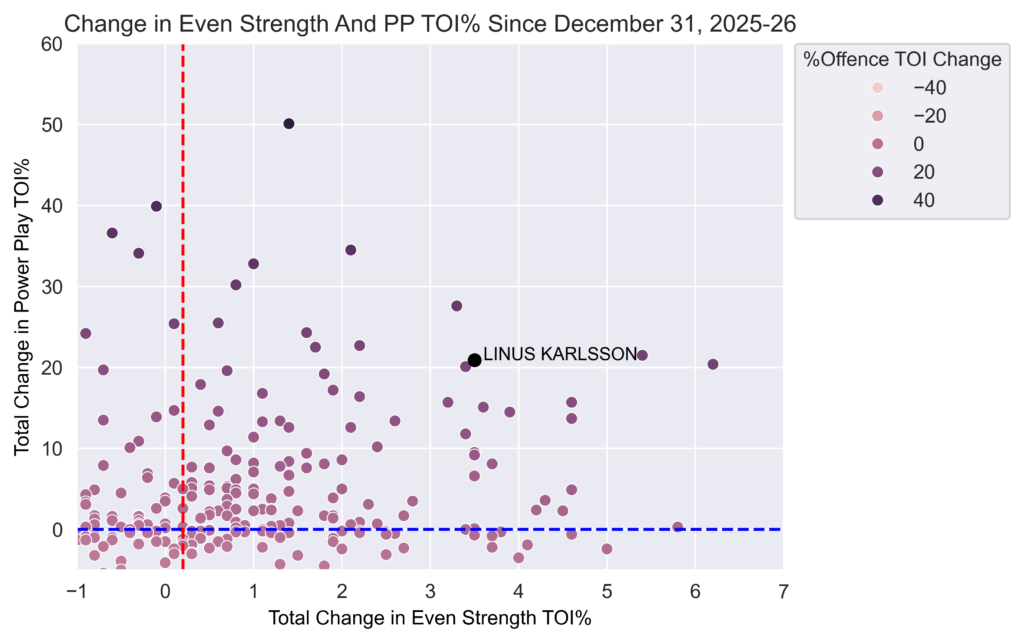
When the Vancouver lineup is healthy, it seems likely all of Elias Pettersson, Brock Boeser, and Jake DeBrusk are on the top power-play unit. It leaves just one spot for the likes of Karlsson, Conor Garland, Marco Rossi, or Evander Kane. However, Karlsson sits third among rookie forwards in points per 60 minutes at even strength, has improved his role as the season has worn on, and the Canucks will be looking to trade some veterans by the Trade Deadline. He is also averaging over a hit per game, so there is some banger value here, and Vancouver is tied for the sixth-most games on ‘light’ days for the rest of the season. Karlsson’s value relies on his lineup slotting, but the same could be said about a lot of depth streaming options.
Matias Maccelli (Toronto Maple Leafs)
Yahoo Roster – 2%
FanTrax Roster – 25%
ESPN Roster – 7%
Maccelli is a case where it is hard to see him keep earning the power-play role he has. William Nylander played just seven games after December 31st, and that was a big reason for Maccelli’s elevated role, and he did see some of the biggest increases of any forward in the league:
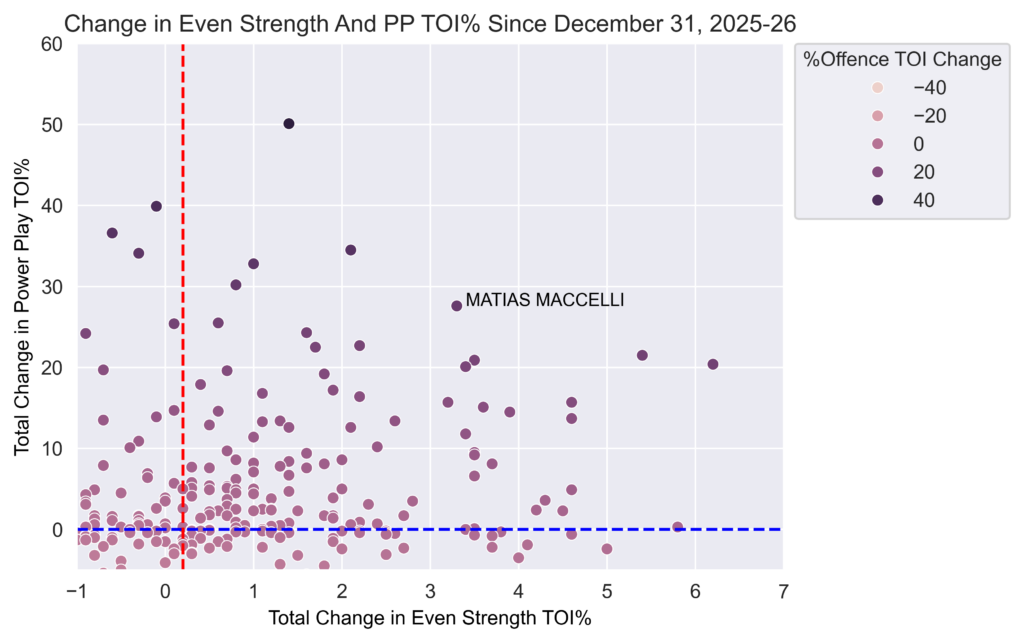
Even without the power play role, Maccelli’s even-strength role increased from 22.7% of the available TOI to 26%, adding 2:30 per game in EVTOI. He doesn’t hit or block shots, so he has very meagre value in leagues counting peripherals, but the Leafs come out of the break with 7 games in 11 days and have the fifth-most games in light days the rest of the way. If Maccelli remains in the top-6 at even strength, and can skate 14-15 minutes a game even without a PP role, he will have some streaming value in deeper formats.
Ryan Leonard (Washington Capitals)
Yahoo Roster – 13%
FanTrax Roster – 63%
ESPN Roster – 15%
Since January 1st, Leonard has been skating 15:59 per game, or 2:25 more per game than he did over the first three months of the season. There were a few reasons for that, not the least being Tom Wilson missing eight games and the Capitals going into a big skid that saw them 10-12-3 over their most recent 25 games. Whatever the cause, we did see Leonard have a significant ice time rise:
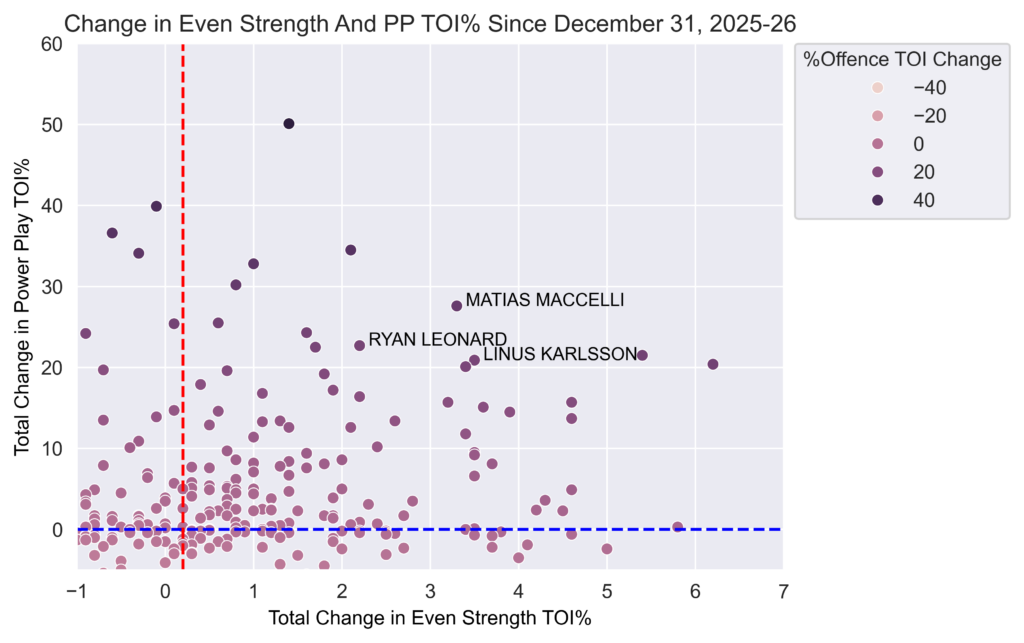
The key here for Leonard is that when Wilson returned just before the Olympic break, Leonard remained on Washington’s top PP unit alongside Wilson, Dylan Strome, and Alex Ovechkin. There is always the concern that the team replaces Leonard with someone like Pierre-Luc Dubois or Justin Sourdif, but as long as Leonard has that PP role, he’s going to be relevant in any multi-cat format because of the production potential alongside his 2.0 shots and 1.5 hits per game.
Corey Perry (Los Angeles Kings)
Yahoo Roster – 7%
FanTrax Roster – 21%
ESPN Roster – 10%
Here are two things that are true about Perry’s 2025-26 season thus far:
As of the Olympic break, he is second among Los Angeles’ 12 regular forwards by points per 60 minutes at even strength (1.71). That isn’t a strong number when compared to others across the league – a bottom-end second liner – but Los Angeles isn’t a strong offensive team.
As of the Olympic break, he is first among Los Angeles’ 12 regular forwards by points per 60 minutes at all strengths (2.62). That is a better mark than his even-strength production when compared to the rest of the league – a bottom-end first liner – and speaks to the work he has done on the power play.
Knowing his success with the man advantage, as well as the solid-but-not-great production at even strength, we have to highlight Perry’s increases in ice time:
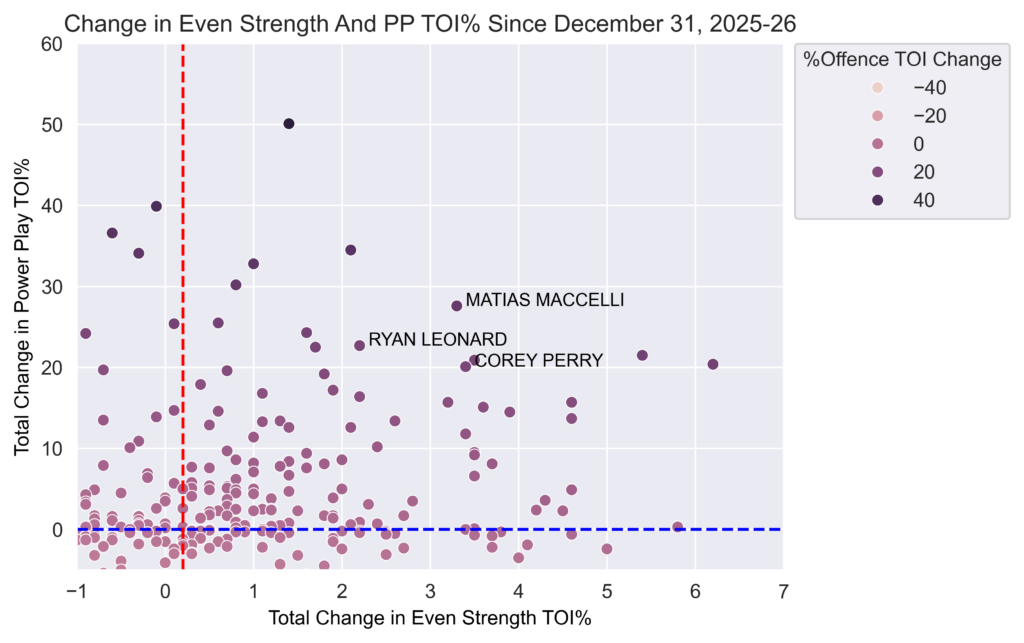
Overall, Perry’s power-play (19th) and even-strength ice time jumps (30th) are both top-30 in the league among the 366 forwards in our sample, or comfortably inside the 90th percentile in both areas. Over Los Angeles’ final 18 games – of which Perry missed five due to personal reasons – our subject skated 15:59 per game. As long as he can skate around 16 minutes a game with top power-play time, he will have some fantasy relevance.
The issue for Perry is his peripherals. Over his most recent 20 games, he has 6 hits and 29 shots. On a 60-minute basis, Perry’s rate of hits this season (1.68) is less than half what it was just two years ago (3.57). With a top PP role and 16 minutes a game, he might be able to produce an 82-game pace of 20 goals and 50 points, but there won’t be much else to go with it.
Alex Laferriere (Los Angeles Kings)
Yahoo Roster – 38%
FanTrax Roster – 54%
ESPN Roster – 76%
Perry’s teammate, Alex Laferriere, might be one of the bigger beneficiaries of the acquisition of Artemi Panarin. While things can change quickly, at practice last week, Zach Dooley reported that the top line was Panarin, Laferriere, and Adrian Kempe. With the injury to Kevin Fiala, Laferriere gets Los Angeles’ two top offensive wingers to skate with.
As opposed to the ice-time jumps listed above where we look at the offensive-heavy minutes – even strength and power play – there are the peripheral-heavy minutes, or even strength and short-handed. That is where Laferriere comes in:
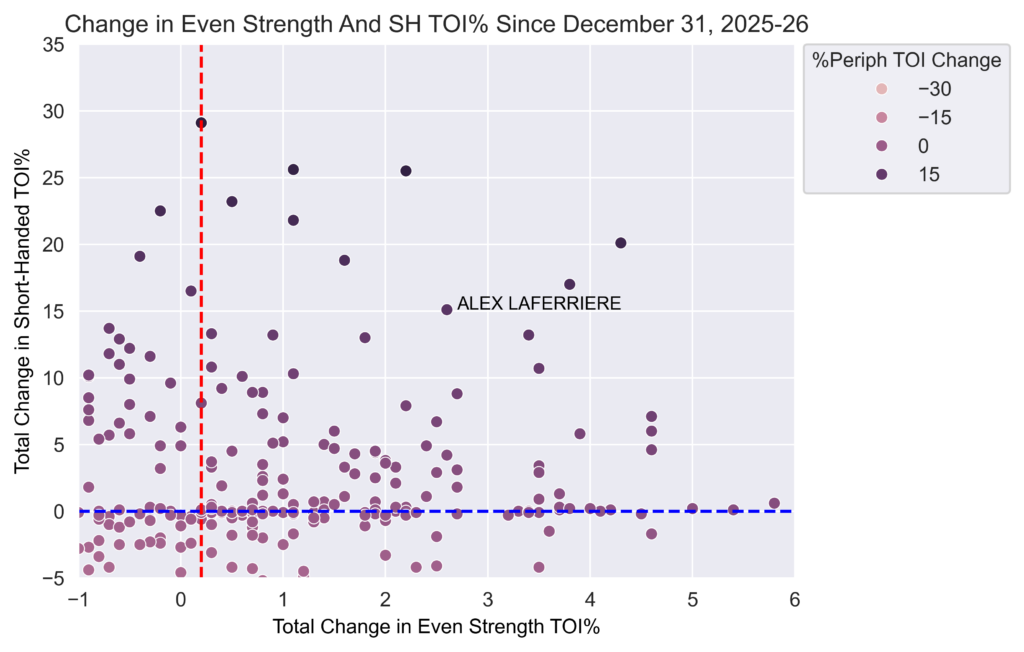
Over his most recent 20 games, Laferriere has 16 blocks and 60 hits; over his previous 36 games, he had 19 blocks and 99 hits. The increase in hits per game (0.25) is nice, but the increase in blocks per game (0.27) is what’s key because he’s a guy that typically laid a lot of hits anyway. With Panarin as his new left winger, a bigger role in situations that give Laferriere a chance to rack up peripherals, and Los Angeles having the second-easiest post-Olympic schedule by opponent points percentage, the third-year forward looks primed for a big stretch run in multi-cat formats. That he has triple positional eligibility is a huge bonus, too.
Liam Ohgren (Vancouver Canucks)
Yahoo Roster – 0%
FanTrax Roster – 21%
ESPN Roster – 0%
While not one of the key pieces of the Quinn Hughes trade, Ohgren has still seen a massive increase in his ice time as he’s added nearly 3:30 per game with the Canucks compared to his role with the Minnesota Wild. That has seen him produce one of the largest increases in even-strength ice time share of all the forwards in our sample with a modest bump in short-handed ice time largely due to seeing a bigger role in the handful of games leading right up to the Olympic break:
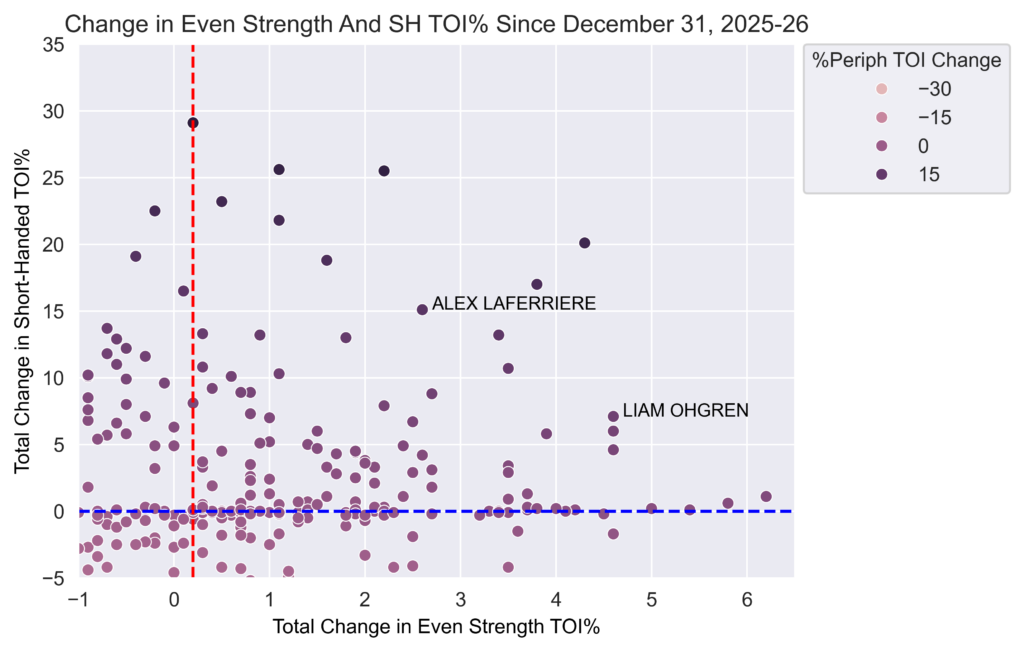
While Ohgren has not been much of a point producer regardless of where he suits up, he has managed 6.36 hits per 60 minutes this season, or a rate that puts him in the range of names like Sam Bennett and Matthew Knies. When Ohgren is skating 10 minutes a game, that doesn’t matter much, but when he’s skating close to 14 minutes a game, then he might have some streaming value in deeper multi-cat formats.