
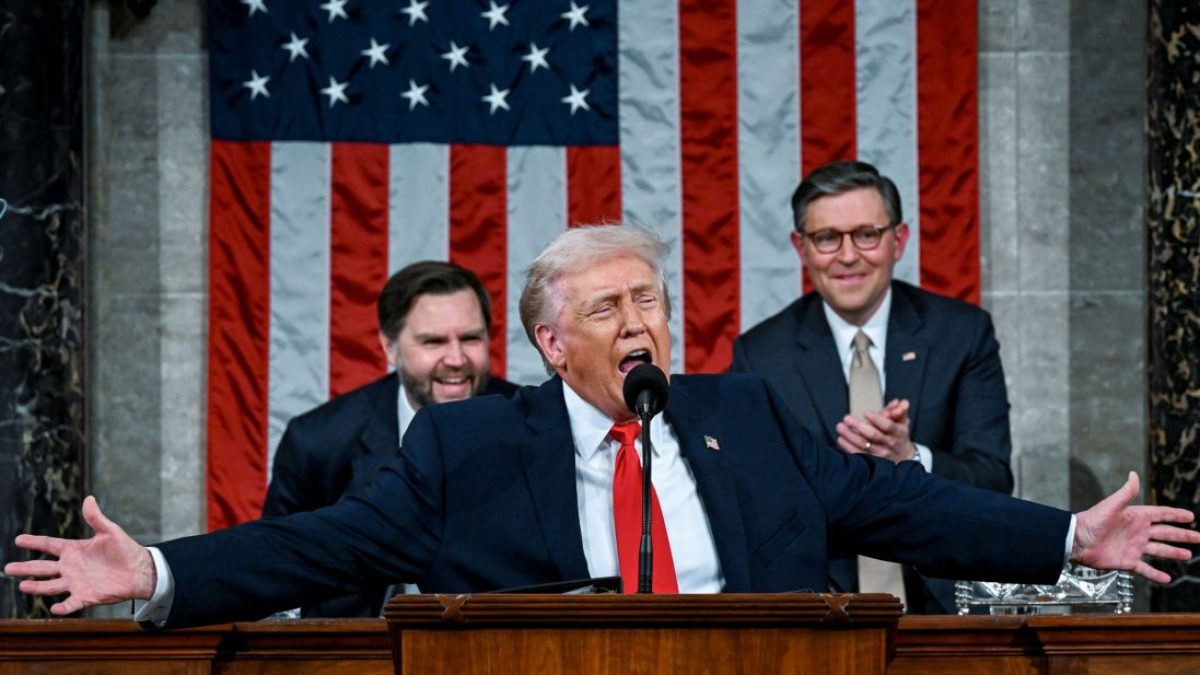
The US President showed up Democrats during his State of the Union speech with a stunt that was pure political theatre
It was the gotcha moment Donald Trump had been hoping for. An hour into his marathon State of the Union address, the US President made an unusual request of US lawmakers.
“Tonight, I’m inviting every legislator to join with my administration in reaffirming a fundamental principle,” he said. “If you agree with this statement, then stand up and show your support: the first duty of the American government is to protect American citizens, not illegal aliens.”
Republicans stood, while Democrats remained seated.
“You should be ashamed of yourself, not standing up,” Trump then said, to applause from Republicans.
New FeatureIn ShortQuick Stories. Same trusted journalism.
White House deputy chief of staff, Stephen Miller, later said on social media that “0 democrats stood for the foundational principle of all government that leaders must serve citizens before invaders”.
The stunt seemed to unite the Republican Party behind Trump’s primary – and most contentious – policy priority, while framing Democrats as un-American and against strong border security.
The President was heckled during his speech by Democratic representatives Ilhan Omar and Rashida Tlaib, with criticism of his immigration policy, but their shouts were drowned out by chants of “USA” from the Republican crowd.
It only added to the sense that this was pure political theatre, designed to be blared on TV screens and clipped up for social media.
But while the moment undoubtedly won Trump headlines, it is unlikely to save him.
The killing of American citizens by federal immigration agents on US streets, and mass deportations that have included a five-year-old boy, have shocked voters and triggered widespread protests.
Polls indicate Americans are turning away from Trump’s signature policy agenda, which has become increasingly extreme.
A survey from CNN and SSRS, released Monday, found 61 per cent of Americans believe the President’s policies will send the country in the wrong direction, with 36 per cent approving of his presidency, a 12-point drop from this time last year. Trump’s approval ratings with independent voters has plummeted from 41 per cent last year to 26 per cent this year.
A second survey from ABC News, The Washington Post and Ipsos found an overall disapproval rating of 60 per cent; the highest it has been for Trump and equal to during his refusal to accept the results of the 2020 presidential election.
Trump’s policy problems
Trump’s foreign policy agenda appears to be fuelling his popularity plunge, with interventions in Iran and Venezuela seeming to fly in the face of his election pledges to reduce US interventionism overseas.
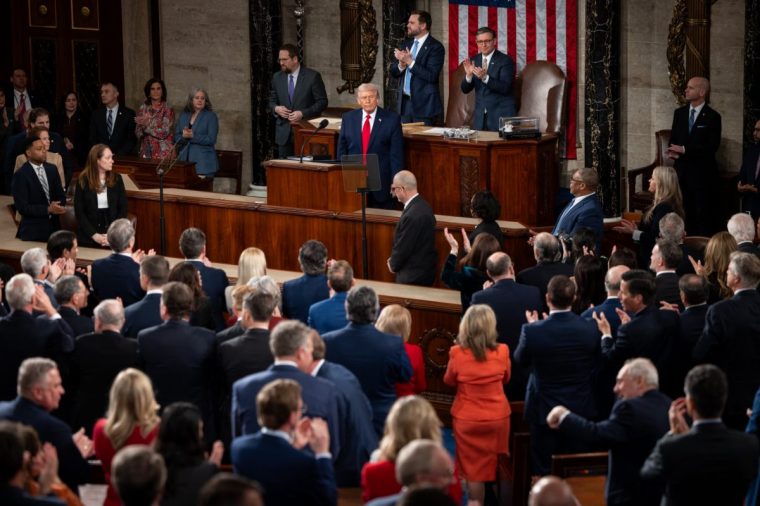 Trump repeatedly received standing ovations from Republicans as the Democrats remained seated in protest (Photo: Nathan Posner/Anadolu via Getty)
Trump did little to redress that on Tuesday night, celebrating the Venezuelan operation which removed president Nicolás Maduro from office and praising the air strikes on alleged drug-smuggling boats in waters off South America.
On Iran, the President said his “preference is to solve this problem through diplomacy” but he made a thinly veiled threat to leaders in Tehran who might be considering developing nuclear weapons.
“I will never allow the world’s number one sponsor of terror – which they are by far – to have a nuclear weapon,” he said.
Trump’s tariff war with some of America’s closest trading partners, meanwhile, threatens to backfire on US consumers, raising prices at a time when many are struggling financially.
He offered little clarity on the saga after a week of turbulence and confusion, during which the measures were struck down by the Supreme Court, before being reintroduced under different legislation at 10 per cent, increased to 15 per cent in a Trump social media post, and then imposed at 10 per cent.
Four-fifths of his voters said they believed his election pledge to slash prices for ordinary Americans and were now disillusioned.
Midterms looming
All this comes just eight months before the US midterm elections, which will determine the make-up of Congress and gauge the mood of the nation.
The sitting president’s party typically loses seats in both the House and Senate in midterm elections, and a Democratic takeover of the House would make it harder for Trump to execute his policy agenda.
It could also see the Trump administration forced to defend itself in a series of congressional investigations.
Some fear that the midterms could be a flashpoint for recent tensions in the courts and in the streets, particularly if Trump once again seeks to overrule or challenge an unfavourable election result.
Trump’s assault on democracy ahead of the midterms is already in motion, with a series of pre-emptive strikes, writes The i Paper columnist Nick Bryant, with the use of gerrymandering and threats to nationalise elections.
The President’s attempt on Tuesday night to rally his base behind his hottest but most contentious topic – immigration – may briefly distract from his waning popularity, but seems unlikely to turn the political tide in his favour for long.