
Illustration by Leon Edler
The press pack had been standing in a churned-up field outside Wood Farm, on the edge of the Sandringham Estate, for two days and nothing had happened. Everyone knew Andrew Mountbatten-Windsor was not going to emerge. One journalist had taken to interviewing passing dog walkers. A desperate presenter holding a wet microphone sighed. “I’m saying the same thing I’ve said since seven in the morning. Just waiting for a man who’s never going to come out.”
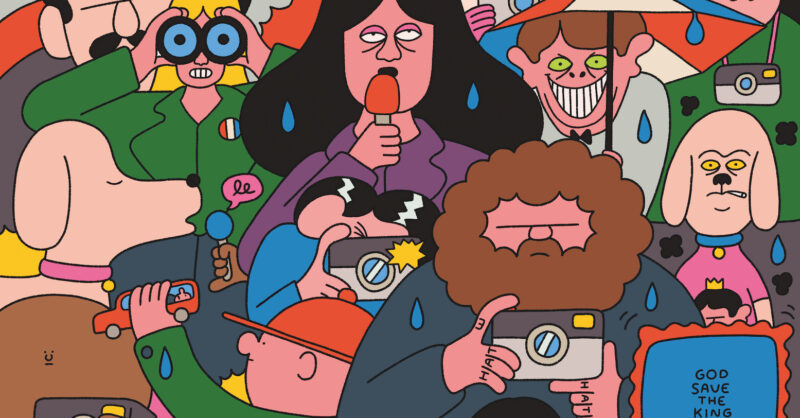
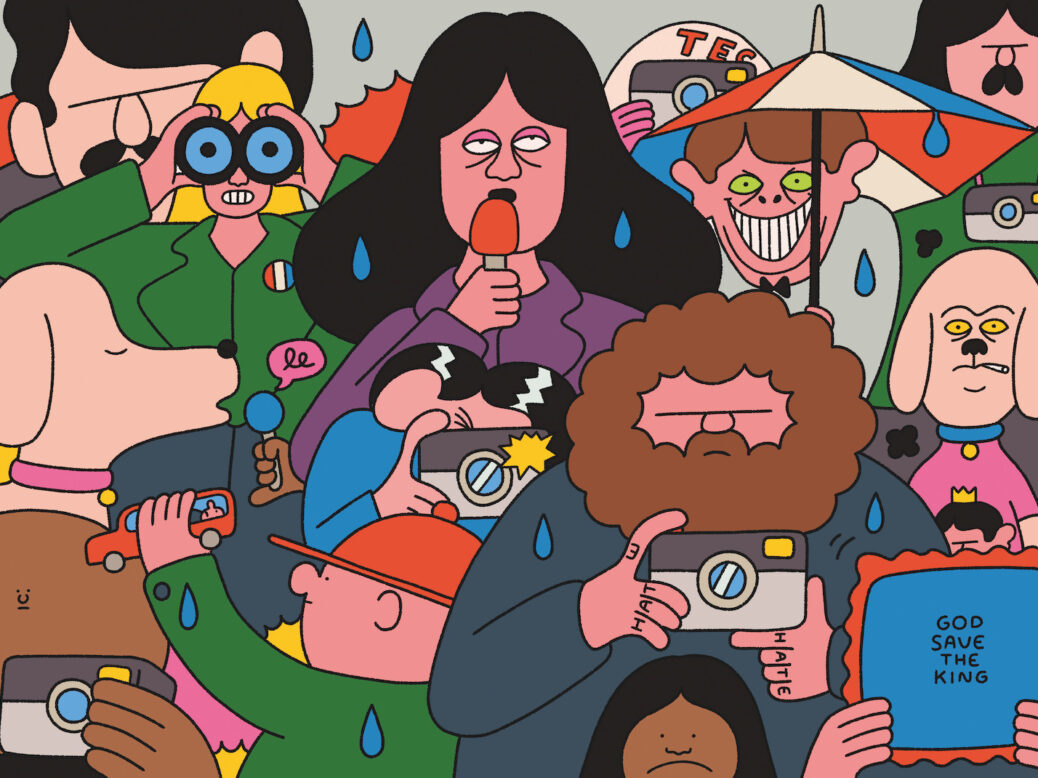
Photographers had covered their cameras in plastic bags to keep off the rain as they tried to get good shots of the gate that led to Andrew’s house. “It needs to feel noble,” one said. A circus of sodden digestive biscuits lay on the grass in front of him.
The previous day, the circus had been buoyed by the chance of catching Andrew returning from the police station after he was detained for 11 hours on suspicion of misconduct in public office. (Andrew has denied any wrongdoing.) But the ex-prince foiled them by taking the back entrance to the farm. It was Phil Noble from Reuters who got the shot of him lying down in the back of a car. The photographers were discussing it enviously. “It’s so sharp,” one said. “Don’t know how he got that – just luck. Perfectly dishevelled.” He admired how alarming Phil had made Andrew look. “They could have easily edited out the red eye, but they didn’t.”
They were disappointed that Andrew’s usual Friday morning Waitrose order hadn’t arrived. “It’s got to the point where someone says ‘Range Rover!’ and we all look,” a journalist said. A black car approached from the road behind. “Ooh, here we go.” The car swung into the private gate. In its windows were parcels from the fast-fashion giant Asos.

Subscribe to the New Statesman today for only £1 a week.
The rain was getting worse. The GB News team had set up camp as close to the gate as possible and cocooned themselves in red, white and blue branded umbrellas. A passing car stopped and a woman ran straight to their huddle and asked if they’d like a hot drink. The presenter, Jack Carson, beamed. “We’ve got fans. Makes the rain go by a little bit easier.” She wasn’t even the first today. This morning a woman came by with her dog. She said she’d seen him on TV. “We’re two-nil up to everyone else around here,” he said. “The people’s channel.”
The seasoned royal photographers were sheltering under the trees by St Peter’s, the neighbouring church. They were swapping war stories about the royals. They didn’t seem to like any of them. William was the rudest of the lot, apparently. “Horrible. Arrogant. C**t,” one said. “Always tells me to fuck off.” The King was a bit more forgiving. “Charles will give me a bollocking and then shake my hand the next day.” They all missed Diana. “She played the game, didn’t she?”
Much more irritating than William were the royals who didn’t even make for good photos. Zara Tindall, Princess Anne’s daughter, always shouted at them, chasing them off racecourses and demanding they put their cameras away. Funny thing was, papers didn’t even want pictures of her. “Flipping Zara, I can’t give her away.”
They can’t stand the way the royal correspondents suck up to the Windsors. “You look at what the Mail writes and you want to vomit,” one said. It’s not as if those journalists actually like the royal family. “They’re all sycophant, sycophant, sycophant on air, and then off air, ‘twat, twat, twat’.”
The main Sandringham house is on the other side of the estate, nearly three miles from Wood Farm. The Georgian mansion is closed to visitors in winter, but there’s a safari tour open all year. For £160 tourists can spend two and half hours trawling the 20,000 acres in a Land Rover, looking for wild animals and disgraced princes.
Most people come to the Royal Parkland to walk their dogs. A few tourists had gathered in the gift shop, which proffered “God Save the King” cushions and a £130 stuffed toy called “Bumpa the Sandringham Bear” and made no mention of Andrew. Groups of mostly elderly people were having afternoon tea in the Sandringham restaurant, their muddy Labradors sniffing at the tables.
There, an older couple, who visited the estate twice a year, told me they felt very sorry for the Windsors. “As we all say, there’s one in every family,” the woman said. She was worried about how Eugenie and Beatrice were holding up. “I can’t bear to think,” she shuddered, turning to her husband. “Just imagine if it was us. What would it be like for our boys?”
Everyone was used to seeing the royals around. Alan, a retired man in his sixties who lived in the nearby town of King’s Lynn, said he wasn’t particularly interested in them. “Every Christmas they walk from that house over there up to the church, and I’ve never bothered to see them,” he said. I asked what he thought of Andrew. “I’ve lost all respect for him,” he said gravely.
Stephen, a local chef originally from Scotland, had seen Andrew around a few times, “unfortunately”. The former prince wasn’t a friendly man. “Doesn’t want to socialise with the great unwashed.” A 27-year-old woman called Freya was delighted by Andrew’s arrest. “In a country with quite a strong class system, it’s actually quite revelatory,” she said. “It shows the royals aren’t above the law.” She didn’t want the local people to be associated with Andrew. “I shan’t be going down there too soon to see him.”
Wood Farm is where the royal family hides people. George V’s youngest son, Prince John, had learning difficulties and suffered epileptic fits. During the First World War he was sent to live at Wood Farm, concealed from public view. There, he played with local children and kept a flock of chickens. His family visited him once or twice a year. According to a biographer, John’s elder brother Prince Edward (later Edward VIII) “saw him as little more than a regrettable nuisance”. John died aged 13 and was buried at Sandringham.
Prince Philip spent the last five years of his life growing truffles there before he returned to Windsor Castle to die. In the Nineties, after she separated from Andrew, Sarah Ferguson stayed at the cottage with princesses Eugenie and Beatrice over Christmas. They were invited to the main Sandringham house for celebrations; she was not.
Wood Farm is only a temporary hideout for Andrew. He is staying there while the King pays for renovations at Marsh Farm, a more ramshackle property a few hundred metres away, where Andrew is due to live out his years of ignominy. I walked down the dirt road to see his future home. It was all uneven red brick, surrounded by outbuildings and empty stables. Crocuses and daffodils had bloomed in the garden. The house had two living rooms and five bedrooms. (Royal Lodge, the prince’s former home in Windsor, has 30).
Two journalists from a Parisian magazine had flown to Britain just to see the farm. They had walked through the open gate and were peering in at the windows. The rooms were bare, with large fireplaces and white walls. No one was home, they said.
The road back to the train station was lined with dead bracken and white trees. On the corner of a field, a solitary bench faced the two farms. The photographers had told me about this earlier. The bench was installed a few years ago in honour of the Queen. It would be useful when Andrew moved house. In winter, when the trees were bare, you could sit on it and watch Marsh Farm. If you brought binoculars, they said, you could see into Andrew’s bedroom.
[Further reading: In Olney, women limber up for the race of their lives]
Content from our partners