
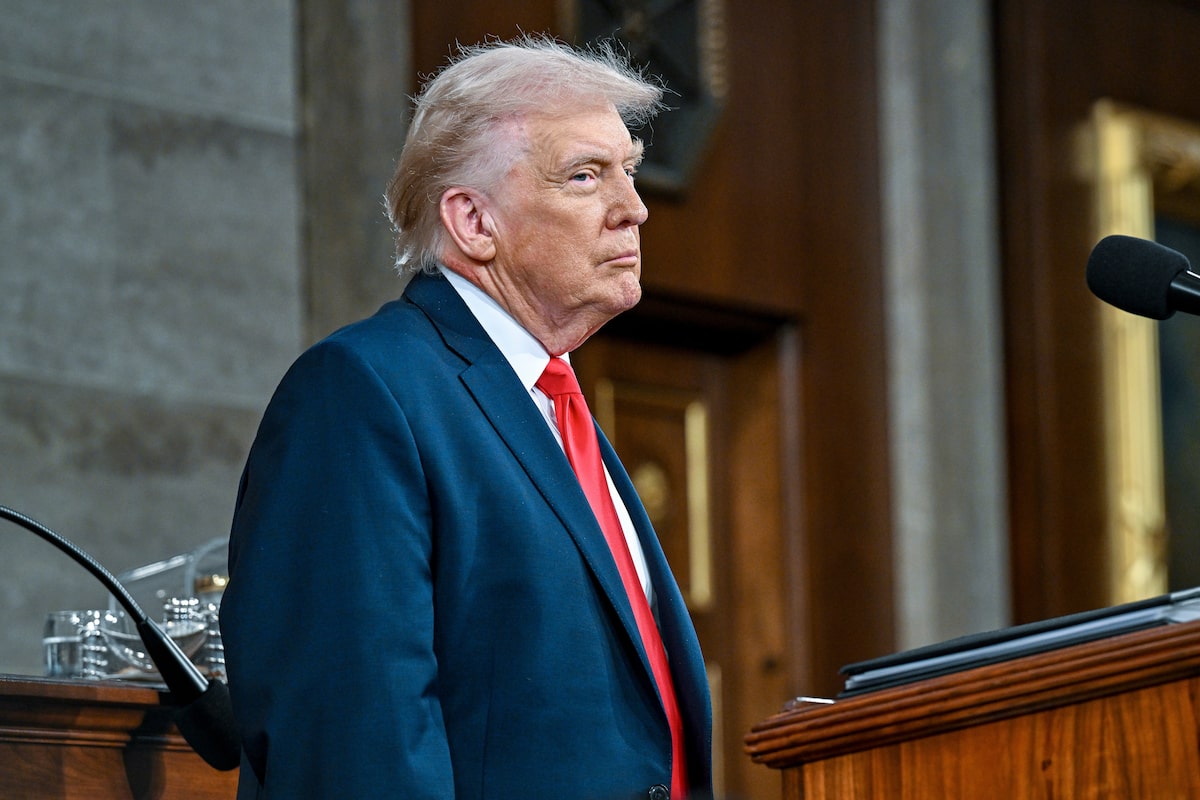
President Donald Trump delivers the State of the Union at the U.S. Capitol on Tuesday.Kenny Holston/The Associated Press
Wolfgang Alschner holds the Hyman Soloway chair in business and trade law at the University of Ottawa and is an academic in residence with McMillan LLP.
There has been a lot of doom and gloom in these pages about the future of North American economic integration. Indeed, U.S. President Donald Trump, stung by the Supreme Court’s rejection of his tariffs, doubled down in his State of the Union address Tuesday night. But consider where we are today.
Over the past two weeks both the U.S. Congress and Supreme Court have pushed back hard against tariffs on Canada. The Supreme Court ruled the International Emergency Economic Powers Act, or IEEPA, tariffs illegal without offering any fig leaves to the U.S. administration. A week earlier the House of Representatives voted to end the international economic emergency that formed the basis for the fentanyl tariffs against Canada. The U.S. judicial and legislative branches have begun to reassert their authority to rein in the executive.
The mood swing is not limited to U.S. institutions. Americans have soured on the tariffs, too. Recent research by the Federal Reserve Bank of New York shows that around 90 per cent of tariff costs are borne by U.S. companies and consumers. A new poll by the New York City-headquartered think tank Council on Foreign Relations found more than 65 per cent of about 2,200 respondents across party lines said tariffs had made everyday items less affordable. Ahead of the midterms, the political capital for Trump’s tariff agenda is dwindling. Some commentators argue that we are past the “peak.”
David Shribman: Donald Trump’s State of the Union address comes at an unusually provocative moment
Mr. Trump’s defence of tariffs Tuesday night, plus the replacement duties announced by the administration after the Supreme Court decision, also reveal a weakened hand. The tariffs imposed based on Section 122 of the Trade Act of 1974 are low (capped by law to 15 per cent), time-limited (they can only be in place for 150 days) and less easily subject to arbitrary changes. The era of late-night, tariff-threats-by-X is largely over.
Moreover, the new Section 122 tariffs continue to unilaterally allow tariff-free access for goods compliant with the United States-Mexico-Canada Agreement, or USMCA. This is a continued admission by the U.S. that the administration, despite all the bluster, wants a special and preferential trading relationship with Canada and Mexico, the U.S.’s largest trading partners.
Finally, the new tariffs contain 76 pages of exempted products, which the U.S. cannot produce or grow in sufficient quantities. Importantly, trading partners over the past year had to bargain hard to win such exemptions. Now, with the cost-of-living crisis in full swing, the U.S. offers those concessions up for free. That benefits Canadian exporters such as coffee roasters that have been unable to claim USMCA-compliant status.
In short, we have reached a turning point that will not only strengthen Canada’s position in the upcoming USMCA review. It will also shift the tone of the talks from threating huffs and puffs to more traditional bargaining over specific issues.
Trump’s new tariffs may be illegal too, legal experts say
First, the U.S. maintains a list of trade irritants with Canada. The U.S. trade representative has said he is preparing new Section 301 tariff investigations against major trading partners. These country-specific tariffs seek to tackle specific unfair trade practices, as deemed by the U.S. If they decide or threaten to launch such an investigation against Canada, these trade irritants will take centre stage. That is a good thing because it will focus the negotiation. While Section 301 tariffs give some discretion to the administration in setting levels, we are unlikely to experience last year’s mission creep where drugs, bridges and adverts became intermingled with tariff threats.
For Canada, that means we need to think hard and rationally about those irritants. Even painful market concessions are likely worthwhile to retain preferential access to the American market. At the same time, Canada also has to set red lines. Some irritants touch on our digital sovereignty, others relate to Quebec’s linguistic identity.
Second, the focus will shift to the sectoral Section 232 tariffs on steel, aluminum, wood products and cars, which are imposed to address U.S. national security concerns and raise different policy questions. Rather than requiring Canadian market concessions, these tariffs are about alignment with U.S. economic security concerns, that is the old “Fortress North America” idea. On steel, Canada has already de facto aligned with the U.S. by putting in place trade-restrictive measures that are roughly equivalent to the tariffs.
The question for Canada will be how far and in what sectors to align with the U.S. so as to not undermine our trade diversification agenda and upset partners abroad. A sober national conversation is needed to navigate tradeoffs and identify creative zones for compromise.