
During a break in the search, Reynalda Pulido told me that when she wakes up every day she asks God: “Tell me why I’m here?”.
“What gives me strength is realizing that no one else is going to look for them. I realize it because no one is moving to search for the disappeared in Sinaloa. And a mother will always look for her child, no matter if it’s to the ends of the earth, she will look.”
The women had received several tip-offs that a body may have been disposed of in the field, but after hours in the midday sun, they found nothing but animal bones.
I asked Reynalda gently if she thought she would ever find her son. “It’s something I ask myself very often,” she said, wiping tears from her eyes.
“But I’ve already found my son in the 250 bodies I’ve located, and in the thirty-something people I’ve found alive. They are my children, too. And the children of all the families who come to ask me for help become my children. My son is there, in each and every one of them. All of them carry a little piece of my son.”
The root cause of Culiacán’s misery is the fentanyl trade.
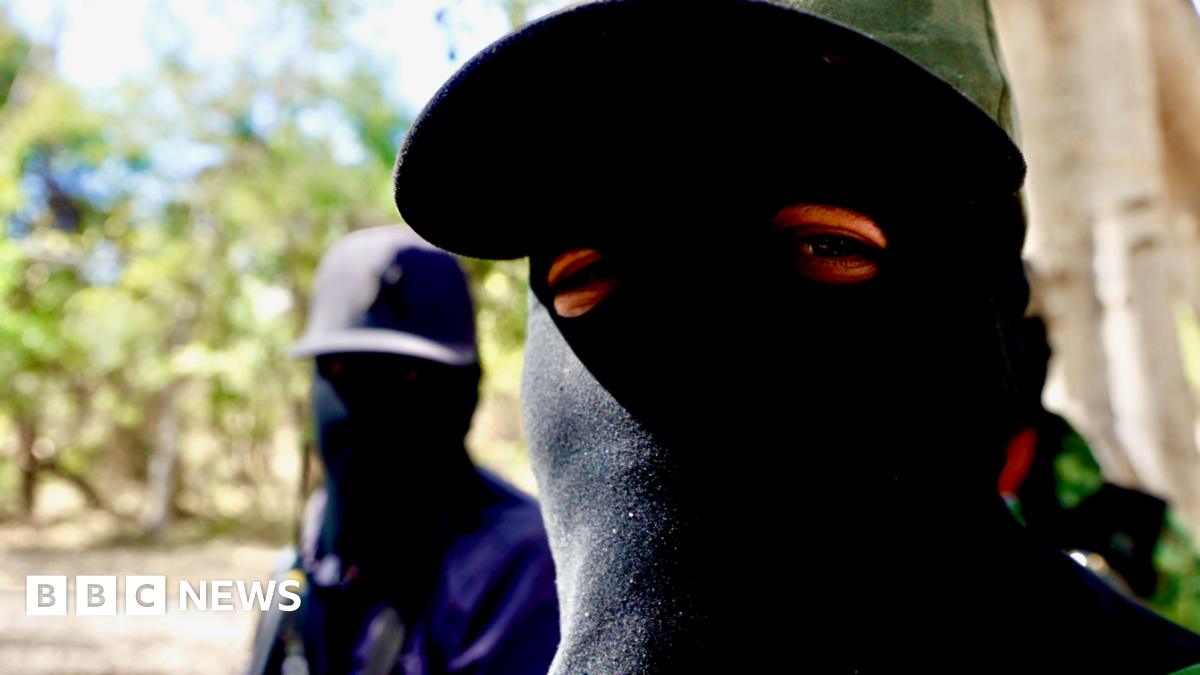
In a cartel-owned basement, “Román” (not his real name), who produces the drug, tells me to follow him.
He’d just packed his latest shipment of the drug, more than half a dozen packages of tightly pressed white powder, bound for the United States.
He wore a face mask and gloves while handling the deadly bundles.
When he opened one package, it was pressed solid, the number 300 indented in the surface.
Before they would ship pills to the US, now they send powder, which they believe makes it easier to avoid US Customs.
Each package weighs a kilo and is worth $20,000 (£14,800). But Román explained that depending on the city it is sent to, it can fetch more. “If we take it to New York, it can go as high as $28,000 or $29,000. The further up it goes, the higher the price, and the greater our profit.”
He takes no responsibility, feels no shame for the business he is in. And he says that whatever the Mexican and United States governments think, the fentanyl will keep flowing.
“Even though the government has intensified the search, they’re coming after us more and getting closer, yes,” he said. “But when it comes to production, we’ve never stopped. Sometimes we do scale back because things get hot, the government gets too close. So we lay low for a few days, but once that problem passes, we either continue or move to other areas.”
The US has labelled you terrorists, we tell him. He replies, blithely: “Well, even though President Donald Trump refers to us as terrorists, I would just remind him that as long as there are consumers, we’re going to keep doing this but that doesn’t necessarily make us terrorists. As long as people want to consume it, they are free to do so. No one is forcing them. No one forced them to start this vice, to start using this stuff.”
The Mexican government has said it is making progress in its fight against drug trafficking. It says it has cut the fentanyl supply to the US by 50%.
From Culiacán I travelled to Mexico City. The capital’s airport was noisy with the sound of drilling and plaster being pulled from walls, preparations for World Cup 2026.
At one of her regular news conferences – held before Sunday’s killing of “El Mencho” – I asked President Claudia Sheinbaum what it would take to bring the violence in Sinaloa under control.
She blamed the internal power struggle within the Sinaloa cartel for the surge in violence in the northern state and insisted that her government was “trying to avoid harm to civilians, to the people”.