
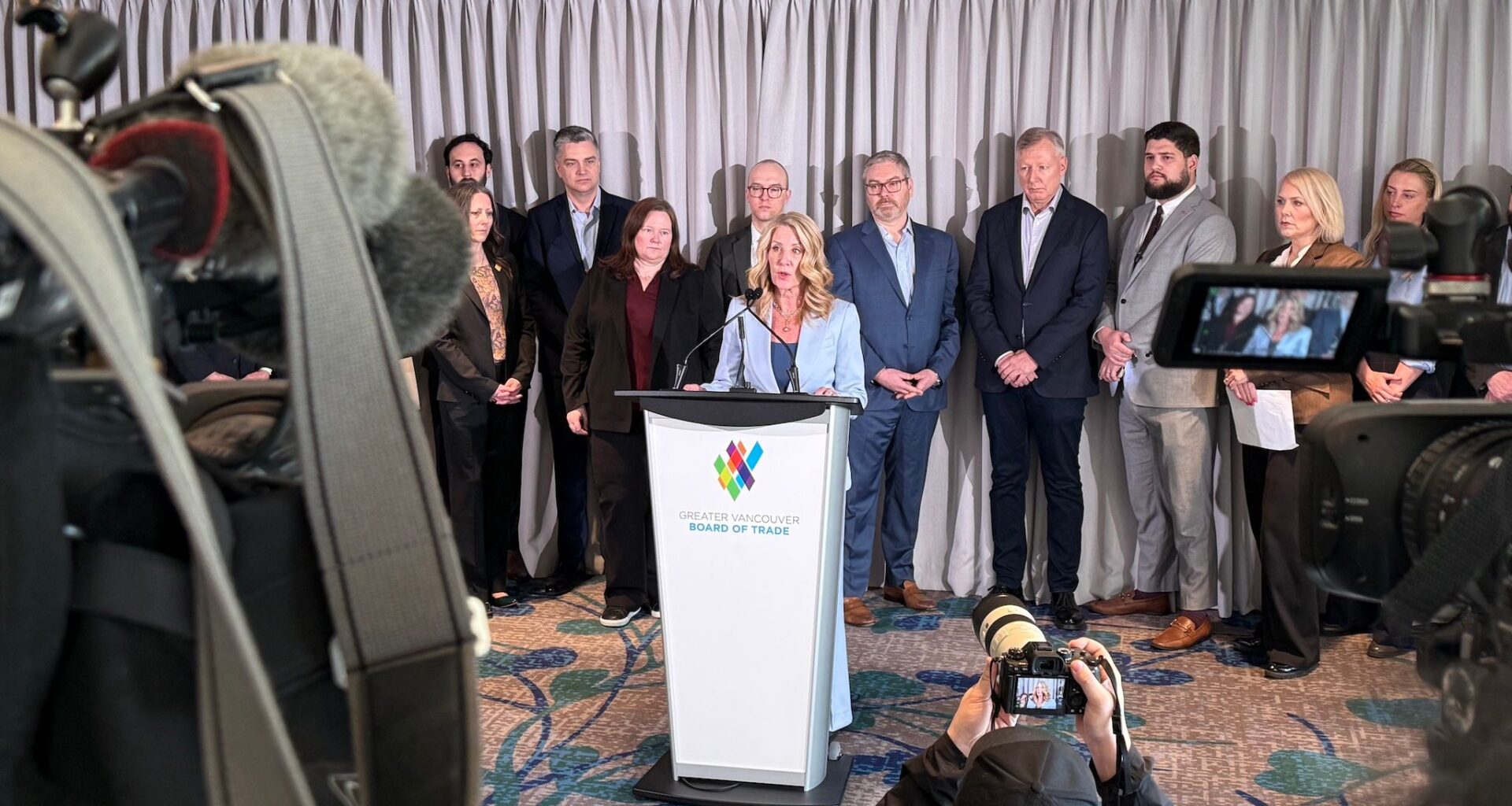
Business leaders from across British Columbia mounted a unified front today against the BC NDP-led provincial government’s plan to expand the provincial sales tax (PST) to a wide range of professional services — especially in areas related to real estate and building development, warning the move will drive up costs across the economy, slow investment, threaten jobs, and further erode the province’s already-weak competitiveness.
They held no punches, painting a very pointed picture that they are fed up and are launching an orchestrated effort to have the provincial government back down and make a real pivot to shore up its own financial situation and improve the economy.
At a press conference this morning led by Greater Vancouver Board of Trade president and CEO Bridgitte Anderson, she said that after taking a week to review the 2026 budget announced on Feb. 17, “It’s clear this government and the business community are not on the same page.”
The budget proposes extending the PST to services such as accounting, engineering, architecture, security, geoscience work, and commercial real estate — inputs that businesses rely on for projects and day-to-day operations. Anderson said competitiveness “comes down to cost, speed, and certainty,” and argued the measure “pushes all three in the wrong direction.”
She described the change as “a tax on tax,” noting that, unlike the federal Goods and Services Tax (GST), B.C.’s PST is not refundable to businesses. As a result, she said, “every time a service is taxed during a project, that cost is baked in and then taxed again,” ultimately leading to higher final prices for consumers. Coming amid tariffs, economic uncertainty, and higher borrowing costs, Anderson said the move will make B.C. “a harder place to build, to scale, and export from.”
She asserts the provincial government “does not have a revenue problem” but “has a spending problem,” and urged Premier David Eby and his cabinet to scrap the PST changes and focus instead on controlling spending and promoting growth.
Anderson said she has spoken with members who see the PST expansion as “the final straw” and are now actively considering leaving B.C. She said the issue of broader tax reform, including the suggestion of reintroducing the Harmonized Sales Tax (HST) to improve the business climate, could be discussed in the future, but insisted the immediate priority is to scrap the expansion.
“There is no middle ground,” she said, arguing the provincial government must act “with urgency” to address slowing growth, tariff impacts, and population decline.
Small businesses will pay more tax for hired private security
Small business groups said the impact will be immediate and painful, with small businesses accounting for 98 per cent of B.C. businesses and employing over one million people. Ryan Mitton, the B.C. legislative director for the Canadian Federation of Independent Business (CFIB), told media that when his organization talks to business owners, “one thing is clear, the cost of doing business is too high.”
Mitton said this amounts to a “massive expansion” of the PST to services like accounting and security, which will only drive those costs higher, with more businesses closing or leaving than opening recently.
He delivered a blunt message to Premier Eby: “If you want to reverse BC’s entrepreneurial drought, you must stop this tax increase.”
Mitton pointed to security and basic paperwork as examples. “By making the cost of security for restaurants and stores more expensive… we are not making it easier to do business in this province,” he said. He added that “PST compliance and paperwork is one of the most time-consuming forms of red tape we hear about from entrepreneurs,” and argued the expansion means businesses are now facing “a new tax on their own safety.” Because it is “a tax on tax,” he said the PST will apply repeatedly through supply chains, “driving up costs for businesses, for customers, and people at home.”
Mitton also emphasized that the current pushback of these business organizations represents just the “tip of the iceberg” of what they are willing to do and escalate.
Joslyn Young, CEO of the Surrey & White Rock Board of Trade, warned that extending the PST to previously exempt professional services will add new fees and administrative burden “at a time when businesses are already managing rising costs.”
“Professional services are not optional extras,” said Young. “They are foundational inputs into housing, infrastructure, manufacturing, and business operations. When you tax these inputs, the cost flows through the entire system — to builders, entrepreneurs, homeowners, and ultimately consumers.”
While welcoming the provincial government’s investments in public safety, Young said it is “difficult to reconcile increased safety spending with the taxing of security-related services, which is just one of the areas being targeted. Businesses are investing in private security to protect their employees and their business.” She calls the approach “mixed signals” and urged the BC NDP to “go back and try again.”
Concerns about crime and private security staffing costs were also raised by Jess Ketchum, co-founder of the Save Our Streets Coalition, who said many small businesses are “fighting for their very existence” amid rising violence and disorder. He cited examples of a cafe needing security guards costing $300 per day — asserting “you need to sell a lot of coffee to pay for that — and said adding PST to those costs is “a real punch in the gut.”
“When capital leaves, housing supply follows”
In the real estate and building development sector, Urban Development Institute interim president and CEO Mike Drummond painted a bleak picture, saying the pre-sale condominium housing market has “collapsed,” resale volumes are “extremely weak,” and rental housing projects are now also increasingly challenging to secure construction financing.
He said the new tax would add about $275,000 in upfront costs and $20,000 in annual operating costs to an average 300-unit secured purpose-built rental housing building, while cutting roughly $500,000 in asset value.
“Every tax introduced is small. Every fee is described as manageable,” he said, but after years of layered costs, “they were not.”
“Adding costs in this market at this moment tells builders that housing is no longer the priority. Capital will respond to that message and will move elsewhere. And when capital leaves, housing supply follows,” said Drummond.
Chris Gardner, president and CEO of the Independent Contractors and Businesses Association, said B.C. is facing both an affordability crisis and a jobs crisis, with layoffs at the subcontractor level that the industry has not seen in a generation.
He said 62 per cent of members expect conditions to worsen this year and pointed to out-migration from B.C., with 70,000 people leaving the province in the past year, many for Alberta.
“You can buy three homes or three townhomes in Calgary for the price of one in Vancouver,” said Gardner.
“The government has proven that they don’t understand housing markets and they’re not prepared to work with builders to understand what the problems are, remove the red tape, simplify building codes and take costs out of construction so that we can build a stronger province,” continued Gardner.
Mitton says he has heard from business operators who are now considering moving to Alberta or Washington state. “This started as a clever joke at the pub, maybe a couple of years ago, for some people, but these jokes are turning into reality,” he said.
“The United States, places like Washington state and California, are eating our lunch when it comes to tax competitiveness. CFIB’s research shows that small businesses there pay 20 per cent less taxes on average. Our payroll taxes are immense. This PST expansion will be another nail in the coffin,” continued Mitton.
“One step forward, two steps back”
Mining industry representatives also warned of significant impacts.
Michael Goehring, president and CEO of the Mining Association of British Columbia, said the PST is already “among the most uncompetitive sales taxes in Canada” and that extending it to engineering and geoscience services is “one step forward, two steps back.” He said one company estimates the tax will add about $1.3 million to project costs over several years, while an operator calculated it would mean an extra $3.7 million in annual costs on a $155 million services spend. For companies with no revenue, he said, the tax would divert capital away from technical work and jobs.
Todd Stone, president and CEO of the Association for Mineral Exploration of B.C. and a former B.C. Minister of Transportation and Infrastructure, said the PST would add about $63,000 to the average $3 million exploration project and nearly $16 million to last year’s $750 million in exploration spending.
Stone warned that the measure is particularly harmful to junior mining companies that rely on consultants and said B.C. risks slipping further behind other provinces. “Government needs to get out of their own way,” he said, and “start backing up their words” by not moving forward with the tax increase.
In the end, the coalition of business groups said their message to the province is simple and unified: the PST expansion should be scrapped. From housing and mining to retail and small business, the leaders of organizations representing hundreds of thousands of businesses across the province — argued the tax will raise input costs, weaken competitiveness, and send investment elsewhere at a time of economic uncertainty.
The budget’s range of new tax measures, including an increase in the lowest bracket and a change of rules for the B.C. personal income tax, is intended to help the provincial government generate new revenue amid its red-ink finances.
The provincial government is expected to end the 2025/2026 fiscal year with a $9.6 billion annual operating budget deficit, with total provincial debt reaching $154 billion. The forecast is for a deficit of $13.3 billion and a debt of $183 billion in 2026/2027, a deficit of $12.2 billion and a debt of $210 billion in 2027/2028, and a deficit of $11.4 billion and a debt of $235 billion in 2028/2029.
While much of this debt is due to the construction cost of major capital projects to build new infrastructure — including SkyTrain extensions, highways, roads, hospitals, and schools — a large portion is also an accumulation of the provincial government’s annual operating deficits.