
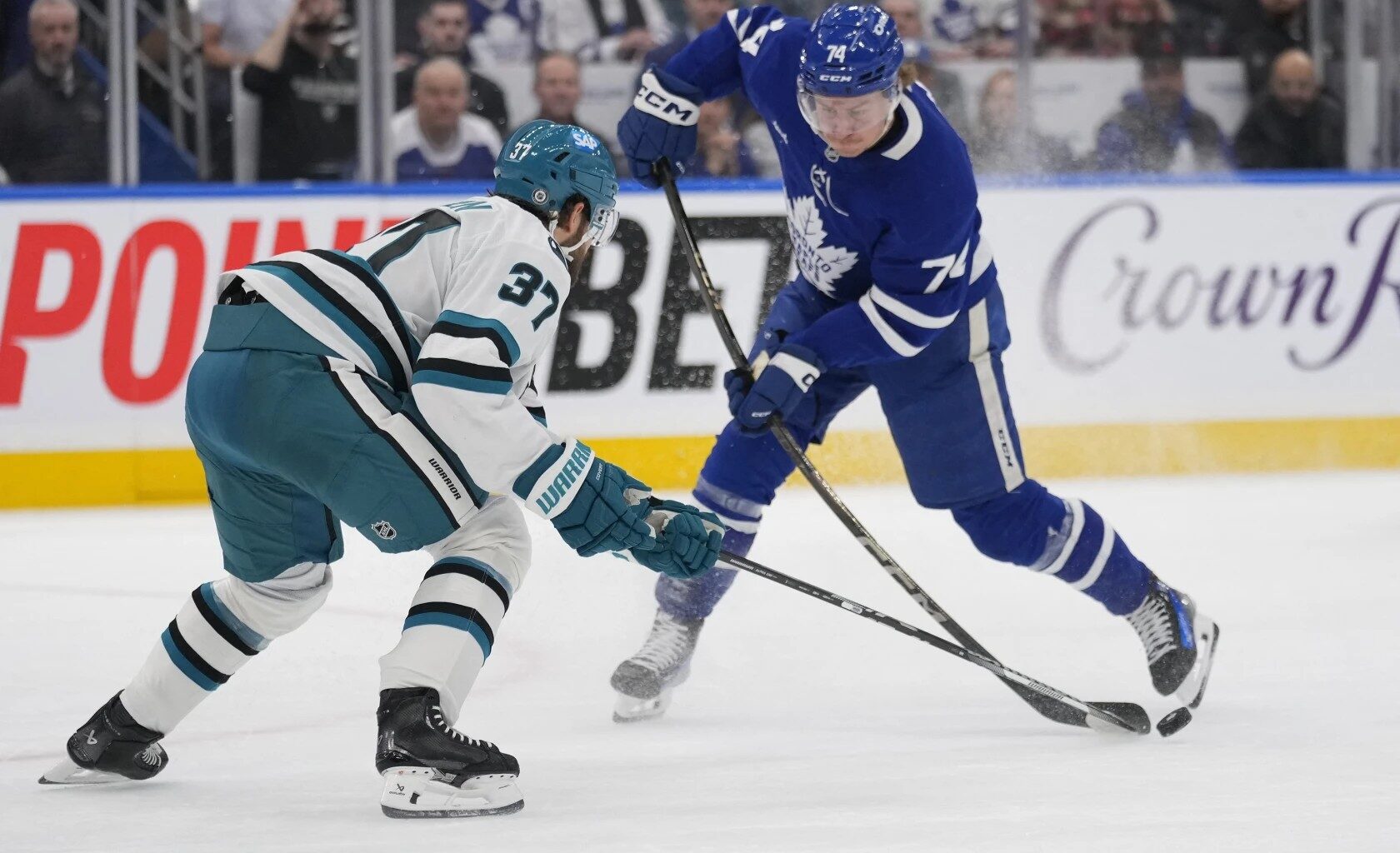
On TSN Insider Trading, Darren Dreger provided the following updates on the Maple Leafs’ deadline approach with their top two pending UFAs, Scott Laughton and Bobby McMann:
Dreger: It sounds strange, what I am about to say. It is less about Toronto’s playoff chances and more about the cost-effectiveness of extending certain players like Bobby McMann and Scott Laughton. Those are decisions pending, but what I am told is that there is a plan in place. Brad Treliving and hockey operations are going to follow this plan. They are not going to chase an expensive extension.
Noteworthy and interesting, given we do have some time: What if Toronto closes the gap? They have to make the call on these pending UFAs. They can’t let them walk for free. It could be interesting in the next several days.
This is the prudent approach, given the Leafs’ standings position (six points out), the absence of their own first-round pick, and their desire to contend within the remaining Auston Matthews window. Tanking into the top five is all but out of the question, leaving them without their first-round pick in 2026, and the intention is to compete next season. They’re not in hard-sell mode, but they’re also not in a position where they should ever pass the trade deadline without either a trade or a contract extension in place (or basically in place) for their important pending UFAs. There certainly can’t be any “own rental” situations this season if you’re the Leafs; that’s completely unjustifiable and would be a fireable offense, even if the team won every game between now and March 6.
The Leafs need certainty within the next week or so on McMann and Laughton, or GM Brad Treliving will need to pivot to maximizing trade returns on one or both players. That’s irrespective of how the six games play out between now and the trade deadline.
Both players appear warm to the idea of staying in Toronto, but the devil is in the details now.
While Laughton plays the premium position (C), Bobby McMann is the more impactful piece and the more difficult one to replace. He’s two years younger, has scored at a 20+ goal pace for three straight seasons, is currently on pace for 27, and is one of the fastest skaters in the league on a team that shouldn’t be looking to get any slower. McMann is sixth in the league among pending UFAs in goals with 19, and two of those ahead of him are the 40-year-old Alex Ovechkin and the 35-year-old Jordan Eberle. He ranks second on the Leafs with 17 even-strength goals (would be third if not for William Nylander’s injury absences) and is just outside the NHL’s top 30 in the category.
If the Leafs can retain McMann for a medium-term deal around $4.5 million, give or take, it starts to make sense to do so rather than hunting for draft picks and trying to replace the even-strength goal production externally.
In Nick Kypreos’ latest trade board, he wrote the following of McMann’s trade value:
What will the Leafs get back for McMann? It’s debatable what his price tag is. A lot of people have talked about Toronto getting a first-rounder back, but one Western Conference team told me they just don’t view him as a legitimate top-six guy. He can play in the top-six, but some teams just don’t see him as a surefire player in that position. Players who are definite top-six upgrades pull first-rounders in trades, but usually not a winger who only has good stretches there. But all it takes is for one team to offer that up, so McMann’s real value is debatable. Many teams would rather give something in the ballpark to what San Jose gave Vancouver for Kiefer Sherwood (two seconds or a second and a third).
If the option is a second-round pick and a third, or re-signing McMann at a palatable number, it’s a real consideration to keep him instead. If McMann won’t sign or is pricing himself too high, the decision is taken out of the Leafs’ hands, given their current circumstances. Current indications are that the Leafs are taking the common-sense approach here: fully understand both the trade value and contract demand, and weigh the two options as best as possible with an awareness of the team’s tenuous position in the standings.
As for Laughton, a high-end faceoff center, excellent PKer, glue guy, and depth contributor, with some versatility to elevate onto the wing higher up the lineup (which we arguably haven’t seen enough of in Toronto), is also worth keeping around at the right price. But it has to be kept in mind that Laughton is turning 32 and has 15 points in 59 games as a Leaf. He’s broken 40 points once in his 11-year career. Realistically, the Leafs, with Nic Roy signed for $3 million through next season, shouldn’t be looking to hand Laughton much of a raise, if any, beyond his current $3 million salary with a fairly modest term, or they’ll need to find the highest bidder in the trade market.
Unlike replacing McMann, it’s easier to plug in a Jacob Quillan, in theory, or shift another option over to center and bring up Bo Groulx (the Leafs should be taking honest looks at both, with both under team control beyond the season), without a major step back at five-on-five, albeit with a notable hole to fill on the penalty kill.
Both are good players, and it’s fair to want them around moving forward, given the Leafs’ desire to compete next season. They are both closer to solutions than problems for the organization. At the same time, it’s reasonable to believe that if Matthew Knies has returned to full health over the break, Dakota Joshua returns, and they plug in Easton Cowan or Jacob Quillan, there is a world where the Leafs can trade both away and still remain competitive down the stretch.
In the end, the devil is in the details of the contract demand versus the trade-market value. Treliving is in the thick of that decision-making matrix now, and the final determinations will be revealed in the next week and a half.