
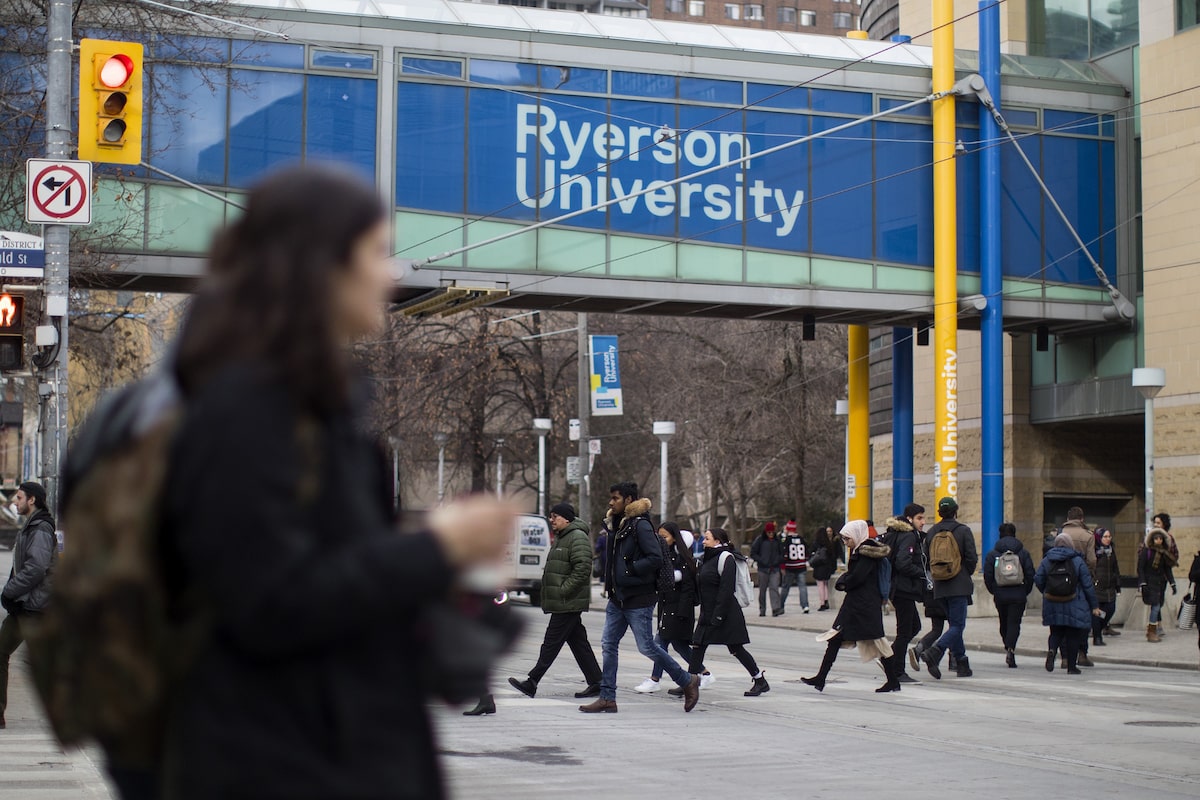
The Ryerson University campus in Toronto in January, 2019. College and university students are concerned about a key change to the Ontario Student Assistance Program.Chris Young/The Canadian Press
College and university students are protesting significant changes to the Ontario Student Assistance Program in a backlash that is poised to intensify over the coming weeks.
Their opposition stems from the Ontario government’s recent announcement about its new postsecondary education initiatives. The various proposals include a revamp of OSAP, the provincial student financial aid program.
To be clear, the majority of the government’s postsecondary initiatives are welcome developments. Among them is a new funding model that involves Ontario investing $6.4-billion over four years.
Tuition increases, which follow a seven-year freeze on those costs, are also reasonable. They will be limited to 2 per cent annually for three years. After that, tuition will rise by a maximum of 2 per cent annually or the three-year average rate of inflation – whichever is lower.
This will amount to 18 cents a day for college students and 47 cents a day for university students, according to the government, which also notes that provisions will be made to absorb this cost for low-income students.
Opinion: With Ontario’s student-loan reforms, universities must now fight for their very lives
College and university students, though, are rightly concerned about a key change to OSAP. Specifically, the funding mix is changing to place a greater emphasis on loans versus non-repayable grants, which will result in low-income students shouldering more debt.
Specifically, students will receive a minimum of 75 per cent of their OSAP funding as loans. Grants, meanwhile, will be capped at 25 per cent. Until now, students could receive up to 85 per cent of that funding in the form of grants. What’s more, OSAP will no longer offer grants to students who enroll at private-career colleges – a sensible change given scandals involving some of those institutions.
However, concerns about low-income students falling deeper into debt as they pursue their postsecondary studies cannot be ignored by the government.
“We are concerned about the continued shift within OSAP from grants to loans, particularly how it risks disproportionately impacting students from various socioeconomic backgrounds,” Sayak Sneddon-Ghosal, president of the Ontario Undergraduate Student Alliance, said in press release.
The alliance is recommending in the wake of the latest changes that Ontario conduct a comprehensive review of OSAP eligibility.
Low-income youth must overcome significant disadvantages to reach a college or university. Burdening them with more student debt as they strive to improve their lives only sets them up to fail as adults.
It’s unconscionable, especially in this economy.
Ontario’s unemployment rate for 15- to 24-year-olds was 14.3 per cent in January. That’s nearly double the province’s overall jobless rate of 7.3 per cent.
The hits will keep on coming.
Ontario Premier Doug Ford is defending his government’s decision to cut back on the amount of financial assistance for post-secondary students. Ford says he heard from thousands of students over Family Day weekend who were angry about the drastic cut to the number of grants given out.
The Canadian Press
Canada is falling behind on poverty reduction, and artificial intelligence is expected to eliminate more entry-level jobs.
There is a dearth of opportunities for low-income students to offset OSAP’s grant cap through sheer grit alone.
Ontario Premier Doug Ford cannot wash his hands of these students. Their plight requires a thoughtful policy response.
Unfortunately, he offered callous commentary.
“A lot of the students – I’m not one to say, you know – like you’re picking basket-weaving courses and there’s not too many baskets being sold out there,” Mr. Ford said at a news conference last week.
“Go into health care. Go into trades. Go into jobs of the future. Focus on STEM: science, technology, engineering and math. Those are where the jobs are.”
He’s right. But professional programs cost more money.
That’s why his comments about OSAP antagonized students.
They are not clamouring to take what he considers to be useless classes. Rather, they understand the grant cap will disproportionately hurt the most vulnerable youth.
Mr. Ford, though, didn’t stop there.
“I’ve heard some nightmare stories on the other side as well, about kids going out there buying fancy watches and cologne and not needing it,” he said. “And families making 200 grand getting their kids’ education. That doesn’t fly with the taxpayers.”
If that’s true, Mr. Ford should instead be scolding middle-class parents – the ones he claims have household incomes of $200,000 a year but whose kids use OSAP anyway.
That allegation is the real outrage for Ontario taxpayers.
A distinction must be drawn between low-income students in need of grants and upper-middle-class kids with parents who have the financial means to pay for their postsecondary education. The latter should not be relying on OSAP.
Yes, there’s a debate about the definition of a middle-class family. But parents with a household income of $200,000 or more should be ashamed if they fail to save and allow their kids to take out student loans to pay for college and university.
You know the type.
Either they live for themselves and not for their kids. Or they spend tens of thousands of dollars a year on youth sports, vacations or frivolous items, but don’t save for what really matters: postsecondary education.
These parents often claim that student loans constitute “good debt” or promote personal responsibility.
Hogwash.
Student loans hold kids back financially in adulthood.
Well-off parents who sidestep financial obligations to their children are the ones who deserve a kick in the pants over OSAP – not low-income students already sucker-punched by life.