
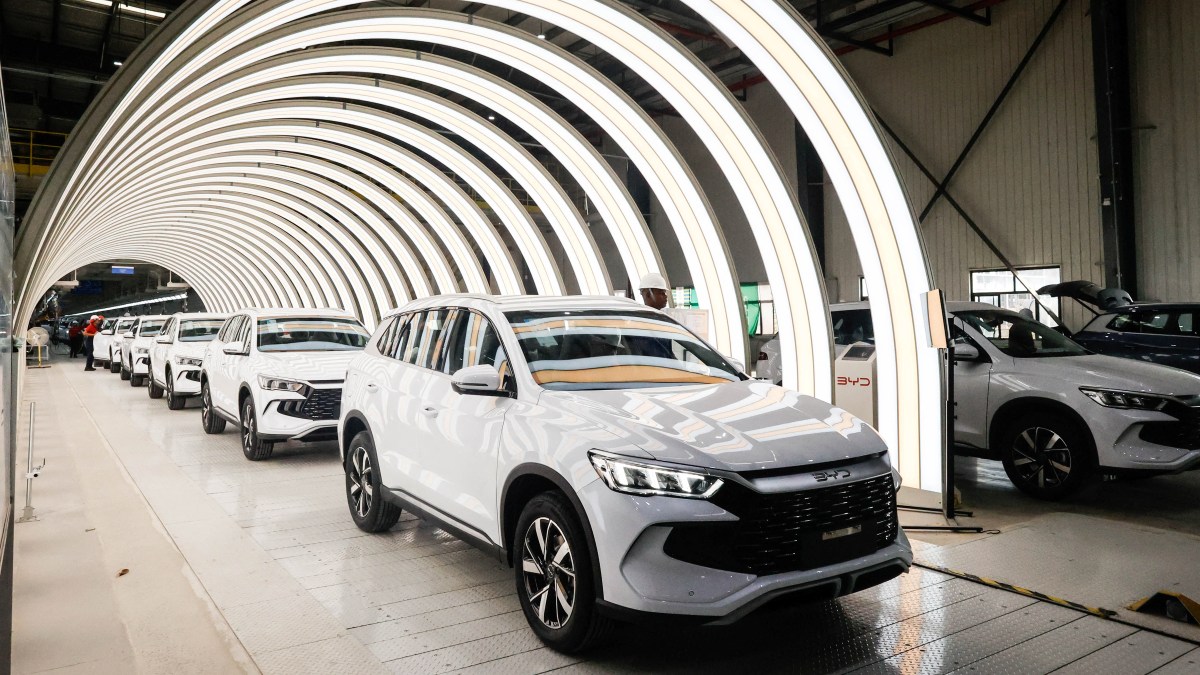
Insuring a Chinese car costs twice as much as for other models — if you can find a company willing to offer you cover.
A limited number of firms will insure Chinese cars, and those that do can charge hundreds of pounds more than they would for similar vehicles built by more established carmakers. Some models cost more than £2,000 to insure, according to the comparison site Carwow. This is mainly down to the fact that repair costs are higher because of a lack of available replacement parts, motoring experts said.
More than 196,000 Chinese cars were sold in the UK in 2025, according to the Society of Motor Manufacturers and Traders — double the 96,000 sold in 2024. The popularity has been driven by their cheap sticker prices. Autotrader said that four of the ten models most looked-at on the site last year were Chinese.
• The UK’s 10 most popular cars in 2026 (so far)
The Jaecoo 7, a hybrid SUV with a retail price of about £30,115, was the bestselling Chinese car in the UK in January, according to the society, and the second most popular model overall. The BYD Seal U, also an electric SUV, was sixth on the list, while the MG HS, an SUV made by the Chinese firm SAIC Motor, was tenth. The closest non-Chinese equivalent of the Jaecoo 7, the Volkswagen Tiguan, costs from £38,030.
Carwow obtained quotes from ten of the UK’s biggest insurers for eight cars: the Jaecoo 7, Xpeng G6, BYD Seal U and Skywell BE11 Chinese models, and the VW Tiguan, Kia EV3, Peugeot E-3008 and Toyota RAV4 non-Chinese equivalents.
Only one insurer would cover the Skywell BE11, an electric SUV, for an annual price of £2,200 — twice as much as it quoted for its Japanese equivalent, the Toyota RAV4. All but one of the ten insurers would cover the Volkswagen Tiguan, with an average policy costing £700. Its Chinese equivalent, the Jaecoo 7, was covered by five companies, with the average premium being £165 higher.
Even drivers of a Seal U, made by BYD, one of the more established Chinese brands in the UK, would not be able to get cover from three of the ten insurers, but the average policy price for those that did cover it was nearly £200 cheaper for the equivalent Peugeot E-3008. The insurers Ageas and Axa wouldn’t provide quotes for the four Chinese cars, according to Carwow.
Iain Reid from Carwow said: “This isn’t a Chinese cars issue, it’s a problem with the UK insurance industry struggling to keep pace with a rapidly changing market.
“New brands, models and technologies are arriving at speed, particularly with the rise of electric and hybrid vehicles, and insurers need to adapt far faster than they are. It’s simply not fair for drivers to be penalised because insurance pricing and data can’t keep up.”
• Read expert reviews, news and insights on cars and motoring
Reid said: “Delays in getting parts to garages to fix cars can take longer than normal, and the longer it takes to repair a car the more it costs the insurer, which increases the risk.”
When setting insurance costs, companies rely on historical data about a vehicle’s reliability, repair costs and the likelihood of it being damaged or stolen. This is hard to do with many of the Chinese models that have been in the UK for only a few years. In the 1960s those buying Japanese cars had similar issues with getting insurance.
“While costs may fall as these models become more established, that offers little comfort to drivers trying to insure them today,” Reid said.
The Association of British Insurers declined to comment.