
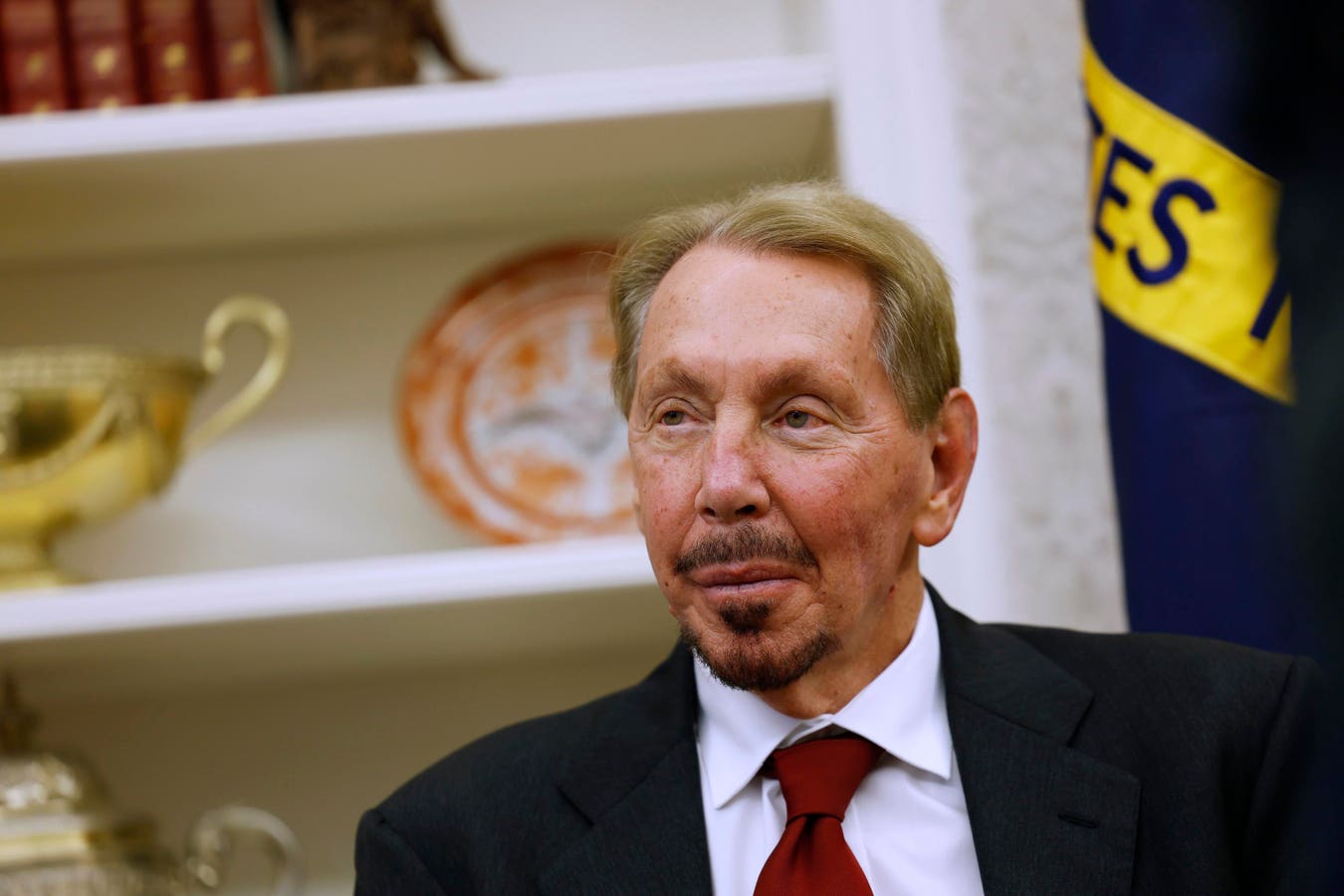
Larry Ellison at the White House in 2025, on one of at least four trips to D.C. last year.
Anna Moneymaker/Getty Images
If regulators clear it, one of the largest mergers in history will hand billionaire Larry Ellison and his son David unprecedented sway over American media—CBS and CNN under one roof, HBO Max and Paramount+ fused, Warner Bros. and Paramount Pictures sharing a parent. That’s on top of the tech and real estate empire the elder Ellison—Oracle’s chief technology officer, President Donald Trump’s new neighbor and the world’s sixth-richest person—already controls.
Last August, the Ellisons took control of Paramount in an $8 billion merger with Skydance, the entertainment company run by David and owned mostly by Larry. Weeks later, Paramount Skydance lobbed a hostile $111 billion bid for Warner Bros. Discovery, which had already agreed to sell itself to Netflix. Netflix declined to counter. Warner’s board deemed Paramount’s offer superior. The Ellison-controlled entity is now in pole position to buy a company with a roughly $70 billion market cap—for a triple-digit billion price.
Here’s the problem: Paramount has just $3 billion in cash on its balance sheet.
To bridge the gap, three big banks are committing $57.5 billion in debt. Most of the rest—a $45.7 billion equity commitment—is coming from Larry Ellison’s trust. And that’s where the math starts to get tight. Ellison has only sold $4.7 billion of Oracle stock (pre-tax) this century. By Forbes estimates, he has less than $10 billion of cash in the bank, mostly from Oracle dividends. He also owns an estimated $15 billion in Tesla shares amassed during his tenure as a Tesla director, which ended in 2022. Even if he liquidated all of that, it wouldn’t fully cover his commitment.
Which leaves the longest, most valuable lever: Oracle stock.
Ellison owns 1.16 billion Oracle shares, currently worth $164 billion. Selling off a meaningful chunk would almost certainly spook Oracle shareholders already queasy over Oracle’s heavy debt load and skyrocketing spending on AI data centers. Big insider sales tend to land like jump scares.
Have a tip about Larry Ellison’s, or another tech billionaire’s, big moves in business, AI or government? Contact Phoebe Liu at pliu@forbes.com and phoebe.789 on Signal.
According to a September regulatory filing, Ellison had 346 million pledged Oracle shares “to fund outside personal business ventures.” They were worth more than $100 billion then and about $50 billion now. Even at the lower end, that’s enough to cover Ellison’s commitment without him selling a single Oracle share and triggering a selloff. No need to sell the crown jewels if you can mortgage them instead.
For an 81-year-old tech founder who once seemed to be drifting towards retirement on Lanai, the pivot to media mogul seems abrupt. But Ellison has a well earned reputation as mercurial and has rarely played the expected move.
“We’ve always gone against convention,” Ellison told Forbes in 1993. “[Convention] is like playing chess and being black and always copying white’s moves. What a sure-fire way to lose!”
A better alternative: flip the board.
Should the deal be approved, the combined company would consolidate legacy rivals across news, film streaming and kids programming—CBS and CNN; HBO Max and Paramount+; Warner Bros. and Paramount Pictures; and Nickelodeon and Cartoon Network all under the same parent company. Typically, that would lead to heavy antitrust scrutiny from the Department of Justice and Federal Communications Commission. But the Ellisons’ chummy relationship with the Trump administration could be a ward against regulators’ attempts to shut down the merger.
And media would become just one pillar of an already sprawling empire. Larry Ellison owns more than 40% of Oracle, which in turn owns 15% of TikTok’s U.S. entity via a government-brokered deal. Ellison also has a $3 billion real estate portfolio, including $500 million in Florida property and an entire Hawaii island, as well as an estimated $2 billion stake in Elon Musk’s merged SpaceX-xAI entity.
The Warner deal would tower over it all. Oracle has acquired more than 150 companies, many via debt-heavy deals, but its largest to date—buying healthtech firm Cerner for $28 billion in 2022—looks modest beside an $111 billion media rollup.
The deal would make Ellison much more powerful, but if financed by stock sales rather than pledges, could hurt his fortune before it helps. More details are set to emerge in the coming days. But in general, large mergers, especially those that come with a heavy debt burden, can rattle markets and drive the acquiring company’s stock price down. Oracle’s three most notable acquisitions—Cerner, NetSuite in 2016 and PeopleSoft in 2005—didn’t help the tech giant’s stock price in the short term, but paid off months or years later. Paramount’s share price fell by half in the months after the Ellisons took over (although it’s up 20% as of today on news of the Warner Bros. bid, adding some $1.8 billion to Larry Ellison’s net worth). But even if Paramount buys a company more than five times its size, it will take a while to pay off all of the debt it’s taking on and allow its market value to catch up.
More from Forbes: ForbesHow The World’s Second-Richest Person And His Son Pulled Off The $8 Billion Paramount DealBy Phoebe LiuForbesLarry Ellison Relocates To Trump’s Palm Beach BackyardBy Phoebe LiuForbesHow The Ellisons Could Still Land Warner Bros.By Matt Craig