
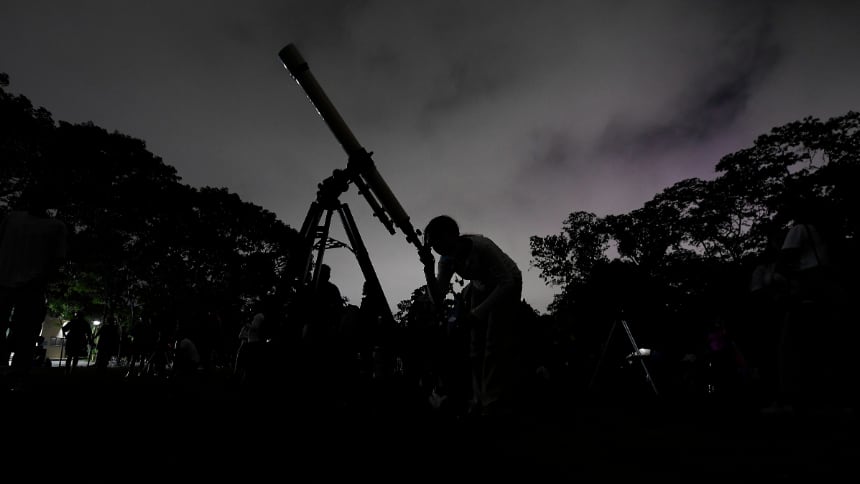
Head to an empty field with a good view of the western horizon
Grab your jacket and head outside tomorrow night, because six planets will be out for a celestial dance across the sky.
Mercury, Venus, Uranus, Jupiter, Saturn and Neptune will all be visible from the Northern Hemisphere in a planetary alignment — commonly referred to as a “planet parade.”
The planets aren’t exactly in a straight line, and they are billions of kilometers apart.
But from our view on Earth, they will all appear close together.
Normally, we see two to three planets in our solar system at the same time.
The last time this many were visible was last year.
Whether you live in a city or in a rural area, you’ll likely be able to see the planets closest to Earth — Mercury, Venus, Saturn and Jupiter with just your eye, though Mercury might be tough without binoculars.
The further two planets, Uranus and Neptune, will only be visible with a telescope or binoculars.
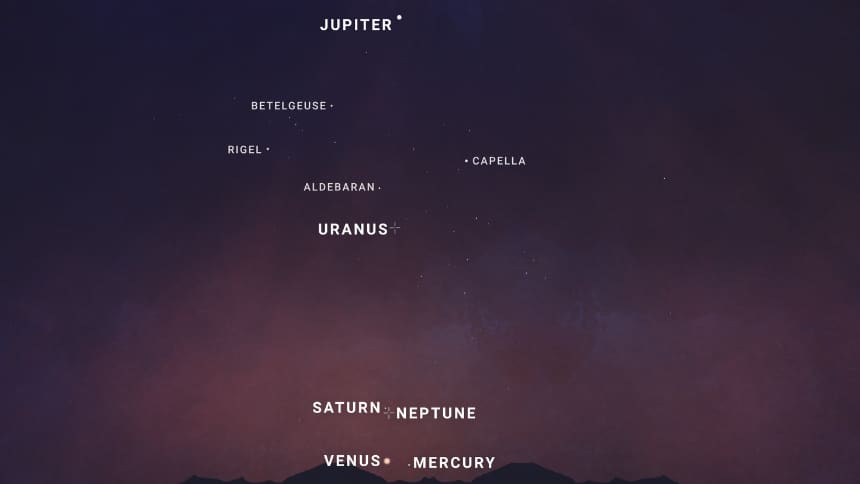
This image is from mid-February, where the planets are getting closer to an alignment. Venus, Mercury and Saturn gather near the horizon while Jupiter, Uranus and Neptune stretch across the night sky. (Image credit: NASA/JPL-Caltech)
Tips from expert
Sara Mazrouei, a planetary scientist at Humber Polytechnic College in Toronto, Ontario, said that the best time to see these planets will be 30 minutes to an hour after sunset.
“If you look up, if it’s twinkling, it’s a star. If it’s not twinkling, and it’s just a solid bright dot, then it’s a planet,” she told CBC Kids News.
Artificial light at night reflecting upwards causes light pollution, a haze that obscures the stars.
But moving away from tall buildings reduces light pollution and will allow you to see the night sky better.
“Go somewhere where there are not a lot of tall buildings, and face the western sky,” she said.
The western sky is the same direction where the sun goes down.
Avoid trees to see Mercury, Venus and potentially Saturn — which are closest to the horizon.
“The trees will only block the planets that are closer to the horizon,” Mazrouei said.
“So if you can get away a little bit to like an open field, that would be perfect.”
Tips from a young astronomer
Siddharth Patel, a 13-year-old from London, Ontario, is one of the youngest Canadians to make a “provisional discovery” of new asteroids.
He will watch his first planet parade from his backyard this weekend, where he often stargazes.
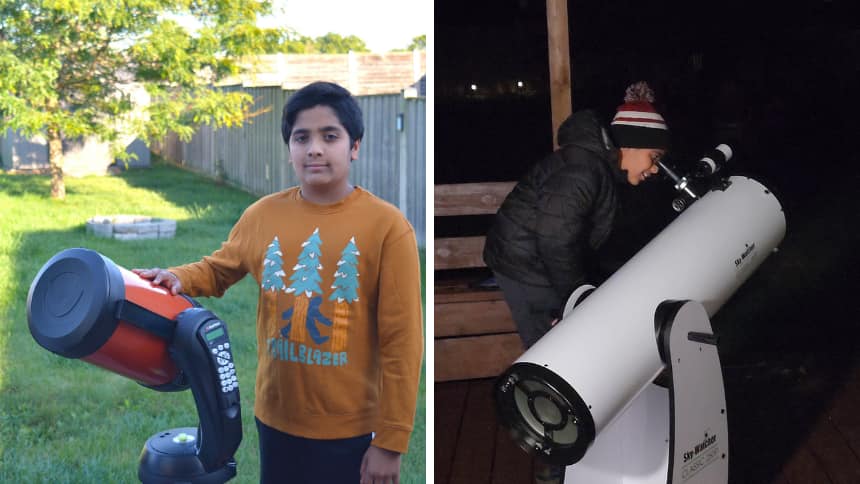
Siddharth, 13, in his backyard stargazing with the Celestron NexStar telescope, left, and the Sky-Watcher Classic Dobsonian telescope, right. (Images submitted by Siddharth Patel)
“I’m looking forward to seeing it around at 6 p.m., just while the sun sets,” he told CBC Kids News.
Siddharth is confident he will be able to see all six planets in his backyard thanks to his telescopes.
If you don’t have a telescope, Siddharth said that you can use your phone to take pictures of the planets if you change some settings.
“If you capture it at a three- to five-second exposure … you can probably see Jupiter, Venus and Mercury.”
One thing to consider is the weather — if the night sky is cloudy, then it will be hard to see any of these planets.
But try not to worry if you can’t see the planets this weekend.
Mazrouei said that you can still see most of these planets until early March.
“Don’t get discouraged if it’s cloudy on the 28th,” she said. “Try the night after.”
Have more questions? Want to tell us how we’re doing? Use the “send us feedback” link below. ⬇️⬇️⬇️
With files from The Associated Press
TOP IMAGE CREDIT: Matias Delacroix/The Associated Press