
By Nadine Yousif
For Carney, this trip is strictly business, aligned with his broader goal of diversifying Canada’s trade partners to reduce economic dependence on the US.
A big focus will be making progress on a comprehensive free trade agreement with India, which has been discussed on-and-off for the last 15 years.
The latest derailment in trade talks occurred after former Prime Minister Justin Trudeau made a bombshell public accusation against India in 2023, alleging it was involved in the killing of Hardeep Singh Nijjar, a Sikh separatist, who was gunned down in British Columbia. Four men were later charged in his death, and their case is still before the courts.
India has repeatedly denied any involvement.
Now faced with US tariffs, and under Carney’s more “pragmatic” approach to foreign policy, Ottawa is repairing ties with Delhi.
Still, the allegations remain a point of contention for some members of Canada’s Sikh community, who say they continue to be targeted by India through transnational repression, and have criticised Carney for prioritising economic interests over their safety.
It is a situation that will require “delicate handling”, Vina Nadjibulla, vice-president of the Asia Pacific Foundation of Canada, told the BBC.
Asked repeatedly about these concerns, Canadian officials told reporters ahead of Carney’s trip that the two countries are engaged in “robust” discussions on national security and foreign interference.
They added that Canada does not believe the Indian government is currently linked to any violent crimes or threats on Canadian soil, and that they “probably would not be taking this trip” if that were the case.
Not everyone is convinced. Sukh Dhaliwal, an MP from Carney’s Liberal party, told Canadian media that the claim of India no longer being a threat is “disconnected from the reality”.
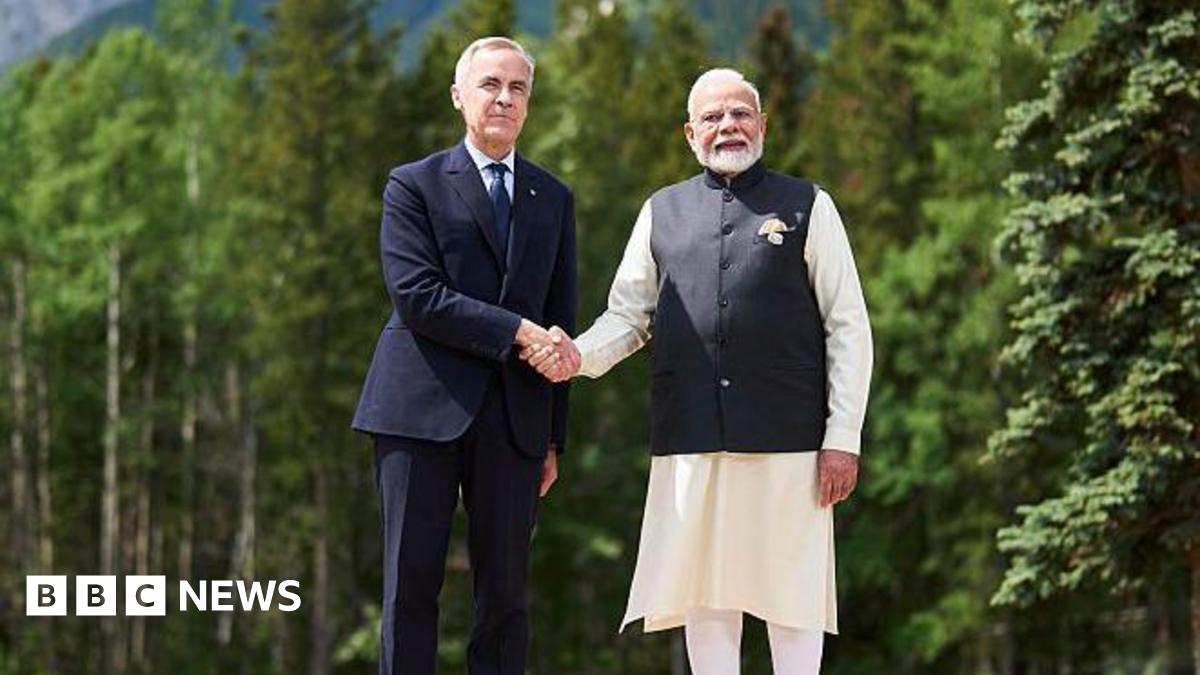
Canada has made several diplomatic overtures to India since Carney took office last year, beginning with inviting Modi to the G7 summit in Kananaskis, Alberta last summer.
That was followed by a series of meetings between Foreign Minister Anita Anand and her Indian counterpart, S Jaishankar, as well as a visit to Ottawa last month by India’s national security advisor, Ajit Doval.
Carney’s itinerary in India offers some insight into his priorities.
He will stop only in Mumbai, India’s financial hub, to meet with business leaders, and New Delhi, where he will sit down with Prime Minister Modi on Monday.
Unlike Trudeau, Carney will not be visiting cultural sites like the Taj Mahal. Nor will he travel to Punjab, the home state of many of India’s Sikhs, which was a stop for both Trudeau and another former prime minister, Stephen Harper.
Those stops were often seen as nods to Canada’s large Indo-Canadian and Sikh communities. Their omission signals that, this time, Canada’s focus is squarely on trade.
On the agenda will be discussions around energy, technology, artificial intelligence and defence, Carney’s office has said, as well as attracting top talent to Canada.
Carney and Modi are also likely to discuss tariff policies enacted by President Donald Trump, which have had an impact on both their economies.
Heading into the trip, Canada remains the only G7 country that has not reached a preferential trade agreement with India. Nadjibulla of the Asia Pacific Foundation of Canada said that fact “adds urgency” for Carney.
“There is a window of opportunity, and it needs to be seized,” Nadjibulla said.