
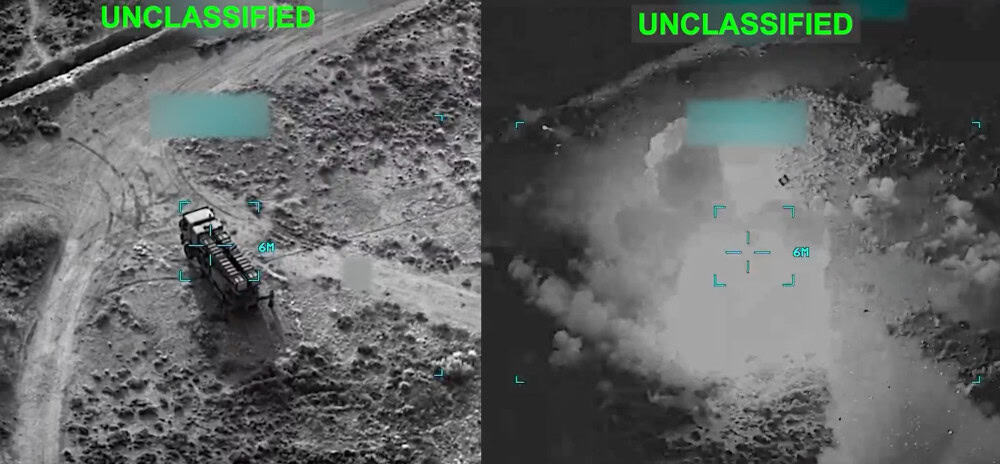
 Footage released by US Central Command shows a strike on an Iranian missile launcher. (CENTCOM on X)
The United States and Israel launched a coordinated military campaign against multiple targets in the Islamic Republic of Iran early on February 28. The Pentagon designated the American operation “Operation Epic Fury,” while Israel named its campaign “Operation Lion’s Roar.” In addition to targeting the regime’s military infrastructure, the joint operation targeted the regime’s senior leaders and reportedly eliminated Supreme Leader Ali Khamenei, an Israeli official told Reuters.
At approximately 3 am EST, President Donald Trump released a video statement outlining an objective of defending the American people by neutralizing imminent threats posed by the Iranian regime. He emphasized that the Islamic Republic has remained hostile to the United States since 1979, citing the hostage crisis and Tehran’s proxies killing US personnel across the Middle East. Trump’s remarks also underscored two longstanding concerns regarding Tehran: nuclear weaponization and long-range ballistic missile capabilities.
The conclusion of Trump’s address drew particular attention. Speaking directly to the Iranian people, he declared that “the hour of your freedom is at hand,” urging them to remain in shelters until the US air campaign concludes so they can “take over your government.” He stated that Washington is backing the anti-regime movement with overwhelming strength and decisive force. Trump also called on the Islamic Revolutionary Guard Corps (IRGC), the Iranian armed forces, and police units to lay down their arms and accept “total immunity or face certain death.”
Israeli Prime Minister Benjamin Netanyahu delivered a message with similar themes. “The aim of the operation is to put an end to the threat from the Ayatollah regime in Iran,” Netanyahu said, adding that the Israel Defense Forces (IDF) is targeting “the oppressive regime, facilities of the Revolutionary Guards and the Basij [the Tehran regime’s internal security paramilitary force].” He further noted that Israel and the United States are jointly attacking ballistic missile infrastructure and striking “hard at the terror regime [to] create conditions that will allow the brave Iranian people to cast off the yoke of this murderous regime.”
Fox News reported that “Israel is targeting Iranian leadership, while the U.S. is targeting military targets and ballistic missile sites that pose an ‘imminent threat.’” That division reflects each side’s strengths: Israel’s extensive reach and penetration of the regime’s intelligence apparatus have enabled Jerusalem to develop significant operational capacity on the ground, while the US uses its superior firepower to strike ballistic missile silos and major military sites.
The first wave of the campaign appeared focused on decapitating the Islamic Republic’s leadership, with reported strikes on residences associated with Supreme Leader Ali Khamenei, President Masoud Pezeshkian, Armed Forces Chief of Staff Sayyid Abdolrahim Mousavi, IRGC Commander Mohammad Pakpour, and other senior officials. At 2:38 pm, Reuters reported that a “senior Israeli official” said that Khamenei was killed “and his body has been found.”
Citing Israeli officials, Axios reported that Jerusalem is “targeting the entire Iranian leadership—political and military—past, present, and future.” In contrast, Israel’s targets during the 12-Day War last June were limited to military personnel, nuclear scientists, and domestic repression forces, not political figures.
The London-based Iran International reported that the strikes also killed four intelligence officials: “Javad Pourhossein, who led the foreign intelligence division; Mohammad Reza Bajestani, chief of the security branch; Ali Kheirandish, director of counterterrorism operations; and Saeed Ehya Hamidi, an adviser overseeing the war portfolio with Israel.”
Reports indicated that sites across Iran were hit, including locations in Tehran, Karaj, Tabriz, Kermanshah, Khorramabad, Bushehr, Qom, Isfahan, Chabahar, and Konarak.
Footage circulating on X shows what appear to be more than 21 Tomahawk cruise missiles traversing Iranian airspace. Additional videos on social media appear to depict a Reaper drone operating over Shiraz in Fars Province, reportedly preceding more than 20 explosions. Other clips show a strike in Tabriz near the Sahand University of Technology.
Iran retaliates across the region
Iran (and potentially its proxies) responded to the US and Israeli operation by firing drones and missiles targeting Israel and US bases and other facilities across the region, with strikes reportedly aimed at Israel, Kuwait, Qatar, the UAE, Bahrain, Iraq, Jordan, Syria, and Saudi Arabia. The strikes included over 200 missiles and drones fired at Israel alone.
The IRGC-affiliated Tasnim News alleged that Iranian ballistic missiles targeted five specific American facilities across West Asia: Al Udeid Air Base in Qatar, Al Dhafra Air Base in the UAE, Ali al Salem Air Base in Kuwait, Muwaffaq al Salti Air Base in Jordan, and the US Fifth Fleet headquarters in Bahrain. The report also cited released imagery purporting to show missile impacts in Haifa, Tel Aviv, and the Galilee in northern Israel.
Most of the missiles and drones were reportedly intercepted by air defenses, and the Persian Gulf theatre has so far remained the main arena on the first day of fighting. However, a missile struck the headquarters of the US 5th Fleet in Bahrain, and there was a reported strike on Al Dhafra Air Base in the UAE, where the luxury hotel Fairmont The Palm in Dubai was also hit and “engulfed in flames.” Iran also reportedly launched 44 missiles and eight drones toward Qatar.
In addition, “Syrian state media said that four people were killed by an Iranian missile that hit the country’s south,” AFP personnel “reported explosions near the US consulate in Erbil [Iraq],” and the Kuwait News Agency reported that Kuwait International Airport was hit by a drone that caused “light injuries to several workers and limited material damage.”
Various regional states, including Qatar, Saudi Arabia, Jordan, Lebanon, and the UAE, have condemned the Iranian strikes.
“The Kingdom of Saudi Arabia condemns and denounces in strongest terms the blatant Iranian aggression and the flagrant violation of the sovereignty of the UAE, Bahrain, Qatar, Kuwait, and Jordan,” the Saudi Foreign Ministry said in a statement. “The Kingdom affirms its full solidarity with and unwavering support for the brotherly countries, and its readiness to place all its capabilities at their disposal in support of any measures they may undertake.”
The latest on Iran’s internal anti-regime movement
Crown Prince Reza Pahlavi, the son of the shah deposed after the 1979 Islamic Revolution, issued a statement in Persian addressed to Iranians. Referring to US intervention, he stressed that outside assistance alone would not determine the outcome, and that ultimate success depends on the Iranian people themselves carrying the struggle through to its conclusion. “The time to return to the streets is near,” Pahlavi said.
Pahlavi delivered a similar message to the regime’s armed forces: “Join the nation and help ensure a stable and secure transition. Otherwise, you will sink with Khamenei and his shattered regime.” He concluded by urging citizens to remain vigilant and be prepared to mobilize when he gives the precise signal for decisive action.
Many Iranians have dubbed the latest unrest the “Lion and Sun Revolution” due to the widespread use of the pre-revolutionary flag and chants in support of Pahlavi. Following the crown prince’s calls for protests in early January, millions poured into the streets in what became the largest anti-regime demonstration in the Islamic Republic’s history.
The opposition is also preparing contingency communications in case of an internet blackout, including launching a secure messaging app and establishing a satellite television channel that broadcasts into Iran.
Other reports indicate that opposition activists are hacking regime-affiliated applications and turning their infrastructure against them. An Iranian app for tracking Muslim prayer times was reportedly breached, with messages urging members of the armed forces to defect and “protect your compatriots. They will protect you in return.” Other messages read, “Help has arrived” and “It’s the time for reckoning.”
Many Iranians have long called for US support against the Tehran regime and welcomed the ongoing operation. Videos posted to social media show people cheering the strikes and celebrating after news broke of the elimination of a regime official, with crowds applauding in the streets as explosions echoed in the background. Other footage shows individuals playing revolutionary anthems from their balconies and people chanting “Long live the Shah” and “Death to Khamenei” as airstrikes hit the military base and missile depots at Tehran’s Mehrabad Airport.