
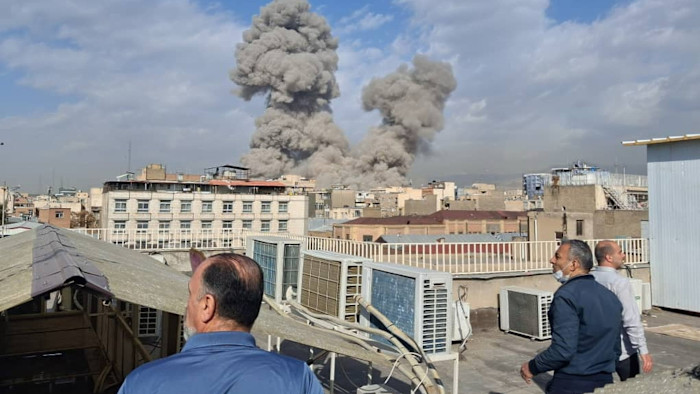
Iran’s supreme leader Ayatollah Ali Khamenei is dead, Donald Trump said on Saturday, hours after the US and Israel pounded the Islamic Republic with air strikes and urged its people to seize power from the regime.
The US president cast the killing as both retribution and liberation, and told Iranians they now had an opportunity to take control of their country.
“Khamenei, one of the most evil people in History, is dead,” Trump said on Truth Social on Saturday afternoon. His killing was “justice” for Iranians and Americans who had been killed by the supreme leader and his “thugs”.
“This is the single greatest chance for the Iranian people to take back their Country. We are hearing that many of their IRGC, Military, and other Security and Police Forces, no longer want to fight, and are looking for Immunity from us,” Trump wrote.
Israel also believes that the supreme leader died in air strikes on Saturday that targeted senior leaders in the Islamic Republic. Iran has disputed that Khamenei was killed.
Iran’s foreign minister Abbas Araghchi earlier on Saturday said Khamenei was alive “as far as I know”. Satellite imagery showed widespread destruction of Khamenei’s compound.
The Israeli military had also said on Saturday that at least seven senior Iranian defence officials were killed during the first wave of US and Israeli air strikes on the Islamic nation.
In his Truth Social post, Trump said “heavy and pinpoint bombing” of Iran would “continue uninterrupted throughout the week or, as long as necessary to achieve our objective of PEACE THROUGHOUT THE MIDDLE EAST”.
Khamenei, the 86-year-old cleric, has ruled over Iran for nearly four decades. His death, if confirmed, would mark a watershed moment for the Middle East.
The move to decapitate Iran’s leadership comes less than two months after Trump authorised US special forces to capture Venezuela’s leader Nicolás Maduro and flew him to the US.
Trump earlier on Saturday called for regime change in Iran as he announced the onset of a new military attack on the country.
“The United States military is undertaking a massive and ongoing operation to prevent this very wicked, radical dictatorship from threatening America and our core national security interests,” Trump said.
“We are going to destroy their missiles and raze their missile industry to the ground.”
Israeli Prime Minister Benjamin Netanyahu said in an address on Saturday evening that strikes in the coming days would hit “thousands of targets . . . to create the conditions for the brave Iranian nation to free itself”.
According to Iranian officials, 118 people were killed in a missile attack on a school in the city of Minab.
The joint US-Israeli attack prompted swift retaliation from Iran, with the Islamic Revolutionary Guard Corps launching a “first wave” of missile and drone strikes against Israel.
Qatar and the United Arab Emirates, which host US military bases, said they had thwarted retaliatory missile attacks while Jordan said it had intercepted two ballistic missiles.
Saudi Arabia said Iran had targeted its capital Riyadh and its oil-rich eastern province. Kuwait said a drone had struck its international airport, causing limited damage, while an apparent drone also struck Dubai’s Fairmont Hotel.
The joint operation appears to be the US and Israel’s most significant attempt to overthrow the Islamic regime since it swept to power in 1979 in a revolution that redrew the political map of the Middle East and transformed Iran into one of America’s biggest adversaries.
Analysts said the assault, which the Pentagon has dubbed Operation Epic Fury, would push up oil prices as supplies from the world’s most important energy-producing region faced disruption.
Iranian media reported the Strait of Hormuz, a waterway vital to the global crude market, had been “effectively” closed after the IRGC warned some vessels that passage through it was unsafe.
A US official told the FT on Saturday Washington was not currently planning on releasing oil from its strategic petroleum reserve to offset any supply disruption.
The attacks follow weeks of tension as Trump sought to press Tehran over its nuclear programme, ordering the largest American military build-up in the region since the Iraq war in 2003.