
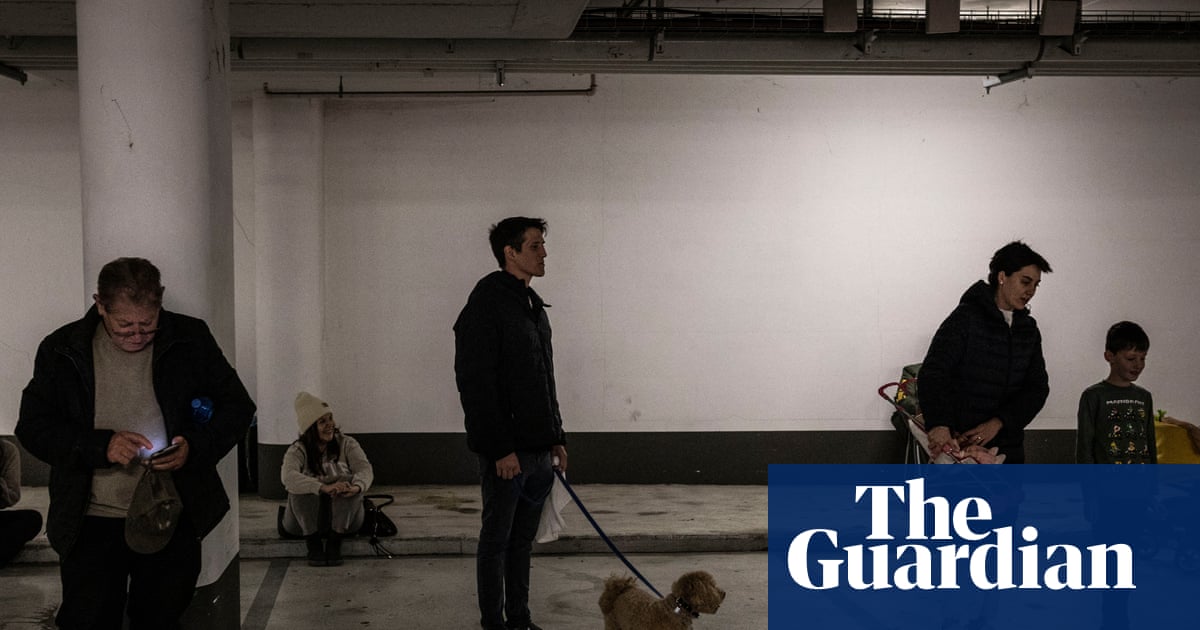
Air raid sirens emptied Israel’s streets on Saturday and filled its bomb shelters, as the country braced for waves of Iranian attacks.
But individual fear and resignation did not temper broad political and popular support for the country’s second regional war in less than a year.
“We all of us feel that what we started needs to be finished,” said Gal Tzairi, a 23-year-old university student sheltering in an underground car park in central Tel Aviv. “We want our safety, so we know we need [this].”
Paramedics had to dig Tzairi out from the rubble of his home last June, when an Iranian missile strike brought down his apartment building.
The first sirens brought back some of his fear from that day, but like many in Israel he said he had been half-expecting another war, after weeks of US military buildup in the region and Israeli prime minister’s warnings to Iran.
“This is round two,” said 30-year-old Tom Zimako, who backed “100%” the decision to attack Iran again. “We need to find a good solution against terror – not against people, against the citizens [of Iran].”
The morning attacks immediately halted bitter Israeli political feuding ahead of elections due by October this year.
Disputes over conscription of ultra-Orthodox men and whether to hold a state inquiry into the 7 October 2023 attacks were set aside, as opposition leaders across most of the political spectrum united behind Netanyahu.
Yair Lapid, the official leader of the opposition, said in a social media post: “I fully support this operation. We all agree about the justification and importance of striking the murderous Iranian regime.”
Yair Golan, head of the centre-left Democrats, said the Israeli military had his “full backing” in “removing the Iranian threat”. Rightwing Naftali Bennett said “the entire nation of Israel stands behind you”.
As European and regional powers urged a return to negotiations to tackle Iran’s nuclear programme, prominent Israelis were calling for a broad, open-ended war.
Yoav Gallant, a former defence minister, said in an interview on Israel’s Channel 12: “It’s clear we have the upper hand regarding Iran. The important thing is we don’t stop until we finish the job.”
Dismissing Iran’s response to Israeli and US strikes, he added: “The small amount of rockets Iranians are shooting shows they are weak.”
One of the few political critics of the war was lawmaker Ayman Odeh, a Palestinian citizen of Israel, who attacked the opposition for falling in line behind a government that wants to “live by the sword forever”.
“There is no opposition in Israel, only 50 shades of militarism,” he said on social media. “Time and again, they try the same formula here: another ‘round’, another operation, more blood. Every time they promise that this time it will bring security, and every time reality proves otherwise.”
Missile attacks on Israel are particularly dangerous for the country’s Palestinian citizens, who have less access to bomb shelters.
Nourka Ghoul, a 30-year-old art director from East Jerusalem, is among those who don’t have a shelter at home. She had bundled her husband, Kenan, and 13-month-old daughter Sofia into the car to head for a relative’s apartment.
“When the sirens sound, we come together and pray,” she said. “It is always the same each time. We want to be with our family. If we are going to die, we will die all in one go.”
For many in Israel, the disruptions of war are part of their daily routine. Aleeza, 35, a film-maker struggling to entertain a baby and a toddler in a shelter, said her three-year-old now plays “sirens” with friends, racing each other to “shelters” in their playground.
She was more frustrated than frightened on Saturday afternoon, because the war had abruptly halted filming of her first feature, a comedy. “I just want it to be over.”
The attack came on the eve of the Jewish festival of Purim, which commemorates the biblical story told in the book of Esther of how a Jewish community in the ancient Persian empire saved themselves from a massacre.
Traditionally celebrations include dressing up, and some people in Tel Aviv went straight from early Purim parties to shelters still in costume.
Others joked that the US president, Donald Trump, wanted to cast himself as a modern-day Mordechai – a hero in the biblical story – by defending Jewish lives in modern-day Iran.
With the airspace closed and all flights cancelled, some tourists had to find their way to shelters as well. Philippe and Juliette Kubler, from Nice, France, had been visiting Jerusalem on a long-planned trip of a lifetime.
“We said to ourselves that there was a small risk. We had a super time here. Everyone was very welcoming. We saw all the sacred sites. We never felt in any danger,” said Philippe, a hospital nurse. “Now I’m just worrying about how we get home.”