
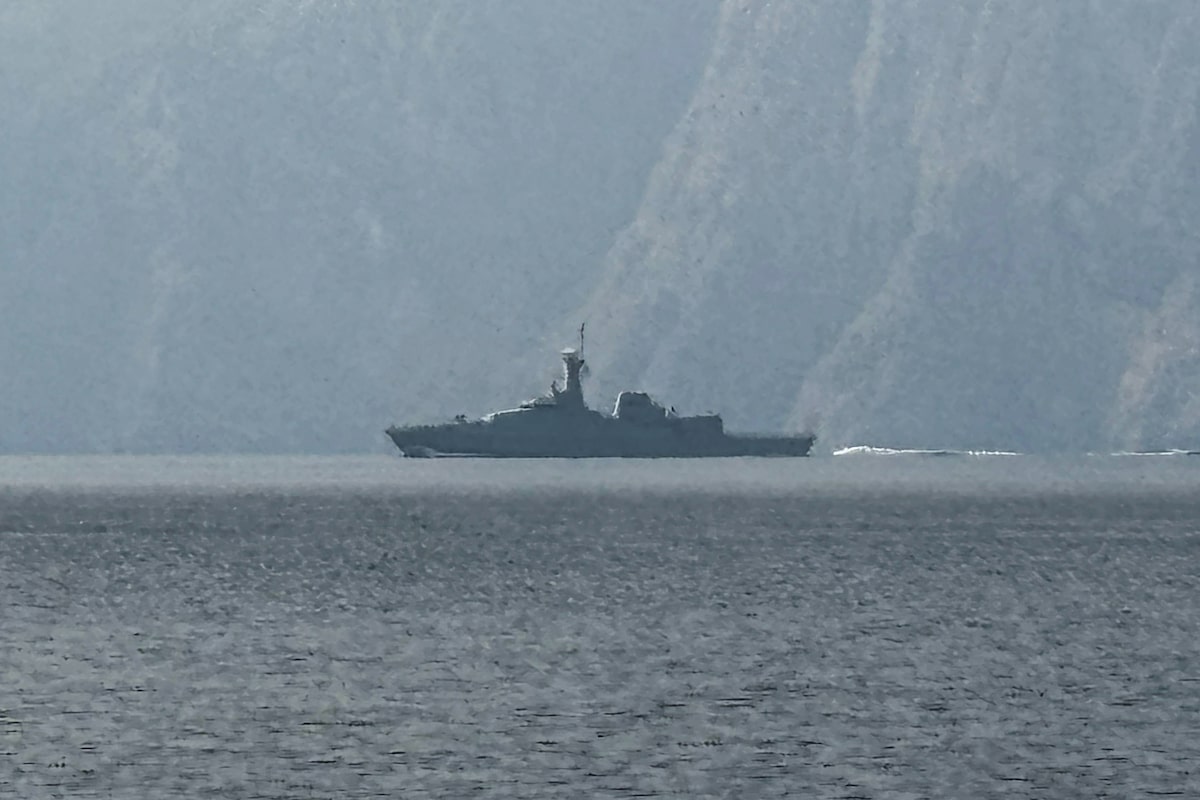
A navy vessel sailing in the Strait of Hormuz on Sunday. About 20 per cent of the world’s oil is shipped to global markets through the critical waterway.SAHAR AL ATTAR/AFP/Getty Images
Oil prices surged as much as 13 per cent in response to U.S. and Israeli military attacks on Iran, and the Islamic Republic’s retaliation, as markets assessed the risks of supply disruptions in the Middle East’s most important shipping route.
The conflict has effectively halted commercial traffic in the Strait of Hormuz, the critical waterway through which about 20 per cent of the world’s oil – more than 20 million barrels a day – is shipped to global markets.
It is also an important route for liquefied natural gas, mostly produced in Qatar, one of the world’s largest suppliers. In 2024, about a fifth of global LNG passed through the strait, bound for China, India, Taiwan and South Korea, as well as European markets, according to the U.S. Energy Information Administration.
The strait is located between Iran and Oman, connecting the Persian Gulf with the Gulf of Oman and the Arabian Sea. It is deep and wide enough that the largest oil tankers can sail through. There are limited alternatives for oil and gas exports from the region.
The global benchmark Brent crude price jumped 13 per cent above US$82 a barrel when Asian markets opened on Monday. It later pared gains to just above US$75.
OPEC+ agrees oil output boost as Iran conflict disrupts shipments
The last time oil hit these levels was June, 2025, when the U.S. and Israel bombed Iran’s nuclear facilities. Over the past several weeks it rose as warships and aircraft amassed in the region, putting markets on edge.
The latest disruption prompted the Organization of the Petroleum Exporting Countries to lift its output target for April, though the increase of 206,000 barrels a day is modest given world supply of more than 108 million barrels a day, based on the International Energy Agency’s estimate.
The slight bump in output was meant to show that OPEC and its allies are prepared to use spare capacity if needed – but not in knee-jerk fashion, Rystad Energy said in a report.
Before the massive military buildup in the region, ordered by U.S. President Donald Trump, crude markets had been weak over fears of oversupply because of fragile global economies.
Spare capacity among OPEC+ members is about 3.5 million barrels a day, which the Norway-based Rystad said cannot be used too quickly, hampering their ability to deal with a larger disruption. As a result, the boost will not likely calm market over the medium term, it said.
Both the U.S. and Iran could use oil as a weapon of mass destruction. They may not
“The bigger issue is physical reality: roughly one-fifth of global oil supply passes through the Strait of Hormuz, a vital artery for world trade, meaning markets are more concerned with whether barrels can move than with spare capacity on paper,” wrote Jorge Leon, Rystad’s head of geopolitical analysis.
As of Sunday, almost 150 tankers had dropped anchor across the Persian Gulf, halting exports and pushing up insurance costs, wrote Pratibha Thaker, editorial director, Middle East & Africa, at The Economist Intelligence Unit.
In the 12-day war last June, U.S. and Israeli air strikes against Iran hobbled the country’s nuclear facilities, oil prices initially surged on worries that military action could spread throughout the region, and even affect oil production. However, they quickly retreated when it became clear that output was left unaffected.
As of Sunday, it was unclear how long the hostilities would last in this far more intense conflagration, and what could be targeted. Iran vowed revenge after the killing of Supreme Leader Ayatollah Ali Khamenei and traded strikes with Israel as part of a widening war. Iran hit U.S. military bases in Bahrain and the United Arab Emirates. Its targets also included a hotel in Dubai and Kuwait’s international airport.
At least three vessels had been attacked, the U.K. Maritime Trade Operations Centre reported on Sunday. Two ships had been struck by unknown projectiles, causing fires that were later extinguished. In the third incident, a projectile exploded “in very close proximity to a vessel,” though all crew members were reported safe, the centre said on its website.
A family look out on the Strait of Hormuz in Fujairah, UAE on Wednesday.GIUSEPPE CACACE/AFP/Getty Images
“Unlike the more time-bound escalation seen in June, 2025, current signals suggest Tehran may sustain a cycle of retaliation, at least for the next few days, increasing the risk of prolonged instability,” Ms. Thaker said in a LinkedIn post.
Any disruption in the Strait of Hormuz will be temporary, and traffic will eventually resume. The only question is when, said Rory Johnston, oil-market analyst at Toronto-based Commodity Context. With the U.S. Navy in the region, it is unclear how long Iran could maintain a closing.
The bigger question, however, is whether Iran could aim its missiles and drones at oil wells and processing plants throughout the region.
“These things are very, very soft targets, and Iran knows that. That, at least for me, is the even more acute, durable concern – the upstream attacks,” Mr. Johnston said in an interview.
“The strait is the headline – I think rightfully so, because it is very real, but it could close down and open up in hours, in days. And then it’s really a question of timeline.”
As markets wager on how long the conflict could last, Mr. Trump is also facing pressure domestically as he struggles to persuade voters that retail gasoline prices are set to fall. For that reason, he could have little appetite for a drawn-out war disrupting crude supplies and driving up pump prices.
Mr. Trump told The Atlantic in an interview on Sunday that he planned to speak with Iran’s new leadership. “They want to talk, and I have agreed to talk, so I will be talking to them,” he said, declining comment on the timing.
With reports from The Associated Press