
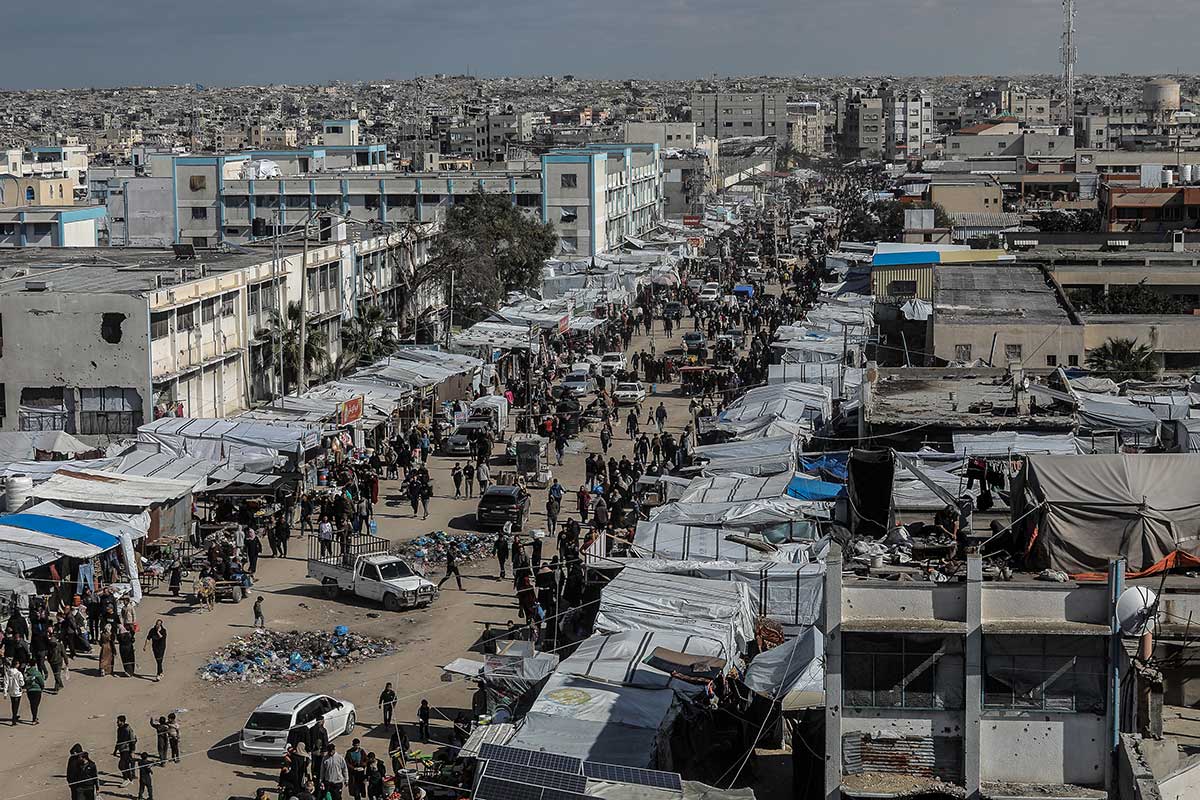
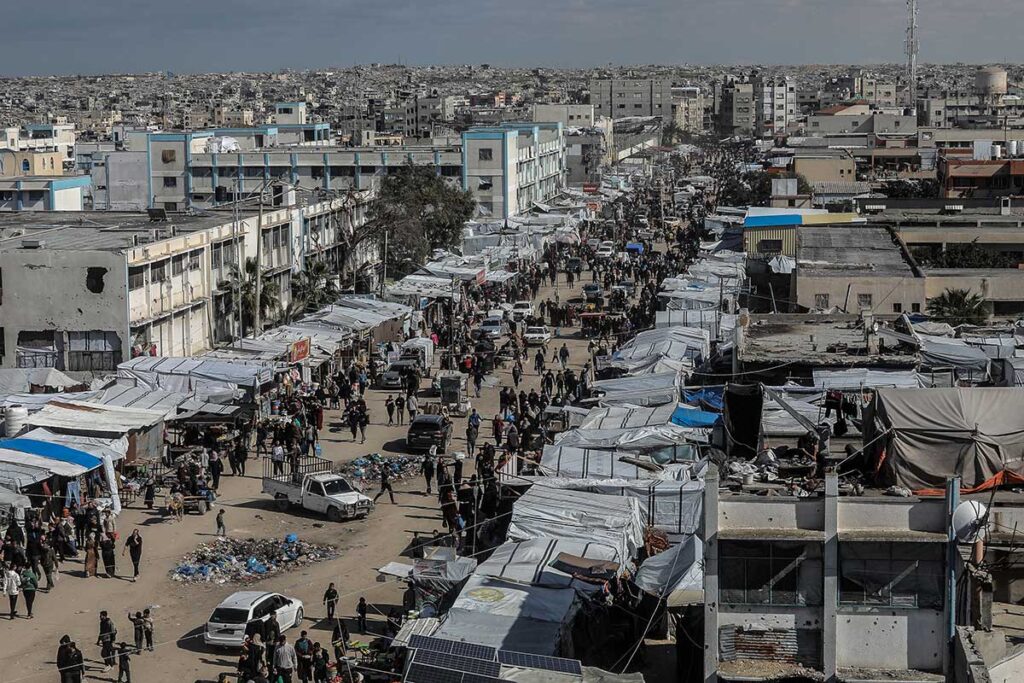
Palestinians crowd into markets in Khan Younis, to buy goods, 28 Feb, Source: Reuters.
For the first week of Ramadan, Reem al-Masdar was cooking vegetables, salad and bread to prepare iftar and sohour meals for her family.
On Sunday, she had only lentils and canned beans to break her family’s fast. In the markets of the Maghazi refugee camp in central Gaza, where her family lives in a tent pitched next to what remains of their home, prices have skyrocketed and shelves have emptied fast.
The scramble to stockpile goods and hike up prices comes in response to the joint aggression launched by the United States and Israel on Iran on Saturday morning.
By the evening, Israel redoubled its blow to the already intermittent supply of commodities to the strip, announcing that its military had closed until further notice all the crossings into Gaza, the main arteries for food supplies.
The crossings have been operating since the conclusion of a ceasefire in October to deliver goods and humanitarian aid to around 2 million people in the strip — although at much lower rates than those Israel promised under the ceasefire agreement.
Many vendors in Gaza had already hiked prices before Israel announced the border closures. In the immediate aftermath of the launch of the US-Israeli operation, the cost of many goods had doubled.
“In a single hour, everything changed,” Mohamed al-Arabid, a resident of Sheikh Radwan in northern Gaza City, told Mada Masr. Prices soared, traders started hoarding and residents scrambled to secure storable stockpiles of food despite the rising costs. “People haven’t forgotten the famine,” he said.
As panic buying spread, products disappeared altogether. Many shopkeepers shuttered their stores, stockpiling essential goods — such as flour, sugar and eggs — rather than selling them.
Ahmed al-Zarad, one of many residents hit hard by the sweeping price hikes, described what is unfolding in Gaza’s markets as akin to another act of violence, this time by merchants against people who have already lost everything to the two years’ war.
The price of a 10-kg sack of flour reached 100 shekels after costing no more than 20 shekels. A carton of eggs went up to 60 shekels from 25 — “all in a single day,” Zarad said.
In Arabid’s neighborhood market, cucumbers climbed from 10 shekels per kg to 20, and so did potatoes and tomatoes. Zarad said he has gone back to cooking simple mujaddara — a dish of rice and lentils — a meal he described as one of the “famine’s nightmares.”
Sugar, among other staples, has become very hard to find. “And if you do find it, it costs five times its normal price,” Ali al-Sik told Mada Masr.
The rapid disappearance of goods from markets in the wake of the US-Israeli operation has fueled fears of a “return to famine,” Maha Khella, a woman displaced from Jabalia camp in the north to Nuseirat in central Gaza, told Mada Masr.
In the military agency that coordinates supply, the Coordination of Government Activities in the Territories’ (COGAT) statement, Israel insisted that the crossings’ closure “will not have any impact on the humanitarian situation in the Gaza Strip,” claiming that enough food had been delivered to the strip since the ceasefire signed in October to meet “four times the nutritional needs of the population.”
Arabid said the absence of food reserves, coupled with the destruction of agricultural land that had once secured a measure of self-sufficiency before the war, was enough to trigger a food crisis within a day or two of the crossings’ closure.
On Saturday, the Palestinian Interior Ministry announced that it has begun intensive deployments and inspections of markets across the strip to monitor supplies, regulate prices and prevent hoarding and exploitation. In a statement the following day, the ministry said police detained 46 violators and shut down 11 shops across various governorates after conducting around 86 inspection rounds.
The Sahm Unit, affiliated with the Interior Ministry in Gaza, said on Sunday that it intends to take punitive action against exploiters, confiscating 70 percent of the value of trade from any seller found to be inflating prices.
But these measures have yet to produce broad relief from the shortages and inflation. Markets remain crowded as people rush to secure whatever remains, accelerating stock depletion. “People have been burned by famine,” Mohamed Abu Samra, a resident of Deir al-Balah in central Gaza, told Mada Masr.
Even fuel prices have surged sharply. “The price of a liter of gasoline has reached 130 shekels,” Sik said. “And if you object, the seller simply refuses to sell to you.”
Mada Masr approached several sellers about the price hike, but most declined to comment, some responding aggressively. A few agreed to speak on condition of anonymity.
“I didn’t raise prices immediately after the war on Iran began,” a seller in Gaza City said. But after nearby sellers increased their prices, they felt compelled to follow suit. “I feared that if I kept my prices unchanged, my inventory would run out — especially with the crossings closed.”
“I know what happened is wrong,” they added. “But I’m forced to do it. I, too, now buy for my family from other shops at high prices.”
Another seller said that “prices will rise sooner or later.” The crossings are closed, they said, “and no more goods will be entering.”
But as people rush to buy and store whatever they can, many residents with no income or who rely on daily wages have been unable to do so at all. Their earnings barely cover immediate needs, leaving them with nothing to cushion the days ahead.
Masdar herself could only prepare the sparse iftar because she had set aside part of a World Food Programme (WFP) parcel. Repeated displacement throughout the war, power outages and poor internet services have slashed three-quarters of her earnings from online marketing. With her sixty-year-old husband unable to work, she carries the burden of providing for her seven family members.
The family receives a parcel from the WFP once a month, containing small quantities of rice, lentils, canned beans, chickpeas, tomatoes and a few kilograms of flour. “Buying is hard and there’s no aid. We’re forced to make do with whatever we can find to eat,” she said.
Masdar said she registered with every aid association but that this doesn’t guarantee access to goods, since “those with connections are the ones who get it.” On Saturday, she saw humanitarian aid being sold on market stalls throughout the camp at prices far beyond her meager means — a scene she said has repeated itself often during the war.
Even before the surge in prices, weakened household purchasing power in Gaza was a major obstacle to families securing food, the WFP said in a report issued in January.
As a result, dietary diversity remains far below pre-war levels, with families struggling to obtain adequate protein, vegetables and fruit. According to the WFP one in five households continues to subsist on just one meal a day, with adults reducing portion sizes in order to prioritize feeding children.
COGAT reiterated the closure on Sunday, saying that crossings would be opened again “when the security situation permits.”