
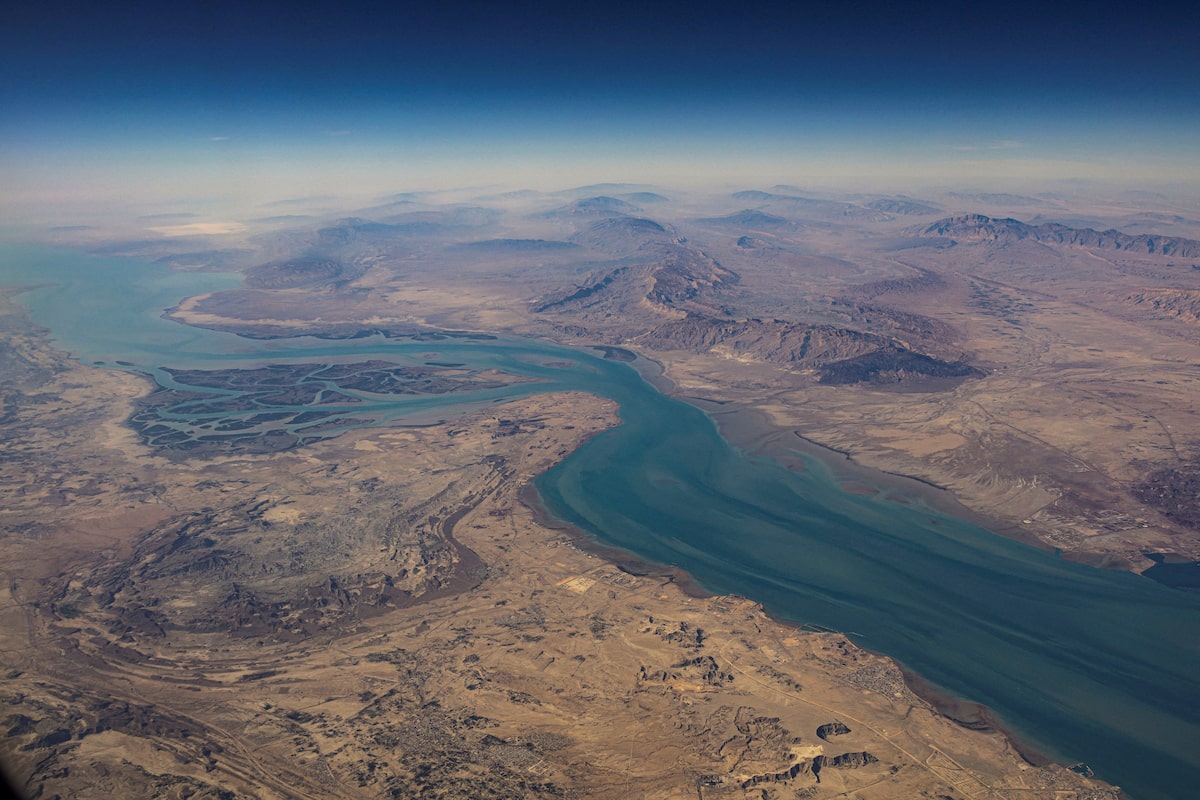
An aerial view of the Iranian shores and the island of Qeshm in the Strait of Hormuz from 2023 shows just how narrow the waterway is.Nicolas Economou/Reuters
Beijing on Monday reiterated its call for the U.S. and Israel to immediately cease military operations against Iran, warning the global economy could be imperiled as the war expanded to multiple Middle Eastern countries and threatened shipping through the Strait of Hormuz.
Around 20 per cent of the world’s oil and gas supply passes through the Persian Gulf into the Arabian Sea before it’s transported to destinations around the world, making the Strait and its adjacent waters “vital international routes for cargo and the energy trade,” Chinese Foreign Ministry spokeswoman Mao Ning told reporters on Monday.
“Safeguarding security and stability in this region serves the common interests of the international community,” she added. “China urges all parties to immediately cease military actions, prevent further escalation of tensions, and avoid regional turbulence inflicting greater damage on global economic development.”
A long-standing ally of Iran, Beijing appeared to have been caught off guard by this weekend’s attacks on Tehran, describing the killing of Iranian Supreme Leader Ayatollah Ali Khamenei as “trampling on the purposes and principles of the UN Charter and basic norms in international relations.”
Ms. Mao said China had not been notified in advance of the military operation and was watching the developments with concern. Some 3,000 Chinese nationals have been evacuated from Iran, she added, while at least one Chinese citizen was killed in the bombing of the Iranian capital.
As with heavily sanctioned Venezuelan oil, China was a major buyer of Iranian crude. Disruptions to this supply could hurt small-scale Chinese refiners that specialize in oil that cannot go to market in much of the world. But the broader Chinese economy should be resilient to any immediate shocks from the war in Iran, said Wang Yiwei, a professor of international affairs at Renmin University in Beijing.
“China already has massive petroleum reserves, plus new energy sources now account for about one-third of our structure,” he said. “On land, Russia is stable, and combined with our large petroleum reserves and new energy, I feel we’ve already made preparations for the worst-case scenarios.”
Oil prices surged Monday as traders priced in major disruptions to the Iranian supply, at least in the short term, which could have a knock-on effect on demand for crude from other countries. This could be exacerbated if Iran’s retaliatory attacks and closing of the Strait of Hormuz also slows shipments of oil from Saudi Arabia – by far the largest non-sanctioned international supplier.
Alex Holmes, regional director for Asia-Pacific at the Economist Intelligence Unit, said in an e-mail that emerging economies in the region will likely feel a jump in oil prices the hardest. He added they could see a brief spike in the cost of consumer goods, similar to the early months of Russia’s war in Ukraine.
“Although China imports discounted Iranian crude – often routed through third countries as a proxy – recent trade data show no surge in purchases,” Mr. Holmes said. “Russia and Iran continue to compete for the Chinese market through steep discounts, underscoring the commercial logic behind China’s buying decisions.”
China will rue any regime change in Iran, as it is likely to further undermine Beijing’s position in the Middle East, where only years ago it seemed poised to be a major player. However, the United States’ brazen aggression and President Donald Trump’s failure to elucidate any clear legal basis for the war could reinforce China’s positioning of itself as the sole responsible superpower.
“The negative repercussions of America’s conduct in the international community may even constitute a fundamental undermining of the ‘rules-based order’ that the United States has long promoted, as well as the value system it has emphasized for many years,” said Su Hao, a professor of international relations at China Foreign Affairs University.
“After Venezuela and now Iran, this represents a huge blow to the dignity and credibility of the United States and the entire Western camp.”
Renmin University’s Prof. Wang agreed, noting “the postwar international system – entirely created by the United States itself – has now been personally destroyed by America, and this is something Europe is worried about, and the world as a whole is worried about.”
For years now, China has been seeking to reshape that postwar order, replacing or supplementing the UN with bodies dominated by Beijing, such as the BRICS economic grouping and massive economic and infrastructure projects under the Belt and Road Initiative. In a Monday editorial, the state-run Global Times said “sudden changes in the Middle East have further highlighted the urgency and extreme importance of promoting reform in the global governance system.”
Mr. Trump is scheduled to visit China at the end of this month. The U.S. President may be hoping that by killing Mr. Khamenei and destabilizing the regime, he’ll be able to remove Iran from the agenda and thus “have more bargaining chips,” Prof. Wang said. “But I don’t think that’s something China is afraid of.”
Asked Monday whether Mr. Trump’s visit would go ahead, Ms. Mao said the two sides were “maintaining communication on this issue.”
With reports from Alexandra Li in Beijing