
Following US and Israeli strikes on Iran that began on 28th February, there have been indiscriminate retaliatory attacks across the Middle East region. Here we summarise the RN position and the broader naval aspects of this developing conflict.
As an implacable enemy of Britain, the collapse of the despicable Iranian regime is very much in the UK’s interests. The Starmer government appears to be treading a confused line between support for Trump and disavowing involvement. Whether attempts at regime change by air and missile strikes can be achieved is highly questionable and may inevitably lead to unforeseen second-order consequences. Any form of Middle East intervention is now politically toxic in the UK, but even if there is no appetite to directly join the strikes on Iran, there are British interests to defend. Despite indications for several weeks, obvious to any casual observer, that this attack was on the way, UK military preparation appears to have been undercooked. The prepositioning of a Type 45 destroyer in the Eastern Mediterranean would seem to have been a bare minimum step, together with better contingency plans for personnel in Bahrain.
Limited choices
As recently as a decade ago, the RN maintained at least a few ships on deployment around the globe and in a crisis had options to quickly re-task assets to respond. This is no longer the case; only the 2 forward-deployed OPVs and submarine HMS Anson in Australia are east of Suez. There are no RN warships in the Mediterranean other than an RFA laid up in Gibraltar. Putting aside the deployment of Anson, countering the Russian threat is really the main priority, but events do not always account for such a delicate balance of resource management. This crisis further exposes the tiny number of combat-ready vessels the RN has available.
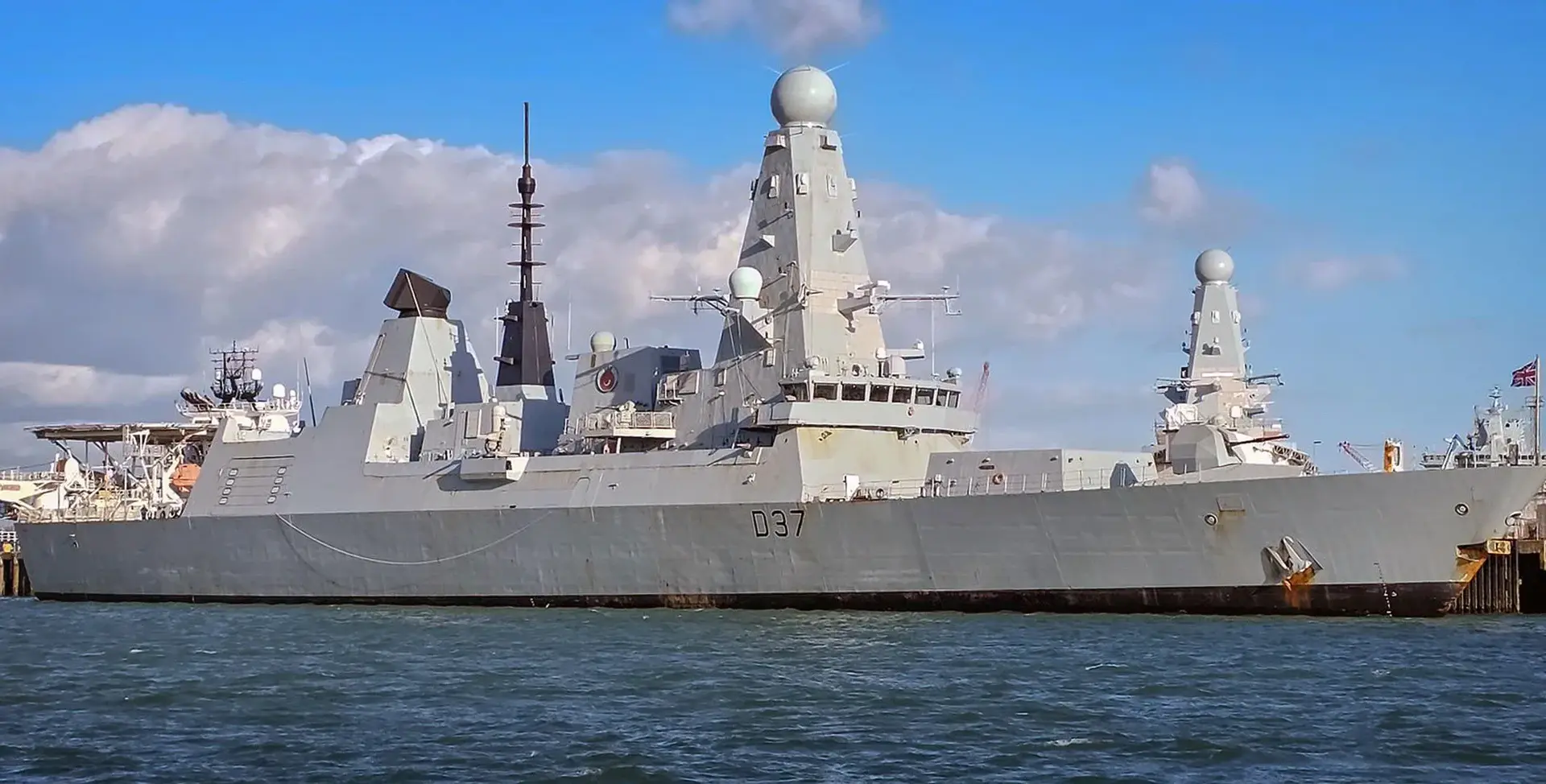
On 19 January, it was officially stated that the RN had 3 Type 45s ‘operational’, technically the case, but an optimistic view. Of the limited options, HMS Duncan would be the obvious choice to deploy as she has recently completed FOST and exercise Sharpshooter, is worked up and immediately available.
In mid-February, HMS Dauntless spent a few days working with the FS Charles de Gaulle carrier strike group, but has now entered a planned 3-month Fleet Time Support period. HMS Dragon is in dry dock in FTSP and is earmarked to become the flagship of Standing NATO Maritime Group One later this year. It should be noted that during FTSP, vessels are theoretically still able to sail with 72 hours’ notice and retain a full ship’s company, a quite different posture to ships in deep refit and out of routine. However, sending a ship to sea in the middle of a support period would typically imply sailing with acceptable defects and would disrupt the taut maintenance schedules and availability in future. The other three destroyers, HMS Defender and HMS Diamond, are in various stages of major refit, while HMS Daring is regenerating and should rejoin the fleet later this year.
Of the struggling frigate force, HMS St Albans is deployed on Towed Array Sonar Patrol in the Atlantic or High North region. HMS Somerset is active and due to sail from Plymouth today. HMS Portland has been stuck in Devonport with a defect since January, and HMS Sutherland seems to be making very slow progress regenerating after her LIFEX refit that officially completed more than a year ago. HMS Kent is completing a major refit, and it is unclear if HMS Iron Duke will return to sea as planned this month following a maintenance period.
Carriers
FS Charles de Gaulle recently visited Sweden as part of the Marine Nationale’s LA FAYETTE 2026 deployment to the Baltic and North Atlantic, but in response to events, France is considering redeploying their carrier group to the Eastern Mediterranean. It should be noted that there is an agreement between European carrier-operating nations intended to ensure there is at least one active carrier always available. Although HMS Prince of Wales is fully crewed, she is undergoing several months of maintenance following the CSG25 deployment to the Pacific last year.
Barring any significant alteration to current planning, HMS Prince of Wales is due to lead the carrier strike group on Operation FIRECREST later this year, deploying across the North Atlantic and into the Arctic. The programme is intended to reinforce transatlantic ties with the United States, Canada and partners within the Joint Expeditionary Force, including activity along the eastern seaboard of North America. The group is expected to visit a US port, with American aircraft planned to operate from the carrier’s flight deck during the deployment, which will also feature tasks aligned with NATO’s new Arctic Sentry mission.
Cyprus
During the night of 1st March, an unmanned drone struck the runway at RAF Akrotiri in Cyprus. Fortunately, no one was injured, and none of the valuable aircraft was hit. Akrotiri has no hardened aircraft shelters and, although a very valuable base, there have been increasing concerns about its defence. At least in the short term until protection could be improved, there is no question that having a Type 45 nearby would provide significant reassurance, rather than trusting to luck or hoping the USN can protect Cyprus.
Recent activity at RAF Akrotiri has centred on continued combat sorties under Operation SHADER against Islamic State targets in Iraq and Syria, including Typhoon strike missions. The base also supports RAF allied air-to-air refuelling, reconnaissance, and other logistical movements within the region. Following the action against Iran, RAF F-35s and Typhoons are flying patrols to intercept potential drones or missiles, although restricted to purely defensive operations.
Bahrain
Iranian drones have struck the US Navy 5th fleet base at least twice in Bahrain, landing close to the UK Naval Support Facility (NSF). An Iranian drone has also hit the oil tanker MV Stena Imperative alongside the Bahrain port today, setting her on fire. The tanker is a civilian vessel but provides support to the US Navy.
The MoD say there are still at least 300 British military personnel in Bahrain, comprising the UK Maritime Component Command (UKMCC) staff, marines and personnel involved in ship maintenance and disposal. There are no plans to abandon the base and it is possible that up to two of the river Class OPVs will be based there in future.
The RN has spent decades exercising and preparing for this scenario, but no longer has any active warships in place. During previous conflicts in the Gulf, the RN was ready to escort and protect merchant shipping transiting the Strait of Hormuz. The present threat environment is of a different scale, but it should not be forgotten that during the prolonged Tanker War of the 1980s, missiles were fired, ships were struck, and mines were laid. Similarly serious risks were endured by RN warships that operated in the Gulf during 1990 to 1991 and again in 2003. The RN of today is simply no longer big enough or properly equipped for the challenge.
HMS Lancaster was decommissioned in December but is still alongside in Bahrain being de-stored. Returning her to operations is not feasible. In her final months of active service, she was driven to “maximise every ounce of operational capability”. She is completely worn out, has ammunition removed and no longer has a full ship’s company. The last operational vessel the RN has in the Gulf, HMS Middleton, is due to return home to the UK on a heavy lift vessel. The base at Bahrain remains vulnerable, and even with all its resources, the US cannot protect everything, even from relatively slow Shahed one-way attack drones, never mind ballistic missiles.
Hormuz
Iran is attempting to close the Strait of Hormuz to all shipping – a key maritime choke point through which approximately 20% of the world’s oil & gas supplies pass. As usual, it is innocent mariners on the front line, with at least four merchant vessels being hit at the time of writing. The tanker MV Skylight was left ablaze and abandoned at anchor south of Hormuz with four casualties, while MV MKd Vyom was struck by a projectile off Oman, resulting in the death of a crew member and two other vessels have reported incidents. The Royal Navy-led UK Maritime Trade Operations (UKMTO) centre has again provided a valuable service that provides credible information, advice and reassurance to mariners across the world in times of danger.
Tehran is leaning heavily on its asymmetric strengths, employing large numbers of attack drones and retaining the ability to deploy missile-armed fast attack craft and lay naval mines in confined waters. By contrast, much of its conventional surface fleet appears to have been obliterated by US strikes on the Iranian Navy’s Konarak base. At least two frigates and two patrol boats have been sunk, as well as the corvette Naghdi, which had been in South Africa in January and had only returned to Iran last week.
Although the Strait is not ‘closed’ to shipping, the risk of attack has immediately sent the cost of war risk insurance rocketing, and most shipping companies have suspended passages through the strait for now. Unlike the recent situation in the Red Sea, there is no alternative route, and ships may resume transit once insurance is arranged and if naval forces, other than the RN, can promise some protection. The majority of the hydrocarbons that must pass through the Gulf are bound for China, but ensuring this flow is in the interest of almost every nation (with perhaps the exception of Russia). Commodity prices are global and a shortage will impact across the world. There is some oil already afloat and in storage around the globe, Saudi Arabia could increase output, but it may not be long before oil and gas prices spike.
This crisis lays bare the widening gap between Britain’s global interests and the limited maritime power now available to defend them, compounded by political paralysis at home, and raises uncomfortable questions about how far UK ambition still matches its means.
Main Image: HMS Duncan alongside in Portsmouth on 28th February (Photo: S. Wenham).