
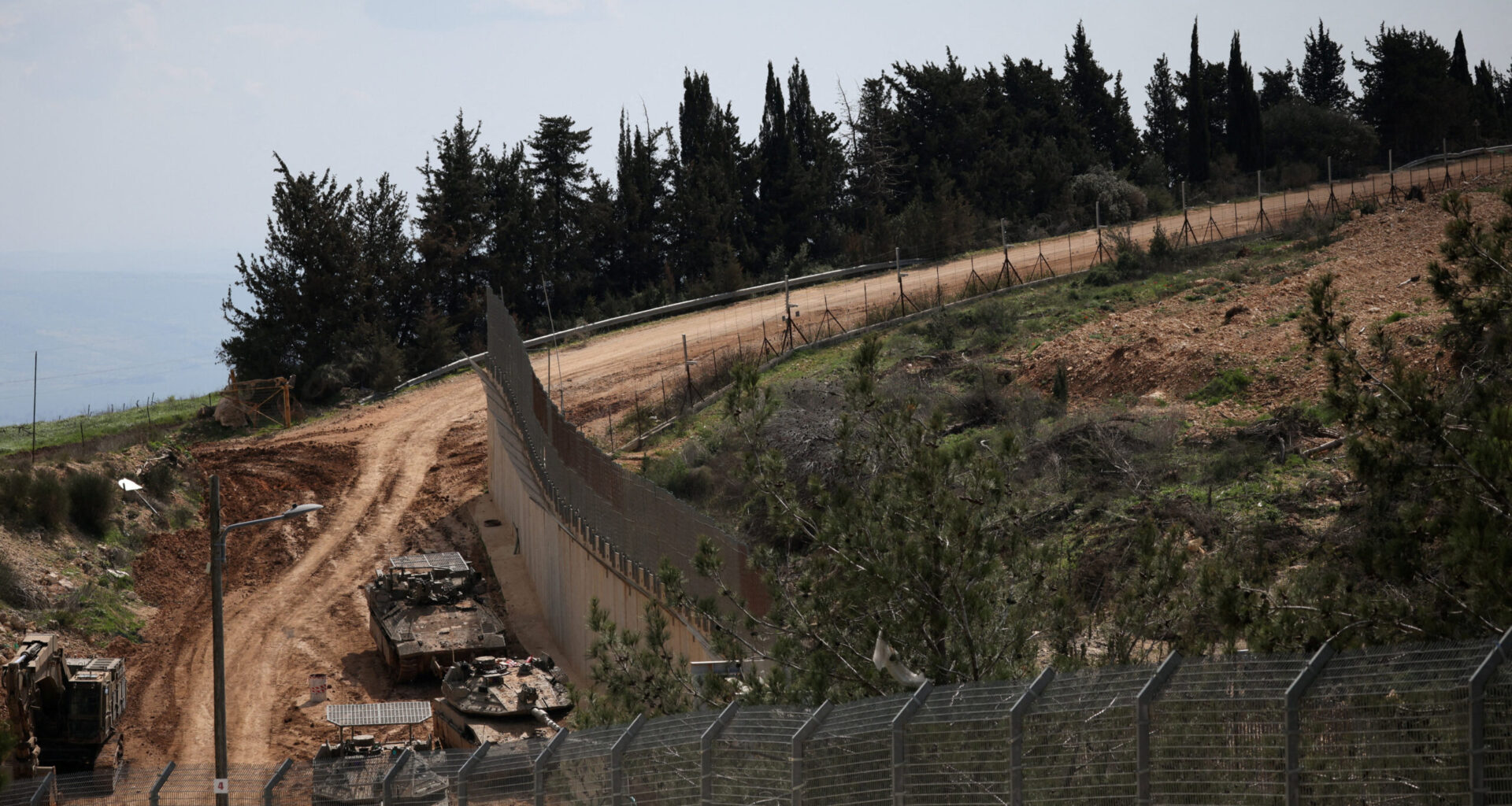
Israeli military vehicles at the Israel-Lebanon border, following an escalation between Hezbollah and Israel amid the US-Israeli war with Iran, March 2, 2026. Courtesy of Reuters, Photo by Shir Torem
Israeli forces began an incursion into south Lebanon on Tuesday under cover of airstrikes, its military announced.
While the Israeli military downplayed the scale of the invasion — calling it a move to create “an additional layer of security” — a Lebanese security source told Mada Masr that the government is preparing for various scenarios, including an Israeli invasion extending as far as areas near Saida, the busiest city in south Lebanon that has been spared ground military action since Israel’s withdrawal from south Lebanon in 2000.
These scenarios were discussed in a meeting at the Baabda palace between Lebanese President Joseph Aoun and the ambassadors to Lebanon of Egypt, the United States, France, Qatar and Saudi Arabia.
At the same time, the Lebanese military has withdrawn from key areas along the border in the face of the incursion. According to a Lebanese government official, Lebanon received a notification from the American side indicating that Israel was conducting a ground incursion into Lebanon.
As such, the official said, Cabinet members discussed in yesterday’s session the evacuation of army positions on the frontlines to spare Lebanese soldiers a direct confrontation with the Israeli army, “especially since they lack the necessary weaponry for such a confrontation.” However, the source said, the military will not withdraw fully from the south but will take up new positions farther from the border. Witnesses cited by Reuters said that the military had withdrawn from seven of its forward positions so far.
Tuesday’s incursion by Israel into the south of Lebanon continues an escalation of the exchange of fire between Hezbollah and Israel that took place throughout last night after erupting in the early hours of Monday when Hezbollah launched rockets toward an Israeli military facility in Haifa.
Hezbollah issued a statement shortly after midnight on Tuesday stressing the legitimacy of its operations against Occupation forces for “everything that is happening in Lebanon.”
“For fifteen months, the Israeli aggression against Lebanon has continued with killing, destruction, bulldozing and all forms of criminality,” despite the ceasefire, said the group, adding that “all political and diplomatic moves have not been effective in curbing this aggression.”
Visible advancements in the eastern sector of the southern border region included a small Israeli force consisting of a tank and three bulldozers advancing from the settlement of Metula, toward south Lebanon’s Tal al-Nahas area between Kfarkela and Burj al-Muluk, according to local media. Reuters cited a Lebanese official saying that incursions were taking place “across parts” of the border.
Israel’s military is also amassing force in its north, with officials saying Sunday that 100,000 reservists were called up to its northern command and images displaying a cluster of tanks at the partition fence published by news agencies.
Announcing the incursion on Tuesday morning, Israeli military spokesperson Ella Waweya described the aggression as “a forward defense operation” including “operating in southern Lebanon” and assuming position “at several strategic points in the area.”
Following a meeting of the foreign ambassadors group at Baabda, Aoun called upon the “quintet” of nations to exert pressure on Israel to halt its attacks on Lebanon to negotiations and a return to the course of action laid out by the ceasefire. “”Lebanon relies heavily on the support of the five-member committee countries,” he said.
Egyptian Ambassador to Lebanon Alaa Moussa emerged from the meeting stressing the quintet’s commitment to supporting the Lebanese military and the latter’s commitment to continuing its role as per the ceasefire agreement.
Both sources, the military and the government officials, noted that Israel’s incursion had propelled a second wave of displacement from areas in and around Saida on Tuesday morning, as people in these areas— already hosting thousands displaced from villages further south — left their homes to seek shelter in areas further north of the city.
Over 30,000 people were already displaced by Israel’s wave of strikes on Monday with families stranded in cars on highways out of south Lebanon for hours in a bid to reach safety.
Government shelters in Saida and other cities across the country were quickly filled, said Ahmed Zeino, who left the border town of Blida with his wife and three children on Monday, undergoing an exhausting, 10-hour journey to reach Saida.
But once there, he couldn’t find accommodation for himself and his family. During the last war, he told Mada Masr, he was able to secure an apartment almost immediately.
“I’ve tried calling every number I could find, but nothing,” Zeino told Mada Masr. Real estate agents quickly told him there were no apartments available, even though it was only the first day of the war, with landlords asking for over US$1,400 in monthly rent for small units.
Many families headed north on Monday only to return to the road on Tuesday morning at the news of Israel’s invasion.
Ahmad Taleb fled with his family from Aaitit, near Sur, toward Sarafand on Monday. But at dawn, Israeli army spokesperson Avichay Adraee issued urgent evacuation warnings for dozens of villages and towns in southern Lebanon including Sarafand and nearby towns such as Kharayeb and Saksakiyeh.
“We didn’t believe it,” Taleb told Mada Masr. “We thought it was safe here because during the last war, they only struck it toward the end. It wasn’t part of the first evacuation warnings.”
Shortly after the evacuation warning, Taleb, his parents and siblings headed to already crowded Saida, where other relatives were staying in a small flat. They are now in a safer area, but more than 20 people, including children, are crammed into the apartment.
“We can’t sleep. We can’t shower. There are just too many people,” he said. “We’re trying to find separate apartments so each family can have some space, but it’s so difficult. We can’t find anything.”
Israeli attacks on Lebanon spanned the southern districts overnight and into Tuesday morning. Targets in Beirut included the building of Hezbollah-affiliated news agency, Al-Manar, and the Al-Nour outlet, both in Haret Hreik, as well as sites in Hadath. Drones have hovered over the city since Monday.
Israel claimed to have assassinated Reza Khazai, Hezbollah’s military buildup chief on behalf of the Quds Force, who also served as the chief of staff of the Quds Force’s Lebanon Corps, in one of its strikes on the capital.