
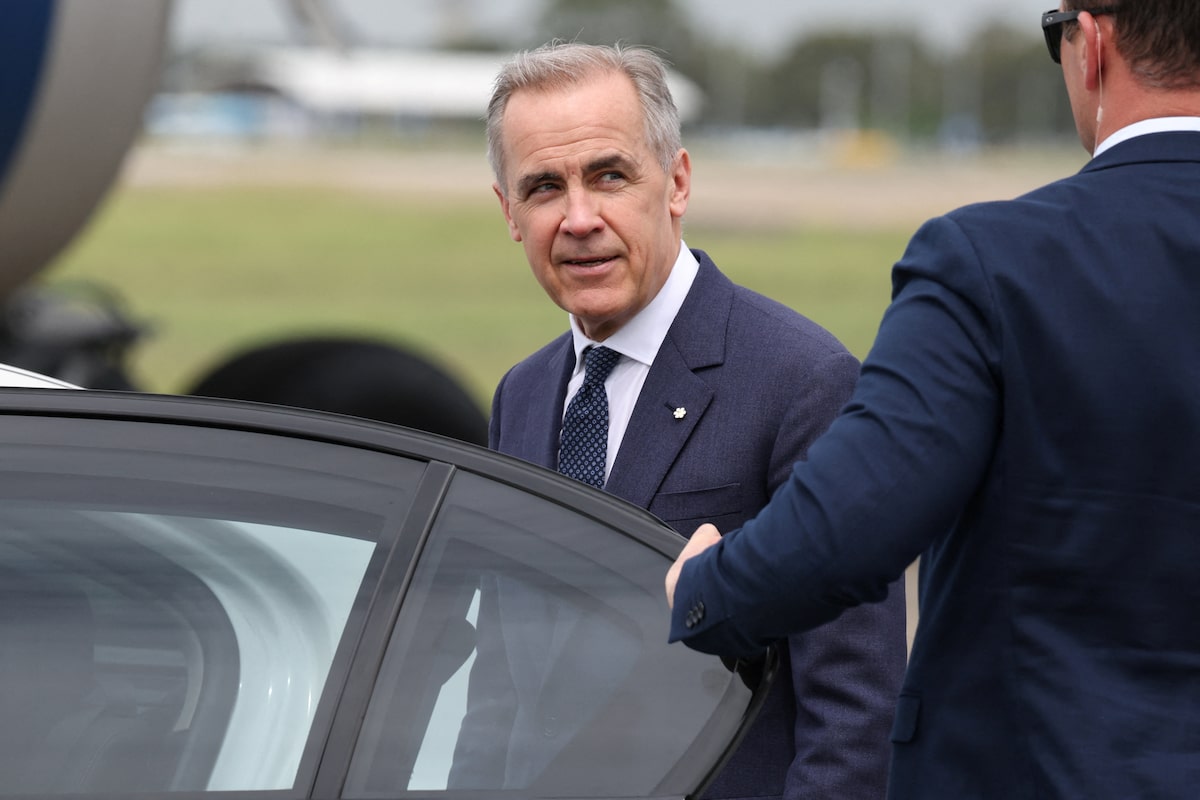
Prime Minister Mark Carney was in Sydney, Australia on March 3.Hollie Adams/Reuters
Prime Minister Mark Carney said Canada’s support of U.S. and Israeli air strikes on Iran was a decision taken with regret but the question of whether the strikes violate international law is for others to determine.
Mr. Carney said Canada’s decision reflects support for efforts to prevent Iran from obtaining a nuclear weapon and from threatening international peace and security.
“We do, however, take this position with regret, because the current conflict is another example of the failure of the international order,” he told reporters in Sydney, Australia on Wednesday morning local time.
Mr. Carney said Iran’s nuclear threat has persisted despite decades of UN Security Council resolutions, the work of the International Atomic Energy Agency and sanctions, and the state continues to export terror.
But the United States and Israel have acted without engaging the United Nations or allies, and, Mr. Carney said, that leaves the question of where things will go from here.
Ayatollah Ali Khamenei, 86, was killed in the U.S.-Israeli strikes on Iran Saturday, a pre-emptive attack that critics say may have violated international law.
Mr. Carney said it appears the attacks are “inconsistent” with international law.
But he said it is up to the United States and Israel to make their legal case, as well as other legal experts.
Canada wasn’t informed in advance, nor asked to participate, Mr. Carney said, so did not have to take make a formal judgment as to whether they met a Canadian standard.
“We support the efforts to end the Iranian nuclear program and the regime’s decade long process of state sponsored terrorism, but we remind that international law binds,” he said.
“It binds particularly with respect to civilians, civilian infrastructure, and it should bind all parties. We call for a de-escalation. We’re prepared to assist in that.”
The remarks came at the start of Mr. Carney’s first media availability since beginning an overseas trip in India on Feb. 26.
Opinion: Carney picks a realpolitik side on Iran war
Critics of Canada’s position in support of the strikes include former Liberal cabinet Lloyd Axworthy.
He has contrasted Ottawa’s 2026 stand with how Canada in 2003 refused to support the U.S. invasion of Iraq because it was not authorized by a UN Security Council resolution.
Two Liberal MPs have also raised questions about Canada’s support.
One, Victoria MP Will Greaves, said “Canada cannot endorse the unilateral and illegal use of military force, the killing of civilians, or the kidnap and assassination of foreign heads of government, while also insisting that our sovereignty, our rights and our independence must be respected.”
Toronto MP Nate-Erskine Smith told the Globe and Mail during an unrelated interview Tuesday that no one will have sympathy for the end of the Iranian regime, calling it authoritarian, repressive and murderous.
“At the same time, no one should be overly comfortable here with pre-emptive strikes from Trump and Netanyahu, and Trump and Netanyahu acting as if they’re the world’s police,” he said.
“That’s not a comfortable state of affairs either.”
Mr. Carney said resolution of the crisis will require a commitment to a broader political solution.
“Diplomatic engagement is essential to avoid a wider and deeper conflict,” he told reporters.
“Innocent civilians must be protected, and all parties must commit to finding enduring agreements to end both nuclear proliferation and terrorist extremism. Canada will pursue this approach with like-minded countries and participants in the conflict.”
Iran has since repeatedly struck back, targeting U.S. bases in the region.
Defence Minister David McGuinty earlier called Khamenei “a force for evil,” and noted that Canada’s position toward Iran has been toughening for years.
In 2012, former prime minister Stephen Harper cut off formal diplomatic ties with Tehran and shuttered Canada’s embassy there.
His successor Justin Trudeau never re-established official relations and became a vocal and persistent critic of Iran’s 2020 shooting down of a commercial plane filled with Canadian citizens and residents and its failure to account for its actions.
“The government of Canada has been very clear about its position on Iran for some time,” Mr. McGuinty said, noting in 2024 Ottawa designated the Islamic Revolutionary Guard Corps as a terrorist entity. He said Canada has been “following very carefully the kinds of human rights abuses, the terror inflicted upon the population in Iran, the suffering of women, in particular in Iran.”
Asked if he believed the death of Iran’s Supreme Leader was a positive development, Mr. McGuinty sharply criticized him. “The Ayatollah Khamenei has been for many, many decades, a very, very powerful force for evil in Iran and in the region,” he said.
He said Canada is well aware of Tehran’s support for terror groups. “We know where funding and financing has been coming from. We know the extent of the involvement of the Iranian regime in, for example, organized criminal syndicates.”
– with a report from Laura Stone