
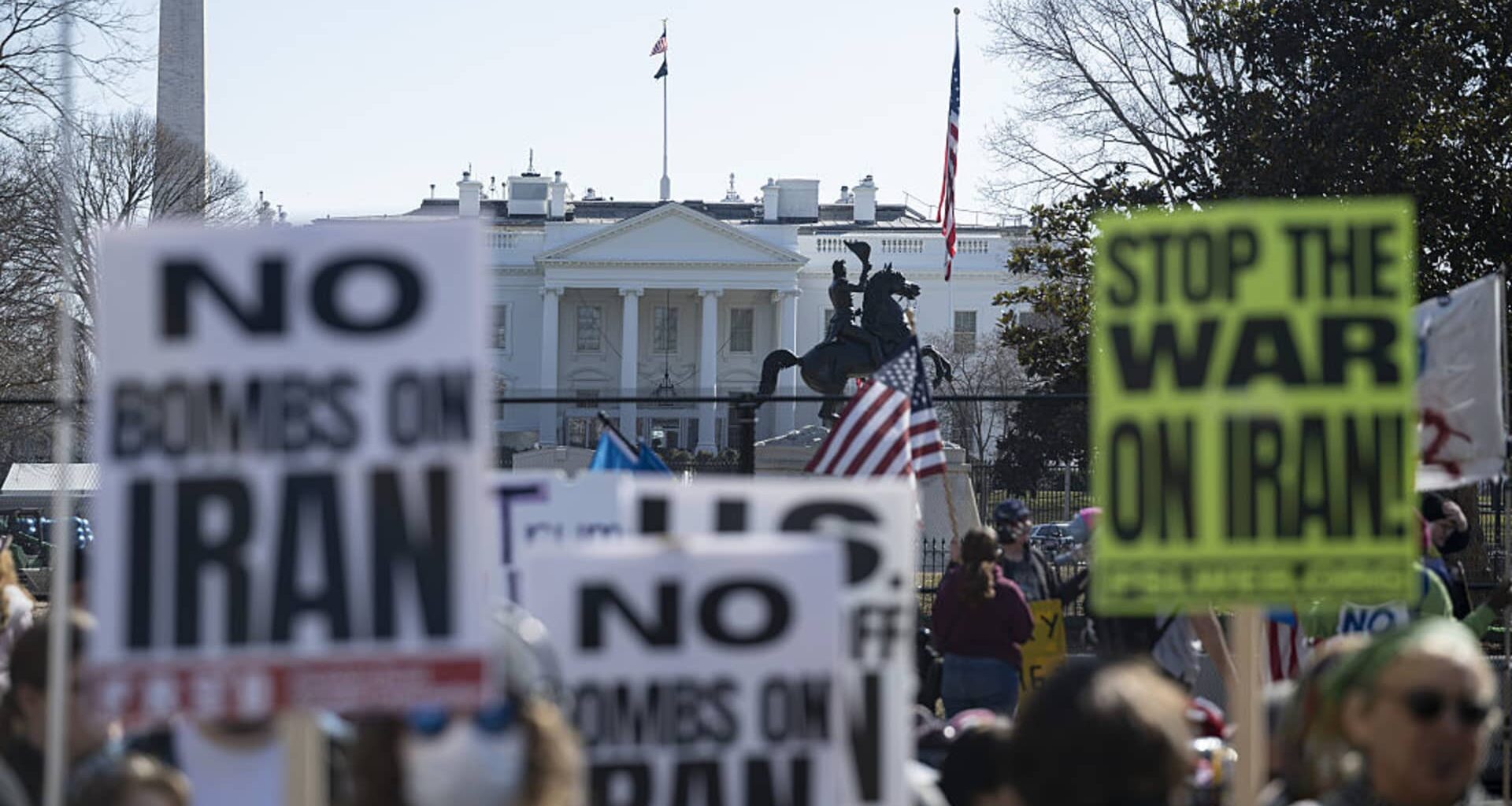
WASHINGTON DC, UNITED STATES – FEBRUARY 28: Demonstrators gathered outside the White House in Washington DC, to protest US and Israeli strikes on Iran. Protesters carried Iranian and American flags as they chanted anti-war slogans during the rally. The demonstration took place in front of the White House, drawing participants who voiced opposition to the recent military actions. (Photo by Celal Gunes/Anadolu via Getty Images)
Anadolu | Anadolu | Getty Images
The Trump administration plans to meet with executives from the biggest U.S. defense contractors at the White House on Friday to discuss accelerating weapons production, as the Pentagon works to replenish supplies after strikes on Iran and several other recent military efforts, five people familiar with the plan told Reuters.
Companies including Lockheed Martin and Raytheon parent RTX, along with other key suppliers, have been invited to attend the meeting, the people said, speaking on condition of anonymity because the discussions are private.
The meeting underscores the urgency felt in Washington to shore up weapons stocks after the Iran operation drew heavily on munitions. Since Russia invaded Ukraine in 2022 and Israel began military operations in Gaza, the U.S. has drawn down billions of dollars’ worth of weapons stockpiles, including artillery systems, ammunition and anti-tank missiles. The conflict in Iran has consumed longer-range missiles than those furnished to Kyiv.
At least one of the people said the gathering was expected to center on pressing weapons makers to move faster to boost output.
Lockheed, the Pentagon and White House did not immediately respond to requests for comment. RTX declined to comment. In a social media post Monday, Trump said there was a “virtually unlimited supply” of U.S. munitions and that “wars can be fought “forever,” and very successfully, using just these supplies.”
The White House meeting comes as Deputy Defense Secretary Steve Feinberg has been leading Pentagon work in recent days on a supplemental budget request of around $50 billion that could be released as soon as Friday, one of the people said. The new money would pay for replacing the weapons used in recent conflicts, including those in the Middle East. The figure is preliminary and could change.
The push to boost production has intensified following U.S. military strikes on Iran, where the U.S. deployed Tomahawk cruise missiles, F-35 stealth fighters and low-cost one-way attack drones on Saturday.
Tomahawk missile maker Raytheon has a new agreement with the Pentagon to eventually ramp production to 1,000 units annually. The Pentagon currently plans to buy 57 of the missiles in 2026 at an average cost of $1.3 million each.
The administration has been steadily ratcheting up pressure on defense contractors to prioritize production over shareholder payouts. President Donald Trump signed an executive order in January to identify contractors deemed to be underperforming on contracts while distributing profits to shareholders.
The Pentagon is expected to release a list of underperforming contractors. Companies named will have 15 days to submit board-approved plans to correct the situation. If those plans are judged insufficient, the Pentagon can pursue enforcement actions, including contract terminations.