
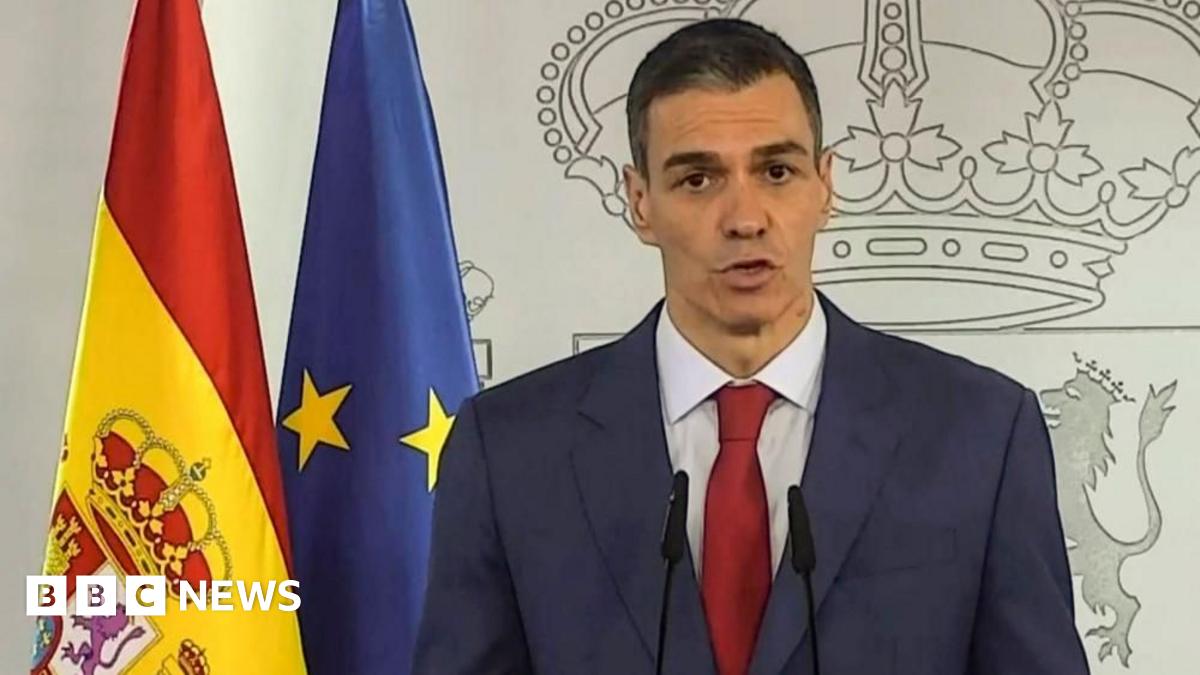
In his televised address from the prime minister’s Madrid residence at La Moncloa , externalon Wednesday, Sánchez said the government was studying economic measures to counter the impact of the conflict on Spaniards, although he avoided directly referring to Trump’s trade threat.
“The question is not if we are on the side of the ayatollahs – nobody is. The question is whether we are in favour of peace and international legality.”
“You cannot answer one illegality with another, because that is how the great catastrophes of humanity begin.”
Spain’s Socialist prime minister explained that the government’s position was comparable to its stance on Ukraine and Gaza. Sánchez has been a vociferous critic of Israel’s military response to the Hamas attacks in 2023.
Spain has been among Europe’s most outspoken governments on Gaza, describing Israel’s actions there as “genocide” and acknowledging a Palestinian state before many other EU members did.
That position was in step with his coalition partners to his left and, broadly speaking, with Spanish attitudes to the Middle East.
Looking back to the invasion of Iraq in 2003, which he said had failed to achieve its goals and had made life worse for ordinary people, he warned that the attacks on Iran could have a similar economic impact for millions.
His reference to the Iraq invasion will connect with many Spanish voters. Spain’s support at the time from the conservative People’s Party (PP) government was deeply unpopular, and triggered mass anti-war protests.
Many believe it also lay the groundwork for the Socialist Party’s surprise election victory in March 2004, days after Madrid was hit by deadly jihadist bombings.
Sánchez reminded Spaniards of the “Azores trio” of then-US President George W. Bush, the UK’s Tony Blair and Spanish conservative leader José María Aznar – who had met on a Spanish base in the region days before the Iraq invasion.
He said they had handed Europeans the “gift” of “a more insecure world and worse life”.
The Spanish leader’s stance contrasts strongly with that of Merz, who told German TV on Tuesday regime change in Iran would leave the world “a little better off”, although he also said this was “not without risk and we would also have to bear the consequences”.
Unlike Spain’s fellow Nato allies – the UK, France and Greece – it has not yet committed to any military involvement in response to the war.
The Spanish prime minister said he wanted to express the solidarity of the Spanish people with countries that had been “illegally attacked by the Iranian regime”.