
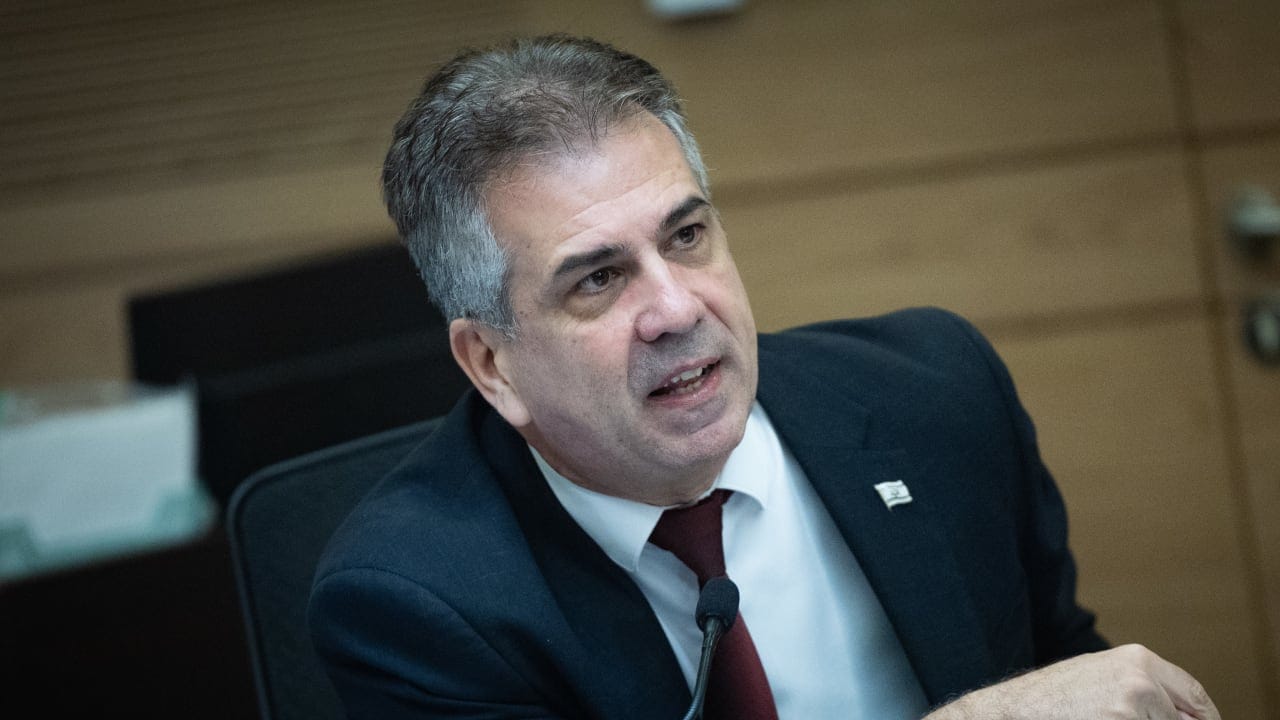
Israel has a rare opportunity to bring down Iran’s regime and could succeed in doing so, though the war may last a few more weeks as Operation Roaring Lion continues, Energy Minister Eli Cohen told The Jerusalem Post on Thursday.
The joint Israel-US operation against the regime began on Saturday, leading to ongoing Iranian missile strikes targeting Israel. Cohen, a member of Israel’s Security Cabinet, said that the operation was “historic” and was already significantly changing the reality in the Middle East.
“This is the opportunity,” Cohen told the Post, adding that he believed it was currently the best timing possible to topple the regime.

There has been much speculation about how long the operation will take to complete, with some reports saying it could last a couple of weeks and others suggesting it could extend into April.
US President Donald Trump said on Monday that the war could take up to four or five weeks to meet its objectives, and possibly longer.
“There are operational timelines, and so far, we are meeting them,” Cohen told the Post. “We estimate that some time will be required in order to complete the entire plan.”
“There is an assessment that it could take a few weeks,” he said, though the energy minister stressed that “There isn’t anything definitive yet.”
“We will continue the operation as long as required, because we understand that the window of opportunity is very unique,” he added.
US and Israel a ‘deadly combination’
Speaking on Operation Roaring Lion, Cohen said that there was no doubt Israel was in “historic days amid a very important campaign against Iran.”
He stated that the coordination between the United States and Israel has led to “a very strong and deadly combination.”
“We saw the opening strike in which we succeeded in eliminating the top Iranian leadership, headed by the murderous dictator [Supreme Leader Ayatollah Ali] Khamenei. This came after years in which he led Iran into economic decline, harmed human rights, harmed democracy, harmed women’s rights, and disrupted global trade and shipping routes.”
“The capabilities of the United States and Israel are leading to aerial dominance over Iranian airspace in a way that allows us to certainly continue these operations.”
Speaking on the significance of the campaign, Cohen explained that “Iran is the main source of instability in the Middle East and the number one sponsor of terrorism in the world today.”
“The war against its nuclear program is not only important for Israel, but also for the entire world,” Cohen said.
“Because if Iran had obtained nuclear weapons, we would have seen a nuclear arms race here in the Middle East that would also affect the international level, and it would turn our region into a much less safe place, along with the world as a whole.”
Cohen also said that there was “a top American interest here to prove that the United States is the strongest country in the world.”
He noted that the United States wants to show how US President Donald Trump is the leader of the free world, and is acting against a state that wants to obtain weapons of mass destruction, that suppresses its own citizens, and intimidates the countries surrounding it.”
Regarding the current operation’s effectiveness, Cohen said, “We see that Iran is losing its legitimacy day by day, as more and more countries join the coalitions against it.”
“This leads to one conclusion: this regime cannot remain in place. More than 70% of the Iranian people do not want this regime to remain.”
“The issue is that about 20% do support the regime, they hold weapons, they hold power, they shut down the internet, and violently suppress, through massacres, the people who want to protest.”
“But I hope that the actions of the United States and Israel will indeed give them the opportunity to move forward and ultimately reach where they want to go,” he told the Post.
Regarding operations in the Energy Ministry, Cohen said: “It’s been proven that Israel has a strong and resilient energy sector.”
“We saw that in previous rounds of fighting, when missiles fell in Israel, and there were hits on infrastructure facilities, Israel did not lack, not even for a second, electricity, gas, water, or fuel,” Cohen remarked.
“We have a very decentralized energy system. We produce energy from gas, diesel, coal, and solar energy, spread across the country.”
“So we have an energy sector that knows how to operate even under missile attacks and continues to supply all the needs of the energy economy.”
Cohen explained that, during missile strikes, it is sometimes necessary to conduct certain shutdowns, but asserted that the Energy Ministry would be able to provide the required energy response regardless.