
Summary
If you’re just joining us, here is a quick recap of the day so far:
The US granted Indian refiners a 30-day waiver to buy Russian oil after the US-Israel war on Iran sparked fears of a supply crunch, lifting global prices. Barely a month ago, Donald Trump claimed India had agreed to stop purchasing oil from Russia, in a shift that he said would “help END THE WAR in Ukraine” by cutting off a key source of funds for Moscow. The US treasury secretary, Scott Bessent, insisted this temporary waiver, designed “to enable oil to keep flowing” into the market, “will not provide significant financial benefit to the Russian government”.
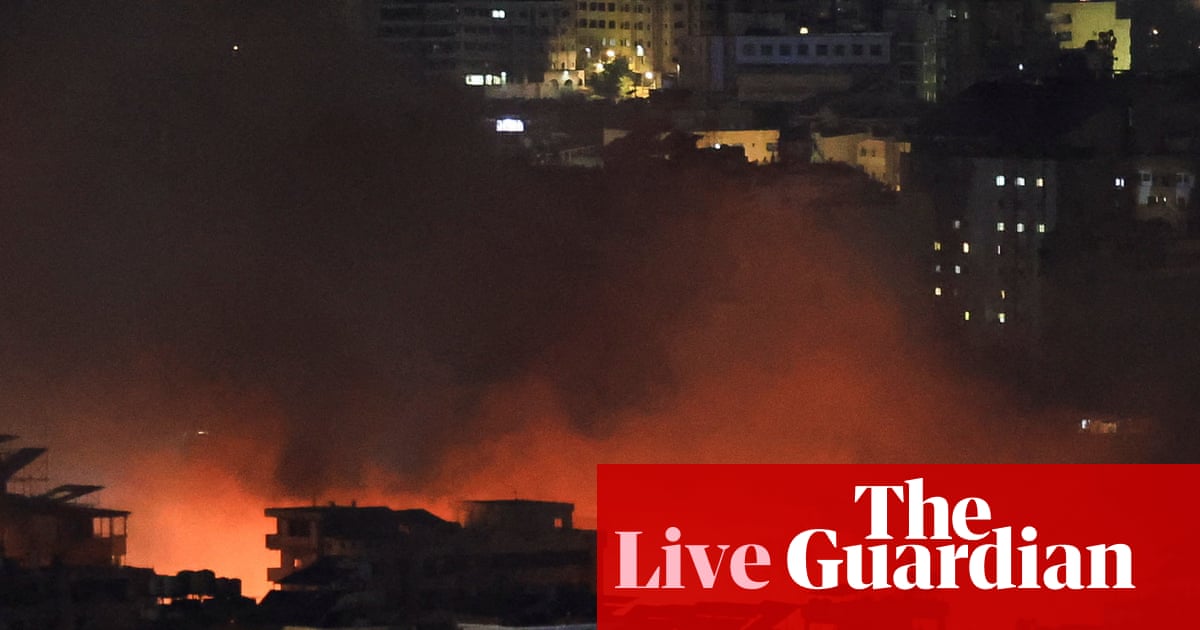
The IDF carried out a wave of 26 strikes on what it describes as Hezbollah infrastructure in the Dahiya neighbourhood, a densely populated commercial and residential area in the southern suburbs of Beirut. The IDF had earlier issued forced evacuation orders for the whole population of Beirut’s southern suburbs – home to 500,000 people – sparking widespread panic and leading to huge queues of traffic as people tried to flee. It comes in spite of calls from world leaders including Emmanuel Macron urging Israel not to expand the war into Lebanon. According to the Lebanese health ministry, Israeli strikes have killed at least 123 people and injured 683 in Lebanon since Monday.
Trump has pushed back against Iranian claims that it is ready for a ground invasion by US and Israeli forces. “They’ve lost everything. They’ve lost their navy,” the US president told NBC News, without citing evidence for the claim. “They’ve lost everything they can lose.” More on that here.
The Iranian leadership council met ahead of selecting new supreme leader, state media reported. State TV reported a leadership council met and discussed how to hold a meeting of the country’s Assembly of Experts, which will select the nation’s new supreme leader. The statement provided no timeline on the selection of the supreme leader, nor information on whether the assembly would meet in person or remotely for the vote.
Trump also said he must “be involved in the appointment” of Iran’s next leader as he was in Venezuela, and dismissed the idea of the assassinated ayatollah’s son, Mojtaba Khamenei, succeeding his father as supreme leader as “unacceptable”. Trump has spoken in vague terms about who he wants to lead the country, but declined to provide specific names. More on that here.
The war has escalated each day, now affecting an additional 14 countries across the Middle East and beyond. On Thursday, Azerbaijan accused Iran of drone attacks, which Tehran denied.
The first government-chartered plane evacuating British nationals has landed in the UK. The plane took off from Muscat, the capital of Oman, at 1.36pm GMT on Thursday and arrived at London Stansted just before 1am on Friday. More on that here.
Meanwhile, the US House of Representatives has voted down a Democratic-backed measure to halt hostilities with Iran, as Republicans cleared the way for Trump to continue the conflict that has drawn in countries across the Middle East, but criticised as having unclear goals. Our story here.
The UK’s defence secretary, John Healey, has declined to rule out Britain joining US-Israeli strikes on Iran. More on that here.
Canada’s top general said allies were in talks about possibly helping Gulf states defend themselves. The defence chief, Gen. Jennie Carignan, said a meeting was set for Friday to discuss such a proposal among allied militaries, and the Canadian Armed Forces would present a recommendation to the Canadian government. She did not specify what type of support this might involve but said Canada is not taking part in the US bombing of Iran and confirmed the discussions were not about participating in Operation Epic Fury.
The Ukrainian president, Volodymyr Zelenskyy, said he received a request from the US “for specific support” in dealing with Iran’s Shahed attack drones, as the US and its allies in the Middle East seek Ukraine’s expertise in countering such attacks from Russia. “I gave instructions to provide the necessary means and ensure the presence of Ukrainian specialists who can guarantee the required security,” Zelenskyy wrote on X. More on that here.
Key events
Show key events only
Please turn on JavaScript to use this feature
 Jamie Grierson
The UK deputy prime minister, David Lammy, has said that 6,500 people have now returned to the UK from the UAE since the US and Israel launched its attacks on Iran.
Lammy confirmed the numbers to broadcasters including Sky News and the BBC today.
ShareIsrael announces new phase in Iran conflict as US warns strikes will ‘surge dramatically’
Israeli attacks hit the Iranian capital Tehran overnight as the IDF announced a “new stage” in its campaign against Iran, with US and Israeli officials hinting at escalating strikes.
The Israel Defense Forces (IDF) chief of staff Lt Gen Eyal Zamir said his military has completed the initial stage of “surprise opening blow” and that it was “now moving to the next phase of the campaign” with surprises ahead.
“We will intensify the strike on the foundations of the regime and its military capabilities,” he said in a statement carried by the Times of Israel.
“We have additional surprising moves in our hands, which I do not intend to reveal.”
His remarks followed an announcement by US defence secretary Pete Hegseth that “firepower over Iran and over Tehran is about to surge dramatically”.
US president Donald Trump has ruled out sending troops to Iran, saying it would be a “waste of time”, but indicated he would like to see Iran’s leadership structure removed. “We want to go in and clean out everything,” he said.
The IDF also conducted renewed strikes against what it described as Hezbollah strongholds in Beirut, the Lebanese capital. Hundreds of thousands of people in the southern suburbs of the city were ordered to leave their homes by the IDF yesterday, causing scenes of panic.
Iran’s Islamic Revolutionary Guard Corps (IRGC) said they had fired missiles towards Tel Aviv after an earlier wave of explosions caused a blaze at a residential building in the city.
Updated at 02.52 EST
Summary
If you’re just joining us, here is a quick recap of the day so far:
The US granted Indian refiners a 30-day waiver to buy Russian oil after the US-Israel war on Iran sparked fears of a supply crunch, lifting global prices. Barely a month ago, Donald Trump claimed India had agreed to stop purchasing oil from Russia, in a shift that he said would “help END THE WAR in Ukraine” by cutting off a key source of funds for Moscow. The US treasury secretary, Scott Bessent, insisted this temporary waiver, designed “to enable oil to keep flowing” into the market, “will not provide significant financial benefit to the Russian government”.
The IDF carried out a wave of 26 strikes on what it describes as Hezbollah infrastructure in the Dahiya neighbourhood, a densely populated commercial and residential area in the southern suburbs of Beirut. The IDF had earlier issued forced evacuation orders for the whole population of Beirut’s southern suburbs – home to 500,000 people – sparking widespread panic and leading to huge queues of traffic as people tried to flee. It comes in spite of calls from world leaders including Emmanuel Macron urging Israel not to expand the war into Lebanon. According to the Lebanese health ministry, Israeli strikes have killed at least 123 people and injured 683 in Lebanon since Monday.
Trump has pushed back against Iranian claims that it is ready for a ground invasion by US and Israeli forces. “They’ve lost everything. They’ve lost their navy,” the US president told NBC News, without citing evidence for the claim. “They’ve lost everything they can lose.” More on that here.
The Iranian leadership council met ahead of selecting new supreme leader, state media reported. State TV reported a leadership council met and discussed how to hold a meeting of the country’s Assembly of Experts, which will select the nation’s new supreme leader. The statement provided no timeline on the selection of the supreme leader, nor information on whether the assembly would meet in person or remotely for the vote.
Trump also said he must “be involved in the appointment” of Iran’s next leader as he was in Venezuela, and dismissed the idea of the assassinated ayatollah’s son, Mojtaba Khamenei, succeeding his father as supreme leader as “unacceptable”. Trump has spoken in vague terms about who he wants to lead the country, but declined to provide specific names. More on that here.
The war has escalated each day, now affecting an additional 14 countries across the Middle East and beyond. On Thursday, Azerbaijan accused Iran of drone attacks, which Tehran denied.
The first government-chartered plane evacuating British nationals has landed in the UK. The plane took off from Muscat, the capital of Oman, at 1.36pm GMT on Thursday and arrived at London Stansted just before 1am on Friday. More on that here.
Meanwhile, the US House of Representatives has voted down a Democratic-backed measure to halt hostilities with Iran, as Republicans cleared the way for Trump to continue the conflict that has drawn in countries across the Middle East, but criticised as having unclear goals. Our story here.
The UK’s defence secretary, John Healey, has declined to rule out Britain joining US-Israeli strikes on Iran. More on that here.
Canada’s top general said allies were in talks about possibly helping Gulf states defend themselves. The defence chief, Gen. Jennie Carignan, said a meeting was set for Friday to discuss such a proposal among allied militaries, and the Canadian Armed Forces would present a recommendation to the Canadian government. She did not specify what type of support this might involve but said Canada is not taking part in the US bombing of Iran and confirmed the discussions were not about participating in Operation Epic Fury.
The Ukrainian president, Volodymyr Zelenskyy, said he received a request from the US “for specific support” in dealing with Iran’s Shahed attack drones, as the US and its allies in the Middle East seek Ukraine’s expertise in countering such attacks from Russia. “I gave instructions to provide the necessary means and ensure the presence of Ukrainian specialists who can guarantee the required security,” Zelenskyy wrote on X. More on that here.
ShareSri Lanka takes control of an Iranian vessel off its coast after US sunk an Iranian warship
Sri Lanka began transferring more than 200 sailors from an Iranian vessel to shore on Friday after the ship sought assistance while anchored outside the country’s waters, AP reports.
The move comes amid mounting tensions in the Indian Ocean, following the sinking of an Iranian warship by a US submarine.
Sri Lanka navy spokesperson, commodore Buddhika Sampath, said the sailors of the IRIS Bushehr were being brought first to the port of Colombo and the ship will later be moved to an eastern port on the island.
“The disembarkation is in progress,” he said, adding the sailors would be taken to the naval base at Welisara, about 20 kilometres north of Colombo, after medical exams and immigration procedures.
ShareIranian leadership council meets ahead of selecting new supreme leader, state media says
Iranian state television said on Friday that a leadership council met and discussed how to hold a meeting of the country’s Assembly of Experts, which will select the nation’s new supreme leader, AP reports.
The leadership council includes President Masoud Pezeshkian, judiciary chief Gholam Hossein Mohseni Ejehi and cleric Ayatollah Ali Reza Arafi.
The statement provided no timeline on the selection of the supreme leader, nor information on whether the assembly would meet in person or remotely for the vote.
The assembly has been meeting virtually, after their compound in the city of Qom was hit by Israeli strikes.
Donald Trump has said he must “be involved in the appointment” of Iran’s next leader and dismissed the idea of the assassinated ayatollah’s son, Mojtaba Khamenei, who is being heavily tipped to succeed his father, as “unacceptable”.
Iranian foreign minister Abbas Araghchi later told NBC it was “the business of Iranian people” to decide who will succeed the former Supreme leader Ayatollah Ali Khamenei.
ShareIsrael carried out 26 airstrikes on Beirut, IDF says
The Israel Defence Force says it conducted “a broad-scale wave” of 26 strikes in the Dahieh area of Lebanon overnight, targeting Hezbollah infrastructure.
double quotation mark”Among the targets were an executive council’s command center and a facility storing UAVs used for attacks against Israel.
The IDF had earlier issued forced evacuation orders for the whole population of Beirut’s southern suburbs – home to 500,000 people – sparking widespread panic and leading to huge queues of traffic as people tried to flee.
It comes in spite of calls from world leaders including Emmanuel Macron urging Israel not to expand the war into Lebanon. According to the Lebanese health ministry, Israeli strikes have killed at least 123 people and injured 683 in Lebanon since Monday.
Lebanon’s Iran-backed Hezbollah militia warned Israeli residents on Friday to evacuate towns within 5 km (3 miles) of the border.
“Your military’s aggression against Lebanese sovereignty and safe citizens, the destruction of civilian infrastructure and the expulsion campaign it is carrying out will not go unchallenged,” Hezbollah said in a message posted on its Telegram channel in Hebrew.
Iran and Lebanon were hit with a wave of intense Israeli strikes overnight.
Israel’s military said Friday morning it had begun “a broad-scale wave of strikes” on Tehran, Iran’s capital.
Witnesses described the airstrikes as particularly intense, shaking homes in the area. Others reported explosions around the Iranian city of Kermanshah in an area that is home to multiple missile bases, AP reported.
In Lebanon, Israel launched a series of airstrikes late Thursday into Friday in the southern suburbs of Beirut and other areas. Motorists jammed roads trying to flee or seek shelter.
Meanwhile, Iran fired missile and drone attacks into Kuwait, Qatar, Saudi Arabia and Bahrain on Friday, all countries that host US forces. There were no immediate reports of casualties.
Fire blazing at the site of an Israeli airstrike that targeted Beirut’s southern suburbs Haret Hreik neighborhood on March 5, 2026. Photograph: Anwar Amro/AFP/Getty ImagesPeople walk past wreckage of Qard al-Hassan building, the financial institution of pro-Iranian Hezbollah that was destroyed in an Israeli air raid in the village of Douirs, in Lebanon eastern Bekaa valley. Photograph: ZUMAPRESS.com/AvalonA displaced boy with his family fleeing Israeli airstrikes in Beirut’s southern suburb of Dahiyeh sets fire to warm themselves on the Beirut corniche in Lebanon. Photograph: Hussein Malla/APSmoke rises from the site of an Israeli airstrike that targeted Beirut’s southern suburbs on March 5, 2026. Photograph: Ibrahim Amro/AFP/Getty ImagesLebanese boys, on their bicycles near the wreckage of Qard al-Hassan building in the village of Douirs, in Lebanon eastern Bekaa valley. Photograph: Marwan Naamani/ZUMA Press Wire/ShutterstockMourners carry the coffins of victims, draped with pro-Iranian Hezbollah flag, who were killed in an Israeli air raid in the city of Baalbek, in Lebanon eastern Bekaa valley. Photograph: Marwan Naamani/ZUMA Press Wire/ShutterstockSmoke rises over buildings following explosions in the central region of the city of Tehran, Iran. Photograph: Majid Saeedi/Getty ImagesThe 12,000-seat hall of Azadi Sports Complex in Tehran, Iran, was destroyed following U.S-Israeli strikes on Thursday. Photograph: EPN/Newscom/AvalonA man stands overlooking the city of Tehran with mountain skyline, during the air attacks by US and and Israel. Photograph: Arash Khamooshi/Polaris/eyevineA mourner holds a portrait of Iran’s slain supreme leader Ayatollah Ali Khamenei on March 5, 2026, during a funeral procession for members of Iraq’s pro-Iran paramilitary group Hezbollah Brigades (Kataeb Hezbollah) who were killed in a strike in Baghdad the previous day. Photograph: Ahmad Al-Rubaye/AFP/Getty ImagesIranian flags hang from a building in Shahid Borujerdi residential complex in south east Tehran which was heavily struck and destroyed by Israel and U.S. during Operation Epic Fury. Photograph: Kaveh Kazemi/Getty ImagesSharePhilippines mulls shorter weeks, less air-con as fuel costs bite
The Philippines government is urging the country to limit their air conditioner use and restrict non-essential travel while it mulls a four-day working week, as tensions in the Middle East push global fuel costs higher, Bloomberg reports.
The country imports nearly all of its oil, and the war in Iran could spur inflation that already hit a 13 month high in February.
Its department of energy said while it does not import crude oil directly from Iran, its dependence on the region leaves makes it vulnerable when shipping lanes are disrupted.
President Ferdinand Marcos Jr.’s administration this week ordered government offices to set their air-cons to no lower than 24 degrees C (75 degrees fahrenheit) and adopt flexible work arrangements to help conserve fuel.
Marcos, who plans to seek emergency authority from Congress to slash taxes on petroleum products, is also entertaining the idea of a four-day work week.
Some government agencies have said they will provide fuel subsidies to fisherfolk, farmers and public transport drivers.
Protesters burn a composite image depicting (L-R) United States President Donald Trump, Philippine President Ferdinand Marcos Jr., and Israel Prime Minister Benjamin Netanyahu during a rally near the US embassy in Manila, Philippines, 06 March 2026. Photograph: Rolex dela Peña/EPAShare
Updated at 01.18 EST
Two Japanaese nationals detained in Iran, Japan calls for release
Two Japanese nationals have been detained in Iran, Japan’s Foreign Ministry said on Friday and requested the early release of both people.
Japan hasn’t confirmed the names of the two citizens, but said one person had been detained before the US-Israel military strikes on Iran.
The ministry said the detainees are safe in good health.
The Committee to Protect Journalists has named the one of the detainees as Shinnosuke Kawashima, the Tehran bureau chief of Japanese public broadcaster NHK. Its report quoted an unidentified source who spoke on condition of anonymity due to fear of retribution.
The committee said Kawashima was arrested on 20 January by the Islamic Revolutionary Guard Corps and was transferred on 23 February to Evin Prison.
ShareEvacuated British nationals return to UK, as crisis continues to disrupt flights
The first government-chartered plane evacuating British nationals back to the UK from the Middle East touched down on Friday.
The plane took off from Muscat, the capital city of Oman, at 1.36pm GMT on Thursday and arrived at London Stansted just before 1am on Friday.
More than 140,000 Britons have registered their presence in the Middle East with the Foreign Office and 4,000 have returned home so far.
In Australia, passengers who had secured seats on the first flight from Abu Dhabi to Sydney, said only about a third of its seats were filled, prompting accusations against the Australian government that it was not doing enough to fill the planes, AAP reports.
A passenger said she had to use her own connections to find a flight out but many others were struggling to board a flight. Foreign minister Penny Wong said she was disappointed at reports flights were arriving with hundreds of empty seats and was seeking to “work even more closely with the airlines”.
Emirates and Etihad Airways resumed limited flight schedules to key global cities from their United Arab Emirates hubs on Friday, though the ongoing threat of missile fire piled pressure on airlines as they scrambled to accommodate travellers.
With most airspace in the Middle East still closed over missile and drone concerns since the start of the US-Israel war against Iran, authorities have been arranging charter flights and securing seats on limited commercial services to evacuate tens of thousands of people.
A government-chartered Air France flight to bring French nationals back from the United Arab Emirates was forced to turn back on Thursday due to missile fire in the area, French transport minister Philippe Tabarot said.
A family from Yorkshire who were living in Dubai greet a relative, as passengers from the first government‑chartered flight for British nationals, which departed from Oman, arrive at London Stansted Airport. Photograph: Isabel Infantes/ReutersShareTrump responds to Iranian claims that ground invasion would be ‘big disaster’ Callum Jones
Donald Trump has pushed back against Iranian claims that it is ready for a ground invasion by US and Israeli forces.
“It’s a waste of time,” the US president told NBC News. “They’ve lost everything. They’ve lost their Navy. They’ve lost everything they can lose.”
He was responding to Iranian foreign minister Abbas Araghchi, who told the US network on Thursday that such a move would be a “big disaster” for the US and Israel. “We are confident that we can confront them,” said Araghchi.
In a phone interview with NBC, Trump also spoke further about his plan to influence the future of Iran – talking in vague terms about who he wants to lead the country, but declining to name names.
“We want to go in and clean out everything,” said Trump. “We don’t want someone who would rebuild over a 10-year period.”
“We want them to have a good leader,” he added. “We have some people who I think would do a good job.”
ShareGulf states intercept missiles amid reports of regional discontent
Persian Gulf states have fended off a wave of Iranian missiles, amid reports of growing frustrations within the nations the US is not providing its partners with enough warning or support.
The Qatari defence ministry said air defences thwarted a drone attack targeting the US air base at Al-Udeid, Washington’s largest military facility in the Middle East on Friday.
double quotation markQatar Emiri Air Defense Forces successfully intercepted a drone attack targeting Al-Udeid Air Base.
Meanwhile, Saudi Arabia’s defence ministry said it had “intercepted and destroyed” three ballistic missiles launched towards an air base.
In Kuwait, air defences were working to intercept “hostile missile and drone attacks,” the Kuwait army said in a post to X.
The Trump administration is confronting mounting discontent from allies in the Gulf who have complained they were not given adequate time to prepare for the torrent of Iranian drones and missiles bombarding their countries in retaliation for strikes launched by the US and Israel, AP reports.
A Gulf official, who spoke on the condition of anonymity, told AP Gulf countries were frustrated and angry, and there was a belief in the region that the operation has focused on defending Israel and American troops, while leaving Gulf countries to protect themselves.
The White House said Donald Trump was in close contact with its regional partners.
ShareExplosions in Tehran, as Israel launches more strikes
Israel said it launched a wave of strikes on Tehran early Friday, targeting “regime infrastructure” in the Iranian capital.
Israeli forces launched a large-scale “wave of strikes against Iranian terror regime infrastructure in Tehran”, a military statement said.
Iranian state TV reported explosions in several parts of the city.
The 12,000-seat hall of Azadi Sports Complex in Tehran, Iran, was destroyed following U.S-Israeli strikes on Thursday March 5, 2026. Photograph: EPN/Newscom/AvalonThe Diplomatic Police Center was targeted during US – Israeli strikes on Iran, leaving the building destroyed and causing damage to surrounding structures.
Photograph: Sobhan Farajvan/Pacific Press/ShutterstockShop owners clean up the rubble caused by missile explosion in the vicinity of a building in Shahid Borujerdi residential complex in south east Tehran which was heavily struck and destroyed by Israel and U.S. during Operation Epic Fury. Photograph: Kaveh Kazemi/Getty ImagesShare
Updated at 22.25 EST
Hezbollah warns Israeli residents to evacuate near border
Lebanon’s Hezbollah warned Israeli residents to evacuate towns within 5 km (3.11 miles) of the border between the countries in a message posted on its Telegram channel in Hebrew early on Friday, Reuters reports.
double quotation markYour military’s aggression against Lebanese sovereignty and safe citizens, the destruction of civilian infrastructure and the expulsion campaign it is carrying out will not go unchallenged.
Hezbollah’s message comes as the Israeli army began a new wave of strikes on Beirut’s southern suburbs, after earlier issuing forced evacuation orders for the area’s whole population – home to 500,000 people.
Cross-border fighting intensified on Monday, after Hezbollah launched missiles and drones towards Israel in retaliation for the killing of Iran’s supreme leader, Ayatollah Ali Khamenei.
Israel has said it will not evacuate its border towns and has sent more soldiers into Lebanon, saying this was a defensive measure meant to protect its citizens who live nearby.
Updated at 23.34 EST
Ukraine to help US and allies counter Iranian drones
Ukraine will help the US and its allies counter Iran’s Shahed drones, Ukrainian president Volodymyr Zelenskyy has said, after the US requested assistance.
Russia has sent tens of thousands of Shaheds into Ukraine since it invaded its neighbour just over four years ago, at one point launching a swarm of more than 800 drones and decoys in its biggest night-time barrage.
Iran has responded to joint US-Israeli strikes by launching the same type of drones at countries in the Middle East.
In a post to social media, Zelenskyy said he had received a US request for support to defend against the drones in the Middle East and had given the order for equipment to be provided along with Ukrainian experts, without providing further details.
double quotation markUkraine helps partners who help our security and the protection of our people’s lives.
Ukraine has pioneered the development of cut-price drone-killing equipment that cost as little as $1,000, rewriting the air defence rulebook and making other countries take notice.
President of Ukraine Volodymyr Zelenskyy speaks during a joint briefing with government officials on 6 March. Photograph: Danylo Antoniuk/Ukrinform/Cover ImagesShare
Updated at 21.46 EST
Opening summary
Hello and welcome to our continuing coverage of the US-Israeli war on Iran.
The US treasury secretary, Scott Bessent, has just announced that the US has issued a 30-day waiver to allow Indian refiners to purchase Russian oil.
The remarkable u-turn comes amid concerns in markets around the world that there will be no quick resolution to the conflict in the Middle East.
“This deliberately short-term measure will not provide significant financial benefit to the Russian government as it only authorizes transactions involving oil already stranded at sea,” Bessent added.
The treasury secretary said the “stop-gap measure” was implemented in response to what he called “Iran’s attempt to take global energy hostage”.
On Tuesday, Donald Trump said the US navy would begin escorting tankers through the strait of Hormuz, which Iran has effectively closed off, “if necessary”.
The IDF has begun striking what it describes as Hezbollah infrastructure in densely populated commercial and residential areas in the southern suburbs of Beirut. The IDF had earlier issued forced evacuation orders for the whole population of Beirut’s southern suburbs – home to 500,000 people – sparking widespread panic and leading to huge queues of traffic as people tried to flee. It comes in spite of calls from world leaders including Emmanuel Macron urging Israel not to expand the war into Lebanon. According to the Lebanese health ministry, Israeli strikes have killed at least 123 people and injured 683 in Lebanon since Monday.
Here are the other key developments of the past few hours:
Iran is ready to face American troops, if there is a ground invasion, Iranian foreign minister Abbas Araghchi told NBC. Trump has sent mixed signals about whether he is willing to deploy US forces in a “boots on the ground” capacity. Araghchi said there would be “no winner in this war” and Iran is not asking for a ceasefire.
Donald Trump has claimed – without evidence – that Iran’s air force and navy are “gone”. Speaking during an event at the White House, the US president said: “We’re destroying more of Iran’s missile and drone capability every single hour – knocking them out.” He went on: “So [Iran] have no air force, they have no air defence. All of their airplanes are gone, their communications are gone. Other than that, they’re doing quite well. Their navy is gone, [they lost] 24 ships in three days, that’s a lot of ships,” he said, along with 60% of Iran’s missiles and 64% of its missile launchers.” Echoing comments he made earlier this week, Trump added that the US military and Israel are “totally demolish[ing]” Iranian targets “far ahead of schedule”.
The US president also said he must “be involved in the appointment” of Iran’s next leader as he was in Venezuela, and dismissed the idea of the assassinated ayatollah’s son, Mojtaba Khamenei, succeeding his father as supreme leader as “unacceptable”. More on that here.
The Trump administration has meanwhile allowed Indian refiners to buy Russian oil for 30 days – just a month after Trump claimed India had agreed to stop purchasing it, in a shift that he said would “help END THE WAR in Ukraine” by cutting off a key source of funds for Russia. Today US treasury secretary Scott Bessent claimed the reversal “will not provide significant financial benefit” to Moscow. More details here.
The war has escalated each day, now affecting an additional 14 countries across the Middle East and beyond. On Thursday, Azerbaijan accused Iran of drone attacks, which Tehran denied.
Meanwhile, the US House of Representatives has voted down a Democratic-backed measure to halt hostilities with Iran, as Republicans cleared the way for Trump to continue the conflict that has drawn in countries across the Middle East, but criticized as having unclear goals. Our story here.
The UK’s defence secretary John Healey declined to rule out Britain joining US-Israeli strikes on Iran. More on that here.
Canada’s top general said allies were in talks about possibly helping Persian Gulf States defend themselves. Defence chief Gen. Jennie Carignan said a meeting was set for Friday to discuss such a proposal among allied militaries, and the Canadian Armed Forces would present a recommendation to the Canadian government. She did not specify what type of support this might involve but said Canada is not taking part in the US bombing of Iran and confirmed the discussions were not about participating in Operation Epic Fury.
Ukrainian president Volodymyr Zelenskyy said he received a request from the United States “for specific support” in dealing with Iran’s Shahed attack drones, as the US and its allies in the Middle East seek Ukraine’s expertise in countering such attacks from Russia. “I gave instructions to provide the necessary means and ensure the presence of Ukrainian specialists who can guarantee the required security,” Zelenskyy wrote on X. “Ukraine helps partners who help ensure our security and protect the lives of our people.” More on that here.