
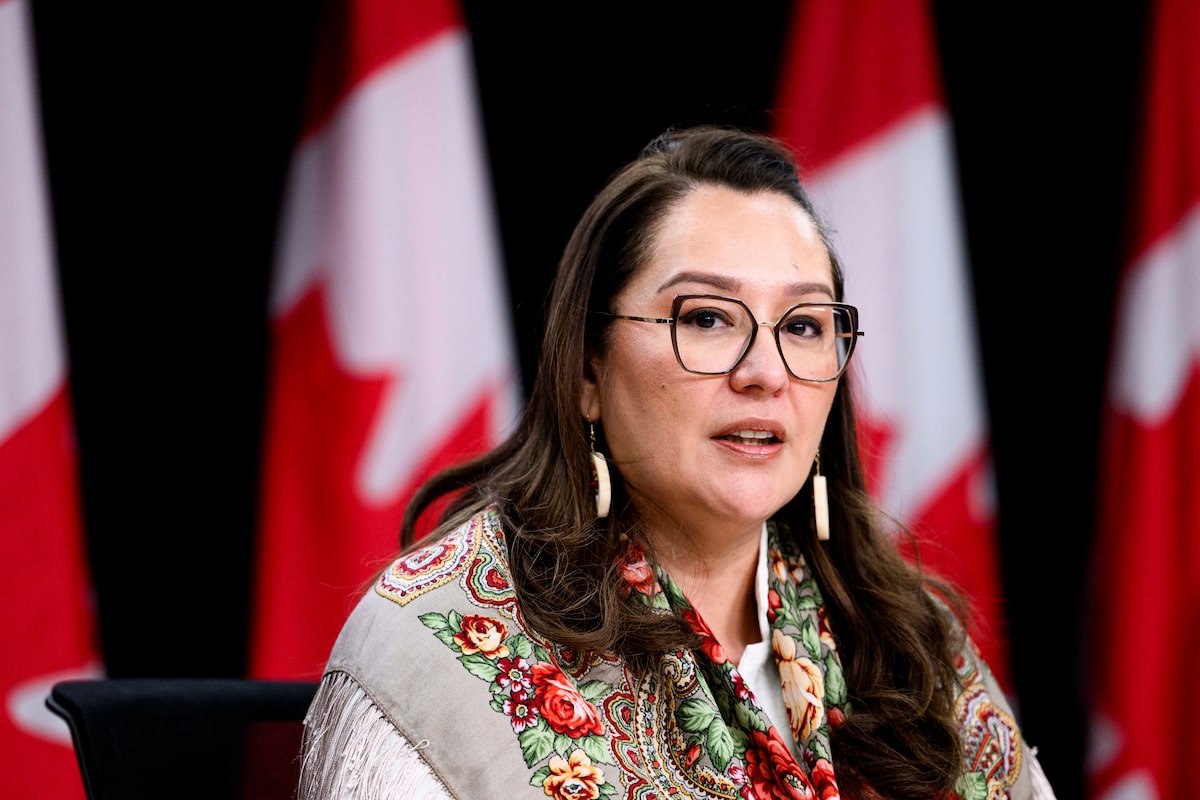
Minister of Indigenous Services Mandy Gull-Masty says she has had an open dialogue with Kashechewan First Nation Chief Hosea Wesley since the beginning of the emergency.Spencer Colby/The Canadian Press
Kashechewan First Nation in Northern Ontario is calling for Indigenous Services Minister Mandy Gull-Masty’s resignation after waiting more than two months for her to visit the community or its members, most of whom were evacuated in January because of a state of emergency.
More than 1,700 members of the fly-in community located near the James Bay Coast are now staying in hotels in five Ontario host cities: Cochrane, Niagara Falls, Kingston, Timmins and Kapuskasing, Kashechewan executive director Tyson Wesley said.
It has been more than 60 days since community members had to evacuate and the minister has been repeatedly asked to visit or meet evacuees where they are staying, the nation said in a Thursday news release.
The community declared a state of emergency on Jan. 4 because of the state of its water and wastewater treatment plant, which is more than three decades old.
“Leadership in a crisis means showing up,” Chief Hosea Wesley said in the release. “Families are struggling, Elders are displaced, and our community is grieving. Yet the Minister Responsible for Indigenous Services has not come to see the situation for herself.”
Federal government commits $1.55-billion for First Nations children
The minister issued her own statement on Thursday evening. “Kashechewan First Nation is facing an incredibly difficult situation,” she said.
“The safety of community members has guided every decision taken during this emergency response,” she added. “Our focus from the outset has been to mobilize quickly, protect residents, and ensure that people have the services and support they need during an extremely difficult time.”
She also said she has had an open dialogue with Chief Wesley since the beginning of the emergency.
Kashechewan said there are “infrastructure failures” as well as concerns about the spread of cryptosporidium – parasites that can cause respiratory and gastrointestinal illness.
A strict order is in place urging members not to consume the water and bottled water is being flown in for 280 people who remain in the community.
Cryptosporidium is believed to be prevalent in the water system in Kashechewan and there have been more than 80 confirmed cases, Mr. Wesley said, adding the actual number is suspected to be much higher. He said Indigenous Services Canada pays for the cost of bringing in the water, but it does not cover the cost of recycling, meaning the plastic bottles end up in a landfill.
This year’s evacuation is part of a broader trend: Kashechewan, which was built on a flood plain, has historically declared many states of emergency that have resulted in evacuations. Often, this occurs in the spring. In 2019, it signed an agreement with the provincial and federal governments to commit to moving the community. This has not happened, much to the dismay of long-time community members.
Indigenous Services Canada spokesperson Eric Head said in a statement last month the department approved $8.4-million to complete detailed planning studies for the community’s relocation.
Mr. Wesley, 36, said he has experienced evacuations dating back to childhood. “My story is everybody’s story in the community and having to deal with evacuations on a yearly basis.”
Ms. Gull-Masty was expected to visit the community at the end of February, but did not, Mr. Wesley added. “We got a last-minute response saying that she’s unable to come due to logistical issues.”
Additionally, the community said there have been six deaths since the evacuation, but it has not offered specifics on the circumstances. Mr. Wesley said it has deeply affected the community to have members at different locations because it means they cannot come together to bury people properly.
“In our culture, in any culture, death is a significant event,” he said. “It brings our whole community together.”
Ms. Gull-Masty said she acknowledges the “tragic loss of life in the community during this emergency.”
“While I have been working with urgency to support this emergency response, I regret not having been able to visit the community in person and remain committed to doing so,” she added.