
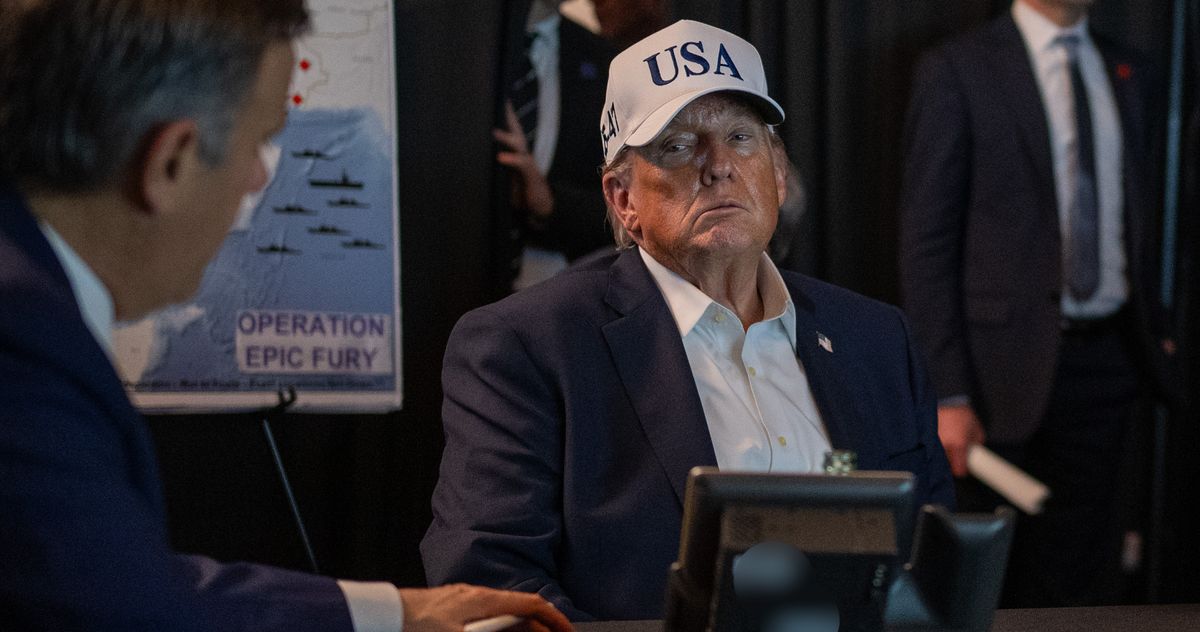
Photo: Daniel Torok/White House/Handout
Years from now, February 28, 2026, might be remembered as the day Israel finally lost the American public.
The Iran war, launched by the U.S. on that date and executed in direct coordination with Israel, is predictably a catastrophe, unleashing deadly chaos throughout the Middle East. American bombs are slaughtering Iranian civilians. Iranian rockets are terrorizing the Gulf States. The Strait of Hormuz, through which a significant portion of the world’s oil flows, is functionally closed, and energy prices are spiraling. At least six American troops are dead.
Invoking the quagmire of the Iraq War makes a great deal of sense at the moment, but the more chilling analog might be Vietnam. Iran is vast and has a fraught and byzantine political culture; Tehran lies at the center, far from any border, and the country is home to enormous mountains, deserts, and steppes. If Donald Trump makes the long-term troop commitments that the hawks in his administration desire, many more Americans are going to die. And there will still be no democracy in Iran. Ayatollah Ali Khamenei’s death won’t readily deliver it.
Why are we there? What are we doing? A majority of Americans are horrified or, at minimum, bewildered. It was Marco Rubio, the powerful secretary of State, who spoke the truth to reporters on Monday. “We knew that there was going to be an Israeli action,” Rubio said. “We knew that that would precipitate an attack against American forces … And we knew that if we didn’t preemptively go after them before they launched those attacks, we would suffer higher casualties.”
The comments made a dark reality plain: It was Israel, not just the U.S., that wanted Khamenei dead and were agitating for the sort of all-out war that past presidents, Republican and Democratic alike, understood carried too many risks to be worthwhile. The Iranian regime is vile and undeniably a state sponsor of terrorism; Israel, a sworn enemy of Iran, has reason to want regime change. But it’s been up to the U.S., as best as it could, to maintain a delicate balance in a volatile region. As dangerous as Iran might be, a nuclear attack was nowhere near imminent. After last year’s bombings, Trump boasted that the U.S. had destroyed whatever nuclear capacity Iran might possess. Barack Obama’s diplomacy — yielding the Iran nuclear accords — had found real success, but Trump tore them up because the Israeli government and its backers in the U.S. hate the idea of negotiating with Iran.
In their view, war is preferable. Benjamin Netanyahu, who has delighted in the slaughter of 60,000 Palestinians and the immiseration of Gaza in the wake of the October 7 attacks, has never met a war he did not like. Bloodshed has allowed him to cling to power. The far right that will effectively determine the future of Israel — even if a more moderate politician replaces Netanyahu, religious zealots and anti-Arab fanatics will continue to hold sway — has longed for a conflict like this one, and Netanyahu has delivered it. Rubio was forced to walk back his comments soon after (“If you tell the president of the United States that if we don’t go first, we’re going to have more people killed and more people injured, the president’s going to go first. That’s what he did.”), but the perception had already hardened. The U.S. was fighting Israel’s war.
The fiercest supporters of Israel in the United States do not quite understand that there is no going back. Gavin Newsom, California’s governor and a 2028 presidential front-runner, now calls Israel an “apartheid” state. A few years ago, this would have been unfathomable — a mainstream Democrat who spoke like this would have been ridiculed and censured, driven to the margins of the party. Even in 2024, the pro-Palestine “Uncommitted” movement was shunned at the Democratic National Convention. A year ago, few pundits anywhere imagined an Israel-skeptical Muslim could get himself elected mayor of New York City. We are in a new era, and it’s going to be a permanent one: Poll after poll shows that Americans under 40 take a startlingly dim view of Israel.
For a while, Israel hawks could dismiss these polls because they showed only the left-wing youth turning on the Jewish State. They were the radicals who could be, perhaps, nudged off the political stage. Now young people on the right, the MAGA youth, are coming to a similar place, if for different reasons: They view the special relationship between the two countries as a violation of America First. Some of this might be antisemitism; some of it, though, is genuine skepticism of an arrangement that doesn’t make sense to most Americans. It’s not as if the U.S. unconditionally arms other nations or gladly hurries into wars they might want to start.
The Iran war could be what decisively breaks the United States from Israel. Not yet — certainly not now, with Trump in the White House. But there will be presidents after Trump. A future Democrat will have no incentive to cater to the whims of a warmongering Israel. A Republican not explicitly bound to pro-Israel, right-wing Evangelicals might not care a great deal about Israel, either. Why should he? The American people do not want this war with Iran. They don’t want their brothers, sisters, sons, and daughters to die. They see this for what it is: a cataclysm.
Sign Up for the Intelligencer Newsletter
Daily news about the politics, business, and technology shaping our world.
Vox Media, LLC Terms and Privacy Notice