
Unlock the Editor’s Digest for free
Roula Khalaf, Editor of the FT, selects her favourite stories in this weekly newsletter.
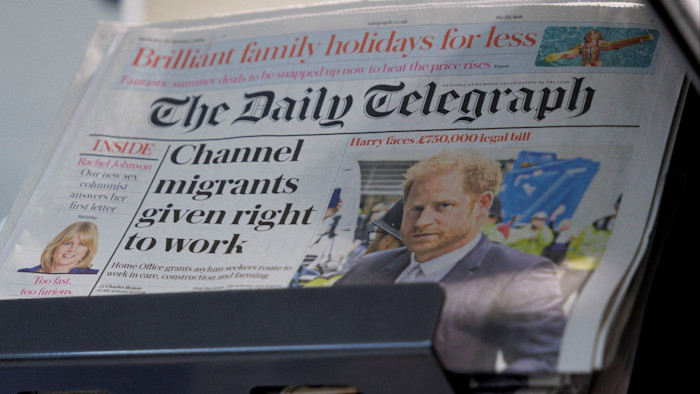
Media group Axel Springer has agreed to buy the Telegraph for £575mn in an unexpected move that gatecrashes the Daily Mail’s proposed acquisition of the UK newspaper and potentially brings a torturous three-year sale process to an end.
The deal will result in one of the UK’s oldest newspapers, which has strong links with the British establishment and Conservative Party, ending up in German ownership.
Britain’s Daily Mail had been close to securing a deal to take control of the Telegraph Media Group, a close rival, in what would have furthered the ambitions of its owner Lord Rothermere to create one of Fleet Street’s biggest media groups.
The FT first reported Axel Springer’s eleventh-hour interest in the Telegraph, as part of a consortium led by New York Sun owner Dovid Efune, last month.
However, in recent days the German publisher behind Bild and Politico started negotiating a deal on its own with RedBird IMI, the US-Emirati group that controlled the right-leaning newspaper.
One person close to the sale said that Axel Springer had moved rapidly to secure the deal, closing negotiations in just three days and paying significantly higher than the £500mn agreed with DMGT.
He added that it was a “knockout bid” that ended Rothermere’s hopes for the deal, describing it as the “ultimate plot twist” in a three-year saga to sell the newspaper.
“Axel Springer was founded in 1946 under a British press licence. He built his company inspired by the tradition of Fleet Street. The Telegraph was his North Star,” said Axel Springer chief executive Mathias Döpfner in a statement on Friday.
 Mathias Döpfner said: ‘Axel Springer was founded in 1946 under a British press licence. He built his company inspired by the tradition of Fleet Street. The Telegraph was his North Star’ © Getty Images
The prospect of the “Torygraph” having German owners will send shockwaves through the ranks of Conservative power brokers in Westminster.
The Telegraph, which was founded in 1855, has long championed Brexit, with many of its commentators maintaining a strong Eurosceptic editorial line in their opinion pieces.
While Döpfner is staunchly pro-European, the German billionaire has been critical of EU institutions and last year praised JD Vance after the US vice-president criticised EU officials for sidelining far-right parties.
In an email sent to staff on Friday, and seen by the FT, Döpfner said the Telegraph’s convictions were closely aligned with Axel Springer’s.
“We support the right of existence of the State of Israel and oppose all forms of antisemitism. We believe in the alliance between Europe and the United States. We stand for a free-market economy and reject extremism and discrimination in any form,” he said.
The deal will also give Axel Springer a long-coveted foothold in the British media industry, having been one of the groups that looked to acquire the Telegraph as long ago as 2004. It also attempted to acquire the FT in 2015.
Döpfner said the company’s dreams had “come true” and that Axel Springer wanted “to grow the Telegraph, while preserving its distinctive character and legacy, to help it become the most read and intellectually inspiring centre-right media outlet in the English-speaking world”.
Axel Springer said that it would invest to grow the newspaper as well as expand the group in the US, “leveraging the significant expertise of its media brands Politico and Business Insider”.
Efune told the FT that he was “glad to have played a meaningful role in guiding this positive outcome and helping secure the long-term future of the Telegraph”.
A protracted sales process has left the Telegraph without a permanent owner for about three years. The sale of the newspaper was kicked off when Lloyds Banking Group seized control after the Barclay family failed to repay debts secured against the newspaper it had owned since 2004.
A deal struck by RedBird IMI, the UAE-backed investment group, to buy the Telegraph was blocked by the then Conservative government, owing to concerns over passing control of an influential newspaper to a foreign state-backed fund.
Agreeing a deal with Axel Springer will be a relief for RedBird IMI, which has sought to extricate itself from the newspaper for months.
However, the sale will still be scrutinised by media watchdog Ofcom and the Competition and Markets Authority, although the bid is less likely to face the same issues as DMGT over competition and media plurality.
Additional reporting by Paola Tamma