
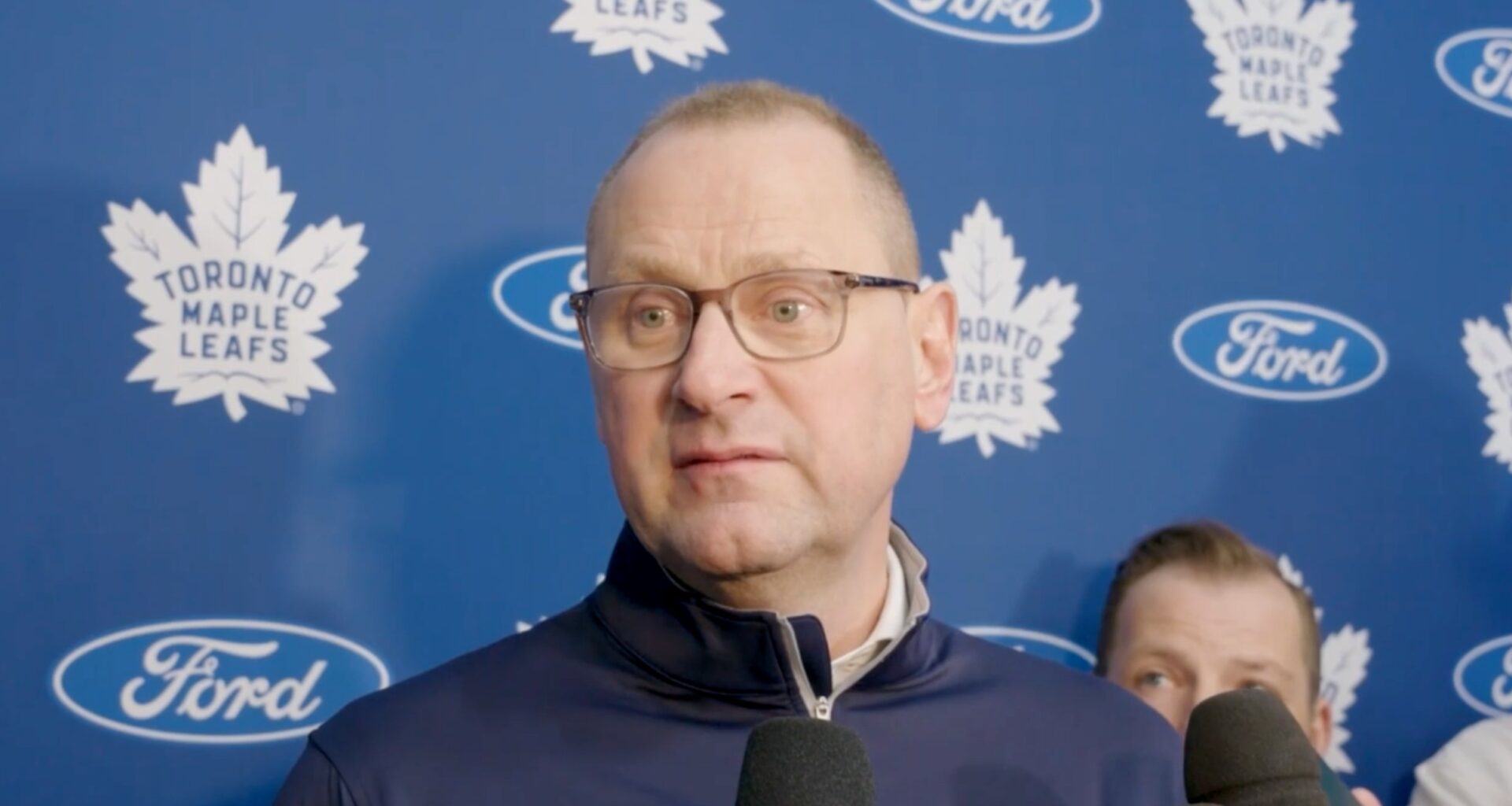
 Maple Leafs GM Brad Treliving After the conclusion of the 2026 trade deadline, GM Brad Treliving discussed the Nic Roy, Scott Laughton, and Bobby McMann trades.
How do you think you ended up in a situation where you were a seller at the deadline?
Treliving: Listen, I’ll answer all the questions and take responsibility for our season. I don’t look at today as the autopsy day. We have 19 games to go. But I think there are a whole host of reasons. I’ll take responsibility.
We met earlier in the year, around the 20-game mark. We got off to a slow start. Again, the failures here start with me. Once we get through the end of the season, there will be all sorts of evaluations. To start parsing through it now… We have games to play, but there is a lot (to go through). We got off to a poor start.
From my standpoint, I look at some roster construction issues, a lack of consistency, and the inability to maintain any kind of level. There have been a whole bunch of factors. We will get into that in due course.
How do you evaluate the work you got done on the deadline day as a whole?
Treliving: It’s not just today. We made a decision a while ago — before the break — that we were going to be as active as we could as far as trying to recoup some assets, whether it be picks or prospects. This team, for a number of years, has been adding at this time of year. Today — and leading up to today — was a day to try to regain some assets.
Again, I know there is a lot of speculation and all sorts of things out there. The market speaks, at the end of the day. We were trying to be as active as we could to obtain and acquire as many young assets as we could. We were able to do what we were able to do.
Why didn’t an Oliver Ekman-Larsson trade materialize?
Treliving: At the end of the day, there was some interest in Oliver. To the level that I thought was required for us to move Oliver — I don’t think it was something we could (do). With term left on his contract, we required a return that we thought would be fair. Nobody met that level.
After paying a heavy price for Scott Laughton at the last deadline, why do you think it turned out this way in Toronto?
Treliving: That is the market. I can’t speak highly enough about Scott Laughton — not only his play, but he is as quality a human as you’re going to find.
I’ll be the first one to say that last year, at this time, we paid a first and a young player in [Nikita Grebenkin] for him. We communicated with everybody. Ultimately, the market dictates. That is where it fell here for Scott today.
How different was the market this year, with the playoff salary cap, no double-retention, and all of the no-movement clauses?
Treliving: There is no excuse. Trade protection is there every year.
Obviously, there are a couple of nuances. I feel this year that there were a lot more players available. There were a lot more players on the market. The retention piece is another area; for the first time in a long time, we had cap space. We were very open to taking on money and taking on contracts. There weren’t a lot of teams — other than one or two — that had the cap issues you’d normally see, right? You’d normally see double retention and teams trying to slot guys in. That wasn’t as big a factor as it had been in the past.
Certainly, there is a lot of talk of how the playoff salary cap will come into play this year. There is a lot of planning for teams leading up to it. But the biggest change for me is the amount of money in the system, as opposed to the most recent years.
Why do you believe Craig Berube is still the right coach for this team?
Treliving: Like everything else, we all take responsibility for it. I think Craig is a terrific coach. It hasn’t worked, right? When it hasn’t worked, we all share blame. We all share responsibility. It starts with me. It’s the coaches. It’s the players. We are all partners in this league, and when it goes poorly, we all have responsibility for it.
Again, to do a summation right now is premature, but like everything else, we will review it at the end of the year.
Did you approach any of the no-movement players and ask if they would consider waiving?
Treliving: No, the communication with those is more, at this time of year, being prepared if something comes up. We’ll use Oliver as an example. We talked to him, and he has some trade protection. We just made him aware that, as we are going through this time of year, there may be a conversation to be had, so you’re preparing them. But I didn’t have any conversations. There was nothing to have conversations.
The trade that was sent to Boston is only top-five protected. Why wasn’t it top-10 protected?
Treliving: Because that is what we had to do to get the deal done last year.
How hard did you push for top 10?
Treliving: We pushed.
How late did the couple of deals you completed today end up getting finished?
Treliving: We weren’t leaving anything. There was a lot of outbound call activity and not a ton of inbound. It went down to the witching hour.
Do you think this team will be a playoff team next year? Is that the plan?
Treliving: We will get to that once we get through this year. Today is not the day for that. There is change that has to occur. There are changes we need to make. That is not for today.
Do you understand that fans might be a bit confused or in the dark about the direction of the organization for next year and beyond?
Treliving: It is important that we communicate that, right? That’s what we have to get to people by the end of the year: where this team is going. The purpose of today was that change has to occur. How and what that is will be determined over the coming days, but today was an opportunity for us to try as hard as we can to collect and gain as many assets as we possibly can and go from there.
Have you ruled out the possibility of a rebuild?
Treliving: I know everybody wants to speculate. We all have the “re” words. There has to be some change. I think that is for us to sit down and look hard and fast at.
It has been a disappointing year. We can look back at the year a good chunk of this team had last year, but this is this year. You have to sit down and be real analytical, real clear, and real honest about where you’re at. At that point, we’ll make some decisions.
When did you fully grasp that you would be a seller and not a buyer this year?
Treliving: You always hold out hope. But there has been so much inconsistency, going back to October and November. There have been injuries; everybody has injuries. The significant ones for us were in goal over the course of the first couple of months. Chris Tanev has been a big loss. But if you’re deep and good enough, you can overcome those things. We were never able to consistently get traction.
I’ve been concerned for a while. You look at how to help and how to make change. We weren’t about to start throwing a bunch of young assets out the door for quick help. We couldn’t find something there earlier in the season to help us change course.
We could just never get traction. We had a stretch where we were 9-0-1 or something, but outside of that, it has just been too much inconsistency. I’ve been concerned for a while.
What has the message been from the top — from ownership?
Treliving: Ownership has been good. They’re updated regularly on what is going on and advised about what is going on and what the plan is moving forward. I can’t speak highly enough of how supportive ownership has been.
Easton Cowan went a month without playing. What are your thoughts on how his development is progressing?
Treliving: Three weeks of it were because we had a break, right? Contrary to some of the things I’ve been sent, he wasn’t eligible to go down due to the number of days on the roster. I think it was good for him to get a break. But, as I said earlier, young players can’t sit.
He sat out a few games before the break and a few games after, but Easton will be playing and playing a lot, whether that be here or with the Marlies. He is an important young player, so that is the plan for Easton. He needs to play at that age to continue to develop.
How many conversations have you had with Auston Matthews about the future of this team and the organization?
Treliving: Auston and I have a lot of conversations. A lot of our conversations are about how the team can get better. Those are conversations you have during the year when dealing with the challenges you face every day. We have a lot of conversations with him. We don’t get much deeper than how we help our team and things we can do better.