
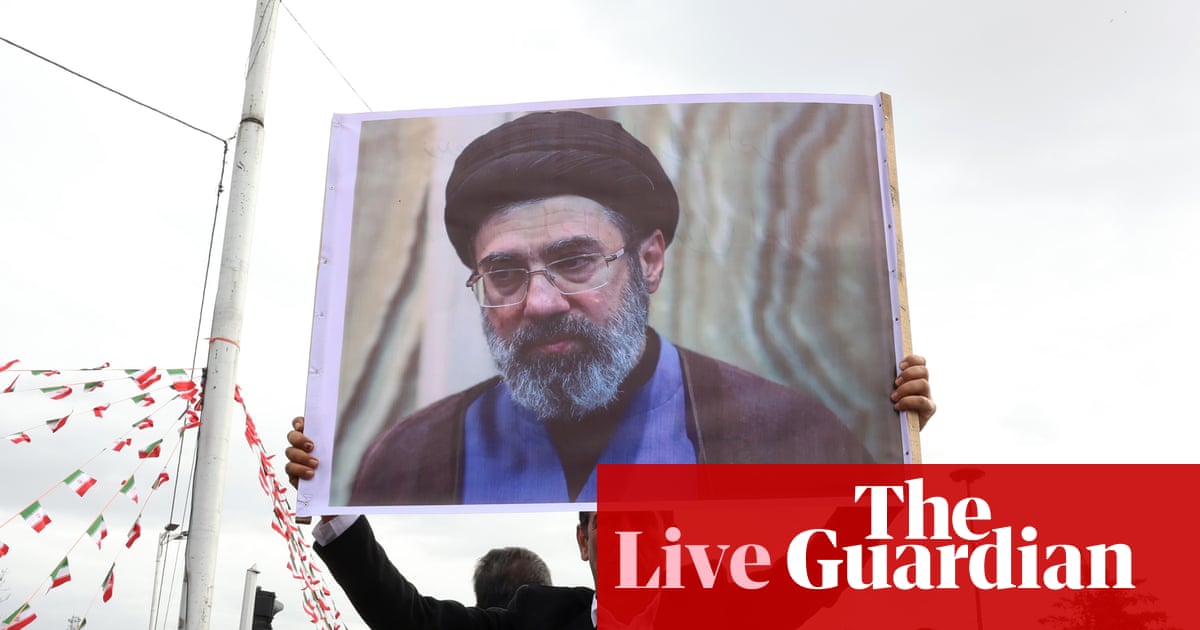
Iran names new supreme leader
Iran has named Mojtaba Khamenei as the country’s new supreme leader following the killing of his father Ayatollah Ali Khamenei in US-Israeli strikes, the state-run media announced early Monday.
He was selected by Iran’s Assembly of Experts, an 88-member body of elected senior clerics tasked with choosing the supreme leader.
Mojtaba, a mid-ranking cleric with close ties to the powerful Revolutionary Guards, had long been viewed by elements of Iran’s ruling establishment as a potential successor to his father, who was killed after the US and Israel launched strikes on Iran on 28 February.
Key events
12m ago
Australian share market plunges nearly 3% as Iran conflict triggers market wipeout
39m ago
Brent crude oil price surges to $108
1h ago
Clashes in east Lebanon as Israeli forces land in area – report
1h ago
Summary of the day so far
1h ago
Trump says oil price spike ‘a small price to pay’
2h ago
Iran war drives oil price above $100 a barrel for first time since 2022
3h ago
Iran names new supreme leader
5h ago
Seventh US military service member killed in action
7h ago
Donald Trump says Iran’s new leader ‘is not going to last long’ if Iran does not get his approval first
8h ago
IDF launches ‘extensive strikes’ in Iran
10h ago
US-Israeli strikes on Iranian energy infrastructure marks ‘dangerous new phase’ of war, spokesperson says
10h ago
Summary of the day so far…
11h ago
UAE acting in self-defence ‘against brutal and unjustified Iranian aggression’, foreign ministry says
11h ago
Israel say two soldiers killed in southern Lebanon
11h ago
Iran ‘reckless’ to attack Gulf states, says Arab League chief
12h ago
Iranian Red Crescent Society warns public to avoid toxic acid rain after Israel struck oil storage depots
12h ago
Nearly 400 people killed in Israeli airstrikes on Lebanon, health ministry says
12h ago
Iran’s new supreme leader has been selected, says deciding body
13h ago
US-Israeli attacks on Iran violated international law, Swiss defence minister says
14h ago
US-Israeli airstrikes on Iran have killed 200 children, health ministry says
15h ago
UK government’s job is not to be ‘outsourcing our foreign policy’, foreign secretary says
15h ago
Iran’s president says his country will ‘not bow easily to bullying’
16h ago
Huge fire engulfs tower in Kuwait after drone strikes
16h ago
Summary
17h ago
Israel warns it will pursue Iran’s next supreme leader
17h ago
China’s foreign minister says Iran war ‘should never have happened’
18h ago
Majority consensus reached on Iran’s next supreme leader: Reports
18h ago
US and Israel strikes damage five oil sites around Tehran, says Iran official
19h ago
Iran ‘will be forced to respond’ if attacked from neighbouring country, says president
19h ago
Israel launches fresh strikes across Iran
19h ago
Iran launches fresh strikes launched across the Gulf
20h ago
Kuwait cuts crude oil production amid renewed attacks
20h ago
Israel renews its assault on southern Lebanon
20h ago
Opening Summary
Show key events only
Please turn on JavaScript to use this feature
Australian share market plunges nearly 3% as Iran conflict triggers market wipeout Luca Ittimani
Australia’s share market tumbled 3% this morning, wiping nearly $90bn from the value of the country’s biggest companies.
The benchmark S&P/ASX200 fell to 8,576.2 points in early trading, after closing at 8,851 last week.
Markets have started to expect the US will continue its war on Iran, which has restricted oil shipping and sent energy prices soaring. Global oil prices surged past US$100 a barrel this morning for the first time since 2022, now sitting at around US$106.
Almost nowhere is safe, with 186 of Australia’s top 200 listed companies falling in value. The big banks are down 3% each, rare earths producers Iluka, Liontown and Lynas are down 5% or more and Qantas and Virgin Airlines are down 6% each.
The only winners are adjacent to the energy sector: gas companies Santas, Beach and Woodside, petrol retailers Ampol and Viva and coalminers.
Economic disruption from the war on Iran has also sent the US dollar surging in value, at the expense of the Australian dollar, which has fallen back below 70 US cents.
Updated at 20.19 EDT
South Korean and Japanese stocks have reportedly fallen sharply amid the Middle East crisis.
French president Emmanuel Macron will visit Cyprus on Monday, his office said, as France deploys warships to the Mediterranean after a drone attack on the island a week ago.
Macron will meet his Cypriot counterpart Nikos Christodoulides and Greek prime minister Kyriakos Mitsotakis in Paphos to show “solidarity” and detail moves to “strengthen security around Cyprus and in the eastern Mediterranean”, the Élysée Palace said on Sunday.
Cyprus was targeted last week by Iranian-made drones, leading Macron to order France’s Charles de Gaulle aircraft carrier to the Mediterranean and a frigate and air defence units to Cyprus
“This trip is intended to demonstrate France’s solidarity with Cyprus, a member state of the European Union with which we have a strategic partnership” and which was recently hit “by several drones and missile strikes”, said the Élysée, cited by Agence France-Presse.
ShareBrent crude oil price surges to $108
More now on oil prices, which have passed $100 a barrel for the first time since 2022 as intensifying military aggression in the Middle East continues to wipe 20m barrels of oil a daily from the market.
The price for a barrel of Brent crude, the international standard, was at $107.97 after trading resumed on the Chicago Mercantile Exchange, up 16.5% from its Friday closing price of $92.69.
West Texas Intermediate – the light crude oil produced in the US – was selling for about $106.22 a barrel, the AP is reporting. That is 16.9% higher than it closed on Friday at $90.90.
The increases followed the US crude price jumping by 36% and Brent crude rising by 28% last week.
Donald Trump has brushed aside concerns about the surging price of oil caused by the US-Israeli airstrikes on Iran, saying on his Truth Social platform:
double quotation markShort term oil prices, which will drop rapidly when the destruction of the Iran nuclear threat is over, is a very small price to pay for U.S.A., and World, Safety and Peace.
The US president added in capital letters: “Only fools would think differently.”
There’s more on the surge in global oil prices in our latest full report here:
Updated at 20.01 EDT
Clashes in east Lebanon as Israeli forces land in area – report
Clashes broke out in eastern Lebanon on Monday after Israeli forces landed by helicopter on the Lebanese-Syrian border, state media reported.
“Fierce clashes are taking place … towards the outskirts of the town of Nabi Sheet to repel Israeli forces that carried out a landing by helicopters on the heights of the eastern mountain range towards the Lebanese-Syrian border and are trying to advance,” Lebanon’s state-run National News Agency reported.
Agence France-Presse, citing the report, has now quoted two sources in Hezbollah as claiming on condition of anonymity that the group downed an Israeli helicopter in the area.
Hezbollah claims it has downed an Israeli helicopter in Lebanon, a news report says.
The AFP agency quoted an official from the Iran-backed militant group as saying on Monday that it had downed the copter in eastern Lebanon amid the renewed fighting between Hezbollah and Israel.
“An Israeli helicopter was downed in the mountains east of Baalbek,” the official was quoted as saying, speaking on condition of anonymity.
Updated at 19.24 EDT
 Robert Mackey
Karim Sadjadpour, a senior fellow at the Carnegie Endowment for International Peace, notes on social media that while Mojtaba Khamenei has been named Iran’s new supreme leader, succeeding his late father, Ayatollah Ali Khamenei, the father of the 1979 revolution, Ayatollah Khomeini, denounced hereditary succession before he died in 1989.
Khomeini wrote:
double quotation markIslam proclaims monarchy and hereditary succession wrong and invalid. When Islam first appeared in Iran, the Byzantine Empire, Egypt, and the Yemen, the entire institution of monarchy was abolished.
Monarchy and hereditary succession represent the same sinister, evil system of government that prompted the Lord of the Martyrs10 (peace be upon him) to rise up in revolt and seek martyrdom in an effort to prevent its establishment. He revolted in repudiation of the hereditary succession of Yazid, 11 to refuse it his recognition. Islam, then, does not recognize monarchy and hereditary succession; they have no place in Islam.
ShareSummary of the day so far
Iran has named Mojtaba Khamenei as the country’s new supreme leader following the killing of his father Ayatollah Ali Khamenei in US-Israeli strikes, the state-run media announced. He was selected by Iran’s Assembly of Experts, an 88-member body of elected senior clerics tasked with choosing the supreme leader.
Donald Trump warned that Iran’s new leader “is not going to last long” if the Iranians do not get his approval first for the theocratic posting. “He’s going to have to get approval from us,” the president told ABC News. “If he doesn’t get approval from us he’s not going to last long. We want to make sure that we don’t have to go back every 10 years, when you don’t have a president like me that’s not going to do it.”
Another US military service member has died from wounds sustained during Iran’s initial counter-attack a week ago, bringing the number of US troops killed in action so far in the war with Iran to seven, the US military said on Sunday.
Lebanon’s health ministry said the amount of people killed from Israeli airstrikes in the past week had increased to 394, including many women and children.
The Iranian army said on Sunday that at least 104 people were killed and 32 were wounded in an attack by the US on an Iranian warship off Sri Lanka’s coast last week.
The IDF began “extensive strikes” against the “infrastructure” of the Iranian regime in Tehran and across other areas in Iran. Despite Israel saying it is striking military or “terror” targets in its war on Iran, many civilians have been killed in its attacks.
Overnight strikes by the US and Israel hit five oil sites around Tehran, according to an Iran official. The official said that the five facilities “were damaged” but the “fire was brought under control”.
Iran’s foreign ministry spokesperson Esmaeil Baghaei said the US-Israeli aerial bombardment of Iranian energy infrastructure sites marked a “dangerous new phase” of the conflict and amounted to a war crime.
The Iran war has driven the price of crude oil above $100 per barrel for the first time since 2022.
ShareTrump says oil price spike ‘a small price to pay’
President Donald Trump brushed aside concerns about the surging price of oil caused by the US-Israeli airstrikes on Iran, even as the price of crude topped $100 per barrel for the first time since 2022.
“Short term oil prices, which will drop rapidly when the destruction of the Iran nuclear threat is over, is a very small price to pay for U.S.A., and World, Safety and Peace,” Trump wrote, adding in all caps that “only fools would think differently.”
Updated at 19.20 EDT
Below, see the announcement of Mojtaba Khamanei as the new leader of Iran that played today on state television. The video was posted by Iranian-British BBC reporter Shayan Sardarizadeh, whose Verify unit specializes in fact-checking and video verification.
This is the moment Iran’s state TV announced that Mojtaba Khamenei, the 56-year-old second son of Ayatollah Ali Khamenei, had been selected as the third supreme leader of the Islamic Republic by the clerical body known as the Assembly of Experts. pic.twitter.com/tEm9w8WYQo
— Shayan Sardarizadeh (@Shayan86) March 8, 2026
ShareIran war drives oil price above $100 a barrel for first time since 2022
Jillian Ambrose
Global oil prices have breached the $100 (£74) a barrel mark for the first time since 2022 as escalating military aggression in the Middle East continues to wipe 20m barrels of oil from the market each day.
Brent crude, the international benchmark, climbed 12.2% to $104.05 a barrel as the new week’s trading began in the Asia Pacific markets, the first time that market prices have soared above this key psychological threshold since Russia’s invasion of Ukraine.
Prices rose after a weekend of escalating conflict in the Middle East, during which Kuwait’s national oil company announced a “precautionary” cut to its crude oil production.
The oil price returned to triple digits after the highest weekly gains since the Covid-19 pandemic six years ago, and included a $10 increase in the price of US crude on Friday alone.
Iran has largely halted oil and gas exports through strait of Hormuz
“The grace period given by the market to the Trump administration expired at the end of last week,” according to Clayton Seigle, a senior fellow at the Center for Strategic and International Studies.
A US National Guard soldier tied in Kuwait on March 6, according to a statement from US Central Command. The soldier, whose name was not disclosed, died in a “health-related incident” that occurred “during a medical emergency.”
“The exact cause of death is under review,” the statement says.
As our colleague Lorenzo Tondo reports, Donald Trump told ABC News on Sunday that Iran’s next supreme leader is “not going to last long” if Tehran didn’t “get approval from us”.
The US president said in an interview with Axios laste week, “Khamenei’s son is a lightweight”, calling Mojtaba Khamenei, “unacceptable to me”.
Mojtaba Khamenei, the second son of Iran’s late supreme leader, Ayatollah Ali Khamenei, visited Hezbollah’s office in Tehran, in October 2024. Photograph: Office of the Iranian Supreme Leader/Reuters
Earlier on Sunday, the Israeli military said in a post on X in Farsi that it would continue pursuing every successor of Ali Khamenei and that it would pursue every person who sought to appoint a successor for him.
Analysts have suggested Mojtaba Khamenei’s appointment is a symbolic move designed to make the regime still appear strong and determined not to bow to western pressure.
The 56-year-old cleric has never held elected office nor formally occupied a senior position within Iran’s government. He has spent much of his life at the centre of power in Iran while remaining largely out of public view.
Updated at 18.11 EDT
 Lorenzo Tondo
For many analysts, Mojtaba Khamenei’s appointment is a symbolic move designed to make the regime still appear strong and determined not to bow to western pressure.
The 56-year-old cleric has never held elected office nor formally occupied a senior position within Iran’s government. He has spent much of his life at the centre of power in Iran while remaining largely out of public view.
Born in 1969 in the north-eastern city of Mashhad, Khamenei was raised within the political and clerical world that emerged after the 1979 revolution. As a young man he studied theology in the seminaries of Qom and reportedly took part in the final stages of the Iran-Iraq war.
Unlike many figures in Iran’s leadership, Khamenei never pursued elected office or a prominent government role. Instead, he gradually became an influential presence inside his father’s office, where he was widely seen as part of a small circle managing political access to the supreme leader.
Over the years he cultivated close relationships with conservative clerics and elements of the Islamic Revolutionary Guards Corps (IRGC), a connection analysts say strengthened his standing within the system.
Read more:
ShareIran names new supreme leader
Iran has named Mojtaba Khamenei as the country’s new supreme leader following the killing of his father Ayatollah Ali Khamenei in US-Israeli strikes, the state-run media announced early Monday.
He was selected by Iran’s Assembly of Experts, an 88-member body of elected senior clerics tasked with choosing the supreme leader.
Mojtaba, a mid-ranking cleric with close ties to the powerful Revolutionary Guards, had long been viewed by elements of Iran’s ruling establishment as a potential successor to his father, who was killed after the US and Israel launched strikes on Iran on 28 February.
Russian foreign minister Sergei Lavrov and his counterpart from the United Arab Emirates called on Sunday for an end to all attacks on both Iran and Gulf states and said renewed diplomacy was needed to ensure long-term regional security, Reuters reported.
“Attention focused on the necessity of stopping attacks that lead to casualties among the civilian population and cause damage to civilian infrastructure both in the Arab countries of the … Gulf and in Iran,” the ministry said of Lavrov’s telephone conversation with Sheikh Abdullah bin Zayed.
The UAE has maintained good relations with both Russia and Ukraine during their four-year-old war and acted as an intermediary in holding talks and arranging exchanges of prisoners of war.