
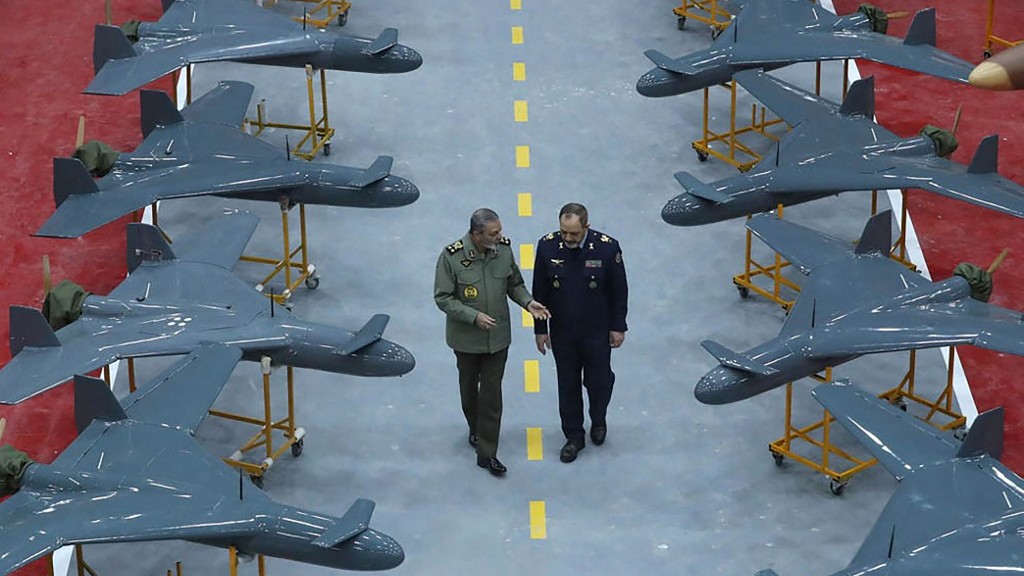
Azerbaijan became the latest country to be drawn into the US–Israeli war on Iran after four drones, which it said were launched from the Islamic Republic, struck its exclave of Nakhchivan on Thursday, damaging infrastructure and injuring two civilians.
Officials in Baku said one of the drones hit the terminal building of Nakhchivan International Airport, located about 10km from the Iranian border. Another fell near a school in a nearby village.
A third drone was shot down by Azerbaijani forces, while another struck civilian infrastructure.
Iran, for its part, has rejected the accusations.
“Iran did not carry out strikes against Azerbaijan,” Iran’s Deputy Foreign Minister Kazem Gharibabadi said in comments published by the Iranian news agency Tasnim.
New MEE newsletter: Jerusalem Dispatch
Sign up to get the latest insights and analysis on
Israel-Palestine, alongside Turkey Unpacked and other MEE newsletters
“We do not strike neighbouring countries. Iran’s policy is to target only the military bases of its enemies operating in the region and previously used for attacks on Iran, including bases of the United States and Israel,” he said.
Iran has offered similar explanations for attacks it has carried out against targets in Qatar, Saudi Arabia, Kuwait and the United Arab Emirates since the conflict began.
The statement suggested Iran’s operations target US and Israeli assets rather than neighbouring states themselves, raising the possibility that Tehran believes such facilities operate in Nakhchivan.
Some Iranian analysts have also suggested the incident could involve Israeli covert activity aimed at inflaming tensions between Tehran and Baku.
“Maybe during [this] war, some Israeli agents are involved to make the Iran-Azerbaijan relationship very challenging,” Seyed Emamian, an assistant professor at Tehran Polytechnic University, told Middle East Eye.
Earlier this week, MEE reported that Iranian officials accused Israel of carrying out some of the drone strikes on energy and civilian sites in the Arabian Gulf, calling the attacks a calculated bid to spark regional anger and pull Arab states into the war on Tehran.
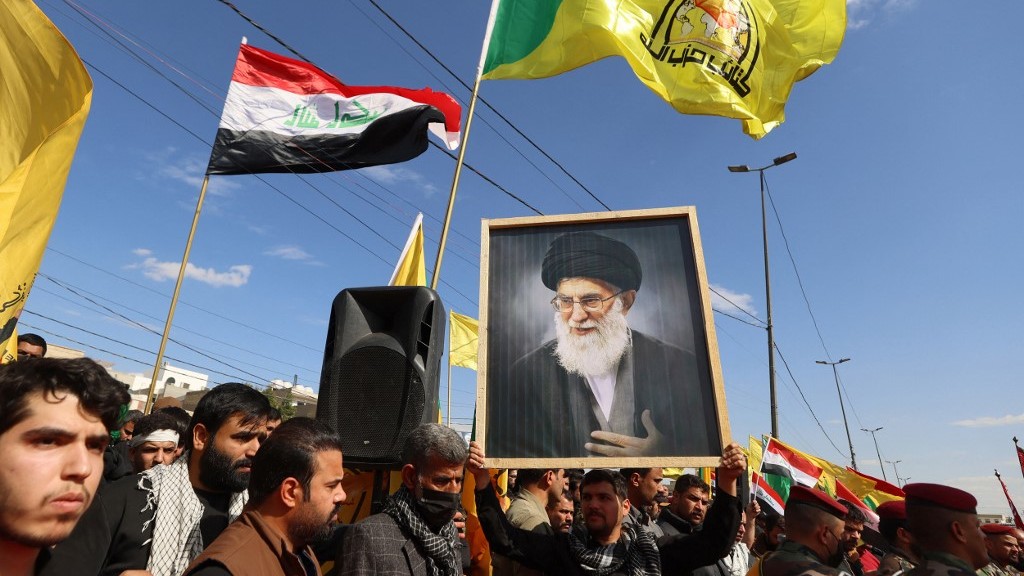
A mourner holds a portrait of Iran’s Supreme Leader Ali Khamenei on 5 March 2026, during a funeral procession in Iraq (Ahmad al-Rubaye/AFP)

What is Iran’s strategy?
Analysts say Iran’s response to the war has centred on its asymmetric regional influence.
For decades, Gulf states have promoted themselves as islands of stability in a volatile region, attracting global investors, tourists and multinational businesses.
Underpinning this idea has been the impression that US military bases in the region would underwrite the security of these states.
Iran’s military campaign appears designed to undermine that perception and demonstrate that the costs of the conflict will extend far beyond its borders.
Economic uncertainty is already spreading. The Financial Times reported that investors in the Gulf are reconsidering overseas commitments amid the war’s disruption to markets.
Khalaf al-Habtoor, a prominent Emirati businessman, publicly criticised the war in a social media post directed at US President Donald Trump.
“A direct question: Who gave you the authority to drag our region into a war with #Iran? And on what basis did you make this dangerous decision?” he wrote on X. “Did you calculate the collateral damage before pulling the trigger?”
The upheaval across the region may be intended to push regional governments to pressure Washington to end the war.
Giorgio Cafiero, the chief executive of Gulf State Analytics, a Washington-based geopolitical risk consultancy, said the instability could encourage Gulf states “to see to it that the United States agrees to halt its aggression”.
“And within this context, I think that if Iran was responsible for the attack [on Azerbaijan]… The relationship that Baku has with Tel Aviv would be an important factor in play,” he added.
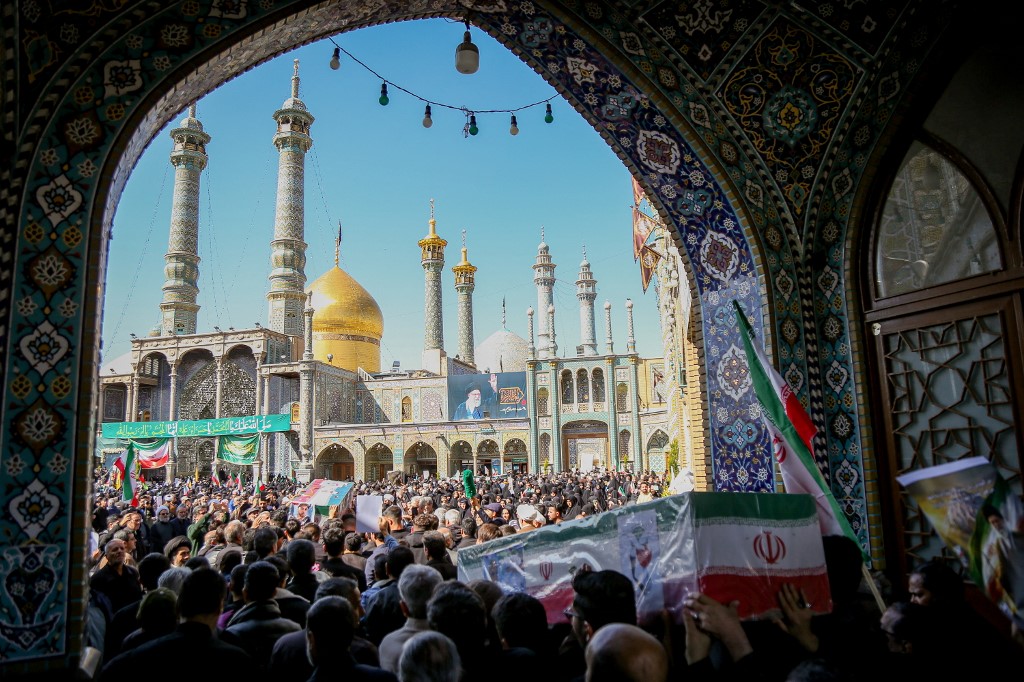
Mourners in the city of Qom attend the funeral of those killed in the US-Israeli war on Iran, 5 March 2026 (Mehdi Alavi/ISNA/AFP)
What is Azerbaijan’s position in the war?
According to Farid Shafiyev, the chairman of the Baku-based Center of Analysis of International Relations, Azerbaijan has tried to remain neutral in the conflict.
President Ilham Aliyev visited Iran’s embassy in Baku on 4 March to offer condolences following the US-Israeli assassination of Iran’s Supreme Leader Ali Khamenei and the killing of civilians.
‘One of the reasons that Iran is attacking the UAE is not only because of the American bases, it’s because of the Israeli bases there’
Seyed Emamian, Tehran Polytechnic University
“But the recent attack shows that Iran would like to escalate,” Shafiyev told MEE.
The Iranians, he said, have “implied that Nakhchivan was also used by the Israelis and Americans, which is a completely false assumption”.
Following the incident, Azerbaijan closed its southern airspace for 12 hours and shut its border crossings with Iran to cargo trucks, including transit shipments.
The move disrupted one of the shortest land routes connecting Iran with Russia.
Aliyev also threatened to respond militarily, but there has been no official response so far.
“We will not tolerate this unprovoked act of terror and aggression against Azerbaijan,” he told a meeting of the country’s security council. “Our Armed Forces have been instructed to prepare and implement appropriate retaliatory measures.”
Why is Iran worried about the Israeli-Azerbaijani relationship?
Tehran has long viewed Azerbaijan’s relationship with Israel with suspicion.
The two countries cooperate in sectors including energy, defence and cybersecurity, although much of that cooperation remains opaque.
Aliyev once described the partnership as resembling an “iceberg”, suggesting most of it lies beneath the surface.
Energy ties also bind the two countries. Israel imports roughly 40 to 50 percent of its oil from Azerbaijan through the Baku-Tbilisi-Ceyhan pipeline, which runs through Turkey.
Emamian said that Azerbaijan’s ties with Israel pose security concerns for Iran.
‘Iran does not want a conflict with Baku…but Baku now is an asset for the US and Israel’
– Iranian analyst
“One of the reasons that Iran is attacking the UAE is not only because of the American bases; it’s because of the Israeli bases there,” he said.
“Not only military bases but also intelligence and security institutions that they have been covering under the titles of different institutions, companies, so they have been very much active in the intelligence gathering against Iran,” he added.
Iran has accused Azerbaijan of allowing Israel to conduct espionage operations against it from Azerbaijani territory – an allegation Baku denies.
A political analyst in Tehran, who spoke on condition of anonymity, told MEE that Iranian officials believed Israel had used Azerbaijani airspace during a previous conflict.
“Azerbaijan let Israel use its airspace to attack Iran in the previous June war,” the analyst said, adding that “people in northern parts of Iran along the Caspian sea reportedly said that they heard jets flying in the sky”.
Baku has rejected the allegation. Still, the analyst said Iranian leaders increasingly view the current war as an existential threat.
“Iran does not want a conflict with Baku,” the analyst said. “But Baku now is an asset for the US and Israel”.
What are Azerbaijan’s options?
The conflict places Azerbaijan in a delicate position. More than 15 million ethnic Azeri live in Iran, giving Baku potential influence if instability spreads across the country.
“If Iran goes down in chaos,” a Tehran-based analyst warned, Azerbaijan could play a role in shaping developments in the region.
The drone incident may provide political justification for a more assertive stance.
Israeli commentator says Iran war will lead to ‘Sykes-Picot 2026’
“It has the excuse and the motive now,” the analyst said.
However, a fragmented Iran would also pose serious risks for Azerbaijan. Large numbers of ethnic Azeri refugees could cross the border if instability spreads.
“I think the leadership in Baku would clearly feel much pressure to come to the aid of these potential refugees. Naturally, that would create burdens for Azerbaijan,” Cafiero said.
If the crisis escalates, Azerbaijan is likely to rely heavily on its closest ally.
“Out of all of Azerbaijan’s allies and partners in the world, probably the one which Baku will turn to most closely in the event of this worsening crisis would be Turkey,” Cafiero said.
Turkey has already backed Azerbaijan militarily, helping it retake territory in Nagorno-Karabakh during the 2020 war with Armenia.
“I think that if there is ever any scenario whereby Azerbaijan’s national security is threatened, it is safe to assume that the leadership in Ankara would consider that to be a threat to Turkey as well,” Cafiero added.
“And I think Turkish officials would go very far to come to the defence of Azerbaijan.”