
The Israel Defense Forces (IDF) has intensified its attacks across Lebanon and issued evacuation orders affecting at least 800,000 people following missile fire from Hezbollah. These orders included an order issued at around 3 pm on 5 March, affecting an estimated 500,000 people in southern Beirut, ahead of a planned bombing of Hezbollah’s strongholds.
Since the November 2024 ceasefire, Hezbollah has restrained itself from responding to Israeli air and drone attacks targeting its members. However, the United States and Israel’s targeted assassination of Supreme Leader Ali Khamenei has pushed the group to open a new front against Israel. What began as retaliatory missile strikes by Hezbollah quickly evolved into a broader conflict. For now, Israel and Hezbollah have moved toward direct ground confrontation in southern Lebanon, particularly in the region’s eastern sector. Israel is conducting sustained air operations and preparing for a ground invasion south of the Litani River that will likely come in the next weeks.
On 1 March, Hezbollah announced it had fired six missiles targeting Haifa and its outskirts. Since the attack, the Israeli military has retaliated with at least 250 airstrikes targeting what it claims to be Hezbollah military and financial infrastructure, as well as targeted assassinations of Hezbollah, Palestinian Islamic Jihad, and Jamaa Islamiya commanders.
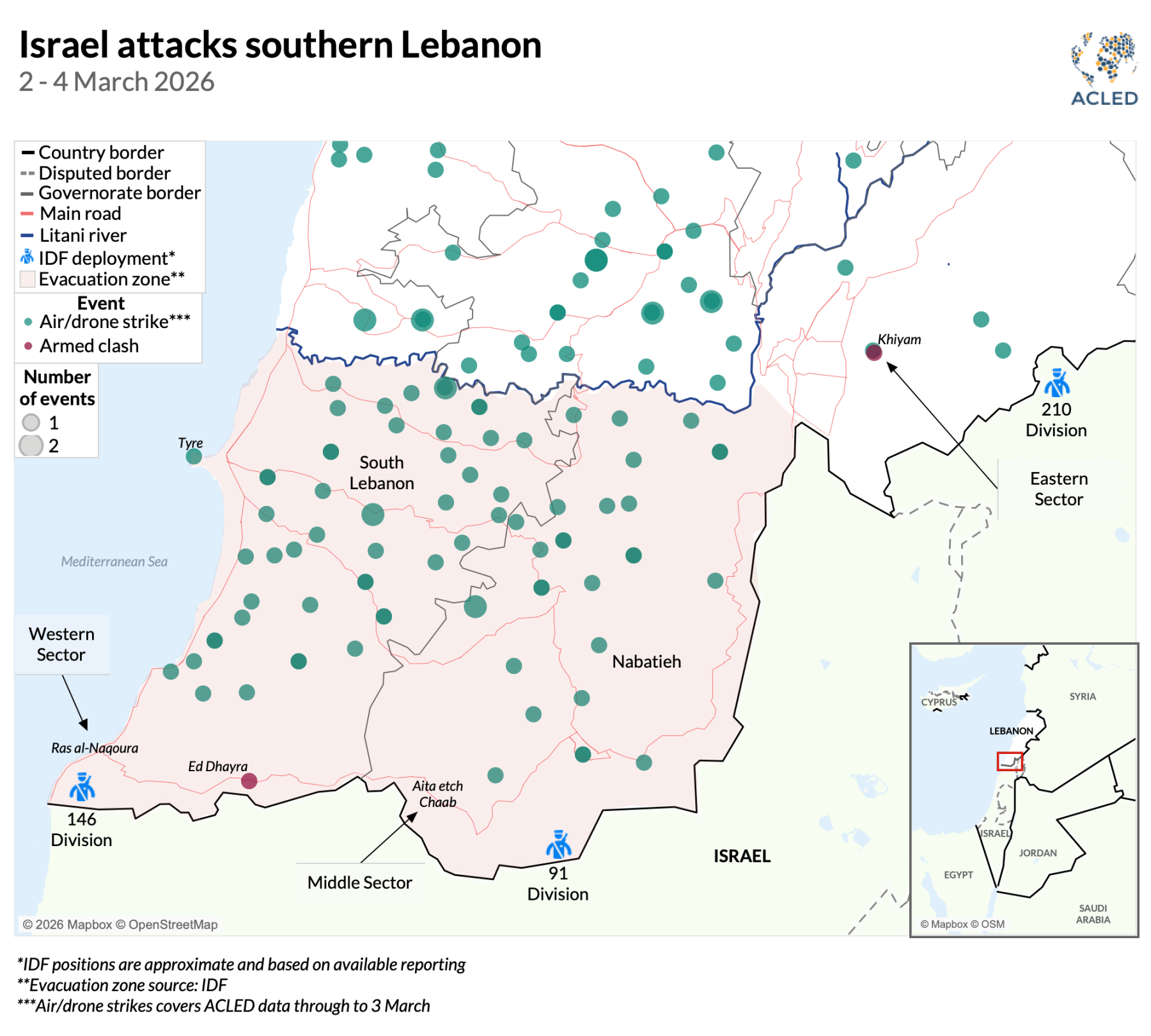
In recent days, the Israeli government began signaling that it would likely move beyond airstrikes to carry out a large-scale ground invasion. On 4 March, the Israeli army’s Arabic-language spokesperson, Avichay Adraee, issued an unusually broad evacuation order instructing civilians to head north of the Litani River. The order creates a major logistical and humanitarian challenge, as the region includes between 250 and 300 settlements, including major cities Tyre and Nabatieh. The order is reminiscent of previous evacuation directives issued by the IDF in southern Lebanon and is likely a precursor to a ground invasion.
Additionally, Israeli Defense Minister Israel Katz has instructed the IDF, with the approval of Prime Minister Benjamin Netanyahu, to occupy additional positions inside Lebanese territory. The Israeli military is likely seeking to create a buffer zone between the Litani River and the Israeli border to eliminate Hezbollah’s capacity to threaten northern Israeli communities (see map below).
Israel’s preparation for a ground invasion comes amid its frustrations with the Lebanese government and army’s progress toward disarmament, which it argues have not done enough to remove the “Hezbollah threat.” Although the Lebanese government announced on 8 January that the army had fully disarmed Hezbollah south of the Litani River, the group was able to launch its recent attacks, bolstering Israel’s long-running claims that Hezbollah is rearming and reorganizing.
An Israeli ground invasion is likely to be conducted by the IDF’s 91st, 210th, and 146th Divisions, currently deployed in the east of southern Lebanon, the Mount Dov area, and the west of southern Lebanon, respectively. It could resemble the limited incursions that previously took place along three main corridors: the Western Sector (Ras al-Naqoura), the Eastern Sector (Khiyam), and the Middle Sector (Aita ech Chaab).
In the short term, a ground invasion south of the Litani River would likely produce sustained clashes between IDF forces and Hezbollah militants, particularly in fortified villages. Already on 4 March, Hezbollah militants and Israeli forces clashed on the outskirts of Khiyam and Ed Dhayra towns. The group announced late that night that its militants had repelled an Israeli incursion and were currently clashing with IDF forces. In the medium term, the creation of a buffer zone would risk entrenching Israeli forces inside Lebanese territory, increasing the probability of protracted insurgent-style resistance and expanding the conflict geographically. Hezbollah may respond by widening its strike range deeper into northern Israel.