
Glenn Carle”
post_date=”March 09, 2026 04:46″
pUrl=”https://www.fairobserver.com/world-news/middle-east-news/fo-exclusive-a-new-iran-us-conflict-looms-large/” pid=”161153″
post-content=”
[Editor’s note: This video was recorded on Wednesday, February 25, three days before the US–Israeli attack on Iran.]
Editor-in-Chief Atul Singh and FOI Senior Partner Glenn Carle, a retired CIA officer who now advises companies, governments and organizations on geopolitical risk, discuss a mounting crisis in the Middle East. A new US–Iran conflict, they warn, now “looms large.” With American military deployments at their highest level since the 2003 Iraq War and faltering diplomacy in Geneva, Switzerland, the risk of a large-scale strike appears high and rising. What began as maximum pressure may be drifting toward shock and awe.
Maximum pressure and military momentum
Atul opens with the scale of the buildup. The US armada now in and around the Persian Gulf follows intensified sanctions and Operation Midnight Hammer, the joint US–Israel action targeting Iranian nuclear facilities. Security, political and diplomatic sources tell Fair Observer that US military action is increasingly probable.
Washington’s approach combines coercive diplomacy with visible force. Negotiators in Geneva, led on the American side by US Special Envoy to the Middle East Steve Witkoff and former Senior Advisor to the President Jared Kushner, have struggled to find common ground with Iranian counterparts whose patient, formal style contrasts sharply with the blunt, fast-moving dealmaking culture of New York real estate. Talks have failed thus far to produce a breakthrough.
Meanwhile, Iran has conducted maritime drills in the Strait of Hormuz, through which roughly 20% of global oil and gas transit. Failed diplomacy and expanding deployments now reinforce each other. With so many assets in the theater, backing down carries political costs. Advancing carries strategic risks.
Three weak governments, one dangerous dynamic
Atul recounts a British security source’s observation that the three pertinent governments — Iran, Israel and the United States — are all domestically weak and cannot afford to appear so. Massive anti-government demonstrations in Iran have narrowed the regime’s social base. Israeli Prime Minister Benjamin Netanyahu leads a fractious coalition and faces corruption allegations. In Washington, the US Supreme Court has just struck down most of US President Donald Trump’s sweeping tariffs, undercutting executive authority at home even as he projects power abroad.
This convergence of weakness raises the risk of miscalculation. As Atul notes, none of the actors may want a full-scale war, yet all may drift toward one. Some US military sources worry that the “Venezuela high” — referring to Operation Absolute Resolve, the January military operation to seize Venezuelan President Nicolás Maduro — could breed overconfidence in Washington. After US Secretary of State Marco Rubio’s Munich speech called for a renewal of the West under American leadership, Iran appears next in line for pressure.
Israeli sources suggest Trump may pursue a shock-and-awe operation, which would use incredible displays of force to make Iran lose its nerve. But Glenn cautions against strategic optimism built on thin assumptions. He argues that the belief that “kinetic power” can remake a society rests on “the thinnest of all imaginable grounds.” History offers sobering parallels.
Regime change or regime hardening?
Atul detects a generational divide within Washington. Some younger Republicans believe Iran’s economic woes, youth unemployment and protests by students, women and minorities create a window for a “smart intervention” that weakens or even topples the regime of 89-year-old Ayatollah Ali Khamenei. American firepower could degrade military capacity, intensify domestic unrest and open space for intelligence operations by the CIA and Mossad, Israel’s foreign intelligence agency.
Older intelligence and military hands are more skeptical. Glenn warns that removing leaders does not dissolve entrenched power structures. The Islamic Revolutionary Guard Corps (IRGC), founded after the 1979 Iranian Revolution as a parallel military reporting directly to the clerical leadership, functions as a praetorian guard. Khamenei has reportedly implemented succession planning up to four levels deep across key posts.
Even if the top leadership was eliminated, Atul predicts that “black beards” would replace “white beards.” The likely successors would not be liberal reformers but hardened elements of the IRGC. To highlight the stakes, Iran’s capital of Tehran has acknowledged 3,117 deaths during recent unrest, while independent authorities have confirmed over 6,800 killings. Higher estimates reach 30,000. The regime is ruthless, but it is organized.
Asymmetry, oil and global shock
Glenn frames the conflict in existential terms. For the Iranian leadership, survival is nonnegotiable. For the US, war remains a policy choice. States do not act on altruism when vital interests face grave danger.
The military balance is asymmetric. The US could reportedly conduct up to 800 sorties a day. Yet Iran possesses large numbers of relatively cheap missiles and drones capable of targeting high-value assets, including $5 billion aircraft carriers. The “cost per kill” calculus favors Tehran: low-cost weapons against high-cost platforms. Iranian tolerance for casualties, in a system that valorizes martyrdom, may far exceed that of the US.
The economic stakes are global. Closure or disruption of the Strait of Hormuz could trigger oil price spikes reminiscent of those seen in the 1973 and 1979 oil crises, raising input costs, transport expenses and worldwide inflation. Missile strikes on refineries, maritime insecurity and surging insurance premiums would disrupt shipping and logistics. Equity selloffs, widening credit spreads, emerging-market currency instability and risk-off capital flows could follow. A prolonged conflict could push the world toward recession.
The nuclear deal revisited
Against this backdrop, Glenn points to a pragmatic alternative: revive the 2015 Joint Comprehensive Plan of Action. The original agreement constrained Iran’s nuclear program under international monitoring. Tehran expanded its activities only after Washington withdrew.
A restored deal, perhaps rebranded to allow Trump to claim political victory, would not satisfy Iranian protesters seeking systemic change. Yet Glenn argues it could avert catastrophe. Even if imperfect, diplomacy is preferable to a regional war that might draw in Israel and Gulf states and potentially escalate to tactical nuclear threats. This rhetoric is already circulating on the far right in Israel and within segments of the IRGC.
Ultimately, on Saturday, February 28, the US and Israel coordinated a bombing attack on Iran as part of Operation Epic Fury, killing Khamenei and initiating a greater offensive.
[Lee Thompson-Kolar edited this piece.]
The views expressed in this article/video are the author’s own and do not necessarily reflect Fair Observer’s editorial policy.
”
post-content-short=”Editor-in-Chief Atul Singh and FOI Senior Partner Glenn Carle, a retired CIA officer who now advises companies, governments and organizations on geopolitical risk, discuss a…”
post_summery=”In this section of the February 2026 episode of FO Exclusive, Atul Singh and Glenn Carle examine the rising risk of a US–Iran military conflict as diplomacy in Geneva falters. Domestic political weakness in Washington, Tehran and Jerusalem increases the danger of miscalculation, while Hormuz disruption could trigger global economic shock. Reviving the nuclear deal remains the least catastrophic option.”
post-date=”Mar 09, 2026″
post-title=”FO Exclusive: A New Iran–US Conflict Looms Large” slug-data=”fo-exclusive-a-new-iran-us-conflict-looms-large”>
FO Exclusive: A New Iran–US Conflict Looms Large

Glenn Carle”
post_date=”March 08, 2026 06:03″
pUrl=”https://www.fairobserver.com/world-news/us-news/fo-exclusive-a-hot-mess-after-the-supreme-court-strikes-down-trump-tariffs/” pid=”161136″
post-content=”
Editor-in-Chief Atul Singh and FOI Senior Partner Glenn Carle, a retired CIA officer who now advises companies, governments and organizations on geopolitical risk, examine a 6–3 US Supreme Court ruling that struck down most of US President Donald Trump’s recent tariffs as illegal. The decision, issued on February 20, found that the administration exceeded its authority under the International Emergency Economic Powers Act (IEEPA), which Trump had used to declare a national emergency over the US trade deficit. Within hours, the president signaled defiance, promising to rebuild tariff barriers using “methods, practices, statutes and authorities that are even stronger than the IEEPA tariffs.” What follows now is deeper constitutional and economic uncertainty.
The constitutional fault line
Glenn frames the ruling as part of a “tectonic” struggle over the nature of American democracy. The US system, he argues, “was by design to be inefficient,” built on separation of powers and checks and balances precisely to prevent “unfettered executive authority.” For decades, however, a dominant strain within the Republican Party has embraced the theory of the unitary executive. They assert that the president must be empowered to act decisively in the national interest, even in the face of congressional or judicial resistance.
The Court’s ruling reinforces a basic constitutional principle: Taxation and tariff powers rest with Congress. Drawing on the major questions doctrine, which was previously used by the conservative majority to curb federal bureaucratic agencies, the justices now turn that reasoning against the executive itself. For Atul, this demonstrates that the Court is “not entirely a handmaiden of the executive yet,” and that checks and balances still function.
But a deeper crisis lurks. If the executive resists implementation, the judiciary has no enforcement arm of its own. The president controls the Department of Justice and the machinery that executes court orders. In theory, impeachment could discipline open defiance. In practice, however, with Congress divided and midterms looming, that appears unlikely. The ruling thus exposes both the resilience and fragility of constitutional governance.
Legal workarounds and fiscal fallout
The economic implications are immediate and complex. The IEEPA tariffs, imposed after Trump’s declaration of a national emergency on April 2, 2025, had already generated an estimated $200 billion in import duties. Those funds must now be refunded, but repayment could take years of litigation. Companies are lining up for reimbursement; class-action lawyers are preparing to argue that any refunds should flow to consumers rather than remain with corporations. Trump himself has noted that the Court did not explicitly address repayment, leaving the issue unresolved.
Meanwhile, the administration is far from out of options. Supreme Court Justice John Kavanaugh’s dissent emphasizes that “numerous other federal statutes authorize the President to impose tariffs.” Section 122 of the 1974 Trade Act allows temporary tariffs of up to 150 days to address balance-of-payments difficulties. Invoking this authority, Trump announced a 10% global tariff, raised to 15% on February 21. Other provisions permit duties of up to 50% against countries deemed to discriminate against US commerce, as well as restrictions justified on national security grounds.
More dramatically, Trump could simply delay dismantling the IEEPA tariffs. With control of the executive branch, the administration might slow compliance indefinitely, using prosecutorial discretion and presidential pardons to shield officials. Such a move would deepen the constitutional clash and compound uncertainty.
Trade deficits and inflation reality
Atul and Glenn stress that the tariffs’ original objective, reducing the US trade deficit, has not been met. The overall deficit declined marginally from $903.5 billion in 2024 to $901.5 billion in 2025, a mere $2 billion shift. In some cases, deficits widened. For instance, the US goods deficit with India rose from $45.8 billion in 2024 to $58.2 billion in 2025. A small US services surplus may turn into a roughly $4 billion deficit.
Simultaneously, tariffs have proven inflationary. Although price pressures have not surged as dramatically as some predicted, Glenn underscores the lag effect: It can take a year for the full impact of trade barriers to filter through supply chains and consumer prices. Markets can adjust to higher or lower tariffs, and even to different constitutional arrangements. What they cannot easily manage is instability. The White House’s determination to maintain and extend tariffs, even after judicial rebuke, amplifies policy unpredictability.
Uncertainty as policy
Capitol Hill sources, including Republicans, privately welcome the ruling. They believe the White House had wrested excessive authority from Congress and that the decision restores some institutional balance. In the long term, they argue, this may prove beneficial for both governance and the economy.
Yet in the short term, FOI expects the opposite of clarity. Businesses and investors should anticipate product-, sector- and country-specific duties proliferating under alternative statutes. Existing tariffs may persist while litigation unfolds. Rather than reducing uncertainty, the Court’s decision may intensify it.
Atul calls the moment a “mini crisis,” constitutional and economic at once. Despite judicial intervention, the administration remains committed to tariffs as both principle and instrument. So despite the Supreme Court ruling, the Trump administration is poised to maintain and extend its already extensive use of tariffs as a central trade policy tool.
[Lee Thompson-Kolar edited this piece.]
The views expressed in this article/video are the author’s own and do not necessarily reflect Fair Observer’s editorial policy.
”
post-content-short=”
Editor-in-Chief Atul Singh and FOI Senior Partner Glenn Carle, a retired CIA officer who now advises companies, governments and organizations on geopolitical risk, examine a 6–3 US Supreme Court ruling that struck down most of US President Donald Trump’s recent tariffs as illegal. The…”
post_summery=”In this section of the February 2026 episode of FO Exclusive, Atul Singh and Glenn Carle analyze the US Supreme Court’s 6–3 decision striking down US President Donald Trump’s IEEPA tariffs and Trump’s defiant pledge to rebuild them. They explore the constitutional clash over separation of powers and the unitary executive theory. Despite the ruling, tariff expansion will likely continue.”
post-date=”Mar 08, 2026″
post-title=”FO Exclusive: A Hot Mess After the Supreme Court Strikes Down Trump Tariffs” slug-data=”fo-exclusive-a-hot-mess-after-the-supreme-court-strikes-down-trump-tariffs”>
FO Exclusive: A Hot Mess After the Supreme Court Strikes Down Trump Tariffs
Glenn Carle”
post_date=”March 07, 2026 06:14″
pUrl=”https://www.fairobserver.com/world-news/fo-exclusive-global-lightning-roundup-of-february-2026/” pid=”161129″
post-content=”
Editor-in-Chief Atul Singh and FOI Senior Partner Glenn Carle, a retired CIA officer who now advises companies, governments and organizations on geopolitical risk, rifle through a month of shocks, scandals and political turns. A pattern emerges when seemingly local events are read as signals of institutional strain, state capacity and the evolving global balance between disorder and control.
Africa: Libya’s afterlife, Congo’s minerals, Ethiopia’s fault lines
In Libya, Saif al-Islam Gaddafi, son of former Libyan dictator Muammar Gaddafi, was killed by four unknown gunmen in the western town of Zintan. Atul treats the assassination as a sign that Libya’s fragmentation persists, with no political settlement in sight.
In the Democratic Republic of Congo, a mine collapse killed 200 people, including children. This illustrates the brutal conditions miners must navigate to obtain coltan, a critical component used in smartphone manufacture. Atul notes the scale and location: It was the Bibatama Mining Concession near Rubaya in Masisi Territory, North Kivu province, which produces roughly 1,000 metric tons annually — about half of DRC output.
The M23 rebellion, operating under the Congo River Alliance banner, reportedly holds the mines and is allegedly backed by Rwanda. Thus, this mineral economy is now a regional power contest. Glenn frames Congo’s governance vacuum as an “utter state of nature.” He argues that predation, warlordism and external meddling are the operating system, not a temporary breakdown.
Elsewhere on the continent, Ethiopian troops moved toward the country’s northern Tigray region. Ethiopia and Eritrea now trade accusations of arming rebels and preparing for war, calling to mind memories of the 2020–2022 Tigray war.
The Americas: cartel power, energy pressure, Peruvian instability
In Mexico, authorities killed Nemesio Oseguera Cervantes (known by the alias “El Mencho”), notorious leader of the Jalisco New Generation Cartel (CJNG), after tracking down his wife, Rosalinda González Valencia. The cartel response was immediate and violent. CJNG torched buildings and vehicles and killed 62 people, including 25 National Guard members. Mexican President Claudia Sheinbaum deployed 2,000 troops to stabilize the situation.
Atul notes that the United States supplied intelligence locating El Mencho, underscoring how cross-border security problems are also cross-border intelligence operations. Glenn emphasizes that decades of US counter-narcotics efforts have not changed the economics that make cartel power rational and durable.
Elsewhere, energy has become leverage. Cuba announced fuel rationing after Venezuela and Mexico reportedly curbed supplies under US pressure, prompting Canadian airlines to suspend flights due to aviation fuel shortages. In Colombia, Atul notes the political mood swing as US President Donald Trump and Colombian President Gustavo Petro publicly reconciled after trading sharp insults; Trump called their meeting “terrific.”
Peru provides a concentrated case of governance stress. Deadly floods struck the south. Simultaneously, rising global gold prices now accelerate illegal mining in the Amazon, expanding deforestation, mercury contamination and violence against remote communities. Politically, José María Balcázar became interim president, the ninth in a decade, after the previous leader was impeached amid lurid allegations about late-night meetings at the presidential palace. Peru’s government is a system where corruption, fragmentation and electoral overload blend into dysfunction, with 36 presidential candidates and 39 parties ahead of a first round this April.
United States: migration calm, market froth, AI spam, climate rollback
In the US, the hosts treat domestic developments as both policy choices and cultural signals. Seven hundred federal immigration agents were withdrawn from Minneapolis, Minnesota, with roughly 2,000 still present. Officials claim “relative peace” has returned. Atul flags personnel politics at the Federal Reserve (or the Fed). Former Member of the Fed Board of Governors Kevin Warsh is nominated to replace Fed Chair Jerome Powell when Powell steps down in May. Economists remain uncertain whether Warsh would prioritize rate cuts or inflation discipline.
Regarding US markets, Walmart reached a $1 trillion market capitalization, becoming the first traditional retailer to do so. In tech culture, the AI “social” layer looks less like a breakthrough and more like an old Internet problem in new clothing. Moltbook, a chatboard for AI agents, reported 1.5 million registered accounts, yet only 17,000 are truly autonomous. The rest are spam.
The sharpest US clash is environmental. Trump reversed the 2009 “endangerment finding,” the legal foundation for federal action against greenhouse gas emissions, especially vehicle rules. Glenn argues from lived memory of pre-regulation pollution and treats the reversal as historic backsliding. The White House touts it as “the largest deregulation in American history,” claiming savings of $2,400 per vehicle. Atul frames the choice more strategically, citing the contrast between a US doubling down on fossil energy and a China betting on electrification.
Epstein’s aftershocks: elites, exposure and moral credibility
The conversation then shifts from policy to legitimacy. In the United Kingdom, Prince Andrew Mountbatten-Windsor and Lord Peter Mandelson were arrested for dealings connected to late sex trafficker Jeffrey Epstein. The infamous Epstein files are corrosive not only because of individual allegations, but because they degrade trust across elite categories, from aristocratic and business circles to political and spiritual brands.
The scandal’s radius extends beyond Britain. Fallout touches Norwegian Crown Prince Haakon, as well as former US President Bill Clinton and Microsoft cofounder Bill Gates. Even celebrity spirituality is pulled into the undertow. Atul highlights allegations involving Indian-American new age guru Deepak Chopra and his disturbing comments, “bring your girls” and “zero in on your prey,” as lines that have returned to haunt him.
Europe and Asia: reassurance theatre, electoral churn, hardening states
In Europe, Atul selects three signals of shifting mood. In Munich, Germany, US Secretary of State Marco Rubio received a standing ovation. Atul reads this as a performance of reassurance tied to arguments about Europe’s civilizational mission and strategic posture. In France, the National Assembly passed a budget after months of instability, frustrating both far-left and far-right efforts to topple the government. French President Emmanuel Macron and Prime Minister Sébastien Lecornu were the immediate winners, but institutional survival is under strain.
The Milano Cortina Winter Olympics provide a rare upbeat civic note. The US won both men’s and women’s hockey gold against Canada in extra time, while Norway topped the overall medal table.
Asia delivers harsher headlines. China was angered after Panama’s Supreme Court annulled a contract allowing Hong Kong conglomerate CK Hutchison to operate in the Panama Canal. In Hong Kong, publisher Jimmy Lai was sentenced to 20 years in prison for offenses tied to foreign collusion and seditious publishing. In Thailand, the Thai Pride Party, aligned with military-royalist power, won about 40% of seats, the largest margin in 15 years.
In Bangladesh, the Bangladesh Nationalist Party under Bangladeshi Prime Minister Tarique Rahman won a two-thirds majority in the first election since the 2024 student-led uprising that ousted the previous prime minister, Sheikh Hasina. Atul stresses the strong performance of the Jamaat-e-Islami political party, which he reads as a rightward, more Islamist drift with clear implications for India and Pakistan.
Japan closes the lightning round. Sanae Takaichi, Japan’s first female prime minister, won Japan’s general election in a historic landslide. Her Liberal Democratic Party won a two-thirds majority in Japan’s lower house of parliament. She campaigned on cutting food-related consumption taxes and boosting defense spending amid fears of Chinese conflict, with markets and the yen surging in response.
[Lee Thompson-Kolar edited this piece.]
The views expressed in this article/video are the author’s own and do not necessarily reflect Fair Observer’s editorial policy.
”
post-content-short=”
Editor-in-Chief Atul Singh and FOI Senior Partner Glenn Carle, a retired CIA officer who now advises companies, governments and organizations on geopolitical risk, rifle through a month of shocks, scandals and political turns. A pattern emerges when seemingly local events are read as signals of…”
post_summery=”In this section of the February 2026 episode of FO Exclusive, Atul Singh and Glenn Carle survey a world marked by institutional fragility, mineral competition and political churn. From Congo’s coltan mines and Mexico’s cartel violence to US deregulation and Bangladesh’s rightward shift, local crises reveal systemic strain. Across continents, legitimacy, governance and state capacity remain under pressure.”
post-date=”Mar 07, 2026″
post-title=”FO Exclusive: Global Lightning Roundup of February 2026″ slug-data=”fo-exclusive-global-lightning-roundup-of-february-2026″>
FO Exclusive: Global Lightning Roundup of February 2026
David Mahon”
post_date=”March 02, 2026 03:49″
pUrl=”https://www.fairobserver.com/economics/fo-talks-india-and-china-can-no-longer-avoid-each-other-militarily-and-economically/” pid=”161049″
post-content=”
Editor-in-Chief Atul Singh and Beijing-based Kiwi investor David Mahon discuss the increasingly unavoidable relationship between India and China. Despite border tensions, distrust and competing regional ambitions, neither country can afford a clean decoupling in a fragmenting multipolar world. Singh presses on security fears and India’s policy constraints, while Mahon argues that interests, not grievances, will ultimately shape the relationship.
Border tensions, “dehyphenation” and the logic of restraint
Singh opens with the core question: Can trade and economic ties be separated from the border dispute and wider strategic rivalry? Mahon says yes, pointing to periodic high-level pragmatism and long stretches of restraint along disputed lines. He argues that escalation offers little strategic gain for either side, noting, “To have any military conflict there at this point for either side is actually pointless.”
Singh counters with India’s security anxieties: Beijing’s ties with Pakistan, the China–Pakistan Economic Corridor and the broader “string of pearls” concern over Chinese influence in South Asia. Mahon acknowledges these fears but suggests Delhi often overestimates Beijing’s political control in neighboring states. He cites Nepal as an example, arguing that domestic grievances, not Chinese orchestration, better explain recent unrest. Reduced engagement breeds suspicion, while dialogue, even without trust, limits miscalculation.
The trade imbalance and India’s supply-chain dependence
Turning to economics, Singh highlights India’s roughly $100 billion trade deficit with China and its continued reliance on Chinese-manufactured inputs, despite post-2020 restrictions. Mahon frames the imbalance as a structural feature of China’s role as the world’s manufacturing hub rather than a uniquely Indian failure. He agrees that the dependency is real, however.
Singh lists the pressure points: industrial machinery, electronics, solar cells and active pharmaceutical ingredients that underpin India’s drug exports. Even where India’s exports are rising, such as Apple smartphone assembly for the US market, key components still originate in China. Diversification is occurring at the margins, but core industrial linkages remain Chinese.
China as a catalyst: Mahon’s Zhu Rongji argument
Mahon proposes that India treat China less as a threat to exclude and more as a competitor-investor to harness. He invokes former Chinese Premier Zhu Rongji, who used China’s entry into the World Trade Organization to force domestic reform. External competition compels regulators to simplify rules, courts to enforce contracts and firms to raise productivity.
Applied to India, this means selective openness. Mahon proposes allowing Chinese investment in sectors such as electric vehicles under clear conditions that require technology transfer and skill development. The aim is not speed but discipline: gradual engagement that strengthens India’s manufacturing base rather than overwhelming it.
Singh reinforces the institutional critique, arguing that India’s administrative and judicial systems impose severe friction on investment. Together, they suggest that without regulatory reform, India’s ambitions to rebuild manufacturing — from roughly 13% of GDP today — will remain constrained.
China’s slowdown, US pressure and a multipolar reality
Singh challenges the idea that China’s economic slowdown will turn India into a dumping ground for excess production. Mahon rejects the narrative of collapse, calling the idea that trade drives China’s growth “an IMF myth.” He stresses that “5% in an economy of the size and scale and complexity of China is absolutely huge.”
On investment, Mahon broadens the lens, arguing that India’s weak foreign direct investment reflects a global slowdown and uncertainty generated by US policy under US President Donald Trump. Singh maintains that domestic policy choices have amplified the damage.
Both agree that India cannot ignore the United States, given its trade surplus and deep cultural ties. Mahon’s answer is structured hedging: deepen selective economic engagement with China while attracting other investment so no single relationship dominates. He even suggests concentrating early reforms in one or two Indian states, echoing China’s early special economic zones.
Pragmatism, nationalism and execution risk
Mahon outlines three broad outcomes. The best case is a “beneficially transactional” relationship in which business proceeds despite political friction. The worst-case scenario is a nationalism-driven shock or a poorly managed opening that triggers scandal or industrial accidents and poisons public opinion. Singh adds leadership risk: Both Chinese President Xi Jinping and Indian Prime Minister Narendra Modi are aging leaders, and succession periods can encourage opportunistic nationalism.
India and China may distrust each other, but supply chains, investment needs and a weakening Western-led order make engagement more likely than separation. For Mahon, the strategic opportunity is to turn that engagement into a catalyst for Indian reform rather than a story of permanent dependence.
[Lee Thompson-Kolar edited this piece.]
The views expressed in this article/video are the author’s own and do not necessarily reflect Fair Observer’s editorial policy.
”
post-content-short=”
Editor-in-Chief Atul Singh and Beijing-based Kiwi investor David Mahon discuss the increasingly unavoidable relationship between India and China. Despite border tensions, distrust and competing regional ambitions, neither country can afford a clean decoupling in a fragmenting multipolar world….”
post_summery=”In this episode of FO Talks, Atul Singh and David Mahon examine why India and China, despite border tensions and strategic mistrust, cannot decouple in a multipolar world. Mahon argues that India should use Chinese capital and competition as a catalyst for domestic reform. They highlight trade dependence, policy failures and risks of nationalism during leadership transitions.”
post-date=”Mar 02, 2026″
post-title=”FO Talks: India and China Can No Longer Avoid Each Other, Militarily and Economically” slug-data=”fo-talks-india-and-china-can-no-longer-avoid-each-other-militarily-and-economically”>
FO Talks: India and China Can No Longer Avoid Each Other, Militarily and Economically

Jenna Nicholas”
post_date=”March 01, 2026 05:24″
pUrl=”https://www.fairobserver.com/economics/fo-talks-can-spirituality-transform-capitalism/” pid=”161036″
post-content=”
Fair Observer’s Video Producer Rohan Khattar Singh speaks with Jenna Nicholas, President of LightPost Capital, about impact investing, inequality and the intersection of ethics and capitalism. Drawing on her experience as an investor and author of the best-selling book, Enlightened Bottom Line: Exploring the Intersection of Spirituality, Business, and Investing, Nicholas explores how climate, healthcare and education ventures can generate financial returns and measurable social good. The conversation also examines how her Bahá’í faith shapes her approach to leadership, capital allocation and long-term strategy.
Rethinking impact investing
Nicholas describes impact investing as a field that has grown significantly over the past decade. Rather than treating profit and purpose as opposing forces, it seeks to align them. As she puts it, “So often when we think about finance, we think about only maximizing financial returns, and that it is the opposite to social impact. But the thesis is that actually, each can reinforce the other.”
In practical terms, this means directing capital toward sectors such as climate, healthcare and education, where social and environmental considerations are embedded in a company’s mission. Nicholas points to investments such as Virta Health, which works to reverse type 2 diabetes, and Esusu, which uses rental payment data to help renters build credit profiles. These companies demonstrate that strong financial performance and social benefit are not mutually exclusive.
However, Nicholas recognizes the scale of the challenge. The global investment industry manages roughly $82 trillion in assets under management. Of that, less than 2% flows to companies or funds run by women and people of color. That disparity may signal a deeper structural imbalance in capital allocation.
Structural bias and capital allocation
Nicholas argues that the financial system does not simply reflect inequality; it often reinforces it. She points to the stark mismatch between who controls capital and the demographic composition of society.
To address this, she cofounded Impact Experience, an initiative that partners with investors and institutions to engage around bias directly. Through immersive programs in places such as Montgomery, Alabama, participants examine the historical roots of racial and gender inequities and how they shape present-day investment decisions. The goal is to bring about behavioral change that leads to different asset allocation choices.
Reform must operate on multiple levels: structural, organizational and individual. Greater transparency, intentional portfolio design and expanded networks for underrepresented founders all play a role. For Nicholas, recalibrating even a small fraction of that $82 trillion could have transformative effects.
Faith, work and the question of legacy
A distinctive dimension of Nicholas’s outlook comes from her identity as a member of the Bahá’í faith. She highlights core principles, such as the equality of men and women, the harmony of science and religion and the abolition of extremes of wealth and poverty. These ideas are not abstract doctrines but operational guideposts.
She references a line from the Bahá’í writings that a human being is “a spiritual being and only when they live in the life of their spirit are they truly happy.” For Nicholas, this reframes work as an expression of spiritual purpose rather than mere material accumulation. The concept that “work is worship” reinforces the idea that professional life can be a space of service.
Her book develops these themes through interviews with investors and entrepreneurs who have integrated values into their business models. She introduces the HEAL framework — Hope, Empathy, Abundance and Legacy — as a tool for aligning financial decision-making with long-term human flourishing. The animating question is not simply how much wealth one creates, but what trace one leaves behind.
Global perspective and expanded capital
Nicholas’s worldview has been shaped by time spent in India, China, the Congo and Silicon Valley. In India, she recalls meeting people with limited financial means but profound spiritual and social resources. These experiences inform her argument for expanding the definition of capital beyond money alone.
She proposes a broader framework that includes spiritual capital, social capital and human capital alongside financial capital. A purely material conception of capitalism, she suggests, misses the fullness of what it means to be human. By recognizing multiple forms of value, investors can make decisions that strengthen communities rather than merely extract returns.
This broader lens also informs her call to incorporate indigenous perspectives into finance. The idea of thinking seven generations ahead and considering the legacy of seven generations in the past, challenges the short-termism of quarterly earnings cycles and public market pressures.
From quarterly capitalism to seven-generation thinking
Khattar Singh presses Nicholas on whether long-term thinking is realistic in a volatile geopolitical environment. She responds that long horizons and daily discipline are not mutually exclusive. Multi-decade goals can be broken down into yearly, monthly and daily actions. The task is to ensure that short-term decisions do not undermine long-term societal well-being.
Nicholas says that finance and faith need not clash; they can coexist in productive tension. Investors and entrepreneurs alike must ask what motivates their work, what legacy they seek to build and how capital can serve broader human purposes.
The conversation ultimately circles back to a foundational question: Can modern capitalism evolve beyond quarterly metrics toward a system that values equity, sustainability and spiritual grounding? Nicholas believes it can, if those who steward capital are willing to align profit with purpose and think about the next generation.
[Lee Thompson-Kolar edited this piece.]
The views expressed in this article/video are the author’s own and do not necessarily reflect Fair Observer’s editorial policy.
”
post-content-short=”
Fair Observer’s Video Producer Rohan Khattar Singh speaks with Jenna Nicholas, President of LightPost Capital, about impact investing, inequality and the intersection of ethics and capitalism. Drawing on her experience as an investor and author of the best-selling book, Enlightened Bottom Line:…”
post_summery=”In this episode of FO Talks, Rohan Khattar Singh and Jenna Nicholas discuss impact investing and the structural biases embedded in the $82 trillion global financial system. Nicholas argues that finance and social good can reinforce one another, drawing on her Bahá’í faith and global experience. She calls for long-term, seven-generation thinking to reshape modern capitalism.”
post-date=”Mar 01, 2026″
post-title=”FO Talks: Can Spirituality Transform Capitalism?” slug-data=”fo-talks-can-spirituality-transform-capitalism”>
FO Talks: Can Spirituality Transform Capitalism?

Esther Wojcicki”
post_date=”February 28, 2026 05:24″
pUrl=”https://www.fairobserver.com/culture/fo-talks-esther-wojcicki-on-raising-resilient-children-in-an-age-of-fear-and-authoritarianism/” pid=”161019″
post-content=”
Fair Observer’s Communications and Outreach officer, Roberta Campani, speaks with renowned educator Esther Wojcicki about the deepening mental health crisis among young people and the social forces shaping it. Drawing on her childhood as the daughter of immigrants, her decades as a journalism teacher at Palo Alto High School and her Parenting TRICK framework, Wojcicki argues that fear-based parenting and political instability are undermining children’s confidence. Her solution is to use trust, responsibility and critical thinking as foundations for resilience.
Childhood lessons and the making of an educator
Wojcicki traces her philosophy back to her early years. Born in New York City to parents from Ukraine and Siberia, she grew up navigating multiple languages and cultures before her family relocated to Los Angeles. School quickly became a site of tension. She recalls being punished for helping classmates with their work, behavior that teachers labeled cheating. After repeated paddlings and being forced to sit under a teacher’s desk, she remembers making a quiet promise to herself: “When I grow up, I’m going to change everything.”
That childhood vow shaped her career. After graduating from UC Berkeley and earning a journalism degree in the 1960s and 1970s, she encountered a profession largely closed to women outside the “women’s section.” She refused to confine herself to writing about cooking or cosmetics, and so she pivoted to education. In 1984, she launched a journalism program at Palo Alto High School, creating a classroom built on student agency rather than rigid obedience.
Wojcicki considers early childhood experiences to be formative. Personality and confidence, she argues, are shaped from the earliest years, not in adulthood.
The TRICK framework: trust over control
At the center of the conversation is Wojcicki’s parenting TRICK model: Trust, Respect, Independence, Collaboration and Kindness. Through her app and advisory work, she encourages parents worldwide to adopt these principles.
Trust means believing children are capable of responsibility. Respect involves listening seriously to their ideas. Independence requires allowing them to attempt tasks on their own. Collaboration replaces dictation with dialogue. Kindness frames all interactions. These principles, she contends, are not ideological but developmental. Regardless of political orientation, parents want children who function well, think critically and adapt creatively.
Wojcicki insists the method works, pointing to her three daughters and generations of students as evidence. More importantly, she sees TRICK as a preventive response to what she calls a growing epidemic of anxiety and depression. Excessive control breeds fragility. When parents micromanage children’s lives, those children struggle to manage themselves.
Depression, politics and a culture of fear
The discussion turns stark when Wojcicki cites a troubling statistic: 54% of US college freshmen are clinically depressed. To her, this reflects a deficit in coping skills. “[They] aren’t deficient in some kind of pill,” she says. “[They] just don’t know how to cope with life.” Medication may have its place, but she believes it cannot substitute for resilience built through experience and responsibility.
Campani raises structural pressures: accelerated university timelines, economic precarity and a culture obsessed with efficiency. Wojcicki widens the lens further, pointing to global political instability, rising authoritarian rhetoric and social polarization. Young people, she argues, absorb the anxiety around them. When leaders challenge democratic norms and public discourse turns hostile, the future appears uncertain. Students question whether education leads to opportunity or whether climate change and political turmoil will override their efforts.
Wojcicki believes that fear has seeped into everyday parenting. Where she once walked a mile to kindergarten alone, many parents today drive children to school and escort them into their classrooms. Campani recounts a similar experience she had in Switzerland, where she was told her child could not walk a short distance to school independently. This pattern reveals a self-perpetuating “monster” of fear that feeds on itself.
Responsibility as resilience
Wojcicki returns to practical measures. If adults are anxious, they must resist transmitting that anxiety. Granting children meaningful responsibility, even small chores, builds competence and self-esteem. Trust communicates belief. Independence communicates capability.
She emphasizes that children who are allowed to navigate manageable risks develop confidence. Those constantly shielded may feel protected but often internalize doubt about their own abilities. The rise of food delivery services and digital convenience has further reduced opportunities for self-reliance. Teaching teenagers to cook, manage money and move through the world independently becomes a quiet act of empowerment.
TRICK is not naïve optimism. It is a strategy for raising emotionally strong individuals in unstable times. In a world she describes as turbulent and, at times, frightening, the answer is deeper trust. By fostering critical thinking, collaboration and kindness, parents and educators can equip the next generation not only to endure uncertainty but to reshape it.
[Lee Thompson-Kolar edited this piece.]
The views expressed in this article/video are the author’s own and do not necessarily reflect Fair Observer’s editorial policy.
”
post-content-short=”
Fair Observer’s Communications and Outreach officer, Roberta Campani, speaks with renowned educator Esther Wojcicki about the deepening mental health crisis among young people and the social forces shaping it. Drawing on her childhood as the daughter of immigrants, her decades as a journalism…”
post_summery=”In this episode of FO Talks, Roberta Campani and Esther Wojcicki examine the alarming rise in youth depression; statistics claim 54% of US college freshmen are clinically depressed. Wojcicki links this to fear-based parenting and political instability, arguing that resilience comes from responsibility and autonomy. Her Parenting TRICK framework offers a practical model for raising confident, emotionally strong children.”
post-date=”Feb 28, 2026″
post-title=”FO Talks: Esther Wojcicki on Raising Resilient Children in an Age of Fear and Authoritarianism” slug-data=”fo-talks-esther-wojcicki-on-raising-resilient-children-in-an-age-of-fear-and-authoritarianism”>

FO Talks: Esther Wojcicki on Raising Resilient Children in an Age of Fear and Authoritarianism

William Softky”
post_date=”February 27, 2026 07:15″
pUrl=”https://www.fairobserver.com/business/fo-talks-are-companies-using-software-to-quietly-eliminate-your-legal-rights/” pid=”161004″
post-content=”
Fair Observer’s Communications and Outreach officer, Roberta Campani, speaks with physicist and former Chief Algorithm Officer Bill Softky about how digital systems are reshaping modern law. Drawing on information theory and decades in Silicon Valley, Softky argues that corporations are exploiting the mechanics of information processing to “hack” legal systems. What began as a technical insight about computers may now help explain why courts increasingly privilege procedural compliance over substantive justice.
Information, surprise and the logic of hacking
Softky begins with first principles. In both brains and computers, small inputs are amplified into large effects. A single corrupted bit can crash a machine or redirect its behavior. That vulnerability, he explains, is the essence of hacking: feeding specially crafted inputs into a system that processes information in predictable ways.
He extends this logic beyond software. Plants, he notes, evolved bright flowers to attract insects, effectively capturing their sensory systems to ensure pollination. Hacking, in this broader sense, is not confined to malicious coders. It is any strategy that exploits how an information-processing system works.
Softky now turns to Claude Shannon, the founder of information theory, who defined information as “change and surprise.” Information is the part of a signal that the receiver did not already know. Whether or not we pay attention, the signal carries measurable informational content. Legal systems, like brains and computers, are also information-processing systems. They receive inputs, apply rules and generate outputs. If their inputs are manipulated, their outputs will be distorted.
When contracts become magic incantations
Campani asks how this logic appears in court. Softky describes a Kansas case in which parents sought to sue a software company for allegedly mishandling a child’s data. The central issue was not whether harm occurred, but whether the parents were allowed to bring the case at all. The company argued that a terms-of-service agreement stripped them of that right.
Softky characterizes this as a form of legal hacking. A digital contract, he says, becomes a “magic incantation” that causes rights to vanish. In his view, “merely having your eyes exposed to its pixels causes your legal rights to evaporate.” Courts are asked to accept that exposure to on-screen text equals informed consent.
He contrasts this with older legal traditions. Historically, contracts involved tangible goods and observable use. The principle that use of the product implies consent made sense when someone bought a hammer or stove and used it for months. Software, by contrast, is “a bunch of blinking dots on a screen.” Companies cannot prove that a user read, understood or meaningfully agreed to dense digital terms. Yet courts are urged to assume comprehension based on technical records showing that an email was sent or a box was clicked.
In one case, a company claimed that notifying customers of new terms by email sufficed to bind them. A judge responded bluntly: “I get thousands of emails a day. I can’t possibly read them all.” This exposes the absurdity of a system that legally requires humans to perform impossible cognitive tasks.
From human judgment to automated enforcement
The deeper shift, Softky argues, is historical. Early legal codes, from the Code of Hammurabi in the 18th century BC to English common law in the 12th century AD, were written down but interpreted by what he calls “high bandwidth subtle human beings.” Laws guided human judgment rather than replacing it.
Today, however, written contracts and corporate structures dominate. Enforcement is increasingly automated. Softky contends that this allows “utter piles of nonsense” to acquire legal force because machines and rigid procedures lack contextual understanding. Regulatory capture compounds the problem, as well-resourced actors shape technical rules to their advantage.
He illustrates the broader pattern with examples from California. Cancer-warning placards appear on nearly every building, offering no actionable guidance yet satisfying statutory requirements. Electronic highway signs flash segmented messages that drivers may not have time to read, even though compliance is legally required. In each case, technical compliance substitutes for practical sense. Systems are designed around administrative convenience and technological novelty rather than human cognitive limits.
Recentering law on human limits and intent
Campani presses Softky for solutions. He offers three principles. First, law must recognize biological realities. Human nervous systems process information at finite speeds; attention and memory are limited. Disclaimers cannot neutralize subconscious manipulation in an information-saturated environment.
Second, humans must be reintroduced into enforcement. Automated systems, such as red-light cameras or algorithmic judicial processes, should not operate without meaningful human oversight. Judgment, not mere rule execution, is essential to justice.
Third, courts should prioritize the intent of the law over its letter. Technicalities that block common-sense adjudication undermine the rule of law. Judges should be empowered to consider whether procedural claims align with the substantive purpose of legal protections.
Softky insists that these principles reflect engineering realities. As technology accelerates, the temptation to encode more law into software will grow. Yet the faster systems move, the more carefully governance must account for human limits.
Even corporations depend on predictable legal frameworks to protect capital. If the rule of law erodes into a battlefield of technical hacks, no actor remains secure. In an economy driven by algorithms and data flows, safeguarding justice may require rediscovering an older truth: law is not merely code. It is a human practice, grounded in interpretation, intention and shared cognitive constraints.
[Lee Thompson-Kolar edited this piece.]
The views expressed in this article/video are the author’s own and do not necessarily reflect Fair Observer’s editorial policy.
”
post-content-short=”
Fair Observer’s Communications and Outreach officer, Roberta Campani, speaks with physicist and former Chief Algorithm Officer Bill Softky about how digital systems are reshaping modern law. Drawing on information theory and decades in Silicon Valley, Softky argues that corporations are…”
post_summery=”In this episode of FO Talks, Roberta Campani and Bill Softky discuss how information theory helps explain the erosion of legal consent in the digital age. Corporations “hack” courts through technical contracts that exploit human cognitive limits and automated enforcement. Softky calls for policymakers to recenter law on biological realities, human judgment and the intent behind legal rules.”
post-date=”Feb 27, 2026″
post-title=”FO Talks: Are Companies Using Software to Quietly Eliminate Your Legal Rights?” slug-data=”fo-talks-are-companies-using-software-to-quietly-eliminate-your-legal-rights”>

FO Talks: Are Companies Using Software to Quietly Eliminate Your Legal Rights?

Josef Olmert”
post_date=”February 26, 2026 07:12″
pUrl=”https://www.fairobserver.com/world-news/middle-east-news/fo-talks-josef-olmert-on-why-a-us-strike-on-iran-now-seems-inevitable/” pid=”160993″
post-content=”
Editor-in-Chief Atul Singh and Josef Olmert, a former Israeli government official and Middle East scholar, examine whether the US and Iran are drifting toward war after the Operation Midnight Hammer strike on Iranian nuclear facilities in June 2025. Was last summer a warning shot, or merely the first act in a larger confrontation? In Olmert’s view, the region is not entering a new crisis but continuing an unfinished campaign.
Unfinished operation
Olmert argues that the strike, which saw US B-52 Stratofortress bombers target Iranian nuclear sites, failed to achieve its core objectives. If the purpose was to halt Iran’s nuclear program, curb ballistic missile development and end the country’s regional interference, then, in his assessment, it did not succeed. Nor did it trigger regime collapse, despite severe unrest and the reported killing of thousands of protesters.
“We talk here about continuation of a situation and not a new one,” Olmert says. The present escalation is a sequel, not a surprise.
Washington has now reportedly issued demands: removal of enriched uranium, dismantling of nuclear sites and limits on missile development. Iran’s capital, Tehran, has rejected them. An unofficial 48-hour ultimatum looms.
For Olmert, the credibility of US President Donald Trump is the central component. A dramatic military buildup without follow-through would damage American standing across the Middle East. He recalls former US President Barack Obama’s 2013 “red line” in Syria and the perception that failure to act emboldened adversaries.
If Iran does not offer what Olmert calls a “dramatic concession,” he believes a strike is likely.
Weak regimes, dangerous incentives
Singh presses Olmert on domestic fragility. Trump faces judicial setbacks at home. Israeli Prime Minister Benjamin Netanyahu remains under legal and political pressure. Iran’s clerical regime confronts periodic protests and narrowing support. Weak governments, Singh points out, cannot afford to look weak.
Olmert agrees. In Netanyahu’s case, retaliation against any Iranian strike would be politically unavoidable. Meanwhile, Iran’s leadership cannot easily concede without losing face to its own security apparatus, particularly the Islamic Revolutionary Guard Corps (IRGC).
Yet weakness cuts both ways. Saudi Crown Prince Mohammed bin Salman, often portrayed as assertive and visionary, appears cautious. The Saudi capital of Riyadh depends on US security guarantees while relying on China as its largest energy customer. Trump, Olmert suggests, views energy leverage over China as a strategic instrument, targeting suppliers from Venezuela to Iran — and potentially pressuring Saudi Arabia.
Across the region, rulers prioritize survival. Domestic constraints are often underestimated by outside observers. “The social support base of any regime inevitably narrows, and the cost of oppression inevitably and inexorably grows,” Olmert notes, highlighting the long-term fragility beneath displays of strength.
The Strait of Hormuz and escalation risks
Iranian military exercises near the Strait of Hormuz have heightened anxiety. This waterway on Iran’s southern border is a chokepoint for global oil and gas flows, particularly to China and the rest of Asia. While US and Israeli officials may not view such drills as decisive, even a temporary disruption could roil global markets.
Olmert believes the US could keep the strait open, and that any closure would invite devastating retaliation against Iran’s oil infrastructure. Still, escalation risks remain real. Iranian retaliation could target US assets, Israel or regional partners such as Saudi Arabia and Jordan. Netanyahu’s sharpened rhetoric — warning of retaliation beyond imagination — adds to the combustible atmosphere, even if talk of tactical nuclear options remains speculative and tied to fringe voices.
The more immediate concern is miscalculation. Once major forces are deployed, leaders may feel compelled to use them. Singh invokes historic parallels to pre-World War I Europe: weak regimes, mounting crises and a drift toward war despite the absence of clear popular enthusiasm for it.
Olmert does not dismiss the analogy. “We are moving towards a confrontation,” he concludes.
Soft strike or shock and awe?
The crux of the debate is the character of any coming strike. Olmert fears an initial limited attack designed to pressure Tehran back to negotiations. “I am afraid that the first initial strike will not be the decisive one,” he says, warning that such an approach would embolden Iran and prolong conflict.
Instead, he argues that a credible campaign would target the regime’s “nerve centers,” particularly IRGC bases and core military assets, to degrade its ability to retaliate and repress domestic dissent. Anything short of that risks repetition of June 2025: impressive force, limited strategic effect.
Singh raises the asymmetry problem. Iranian drones and missiles are relatively cheap; the political and human cost of casualties for the US or Israel is high. A single successful Iranian strike could be framed domestically as a victory. The window for perceived success may therefore be wider for Tehran than for Washington.
The day after Iran
Even if military action weakens the regime, what follows? Olmert highlights the absence of planning for a post-clerical Iran. Roughly half the country’s population belongs to ethnic minorities — Kurds, Baluchis, Arabs and Azeris among them. Would regime collapse empower these groups, fragment the state or enable the IRGC to consolidate power under a different guise?
Olmert suggests that a religiously grounded regime may be more resilient than a purely personal dictatorship. Millions of committed supporters, armed and organized, can sustain repression longer than outside observers expect. Without a coherent “day after” strategy, even successful strikes could produce instability rather than transformation.
The test is clear. Any confrontation must allow the US and Israel to say authoritatively that Iran no longer possesses the capacity to develop nuclear weapons or destabilize the region. If the outcome again ends with a qualified “but,” the cycle will continue.
The conversation closes without easy answers. No actor openly seeks a prolonged regional war. Yet weak governments, entrenched positions and escalating rhetoric may be pushing the Middle East toward one.
[Lee Thompson-Kolar edited this piece.]
The views expressed in this article/video are the author’s own and do not necessarily reflect Fair Observer’s editorial policy.
”
post-content-short=”
Editor-in-Chief Atul Singh and Josef Olmert, a former Israeli government official and Middle East scholar, examine whether the US and Iran are drifting toward war after the Operation Midnight Hammer strike on Iranian nuclear facilities in June 2025. Was last summer a warning shot, or merely the…”
post_summery=”In this episode of FO Talks, Atul Singh and Josef Olmert discuss whether the US and Iran are drifting toward war after the potential strategic failure of Operation Midnight Hammer. Domestic weakness in those countries, plus Israel, could incentivize escalation and narrow the room for compromise. A limited “soft strike” would pose danger, and Iran’s “day after” problem remains unresolved.”
post-date=”Feb 26, 2026″
post-title=”FO Talks: Josef Olmert on Why a US Strike on Iran Now Seems Inevitable” slug-data=”fo-talks-josef-olmert-on-why-a-us-strike-on-iran-now-seems-inevitable”>
FO Talks: Josef Olmert on Why a US Strike on Iran Now Seems Inevitable

Evan Munsing”
post_date=”February 20, 2026 06:29″
pUrl=”https://www.fairobserver.com/world-news/fo-talks-great-power-competition-is-back-how-the-us-plans-to-deter-china-and-russia/” pid=”160884″
post-content=”
Editor-in-Chief Atul Singh and Evan Munsing, candidate for Colorado’s competitive 8th Congressional District, Marine Corps veteran and entrepreneur, examine why American national security feels harder to define now than it did a decade ago. Munsing frames the moment as a hinge in history, echoing former German Chancellor Olaf Scholz and his famous Zeitenwende speech. In his view, the United States now faces renewed great-power rivalry with China and Russia while also confronting cheaper, faster-moving threats that blur the line between war, crime and politics.
A turning point with two adversaries
Munsing believes the US is entering an era where strategic competition is no longer theoretical or confined to distant theaters. As he says, “There’s an emergence of great-power competition” that has returned China and Russia to the center of US threat perceptions in ways Americans have not experienced in a long time. Where the post-Cold War period encouraged assumptions about integration and stability, Munsing suggests Washington has to operate again with peer competitors in mind.
Challengingly, the US has capable rivals willing to test boundaries across multiple arenas at once. Deterrence therefore, becomes more than ships and missiles. It becomes a question of whether the US can protect the homeland, sustain economic growth and keep alliances credible under constant pressure.
Multi-domain conflict comes home
Though not facets of the traditional battlefield, Munsing highlights cyber operations, economic coercion and information warfare as essential parts of modern competition. He warns that the falling cost of technology has widened the pool of potential disruptors. Drones, commercial tools and increasingly accessible AI systems mean individuals and small groups can create outsized effects, including attacks on infrastructure or disruptions to civilian life.
To make the point tangible, he references the drone sightings near New Jersey airports that disrupted air traffic. Vulnerabilities once associated with war zones now appear in domestic settings, and the systems that keep daily life functioning can be probed by state actors and non-state actors alike.
China and Russia require different playbooks
Munsing urges Americans not to condense Beijing and Moscow into one category. China is territorially focused yet deeply enmeshed in the global economy, which creates leverage but also mutual exposure. He calls the country the “pacing challenge,” arguing that “they’ve been neck and neck with us both in terms of military technology development but also the strength of their economy for some time.” In that framing, policy must combine credible deterrence in flashpoints like Taiwan and the South China Sea with an economic strategy that pressures unfair practices without locking the world into permanent decoupling.
Russia, by contrast, appears to be more willing to use direct force quickly. Munsing cites Russia’s invasions of Georgia and Ukraine as evidence of a leadership prepared to gamble, even when the costs are high. It implies that Russian deterrence looks closer to Cold War containment, with NATO as the central instrument. He doubts that Europe moves as one unit, noting that proximity shapes urgency, and that countries like Poland treat Russia differently than states farther west.
Still, Munsing believes Europe’s conventional capabilities need rebuilding and that the US should encourage Europe to shoulder more of its own defense burden, while preserving interoperability and alliance cohesion.
Afghanistan and the problem of institutional self-belief
Munsing’s experience with the war in Afghanistan shapes his distrust of blind trust in career politicians and his insistence on accountability. Many veterans did not share the confidence that the Afghan National Army could hold after a US withdrawal, and he criticizes institutional bias inside large organizations. His remedy: stronger “red teaming,” routine efforts to poke holes in official assessments and consequences for major predictive failures.
That critique extends to the broader US intelligence ecosystem, including the post-September 11 architecture overseen by US Director of National Intelligence Tulsi Gabbard. Munsing suggests the volume of surprises indicates that the system does not deliver what its scale and budget imply.
If leaders send troops into harm’s way, the goals must be concrete, limited and worth the cost — as a former officer, Munsing knows this. He warns that the US should be “very leery of any kind of sense of overseas adventurism” untethered from direct national interests.
Cyber, supply chains and the military-industrial bottleneck
When Singh presses him on what voters in Colorado gain from foreign policy debates, Munsing tries to make national security local. He points to the opioid crisis and fentanyl flows as issues with border and international dimensions. Cyber insecurity hits ordinary Americans through scams, data leaks and persistent hacking, including Chinese state-linked activity like Salt Typhoon and “pig slaughtering” fraud operations.
Munsing wants a more aggressive cyber posture and suggests deterrence must include offensive capability. Asked directly whether that implies hacking adversaries, he answers, “Absolutely. I mean, if they’re us then we should be hacking them.” Alongside cyber, he emphasizes industrial resilience. Covid-19-era shortages of personal protective equipment and the 2022 infant formula shortage illustrate how supply-chain fragility becomes a US security issue, and that fragility connects to workforce gaps such as the Navy’s difficulty finding skilled welders.
Finally, Munsing turns to defense procurement as a cautionary tale and a target for reform. The system is dominated by major “prime” contractors, slow processes and weak accountability. Greater competition, smaller pathways for startups and clearer consequences for failure would improve outcomes for taxpayers and warfighters. He frames it as a political project that requires public pressure as well as congressional will, because entrenched interests do not surrender quietly.
[Lee Thompson-Kolar edited this piece.]
The views expressed in this article/video are the author’s own and do not necessarily reflect Fair Observer’s editorial policy.
”
post-content-short=”
Editor-in-Chief Atul Singh and Evan Munsing, candidate for Colorado’s competitive 8th Congressional District, Marine Corps veteran and entrepreneur, examine why American national security feels harder to define now than it did a decade ago. Munsing frames the moment as a hinge in history,…”
post_summery=”In this episode of FO° Talks, Atul Singh and Evan Munsing discuss why US national security is tightening around two pressures: renewed great-power competition and cheap threats in cyber, information and drones. Munsing argues China and Russia require different strategies, and calls for better accountability after Afghanistan. He ties deterrence to cyber standards, resilient supply chains and procurement reform.”
post-date=”Feb 20, 2026″
post-title=”FO° Talks: Great Power Competition Is Back: How the US Plans to Deter China and Russia” slug-data=”fo-talks-great-power-competition-is-back-how-the-us-plans-to-deter-china-and-russia”>
FO° Talks: Great Power Competition Is Back: How the US Plans to Deter China and Russia

Evan Munsing”
post_date=”February 19, 2026 06:37″
pUrl=”https://www.fairobserver.com/world-news/us-news/fo-talks-end-of-american-global-leadership-trump-tariffs-and-the-rise-of-a-multipolar-world/” pid=”160872″
post-content=”
Editor-in-Chief Atul Singh and Evan Munsing, candidate for Colorado’s competitive 8th Congressional District, Marine Corps veteran and business leader, discuss whether the United States can still claim global leadership in the second era of US President Donald Trump. They treat “American leadership” as more than military primacy or GDP. It is also a story a country tells about itself, and the bargain it offers its own citizens.
Munsing argues that Trump’s worldview discards the post-1945 idea of the US as guardian of allies and institutions, replacing it with spheres of influence, deal-making and economic nationalism. Singh presses the deeper question underneath the headlines: If the old model produced costly wars, offshoring and inequality, what would a credible alternative look like?
From “moral leader” to spheres of influence
Singh frames the post-World War II order as an American-built system, from the United Nations headquartered in New York to unmatched soft power through universities and entertainment. But he also suggests something has curdled in the US model, pointing to European anger and strategic drift. Munsing says America was once a “shining city on the hill,” but Trump and the Make America Great Again movement have tried to erase the moral register of US leadership in favor of raw bargaining power.
Munsing states that Trump’s foreign policy is less “rules-based order” than a return to 19th-century great-power logic, with the Western Hemisphere treated as an American zone and other regions ceded to rivals. The danger is greater than a colder tone; it is a different set of partners and legitimacies. As Munsing puts it, “Trump… feels very comfortable with cutting deals with dictators, and he feels… closely connected to Putin… he has no desire to have America be a moral leader, or a leader of democracies or leader of the free world.”
Singh agrees that the value component matters. Additionally, he mentions that critics of American leadership argue it is financially unsustainable.
Why the old system lost legitimacy at home
Trump is not the sole cause of America’s plight, however. Munsing describes a landscape of accumulated failures that made it attractive to “break the system.” First came the wars. As a veteran of the war in Afghanistan, he recounts that Iraq and Afghanistan consumed “blood and treasure” and ended with outcomes many Americans read as defeat, especially with the Taliban returning to power in Afghanistan in August 2021. He notes that many veterans feel a sense of betrayal because politicians were willing to sacrifice young men and women, as they were unwilling to make tough political decisions about the war.
Then comes globalization. Singh and Munsing accept that manufacturing jobs moved overseas for decades, and that the relationship with the People’s Republic of China was sold as broadly beneficial while imposing concentrated losses. Singh adds the narrative failure, that elites celebrated cheaper goods while refusing to acknowledge hollowed-out towns and social collapse. Munsing sharpens the point, highlighting that “unrestricted free trade” was effectively justified by consumer bargains, even when it failed the workers’ side of citizenship. In that gap between lived experience and official story, Trump’s promise to rupture institutions gained force.
Tariffs, uncertainty and the squeeze on citizens
When the conversation turns to economics, Munsing calls Trump’s view mercantilist and argues it misdiagnoses who pays for protectionism. He explains tariffs as a domestic tax incidence problem rather than a punishment of a foreign exporter. “Tariffs are paid by American businesses,” he says, and those costs move through the economy into consumer prices. Singh connects this to a broader cost-of-living squeeze, where wages stagnate while housing and healthcare rise. Munsing adds that tariffs can also alienate partners, weakening the very alliances that once made American leadership cheaper and more credible.
They emphasize economic uncertainty as well. Singh teases Munsing with a personal comparison to India’s regulatory unpredictability, but the point is structural. If policy changes overnight, businesses stop planning, investing and hiring. Munsing sees CEOs hesitate because they cannot price the next six months. In his framing, the “feature” Trump offers his inner circle is discretion and leverage, but the “bug” for everyone else is chaos that punishes ordinary planning.
Inequality, campaign finance and the credibility crisis
Singh situates the moment in Gilded Age-style wealth inequality and argues that America’s internal fracture now shapes its external posture. Many Americans already believe this game is rigged. Munsing uses high-profile impunity and selective pardons as symbols of a two-track legal system. The fix he returns to is political plumbing, especially campaign finance.
Munsing describes a Congress that structurally rewards donors and lobbyists, because fundraising consumes the time that should go to voters or policymaking. “As a candidate for Congress, I spend 40 to 50 hours a week raising money,” he says, arguing that the system invites special interests to write the rules. Without reforms, any promise to restore a durable national strategy will look like branding rather than governance.
AI, energy constraints and a competition with China
The final arc looks forward. Singh and Munsing treat artificial intelligence as both a geopolitical race and a social disruption machine. Munsing believes the US cannot afford to be outpaced by China, but he simultaneously rejects the idea that technology firms will self-regulate. He worries about harms to children and about the collapse of entry-level career ladders as automation eats apprenticeship jobs in law, accounting and sales.
Singh pushes the material constraints. AI requires data centers that consume electricity and water, a serious issue for water-stressed states such as Colorado. Munsing answers with “energy security” as national security, advocating an “all of the above” transition that ends with a greener grid, including nuclear power. China has already built dominance across solar, batteries and other green supply chains.
Munsing argues that reshoring those industries could marry strategic autonomy with well-paid manufacturing work. He ends on guarded optimism that bipartisan common ground exists on reindustrialization, immigration pragmatism and campaign finance reform.
[Lee Thompson-Kolar edited this piece.]
The views expressed in this article/video are the author’s own and do not necessarily reflect Fair Observer’s editorial policy.
”
post-content-short=”
Editor-in-Chief Atul Singh and Evan Munsing, candidate for Colorado’s competitive 8th Congressional District, Marine Corps veteran and business leader, discuss whether the United States can still claim global leadership in the second era of US President Donald Trump. They treat “American…”
post_summery=”In this episode of FO° Talks, Atul Singh and Evan Munsing examine whether America can continue leading the world after US President Donald Trump’s break with the postwar order. Military failures, globalization’s social costs and rising inequality hollowed out domestic support for global leadership. They weigh tariffs, energy security and reform as tests of whether America can rebuild legitimacy.”
post-date=”Feb 19, 2026″
post-title=”FO° Talks: End of American Global Leadership? Trump, Tariffs and the Rise of a Multipolar World” slug-data=”fo-talks-end-of-american-global-leadership-trump-tariffs-and-the-rise-of-a-multipolar-world”>
FO° Talks: End of American Global Leadership? Trump, Tariffs and the Rise of a Multipolar World
Christopher Coates”
post_date=”February 17, 2026 09:44″
pUrl=”https://www.fairobserver.com/video/fo-talks-decoding-mark-carneys-davos-speech-amid-rising-global-strategic-competition/” pid=”160855″
post-content=”
Fair Observer’s Video Producer Rohan Khattar Singh speaks with Christopher Coates, a former Royal Canadian Air Force lieutenant general and former North American Aerospace Defense Command (NORAD) deputy commander, about Canadian Prime Minister Mark Carney’s viral speech at the World Economic Forum in Davos, Switzerland. Is the post-World War II rules-based global order finished? Or is the world entering a harder phase of strategic realism in which middle powers like Canada must adapt quickly to survive?
The rules-based order: over or outdated?
Khattar Singh opens with Carney’s claim that the postwar rules-based order is over. Coates disagrees. “I don’t agree that the rules-based order is over,” he says, arguing instead that it has become less effective over time.
Drawing on his experience in Bosnia, Coates explains how the mismatch between international mandates and realities on the ground can erode institutional credibility. The United Nations mission initially operated under Chapter 6 of the UN Charter, which required consent from all parties. That consent did not exist, and the mission struggled. When it shifted to Chapter 7 peace enforcement, the operational environment changed dramatically. For Coates, the lesson is clear: Rules fail when they no longer match reality.
The broader international order faces a similar problem. States followed the rules because it served their interests. As global power dynamics shifted, some rules were ignored and others proved insufficient. That does not mean the order has vanished; rather, it has not kept pace with geopolitical change.
Rupture or intensified competition?
Carney’s reference to a “major rupture” in the global order prompts skepticism from Coates. He questions whether the term has been properly defined, suggesting it risks becoming a political catchphrase rather than an analytical tool.
The more substantive question, Khattar Singh believes, is whether the world is entering a new Cold War. Coates distinguishes sharply between the 20th-century Cold War and today’s environment. The earlier era was marked by a clear division between East and West. Today’s great powers are deeply entangled economically and technologically.
Hybrid warfare, gray-zone operations and cyber conflict complicate the picture. While there is no clear bipolar split, Coates acknowledges that strategic competition has intensified to levels unseen in decades. Russia, China and the United States are all engaged in overlapping contests, with additional tensions involving regional actors such as Iran. The structure is not Cold War 2.0; it is a more complex and diffuse struggle.
Canada as a lesser power
Where does Canada fit? Coates offers a blunt assessment: “I think Canada is a lesser power.” Though a G7 economy with considerable natural resources, Canada lacks the military weight to shape great-power outcomes independently. Many of its key indicators are trending downward.
If global divisions harden, Coates sees little room for neutrality. Economically, 74% of Canada’s external trade is with the US. Militarily, the two countries are bound through NORAD. Geographically, they share the world’s longest undefended border. For Canada to detach itself from Washington would be unfeasible.
That reality persists despite growing friction between the Canadian capital of Ottawa and US President Donald Trump. Coates describes the relationship as increasingly transactional. Canada must strengthen its defense and security posture in order to negotiate from a position of credibility rather than vulnerability.
F-35s, China and strategic coherence
The debate over replacing Canada’s aging McDonnell Douglas F/A-18 Hornet aircraft fleet illustrates the tension between emotion and strategy. Social media enthusiasm for Sweden’s Saab JAS 39 Gripen jets reflects political frustration with Washington. Coates is unmoved. “There is no viable option,” he insists, arguing that the F-35 is operationally and economically superior. Even the Gripen relies heavily on US-controlled components, meaning it would not insulate Canada from American leverage.
On China, Coates adopts a cautious tone. Trade with Beijing represents roughly 4% of Canada’s external commerce, far below US levels. Recent outreach signals a partial normalization after years of strained relations. Yet Coates worries about renewed coercive vulnerabilities, noting that Carney previously described China as Canada’s greatest geopolitical threat. Engagement must be bound by clearly defined guardrails that protect national security.
Regarding Ukraine, Coates underscores Canada’s strong per capita support for the capital of Kyiv. However, he observes that Canadian threat perceptions differ from those in Eastern Europe. While Canadians condemn Russia’s 2022 invasion, they do not feel the same immediacy of danger as Baltic or Scandinavian states. Canada’s contribution, he argues, should focus on deterrence in the North Atlantic and Arctic arcs, hardening defenses against hybrid and gray-zone threats.
Is great-power war inevitable?
In closing, Khattar Singh asks whether escalating tensions make a larger war among the US, Russia and China inevitable. Coates believes it is avoidable, provided Western nations refocus on deterrence.
He anticipates a gradual rebalancing rather than a dramatic new conference or treaty. A new, steady state may emerge, though it will not resemble the old Cold War alignment or the original rules-based order. The key variable is whether rational actors continue to prevail.
For Canada, survival in this harsher era demands clarity: acknowledge its limits, strengthen its defenses and align its values with credible power. The rules may not have disappeared, but the margin for complacency has.
[Lee Thompson-Kolar edited this piece.]
”
post-content-short=”
Fair Observer’s Video Producer Rohan Khattar Singh speaks with Christopher Coates, a former Royal Canadian Air Force lieutenant general and former North American Aerospace Defense Command (NORAD) deputy commander, about Canadian Prime Minister Mark Carney’s viral speech at the World Economic…”
post_summery=”In this episode of FO Talks, Rohan Khattar Singh and Christopher Coates discuss whether the post-World War II order is over. Coates believes it remains but has failed to keep pace with shifting power realities, bringing intensified strategic competition. Canada should strengthen its defenses, align pragmatically with the United States, navigate tensions with China and support deterrence in Europe.”
post-date=”Feb 17, 2026″
post-title=”FO Talks: Decoding Mark Carney’s Davos Speech Amid Rising Global Strategic Competition” slug-data=”fo-talks-decoding-mark-carneys-davos-speech-amid-rising-global-strategic-competition”>
FO Talks: Decoding Mark Carney’s Davos Speech Amid Rising Global Strategic Competition

Abdullah O Hayek”
post_date=”February 16, 2026 06:48″
pUrl=”https://www.fairobserver.com/world-news/middle-east-news/fo-talks-iran-is-breaking-from-within-but-regime-collapse-wont-look-like-1979/” pid=”160830″
post-content=”
Fair Observer’s Video Producer Rohan Khattar Singh speaks with Abdullah O Hayek, a Middle East analyst and senior contributor at Young Voices, about the future of the Islamic Republic of Iran. Rather than predicting a dramatic collapse or a second revolution akin to the one in 1979, Hayek argues that Iran is experiencing something slower and more structural: a system that is eroding from within. The state is not about to implode, but it is steadily hollowing out.
A structural fracture, not a sudden fall
Hayek frames the crisis as a “slow but profound structural fracture.” Washington often imagines regime change as a singular rupture: mass defections, a revolutionary cascade or a sudden implosion. He believes what is unfolding in Iran is different.
The Islamic Republic is losing legitimacy, especially among younger Iranians who have no memory of the 1979 revolution or the Iran–Iraq War, which lasted from 1980 to 1988. For them, the regime is not a symbol of resistance but a barrier to opportunity and personal autonomy. This generational shift is not cyclical or temporary. It reflects a long-term estrangement between state and society.
Yet Hayek cautions against equating brittleness with weakness. The regime still governs, though increasingly through coercion rather than consent. It was designed to survive unrest, with layered security institutions and parallel chains of authority. The military and security services remain economically and politically tied to the system’s survival, making elite defection unlikely. Despite the West’s assumptions, the state is “brittle but not weaker in the simplistic sense.”
Economic decay and a risk-averse society
Iran’s second fracture is economic. Sanctions matter, Hayek acknowledges, but they are not the whole story. Decades of mismanagement, corruption and the militarization of the economy — particularly the dominant role of the Islamic Revolutionary Guard Corps — have hollowed out productive sectors while enriching a narrow elite.
Inflation, currency instability and declining purchasing power have become permanent features of daily life. This results in a society that is angry yet cautious. Economic exhaustion does not automatically translate into revolutionary momentum. Rather, it produces cynicism about reform and fear of further instability.
This is why, despite recurring protests, the system endures. Economic decay corrodes legitimacy, but it does not automatically generate a coherent alternative.
Why this is not 1979 — or Syria
Khattar Singh raises comparisons to the 1979 revolution, but Hayek makes his point clear: Today’s conditions are fundamentally different. The revolution succeeded because it united diverse social forces — clerics, merchants, students and the poor — under a charismatic leader, Ayatollah Khomeini, who offered a clear ideological project.
Today’s opposition is fragmented and intentionally leaderless. There is no unifying figure, no organizational infrastructure capable of translating protest into power. Iran faces what Hayek calls a “prolonged legitimacy crisis without a revolutionary vehicle.” Protests are widespread, spanning all 31 provinces and cutting across ethnic and class lines. — but they lack a mechanism for regime capture.
Nor does Iran resemble modern-day Syria on the brink of civil war. The state maintains control over its territory. The Iranian army has not fractured along sectarian lines. There are no large-scale armed opposition groups challenging the state’s monopoly on violence. Ethnic minorities — Kurds, Azeris, Arabs and Baluch — are integrated into state institutions, and there is no significant foreign sponsorship for internal militarization. Iran is unstable, Hayek argues, but not unraveling.
Three paths forward
Looking ahead, Hayek outlines three plausible trajectories. None of them are clean transitions.
The first is what he describes as an “enhanced management of instability.” In this scenario, the regime survives while society continues to resist in intermittent waves. Protests flare around specific triggers — economic shocks, social restrictions or symbolic incidents — but the system adapts and absorbs them. This becomes a marathon rather than a sprint.
The second path is partial adaptation. The leadership may introduce limited social easing or targeted economic relief to lower tensions without undertaking structural reform. Such measures can reduce pressure temporarily, but they rarely restore legitimacy.
The third and most dangerous trajectory is deeper securitization. As trust erodes, the state may rely more heavily on surveillance, intelligence and preemptive repression. This approach can suppress unrest in the short term but risks accelerating long-term decay. The outcome would be a state that appears stable yet is, in Hayek’s words, “very, very, very hollow underneath.”
Why the region fears collapse
Khattar Singh broadens the discussion to regional geopolitics. Hayek argues that neighboring powers, including Saudi Arabia, the United Arab Emirates and Turkey, do not necessarily want Iran to implode.
A civil war or fragmentation would destabilize energy markets, trigger refugee flows and create security spillovers. Saudi Arabia, focused on its Vision 2030 transformation, seeks deescalation rather than regime change. As a commercial hub, the UAE depends on regional predictability. Turkey, which shares a land border with Iran, fears refugee influxes and renewed Kurdish conflict.
Even Israel, though deeply concerned about Iran’s nuclear and missile capabilities, must weigh the risks of provoking retaliation against regional US bases and infrastructure. The paradox is that many of Iran’s rivals prefer a contained, brittle Islamic Republic to a chaotic collapse. The system may be eroding, but for now, its endurance serves regional stability.
Iran is not on the brink of dramatic revolution. It is a state caught in slow-motion fracture: stable on the surface, strained beneath it and uncertain in the years ahead.
[Lee Thompson-Kolar edited this piece.]
The views expressed in this article/video are the author’s own and do not necessarily reflect Fair Observer’s editorial policy.
”
post-content-short=”
Fair Observer’s Video Producer Rohan Khattar Singh speaks with Abdullah O Hayek, a Middle East analyst and senior contributor at Young Voices, about the future of the Islamic Republic of Iran. Rather than predicting a dramatic collapse or a second revolution akin to the one in 1979, Hayek argues…”
post_summery=”In this episode of FO Talks, Rohan Khattar Singh and Abdullah O Hayek discuss why Iran is not facing imminent collapse, but a slow internal fracture. Hayek argues that legitimacy loss, economic decay and generational anger have made the regime brittle, though still durable. Regional powers, fearing chaos more than continuity, quietly prefer a weakened but intact Islamic Republic.”
post-date=”Feb 16, 2026″
post-title=”FO Talks: Iran Is Breaking From Within, But Regime Collapse Won’t Look Like 1979″ slug-data=”fo-talks-iran-is-breaking-from-within-but-regime-collapse-wont-look-like-1979″>
FO Talks: Iran Is Breaking From Within, But Regime Collapse Won’t Look Like 1979

Leonardo Vivas”
post_date=”February 15, 2026 06:18″
pUrl=”https://www.fairobserver.com/video/fo-talks-is-sovereignty-dead-trumps-maduro-arrest-and-the-end-of-global-norms/” pid=”160818″
post-content=”
Editor-in-Chief Atul Singh and Professor Leonardo Vivas of Lesley University discuss Operation Absolute Resolve, US President Donald Trump’s January 3 operation to seize Venezuelan President Nicolás Maduro and fly him to New York for trial. The extraction was a turning point with consequences far beyond Venezuela’s capital of Caracas: a test case for the so-called “Donroe Doctrine,” an experiment in regime alteration and a sign that the post-World War II order is giving way to a harder, more transactional world.
The operation and its message
Singh opens with the scale and symbolism of the operation. US forces did not launch an invasion; they conducted a high-tempo extraction that removed the head of state and left a reassembled government behind. Vivas describes it as “a move very well executed by the military,” noting that the mobilization involved thousands of personnel, naval assets and preparatory strikes near the Colombian border tied to alleged narcotics infrastructure.
The human cost is central to his account. There were no American casualties, but roughly 100 deaths inside Venezuela, including members of the Cuban security detail that had guarded Maduro. That detail shows what changed immediately: not just a leader, but a protective ecosystem in which Cuba’s footprint is deeply embedded. Cuba is the clearest early loser, both in personnel and in the loss of privileged access to Venezuelan oil.
Singh frames the event as a win-win for Washington and for elements of the Venezuelan elite who see Maduro as a liability. Vivas broadly agrees, arguing the extraction succeeds because parts of the regime decide survival without Maduro is preferable to loyalty with him.
Regime alteration and the Donroe Doctrine
Singh situates Venezuela inside a wider hemispheric strategy. He argues the Trump administration is operationalizing a new corollary to the Monroe Doctrine — the Donroe Doctrine — aimed at limiting Chinese, Russian, Iranian and Cuban leverage in the Western Hemisphere. Venezuela becomes the proof-of-concept: Remove the linchpin, then renegotiate influence through energy, security cooperation and market access.
Vivas says the new leadership, which is centered on Venezuelan Vice President Delcy Rodríguez and Venezuelan National Assembly President Jorge Rodríguez, is positioned as an interim instrument of that strategy. Washington, he suggests, wants the regime dismantled from within to avoid the chaos that followed occupation in Iraq or Afghanistan. Yet he stresses the fragility of the arrangement. The Rodríguez network carries a history of corruption, and Venezuela’s institutional decay makes quick stabilization unlikely.
He expects China’s commodity hunger to keep Latin American trade links alive, even if Beijing’s political leverage is reduced in strategic sectors. The Donroe Doctrine seems to be about controlling key levers: oil, ports, minerals and chokepoints like the Panama Canal.
The petrol reset meets Venezuela’s reality
Singh presses the claim circulating in Washington that Venezuela’s reserves — often cited at 303 billion barrels — could fuel a “petrol reset,” lowering US pump prices while reviving Venezuela’s economy. Vivas does not dismiss the arithmetic but insists the constraints are structural.
The oil is largely heavy crude that requires specialized refining capacity and costly diluents. Years of underinvestment have hollowed out production and maintenance. Refineries have collapsed, infrastructure has degraded and trained personnel have fled after political purges and crony appointments.
Credibility is the decisive barrier. Venezuela’s history of expropriation without compensation makes investors cautious, even after Maduro. Vivas underscores the point with one word used by a major industry figure: “uninvestable.” His skepticism is about institutions and trust. A state that does not reliably publish inflation or basic economic data cannot easily restructure debt or persuade companies that contracts will endure.
Venezuela’s opposition forces
Singh and Vivas turn to Venezuela’s democratic opposition and former Deputy of the Venezuelan National Assembly María Corina Machado’s role. Vivas notes the depth of electoral rejection of Chavismo, a left-wing, anti-imperialist political ideology based on the policies of former Venezuelan President Hugo Chávez. He points to the opposition’s claim of a decisive 2024 victory through its surrogate candidate, Edmundo González. Singh highlights Machado’s outreach in Washington.
Vivas sketches two possible paths. In the best case, the Rodríguez leadership does the “dirty work” of loosening control over courts and security services, then reaches a point where a genuine transition becomes possible. In the darker case, the new rulers offer limited concessions to consolidate themselves while preserving the system’s core.
He sees early signs of “breathing room,” including incremental releases of political prisoners and small shifts in public speech. But these are openings to be organized around, not proof of democratization. The decisive variable remains the Venezuelan public and whether pressure can be sustained as the regime’s internal balance shifts.
Sovereignty after the rules-based order
Finally, Singh raises former UK diplomat Rory Stewart’s argument that the extraction violates national sovereignty. Vivas elevates popular sovereignty over state sovereignty in cases of dictatorship. “Sovereignty of a dictatorship … has little value,” he states. In practice, power politics imposes limits; nuclear-armed states are not comparable targets.
The debate widens into a diagnosis of institutional collapse. Vivas points to paralysis at the Organization of American States, the UN Security Council and the International Criminal Court, arguing that when enforcement fails, strongmen fill the vacuum. As he puts it, “The international system ran out of gas.”
Singh and Vivas end at a shared conclusion: Venezuela is a template for how the United States might pursue influence without occupation, how energy could become a strategic lever and how sovereignty itself is being renegotiated in a more fragmented world.
[Lee Thompson-Kolar edited this piece.]
The views expressed in this article/video are the author’s own and do not necessarily reflect Fair Observer’s editorial policy.
”
post-content-short=”
Editor-in-Chief Atul Singh and Professor Leonardo Vivas of Lesley University discuss Operation Absolute Resolve, US President Donald Trump’s January 3 operation to seize Venezuelan President Nicolás Maduro and fly him to New York for trial. The extraction was a turning point with consequences…”
post_summery=”In this episode of FO Talks, Atul Singh and Leonardo Vivas examine US President Donald Trump’s extraction of Venezuelan President Nicolás Maduro as a test of the “Donroe Doctrine.” Can Venezuela deliver a “petrol reset” despite institutional collapse? National and popular sovereignty now clash in a world where institutions are weakening and power politics resurging.”
post-date=”Feb 15, 2026″
post-title=”FO Talks: Is Sovereignty Dead? Trump’s Maduro Arrest and the End of Global Norms” slug-data=”fo-talks-is-sovereignty-dead-trumps-maduro-arrest-and-the-end-of-global-norms”>
FO Talks: Is Sovereignty Dead? Trump’s Maduro Arrest and the End of Global Norms

Glenn Carle”
post_date=”February 10, 2026 06:19″
pUrl=”https://www.fairobserver.com/politics/fo-exclusive-xi-jinpings-military-purge-signals-rising-paranoia-in-china/” pid=”160730″
post-content=”
Editor-in-Chief Atul Singh and FOI Senior Partner Glenn Carle, a retired CIA officer who now advises companies, governments and organizations on geopolitical risk, examine the political and military significance of Chinese President Xi Jinping’s decision to purge senior military leaders of the People’s Liberation Army (PLA). They raise questions about Xi’s grip on power and about China’s institutional stability at a time when the PLA is increasing its capabilities as well as becoming ever more politicized.
A purge without precedent since Mao
Xi’s removal of Zhang Youxia, the seniormost PLA officer and a longtime personal ally, is historic. Since early 2023, only seven of 30 senior Chinese generals and admirals have survived in their posts. Of the seven members of China’s Central Military Commission, only two now remain. One of them is Xi and the other is a general who is in charge of enforcing loyalty to the Chinese Communist Party (CCP) in the PLA. Such a purge has not occurred since CCP Chairman Mao Zedong’s death in 1976.
Xi’s dismissal of Zhang is especially striking. Like Xi, Zhang was a “princeling” whose father had marched with Mao. The 75-year-old was one of the very few senior PLA figures with real combat experience. He fought with distinction in the 1979 China–Vietnam War. Zhang’s removal signals that revolutionary pedigree and loyalty to the CCP no longer guarantee protection.
Glenn stresses that Zhang’s stature within the Chinese system makes his fall exceptional. Among China’s senior officers, Zhang stood out not only for lineage but for battlefield experience in a force whose modern leadership has never fought a war. Removing such a figure suggests a willingness on the part of Xi to sacrifice institutional credibility for political security.
Atul emphasizes the purge’s scale. Alongside Zhang, Xi removed or placed under investigation other senior figures — including Liu Zhenli, the second seniormost PLA officer — effectively gutting the Central Military Commission. As mentioned earlier, just two of the seven members remain. Analysts compare this concentration of power to Joseph Stalin’s consolidation of control over the Red Army through his relentless purges. Loyalty to Xi now ensures survival and promotion with the officer corps of the PLA.
Atul and Glenn disagree slightly about Xi’s purge affecting the PLA’s fighting capability. Glenn believes that the purge tightens Xi’s control over the PLA but does not, by itself, undermine its immediate military capability. Atul thinks of the scale of the purge and its high-profile casualties as evidence of deep-seated insecurity on the part of Xi. There must be massive dissatisfaction among Chinese elites and Xi must feel paranoid enough to crush any alternative power centers at the expense of weakening command and control within the PLA.
Note that reports of dissatisfaction within the CCP elite have circulated for years. As 2027 kicks off, Xi’s continued rule could become more openly contested. When even loyal figures with independent stature may appear threatening, that is not a good sign for the regime. Zhang’s longevity and prestige made him powerful and, therefore, dangerous. Now, the PLA is bereft of effective leadership and thereby stands weakened.
How good is the PLA and what about Taiwan
Militarily, the PLA still remains vast, well-funded and increasingly capable. Glenn points out that one man’s removal does not erase years of investment, training and modernization. He cautions against overstating operational disruption. The PLA’s material capabilities continue to grow, and its training has improved markedly over the past decade. A single purge does not suddenly render the force ineffective.
Atul counters by stressing the institutional consequences of Xi’s actions. Repeated purges create uncertainty, taint lower-ranking officers by association and disrupt clear promotion pathways. Unlike Western militaries with relatively stable professional norms, the PLA operates within a highly politicized system, compromising professionalism and amplifying the effects of changes in leadership. When senior leaders fall, those beneath them — who worked for them, were promoted by them or trained under them — become suspect by association. Fear distorts incentives, encouraging conformity over initiative and loyalty over competence.
No current PLA general has real experience with modern warfare. Zhang’s 1979 Vietnam service made him an outlier. His removal further thins an already shallow reservoir of combat experience at the top. Earlier purges, notably within the Rocket Force beginning around 2023, reinforce this pattern. While Xi’s regime cited corruption and modernization failures as justifications for the removal of top officers, the cumulative effect of the purges must sap the confidence and decision-making ability of top PLA officers.
This has implications for Taiwan, though not the apocalyptic ones many assume. Although no invasion is likely in the near term, a military whose command structure is brittle and politicized is also more prone to miscalculation in a crisis, even if it is not seeking war.
Finally, it is clear that Xi has taken Mao’s maxim to heart: Power flows from the barrel of a gun. By ensuring that no rival authority exists within the PLA, he has reduced the risk of organized resistance to his regime. Yet the very methods that secure control may increase systemic risk.
A military that is powerful but internally distrustful, modern but institutionally unstable, poses dangers not only to adversaries but to its own leadership. In that sense, the purge strengthens Xi’s position today while storing uncertainty for tomorrow — a familiar trade-off in highly centralized authoritarian systems.
[Lee Thompson-Kolar edited this piece.]
The views expressed in this article/video are the author’s own and do not necessarily reflect Fair Observer’s editorial policy.
”
post-content-short=”
Editor-in-Chief Atul Singh and FOI Senior Partner Glenn Carle, a retired CIA officer who now advises companies, governments and organizations on geopolitical risk, examine the political and military significance of Chinese President Xi Jinping’s decision to purge senior military leaders of the…”
post_summery=”In this section of the January 2026 episode of FO Exclusive, Atul Singh and Glenn Carle examine Chinese President Xi Jinping’s purge of senior military leaders and what it reveals about rising paranoia within China’s government. Xi certainly consolidated control over the Chinese government but his regime might be becoming more brittle.”
post-date=”Feb 10, 2026″
post-title=”FO Exclusive: Xi Jinping’s Military Purge Signals Rising Paranoia in China” slug-data=”fo-exclusive-xi-jinpings-military-purge-signals-rising-paranoia-in-china”>
FO Exclusive: Xi Jinping’s Military Purge Signals Rising Paranoia in China
Glenn Carle”
post_date=”February 09, 2026 07:25″
pUrl=”https://www.fairobserver.com/video/fo-exclusive-mark-carney-challenges-american-hegemony-at-davos/” pid=”160715″
post-content=”
Editor-in-Chief Atul Singh and FOI Senior Partner Glenn Carle, a retired CIA officer who now advises companies, governments and organizations on geopolitical risk, examine the significance of Canadian Prime Minister Mark Carney’s speech at the World Economic Forum in Davos, Switzerland. Delivered at a venue long associated with globalization and consensus, Carney’s remarks challenged the new transactional world order defined by great power rivalry and called for the middle powers to respond by finding common ground and acting resolutely.
Saying the quiet part out loud and why Mark Carney matters
Carney’s speech was a rare moment when a Western leader articulated openly what many governments had been saying quietly: The rules-based international order no longer functions as an effective constraint on power. Speaking at the symbolic center of globalization, Carney argued that ritualized commitments to norms cannot survive in a world where major powers increasingly exempt themselves from them.
What made the speech unusual was not merely its content, but its venue and candor. Davos has historically served as a ceremonial reaffirmation of globalization’s virtues, even as those foundations have eroded. By declaring the normative order effectively dead from that stage, Carney broke a long-standing taboo among close US allies.
A former central banker with deep academic credentials and long experience managing systemic risk, Carney framed the moment in historical and philosophical terms. He invoked thinkers such as Athenian historian Thucydides and Czech leader Václav Havel to contrast a rules-governed order with an emerging Hobbesian reality. He warned that if medium and small powers do not act collectively, they will be subordinated individually. As he put it, “If you’re not on the table, you’re on the menu.”
Carney’s background lends unusual weight to the argument. As a former governor of both the Bank of Canada and the Bank of England, Carney is not a populist insurgent or ideological critic of globalization. He is a system insider warning that the system no longer works as advertised.
That credibility is crucial. Carney speaks not as a nationalist firebrand but as a technocrat accustomed to managing crises within established institutions. His conclusion — that those institutions can no longer be relied upon — therefore carries particular force.
Middle powers in a predatory world
Carney argued that speaking openly changes political reality by breaking taboos that preserve inertia. At the national level, he called for a redefinition of US–Canadian relations and outlined concrete steps already underway. Canada has accelerated trade diversification through bilateral and multilateral agreements that exclude the US, increased defense spending and cooperation with non-US partners and dismantled long-standing internal trade barriers to improve economic resilience.
Carney’s intervention was not rhetorical posturing but strategic signaling. The message was aimed as much at other middle powers as at Washington: Passivity is itself a choice, and usually a losing one.
Carney framed middle powers not as victims but as potential coalition builders. Individually, they cannot match great powers, but collectively, they can shape outcomes, constrain behavior and create alternative centers of gravity.
Critics note that Canada remains deeply dependent on the US market, lending weight to the argument that “there is no alternative.” After all, two-thirds of Canada’s trade is with the US. Glenn accepts the structural constraint but rejects the fatalism. Diversification can reduce dependence on the US and Canadian vulnerability.
Carney’s key point is that middle powers have agency. He did not provide a template for coordinated middle-power action but gave a clarion call for such action. Carney said, “We’re in the midst of a rupture,” while rupturing the illusion that the rules-based order still existed. Now that he has said the quiet part aloud, he has set off a rethinking about a new world order.
By incrementally diversifying trade, defense and diplomatic partnerships, Canada can reduce the costs of disagreement with Washington, even if it cannot eliminate them. That distinction — between dependence and fragility to independence and resilience — is central to Carney’s logic.
Carney’s speech resonated globally because it gave voice to anxieties widely shared but rarely expressed. It is the first signal by a Western leader that resistance to unilateral dominance need not begin with power parity, but with strategic clarity and collective intent.
Atul notes that the reaction to Carney’s speech was itself revealing. Praise came from diplomats, academics and policymakers across Europe, Asia, Latin America and Africa. Many leaders, he suggests, had been waiting for someone to say out loud what they were too scared to say themselves.
In that sense, Carney’s challenge to the Donald Trump administration was less about Canada exercising immediate leverage and more about setting a goal for American allies who have lost or are losing faith in the US. Once the death of the normative order is acknowledged, new strategies — alliances among middle powers, selective decoupling and institutional workarounds — are no longer forbidden. They have now become imaginable and, hence, possible.
[Lee Thompson-Kolar edited this piece.]
The views expressed in this article/video are the author’s own and do not necessarily reflect Fair Observer’s editorial policy.
”
post-content-short=”
Editor-in-Chief Atul Singh and FOI Senior Partner Glenn Carle, a retired CIA officer who now advises companies, governments and organizations on geopolitical risk, examine the significance of Canadian Prime Minister Mark Carney’s speech at the World Economic Forum in Davos, Switzerland….”
post_summery=”In this section of the January 2026 episode of FO Exclusive, Atul Singh and Glenn Carle assess Canadian Prime Minister Mark Carney’s speech at the World Economic Forum. They examine why Carney’s words resonate globally and how they reflect the current unease among US allies. Carney also boldly laid claim to a new space for middle powers in an increasingly transactional international system.”
post-date=”Feb 09, 2026″
post-title=”FO Exclusive: Mark Carney Challenges American Hegemony at Davos” slug-data=”fo-exclusive-mark-carney-challenges-american-hegemony-at-davos”>
FO Exclusive: Mark Carney Challenges American Hegemony at Davos
Glenn Carle”
post_date=”February 08, 2026 06:11″
pUrl=”https://www.fairobserver.com/video/fo-exclusive-the-trump-administration-tries-regime-change-and-oil-grab-in-venezuela/” pid=”160697″
post-content=”
Editor-in-Chief Atul Singh and FOI Senior Partner Glenn Carle, a retired CIA officer who now advises companies, governments and organizations on geopolitical risk, examine Washington’s renewed assertion of the dominance of the Western Hemisphere under US President Donald Trump. Framed first as the “Trump Corollary” to the Monroe Doctrine and now as the “Donroe Doctrine,” this approach seeks to reestablish the Americas as an exclusive sphere of influence of the US. Venezuela is a test case for this doctrine. Atul and Glenn explore the strategic logic behind the Donroe Doctrine, its economic ambitions and its broader implications for a global order increasingly defined by power alone.
Doctrine revived and unrestrained
Glenn frames the Donroe Doctrine as an explicit assertion of American sphere-of-influence politics, modeled rhetorically on the Monroe Doctrine but stripped of any restraint. Its purpose is unambiguous: to exclude China and Russia from the Western Hemisphere, especially from strategic sectors like energy, and to formalize US dominance in the Americas as a geopolitical fact rather than a normative aspiration.
The historical irony matters. The original Monroe Doctrine, articulated in 1823, began as a declaration of weakness rather than strength — an attempt by a young United States to deter European imperial powers it could not yet confront militarily. Over time, as American power expanded, the doctrine evolved into a justification for intervention. The Donroe Doctrine reverses this arc: It is declared from a position of power, without the diplomatic restraint or multilateral cover that later tempered US hemispheric policy.
Where US President Franklin Roosevelt’s “Good Neighbor” policy sought to soften imperial optics, the Donroe Doctrine openly embraces a might-is-right philosophy. This candor reflects a broader shift in Washington away from normative language and toward assertions of dominance.
The “Petro Reset” and Washington’s internal logic
Atul explains Washington’s internal logic, described as the “Petro Reset.” Venezuela holds the world’s largest proven oil reserves but produces only a fraction of its potential. US policymakers argue that a compliant or US-administered Venezuela could bring several million additional barrels per day online. This would trigger a benign supply shock that lowers global energy prices and eases cost-push inflation.
Atul emphasizes how central energy remains to the global economy despite years of green energy transition rhetoric. Lower oil prices ripple through everything from food production to logistics, making energy a powerful lever for macroeconomic stabilization. From this perspective, Venezuela is seen as a distressed asset with enormous upside.
Because Venezuela’s extra-heavy crude oil can be refined at scale primarily on the US Gulf Coast, American firms would control the value chain. Proponents also point to dollarization of the Venezuelan economy as a stabilizing mechanism. They cite Ecuador as an example — the country dollarized its economy in 2000. A rehabilitated Venezuela could eventually rival Mexico as a manufacturing hub while reducing migration pressures northward.
This vision has an appealing internal coherence for policymakers. Dollarization promises to eliminate hyperinflation. Cheap energy could make Venezuela attractive for certain energy-intensive industries. Millions of Venezuelans who fled might return. American consumers might get gas at $1 per gallon. This seemingly brilliant strategy addresses inflation, supply chains and migration in one single stroke.
Feasibility, fantasy and the limits of power
Atul and Glenn stress the speculative nature of this vision. Venezuela’s infrastructure is severely degraded, investment requirements are enormous and political risk is extreme. Glenn highlights an often overlooked driver: US Secretary of State Marco Rubio’s determination to cut off Venezuelan oil support for Cuba. Rubio is Cuban American and has a Pavlovian aversion to communist regimes. He aims to strike at both Venezuelan and Cuban regimes and limit Russian and Chinese influence in the region. In this view, Venezuela is both an energy prize and a lever in a broader ideological campaign.
Glenn draws from his own experience to inject a note of realism. Atul points out that serious energy executives, including leaders of major US oil firms, have described Venezuela as effectively uninvestable. Pipelines have decayed, equipment has rusted and institutional capacity has collapsed. Even under ideal political conditions, the timeline between massive investment and meaningful output, as well as return on investment, would be long, uncertain and vulnerable to disruption.
Rubio’s role adds a distinct ideological layer. As a Cuban American with deep anti-communist convictions, Rubio views Venezuelan oil not only as an economic resource but as the lifeline sustaining the Cuban capital of Havana. By severing that lifeline, Washington could weaken two adversarial regimes simultaneously while constraining China’s foothold in the Caribbean basin.
A world of spheres of influence
Beyond Venezuela, the doctrine signals a deeper systemic shift. Spheres of influence displace rules, pushing the international order toward something closer to a pre-Westphalian order (pre-1648) or the logic of the Congress of Vienna (1814–15). If Washington asserts primacy in the Americas, it implicitly legitimizes Chinese dominance in Asia and weakens Western commitments to Ukraine and Taiwan.
Glenn is explicit about the precedent being set. Once great powers openly divide the world into exclusive zones, appeals to sovereignty and international law lose force. Smaller powers are left to choose between becoming symbiotes, clients or casualties.
Atul connects this logic directly to events beyond Latin America. Trump’s transactional approach to alliances fit comfortably within a worldview that believes in spheres of influence. So too does the implicit message to other major powers to dominate their respective spheres.
While US influence may increase in the short term, the longer-term result will likely be fragmentation, coercive bilateralism and declining American legitimacy, particularly among smaller states forced to choose between subordination and exclusion. Brazil, in particular, has shown unease at Washington’s willingness to enforce hemispheric dominance by coercion. Early trade diversification suggests that the doctrine may already be encouraging the strategic shift it seeks to prevent.
Even as Washington attempts to lock down its hemisphere, other powers are accelerating efforts to reduce dependence on the US altogether. Trade deals, alternative supply chains and new alignments are not acts of defiance so much as acts of insurance.
In that sense, the Donroe Doctrine may succeed tactically while failing strategically — asserting dominance in the near term while hastening a more fragmented, less deferential global order in the long run.
[Lee Thompson-Kolar edited this piece.]
The views expressed in this article/video are the author’s own and do not necessarily reflect Fair Observer’s editorial policy.
”
post-content-short=”
Editor-in-Chief Atul Singh and FOI Senior Partner Glenn Carle, a retired CIA officer who now advises companies, governments and organizations on geopolitical risk, examine Washington’s renewed assertion of the dominance of the Western Hemisphere under US President Donald Trump. Framed first as…”
post_summery=”In this section of the January 2026 episode of FO Exclusive, Atul Singh and Glenn Carle analyze US President Donald Trump’s “Donroe Doctrine,” which declares Latin America to be in the American sphere of influence. They examine the economic logic behind targeting Venezuela, stressing the immense practical, political and infrastructural obstacles. The doctrine signals an erosion of rules-based order and accelerating global fragmentation.”
post-date=”Feb 08, 2026″
post-title=”FO Exclusive: The Trump Administration Tries Regime Change and Oil Grab in Venezuela” slug-data=”fo-exclusive-the-trump-administration-tries-regime-change-and-oil-grab-in-venezuela”>
FO Exclusive: The Trump Administration Tries Regime Change and Oil Grab in Venezuela
Glenn Carle”
post_date=”February 07, 2026 06:03″
pUrl=”https://www.fairobserver.com/politics/fo-exclusive-global-lightning-roundup-of-january-2026/” pid=”160671″
post-content=”
Editor-in-Chief Atul Singh and FOI Senior Partner Glenn Carle, a retired CIA officer who now advises companies, governments and organizations on geopolitical risk, survey a turbulent opening to 2026 marked by accelerating geopolitical fragmentation and mounting institutional strain. From trade diplomacy and military posturing to domestic unrest and market volatility, January offered an early snapshot of a world adjusting to a more confrontational and transactional international environment.
In this portion of the January 2026 episode of FO Exclusive, Singh and Carle trace how governments, markets and institutions are responding to rising uncertainty. Their analysis connects Europe’s trade hedging, unrest in Iran, political reckonings across Asia and Africa, intensifying US immigration enforcement and warning signs from global markets into a single pattern: a steady erosion of predictability as power, rather than rules, increasingly shapes outcomes.
Trade hedging and the rewiring of global commerce
January 2026 opened with evidence that governments were hedging against a more protectionist United States. The EU signed a trade agreement with India, timed to New Delhi’s Republic Day celebrations on January 26. This deal symbolically underscored political alignment alongside economic integration. Earlier, the EU finalized another trade deal with the South American trade bloc, Mercosur (meaning, “Southern Common Market”) — comprising Argentina, Brazil, Paraguay, Uruguay and Bolivia — to lower tariffs and deepen access to commodity and industrial markets. In both cases, analysts widely interpreted the agreements as insurance against US tariffs imposed under US President Donald Trump.
Strategic timing makes these deals notable. They reflected a growing determination among major economies to reduce reliance on a single market whose trade policy had become unpredictable. They are treating trade diversification as a form of geopolitical risk management.
That same logic appeared clearly in global trade data. China reported a record $1.2 trillion trade surplus in 2025. Chinese exports to the US fell by 20%. In 2025, only 11% of Chinese exports went to America — the lowest share since the 1990s — as trade pivoted toward Africa (up by 26%), the Association of Southeast Asian Nations (up by 13%) and the EU (up by 8%). Rather than collapsing under tariff pressure, Chinese manufacturing reoriented geographically, revealing the limits of unilateral trade coercion in a global market.
Industrial competition follows this pattern. In the automotive sector, Tesla delivered roughly 1.6 million electric vehicles in 2025, down 9% year-on-year, while China’s BYD sold about 2.3 million, up 28%. The deeper story lies in China’s growing advantage in the electric vehicle sector. Scale, cost and technology, along with extensive state subsidies, have helped China become a world leader in electric vehicles.
There is some good news for the US though. In aerospace, Boeing recorded 1,075 net aircraft orders in 2025, narrowly surpassing Airbus’s 1,000 and marking Boeing’s first lead since 2018. Signs of strain for European companies emerged too, with Porsche sales falling 10% in 2025 — the fancy German carmaker’s steepest decline since the 2008 global financial crisis.
Taken together, these signals suggest that the international economy is adapting to political pressures instead of completely succumbing to them.
Transactional diplomacy and the personalization of power
Following European backlash, Trump backed away from earlier threats to seize Greenland by force. Instead, he promoted a self-styled “Board of Peace” involving Egypt, Israel, Turkey, Saudi Arabia and the United Arab Emirates. He invited Russian President Vladimir Putin to participate. Former British Prime Minister Tony Blair is involved in Trump’s initiative, reinforcing the perception that personality and spectacle were substituting for institutional diplomacy.
The episode illustrated a defining feature of Trump’s foreign policy style: maximalist signaling followed by abrupt recalibration once resistance emerges. The Board of Peace, loosely defined and institutionally thin, stands in stark contrast to treaty-based diplomacy and underscores a preference for ad hoc leader-to-leader arrangements over durable frameworks.
Iranian protests and East Asian politics
Iran experienced a violent internal crisis. Large-scale protests against Ayatollah Ali Khamenei’s regime erupted across multiple cities, drawing hundreds of thousands into the streets. The Islamist regime responded with force. Iranian security forces killed 4,500 protesters and packed off around 26,000 to prison. While street demonstrations have subsided, the underlying drivers — inflation, unemployment and regime illegitimacy — remained unresolved. The absence of a viable alternative power center enabled the regime’s survival.
Iran’s unrest highlights a recurring pattern in contemporary uprisings: Mass mobilization can shake regimes but rarely dislodges them without an organized alternative capable of contesting power.
In East Asia, Japanese Prime Minister Sanae Takaichi called a snap election for February 8, seeking to convert personal popularity into a stronger parliamentary mandate. In South Korea, Han Duck-soo, who had served as prime minister during the December 2024 declaration of martial law, was sentenced to 23 years in prison for insurrection. This marked one of the harshest legal reckonings for a senior South Korean official in decades.
These developments illustrated diverging democratic responses to crises. Japan’s snap election reflected confidence in institutional continuity, while South Korea’s sentencing demonstrated a willingness to impose severe accountability on elite actors. Both stood in contrast to the erosion of restraint elsewhere.
The decline of the rule of law
Africa offered a darker contrast. Ugandan President Yoweri Museveni secured another term amid an Internet blackout and repression by security forces. His son, Muhoozi Kainerugaba — commander of the army — publicly claimed responsibility for killing 22 opposition supporters and issued threats against rival Bobi Wine, who went into hiding.
In the US, immigration enforcement became a flashpoint. ICE raids intensified in Minneapolis, Minnesota, prompting demonstrations after multiple civilians — most infamously Renée Good and Alex Pretti — were killed by federal agents. This was a crisis regarding the rule of law and involved state violence against noncombatants.
The State Department suspended visa processing for applicants from 75 countries deemed likely to become “public charges,” a significant expansion of restrictive immigration policy that initially drew limited public attention. The second Trump administration has definitively changed American immigration policy.
Across very different political systems, January revealed a common reality: Coercive state power often proved more durable than popular outrage, even in societies that formally claimed strong legal protections.
Institutional confidence also took a hit. The Justice Department issued subpoenas linked to Federal Reserve Chair Jerome Powell’s testimony on renovation costs. In a pithy, pointed and unprecedented response, Powell warned that the Trump administration was using criminal threats to pressure the Fed and influence monetary policy. A dozen central bankers, including European Central Bank President Christine Lagarde and Bank of England Governor Andrew Bailey, publicly backed Powell, declaring their “full solidarity.”
Bond markets reacted nervously: US long-term yields rose amid a broader sell-off, while yields on 30-year Japanese government bonds jumped the most since 2003. Gold prices surged from roughly $4,329 per ounce on January 2 to above $5,319 by January 28, signaling rising demand for safe havens.
By the end of January, markets were signaling unease not only about growth and inflation, but also about central banks and leading global currencies themselves.
[Lee Thompson-Kolar edited this piece.]
The views expressed in this article/video are the author’s own and do not necessarily reflect Fair Observer’s editorial policy.
”
post-content-short=”
Editor-in-Chief Atul Singh and FOI Senior Partner Glenn Carle, a retired CIA officer who now advises companies, governments and organizations on geopolitical risk, survey a turbulent opening to 2026 marked by accelerating geopolitical fragmentation and mounting institutional strain. From trade…”
post_summery=”In this section of the January 2026 episode of FO Exclusive, Atul Singh and Glenn Carle review a turbulent month that reveals how governments, markets and institutions adapt to a more transactional global order. From trade hedging and personalized diplomacy to repression, market stress and pressure on central banks, January’s developments point to rising fragmentation, declining institutions and a decline in the rule of law.”
post-date=”Feb 07, 2026″
post-title=”FO Exclusive: Global Lightning Roundup of January 2026″ slug-data=”fo-exclusive-global-lightning-roundup-of-january-2026″>
FO Exclusive: Global Lightning Roundup of January 2026
Dhruv Jatti”
post_date=”February 03, 2026 06:32″
pUrl=”https://www.fairobserver.com/politics/fo-talks-freebies-religion-and-corruption-the-brutal-reality-of-indias-politics/” pid=”160596″
post-content=”
Fair Observer’s Video Producer Rohan Khattar Singh speaks with Dhruv Jatti, a young Congress spokesperson from Karnataka, India, about how Indian democracy functions. The country’s elections are often explained through ideology, religion or social media narratives. Drawing on his experience in both rural and urban politics, Jatti strips away abstraction and focuses on turnout, money, leadership structures and voter behavior. The result is a portrait of Indian politics driven less by ideas than by participation, incentives and power concentration.
Urban apathy vs. rural power
Jatti begins by outlining what he describes as two political realities coexisting within one country. Rural politics, he explains, is shaped by immediate socioeconomic concerns — employment close to home, agriculture, education, water and sanitation. Urban voters, by contrast, focus on infrastructure, crime and cost of living, but participate far less consistently.
Notably, rural India, which makes up roughly two-thirds of the electorate, votes at much higher rates than urban India. As a result, political parties logically prioritize rural demands. He argues that urban frustration often masks a deeper contradiction: City voters complain about governance failures yet frequently opt out of the electoral process.
Rural voters are “more emotionally driven compared to the urban spaces,” Jatti comments, while urban voters display habitual apathy. Indian democracy is not distorted by rural dominance; it simply reflects where participation actually occurs.
Welfare, freebies and accountability
The discussion turns to the contentious issue of welfare schemes, often dismissed in public debate as “freebies.” Jatti rejects the label, framing these programs as socioeconomic policies designed to stabilize vulnerable populations. He notes that similar redistributive mechanisms exist globally and argues that India’s developmental gap makes them unavoidable.
Simultaneously, he acknowledges the legitimacy of urban resentment, particularly among taxpayers who feel excluded from direct benefits. The deeper problem, he argues, is not redistribution itself but the lack of follow-through. Without mechanisms to track how funds are used, governments cannot demonstrate whether welfare actually leads to long-term empowerment.
Jatti stresses that assistance should not “end at the fact that political parties give 2,000 rupees.” For him, accountability, not austerity, is the missing piece that could reconcile welfare politics with urban skepticism.
BJP, Congress and the urban narrative
Khattar Singh presses Jatti on why the conservative Bharatiya Janata Party has dominated urban India for over a decade. Jatti attributes this success to the party’s sustained outreach to upper-middle-class and business communities, supported by a disciplined organizational structure that elevates younger leaders.
Congress has historically focused its messaging on rural and backward communities, leaving urban spaces underdeveloped. Jatti defends that emphasis as morally necessary but argues that it has created a representational gap. Congress, he says, needs to identify younger leaders from urban and upper-middle-class backgrounds and give them visible roles.
Jatti contrasts the BJP’s pipeline for promoting cadre-level figures with Congress’s slower, more fragmented process. Without systematic talent identification, urban constituencies will likely remain politically hollowed out for the party.
Leadership, dynasties and cult politics
The conversation then shifts to leadership concentration within India’s major parties. Addressing the Gāndhī family’s prominence, Jatti explains that at the grassroots level, party workers almost exclusively recognize Rahul Gāndhī and Priyanka Gāndhī Vadra — the Opposition leader and member of the lower house of Indian Parliament, respectively. Leadership reflects internal demand rather than imposed symbolism.
This model cannot endure indefinitely. Without nurturing new leaders over the next decade, Jatti warns, Congress risks stagnating. He calls for a nationwide youth “talent hunt” tied to real organizational power, not symbolic inclusion.
This concern extends to the BJP as well. Jatti argues that Indian Prime Minister Narendra Modi represents a classic “cult personality,” comparable to former Indian Prime Minister Indira Gandhi in her era. Such dominance weakens second-tier leadership and makes succession dangerous. “Your state leaders or the leaders at a lower level become very negligent,” he comments. When power is centralized so completely, transition becomes the system’s greatest vulnerability.
Religion, identity and the limits of electoral change
Jatti insists that Congress has allowed itself to be falsely branded as anti-Hindu despite its historical role in protecting religious communities during independence. He argues that Congress’s outreach to Muslims has been deliberately mischaracterized.
By contrast, he describes the BJP’s appeal as offering Hindu communities a sense of collective security, likening its narrative to Israel’s self-conception as a protective homeland. Unless Congress can articulate its own version of cultural security without abandoning secularism, it may struggle to reclaim lost vote banks.
The conversation closes on electoral reform and voter responsibility. Jatti delivers a stark assessment of money politics, warning that elections are increasingly easy for those who can afford them. Real change, he argues, cannot come from parties alone. Voters must demand cleaner air, education and accountability over caste and religion — otherwise politics will continue to supply exactly what the electorate rewards.
For young Indians considering public life, Jatti’s advice is simple and unromantic: Start small, work locally and resist the lure of money. Democracy, he concludes, reflects what citizens ask for and what they tolerate.
[Lee Thompson-Kolar edited this piece.]
The views expressed in this article/video are the author’s own and do not necessarily reflect Fair Observer’s editorial policy.
”
post-content-short=”
Fair Observer’s Video Producer Rohan Khattar Singh speaks with Dhruv Jatti, a young Congress spokesperson from Karnataka, India, about how Indian democracy functions. The country’s elections are often explained through ideology, religion or social media narratives. Drawing on his experience in…”
post_summery=”In this episode of FO° Talks, Rohan Khattar Singh and Dhruv Jatti discuss how Indian elections are shaped by the urban–rural divide, welfare politics and party organization. Rural voters decide outcomes because they participate more, while urban frustration often comes with apathy. Jatti warns about personality-driven politics, succession risks and money’s growing power in elections.”
post-date=”Feb 03, 2026″
post-title=”FO° Talks: Freebies, Religion and Corruption: The Brutal Reality of India’s Politics” slug-data=”fo-talks-freebies-religion-and-corruption-the-brutal-reality-of-indias-politics”>

FO° Talks: Freebies, Religion and Corruption: The Brutal Reality of India’s Politics

Olawole Fajusigbe”
post_date=”February 02, 2026 06:30″
pUrl=”https://www.fairobserver.com/video/fo-talks-trumps-nigeria-airstrikes-protecting-christians-or-showing-american-power-in-africa/” pid=”160580″
post-content=”
Fair Observer’s Video Producer Rohan Khattar Singh speaks with Olawole Fajusigbe, a lawyer based in Lagos, Nigeria, about the ramifications of the recent US airstrikes inside his country. The strikes, ordered by US President Donald Trump, targeted Islamic militant groups and were publicly framed as an effort to protect persecuted Christians. Inside Nigeria, however, the explanation is far more complex. The conversation examines competing narratives around religion and security, the regional geopolitics behind the strikes and the deeper structural weaknesses that continue to fuel violence across Africa’s most populous nation.
Airstrikes, sovereignty and the regional chessboard
The US airstrikes took place on December 26, 2025, in northwestern Sokoto State, a region bordering Niger. According to Fajusigbe, geography matters. After Niger’s 2023 military coup, US forces faced expulsion from a surveillance base that had monitored extremist movements across Africa’s northern Sahel region. Russian forces later occupied the same facilities, shifting the regional balance of power.
Washington and the Nigerian capital of Abuja offered different explanations for the strikes. Trump stated they were intended to punish those killing Christians, while Nigerian authorities described them as counter-insurgency operations aimed at destabilizing armed groups fueling regional unrest. The absence of a joint statement underscored the lack of narrative alignment and raised questions about consent, coordination and sovereignty.
Khattar Singh situates the strikes within Trump’s broader foreign policy posture, where military action increasingly doubles as strategic signaling. With Niger lost, Venezuela freshly destabilized and China expanding its footprint in Africa, Nigeria suddenly appears on a crowded geopolitical chessboard.
Yet Fajusigbe doubts Washington wants to open another major front. He warns that destabilizing a country of roughly 250 million people would carry continent-wide consequences.
Religion, violence and the danger of oversimplification
Nigeria is frequently ranked among the world’s most dangerous countries for Christians. Islamist groups such as Boko Haram and Islamic State West Africa Province openly seek to establish a caliphate and have targeted Christians, moderate Muslims and traditional communities alike. The nation has seen churches bombed, priests kidnapped and villages attacked.
Simultaneously, Fajusigbe urges caution against reducing Nigeria’s violence to a single religious narrative. In the northwest and northeast, Muslims form the majority and are often the primary victims of kidnappings and killings. Many attacks are opportunistic rather than sectarian and religious identity is frequently layered onto deeper disputes.
As he explains, “it may be religious, but it’s underpinned by economic factors and land disputes.” Long-running clashes between predominantly Muslim cattle herders and predominantly Christian farming communities over grazing land have become deadlier as climate stress, population growth and weak governance intensify competition. According to Fajusigbe, a “minority of malcontents” benefits from framing every conflict in religious terms, inflaming tensions and attracting external attention.
This complexity is often lost in Western political discourse, where simplified narratives make military solutions appear more decisive than they truly are.
Governance, migration and the limits of military power
The conversation then turns to Nigeria’s diplomatic response. Facing scrutiny from Washington, Abuja hired a major lobbying firm to demonstrate its commitment to protecting Christians. But Fajusigbe insists rhetoric alone will not suffice. Quoting Nigeria’s defense minister, he notes that “military intervention will only solve about 30% of the current issues,” with the remaining 70% dependent on governance.
In remote regions where the state is absent, insurgent groups often function as de facto authorities, collecting taxes and enforcing order. Breaking this cycle requires arrests, prosecutions, territorial control and credible public services, not just airstrikes. Without tangible results, lobbying efforts in Washington risk ringing hollow.
US–Nigeria relations face additional strain from Trump’s 2026 travel restrictions, which placed Nigeria among 75 affected countries. While Washington cites illegal immigration and vetting failures, Fajusigbe calls the framing misleading. As the world’s most populous black nation, Nigeria naturally produces large migrant numbers. For him, the visa ban presents the deeper challenge that unless Nigeria improves domestic opportunity, people will continue to leave in droves.
The discussion closes on the question many Nigerians are now asking: Could Nigeria become the next Venezuela? Despite Nigeria’s oil wealth, Fajusigbe remains skeptical that Washington seeks another regime-shaking intervention. He cautions that foreign military action often leaves societies worse off and emphasizes local responsibility over external rescue.
Fajusigbe makes a stark conclusion: “We are on our own. Don’t look for a savior out there.” Sustainable peace, he believes, cannot be imposed from the air. It must emerge from within, shaped by Nigerians who understand the social, economic and cultural roots of their own conflicts.
[Lee Thompson-Kolar edited this piece.]
The views expressed in this article/video are the author’s own and do not necessarily reflect Fair Observer’s editorial policy.
”
post-content-short=”
Fair Observer’s Video Producer Rohan Khattar Singh speaks with Olawole Fajusigbe, a lawyer based in Lagos, Nigeria, about the ramifications of the recent US airstrikes inside his country. The strikes, ordered by US President Donald Trump, targeted Islamic militant groups and were publicly framed…”
post_summery=”In this episode of FO° Talks, Rohan Khattar Singh and Olawole Fajusigbe discuss the US airstrikes in Nigeria and US President Donald Trump’s claim that they were to protect persecuted Christians. The country’s violence isn’t about religion alone; insurgency and land disputes are also culpable. Sustainable peace must come from internal political and economic reform, not foreign force.”
post-date=”Feb 02, 2026″
post-title=”FO° Talks: Trump’s Nigeria Airstrikes: Protecting Christians or Showing American Power in Africa?” slug-data=”fo-talks-trumps-nigeria-airstrikes-protecting-christians-or-showing-american-power-in-africa”>
FO° Talks: Trump’s Nigeria Airstrikes: Protecting Christians or Showing American Power in Africa?

Leonardo Vivas”
post_date=”February 01, 2026 06:14″
pUrl=”https://www.fairobserver.com/video/fo-talks-trump-maduro-and-oil-how-the-venezuela-operation-redefines-american-power/” pid=”160569″
post-content=”
Fair Observer’s Video Producer Rohan Khattar Singh speaks with Professor Leonardo Vivas of Lesley University about the dramatic US military operation that captured Venezuelan President Nicolás Maduro and his wife, Venezuelan First Lady Cilia Flores. They examine how the operation was executed, why oil sits at the center of Washington’s strategy and what the episode reveals about American power in an era of global instability. More than a regional shock, the Venezuela operation becomes a case study in how force, energy and geopolitics now intersect.
Trump’s precision operation
Vivas outlines the scale and sequencing of the Operation Absolute Resolve, which involved a large US naval presence in the Caribbean, strikes on drug-trafficking routes and the interception of oil shipments bound for China, India and Cuba. The final phase unfolded in the early hours of Saturday, January 3, when US forces launched a helicopter raid on Fuerte Tiuna, Maduro’s heavily guarded residential compound in the Venezuelan capital of Caracas.
According to Vivas, the operation’s success depended on surprise, intelligence and timing. The compound, often misunderstood as a single residence, is closer to a fortified city, staffed largely by Cuban security personnel rather than Venezuelan forces. When Delta Force units moved in, resistance collapsed quickly. Around 40 Cuban guards were killed, while US forces reportedly suffered no casualties.
Khattar Singh notes the global disbelief that followed the first videos on social media, which many assumed were fabricated. The lack of visible resistance and the speed of the operation made the outcome appear almost unreal. For Vivas, however, the operation reflected months of preparation and a clear strategic intent. It also demonstrated that Washington was willing to act unilaterally and decisively, outside traditional diplomatic frameworks.
Betrayal at the top
The operation raises a central question: Why did Venezuela’s military and political elite fail to respond? Vivas argues that key figures inside the regime may have facilitated Maduro’s downfall to preserve their own survival.
He points to the rise of Venezuelan Vice President Delcy Rodríguez as acting president and the continued influence of her brother, President of the National Assembly of Venezuela Jorge Rodríguez, who has long overseen negotiations with both the US and the Venezuelan opposition. In Vivas’s view, the absence of resistance suggests coordination rather than paralysis. As he puts it, “They just double-crossed Maduro, and they just offered him on a platter.”
Formally, the Rodríguez leadership condemned the operation, but Vivas argues this response was largely performative. In practice, the interim leadership is operating under intense US pressure, particularly over oil exports and revenues. Control of shipments, escrow accounts and destinations effectively places Venezuela’s most important economic lever under external supervision.
This arrangement, Vivas suggests, explains the regime’s internal fragility. Those excluded from the alleged conspiracy now face a serious query: If Maduro was expendable, who is safe? Sporadic unrest by paramilitary groups and armed colectivos reflects this underlying uncertainty.
Oil as leverage, not salvation
Oil dominates the strategic logic of the operation, but Vivas cautions against assuming a rapid recovery of Venezuela’s energy sector. Production has fallen from a peak of 3.3 million barrels per day to roughly 900,000. Refineries are degraded, infrastructure has collapsed and the country now imports gasoline from Iran.
Even with the world’s largest proven reserves, Venezuela’s oil is heavy and technically demanding. Restarting production requires years of investment, advanced processing and institutional stability. Vivas estimates that meaningful recovery would take at least two to three years, even under favorable conditions.
He is skeptical that US energy companies, beyond Chevron Corporation, will commit serious capital. Property rights remain uncertain, inflation approached 700% by the end of 2025 and Venezuela carries massive sovereign and corporate debt. In a global market with ample supply and soft prices, Venezuela is a high-risk proposition. Oil, in this context, functions less as an economic windfall than as a geopolitical bargaining chip.
Venezuela’s uncertain future
Maduro’s removal delivers a major blow to Russia, which had supplied Venezuela’s arms and valued it as a strategic foothold near the United States. Vivas argues that Moscow stands to lose the most, noting that “the one that loses more is Russia.” China, by contrast, appears more adaptable, shifting its energy focus toward neighboring Guyana while gradually reducing its exposure to Venezuela.
Regionally, the operation sends a warning. Leaders in Colombia, Brazil and beyond are forced to reassess Washington’s tolerance for defiance. Vivas describes Trump’s negotiating style as coercive but transactional, recalling that “once you put the gun on the table, then you go and negotiate.”
Looking ahead, Vivas expresses sympathy for Venezuela’s democratic opposition but remains pragmatic. “I would love that Edmundo González Urrutia, who is the legitimately elected president of Venezuela, could take power,” he says, yet he doubts that such a transition is currently sustainable. Chavista forces — supporters of late Venezuelan President Hugo Chávez, whose ideologies Maduro carried on — still dominate the military, judiciary and security services, while non-state armed actors further complicate the landscape.
For now, Venezuela’s future hinges on whether the interim leadership carries out reforms under US pressure and whether those reforms are meant as genuine change or merely a survival strategy. The outcome remains uncertain, but one thing is clear: Power projection, not diplomacy, has reshaped the Venezuelan equation — and the effects will extend far beyond Caracas.
[Lee Thompson-Kolar edited this piece.]
The views expressed in this article/video are the author’s own and do not necessarily reflect Fair Observer’s editorial policy.
”
post-content-short=”
Fair Observer’s Video Producer Rohan Khattar Singh speaks with Professor Leonardo Vivas of Lesley University about the dramatic US military operation that captured Venezuelan President Nicolás Maduro and his wife, Venezuelan First Lady Cilia Flores. They examine how the operation was executed,…”
post_summery=”In this episode of FO° Talks, Rohan Khattar Singh and Leonardo Vivas discuss the US military operation that led to the capture of Venezuelan President Nicolás Maduro and redefined Washington’s use of hard power. They explore oil as geopolitical leverage, internal regime fractures and the decline of Russian influence. Venezuela’s future remains uncertain, shaped by coercive diplomacy.”
post-date=”Feb 01, 2026″
post-title=”FO° Talks: Trump, Maduro and Oil: How the Venezuela Operation Redefines American Power” slug-data=”fo-talks-trump-maduro-and-oil-how-the-venezuela-operation-redefines-american-power”>
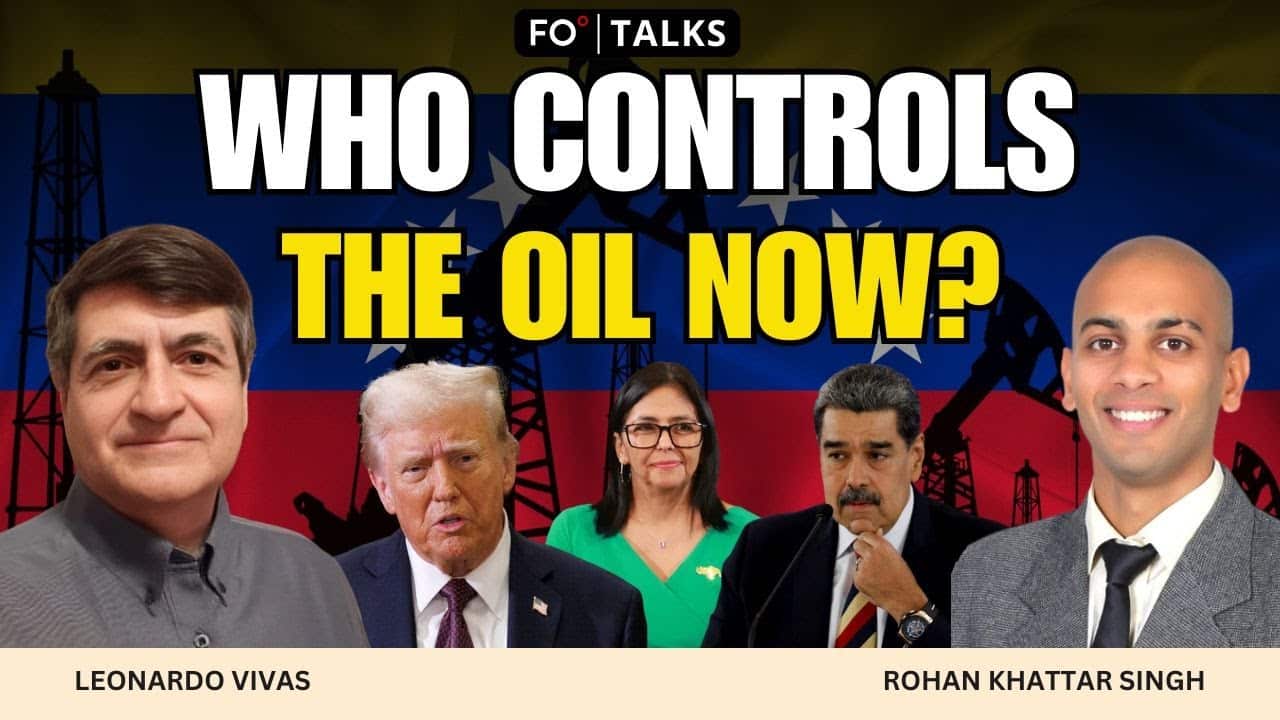
FO° Talks: Trump, Maduro and Oil: How the Venezuela Operation Redefines American Power