
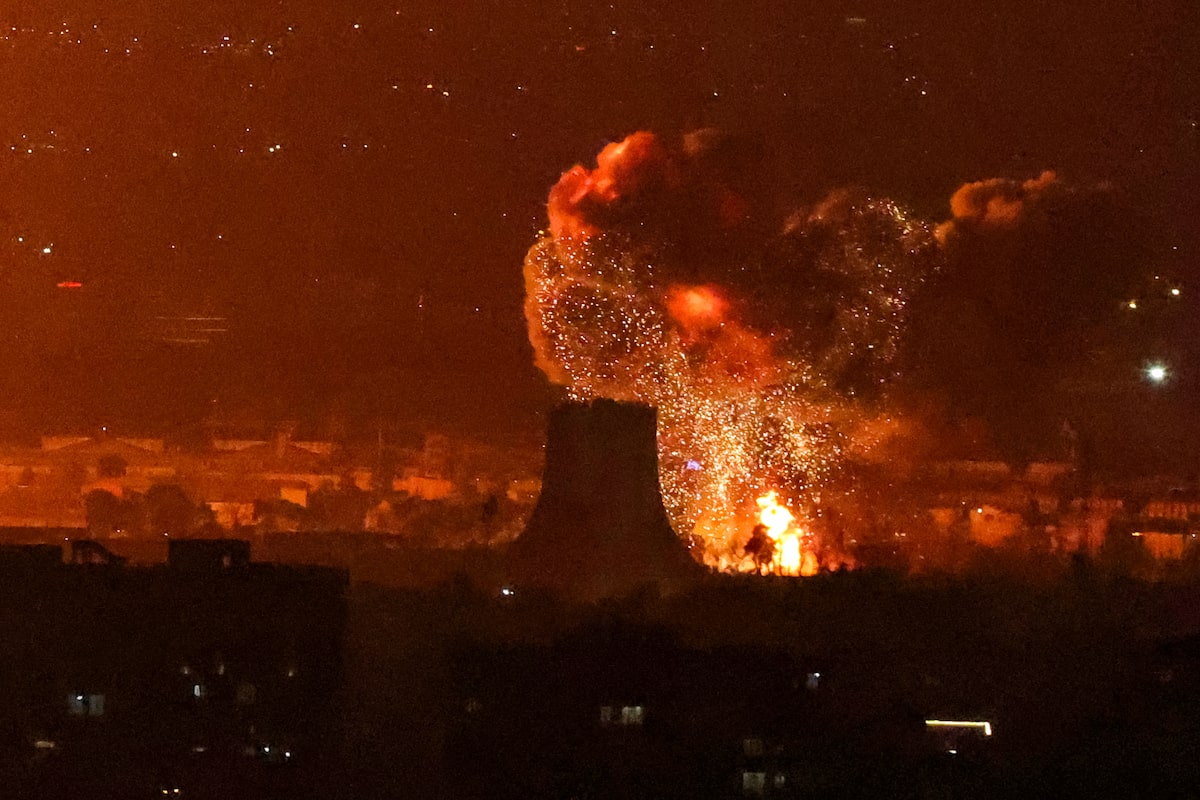
An explosion erupts following strikes near Azadi Tower close to Mehrabad International Airport in Tehran on Saturday.ATTA KENARE/AFP/Getty Images
In his second inaugural address, Donald Trump vowed to be a “peacemaker” and expounded on one of his favourite themes: the value of not getting involved in foreign conflicts.
“We will measure our success not only by the battles we win but also by the wars we end,” he told the assembled before the Capitol that day. “And, perhaps most importantly, the wars we never get into.”
A little over a year later, Mr. Trump has launched a war of choice against Iran.
In just a week, air strikes by the U.S. and Israel have inflicted thousands of casualties, while Tehran has retaliated with missile and drone attacks on a dozen countries. The Lebanon-based Hezbollah has reignited its long-running battle against Israel. And the Strait of Hormuz is effectively shut down, driving down global oil supplies and sending prices sharply higher.
The President appears to be digging in further. “There will be no deal with Iran except UNCONDITIONAL SURRENDER!” he wrote Friday on Truth Social.
Analysis: Does Donald Trump really know what ‘unconditional surrender’ means?
For the Middle East, Mr. Trump’s about-face threatens to engulf the region in a widening war. For the U.S., it risks dragging the country into another foreign quagmire of the type Mr. Trump once vowed to end. And for the rest of the world, it heralds an era of unilateral American military intervention at any time, for any reason.
With Mr. Trump’s stated war aims continually shifting, it remains wholly unclear how long the conflict might last or which country the President might decide to strike next.
“It’s a declaration of imperialism, clear and simple,” said Lloyd Axworthy, a former Canadian foreign affairs minister, in an interview. “It’s whim, it’s caprice, it’s ambition, and it’s a sense that there is no rule or law or agreement or treaty or any restraint.”
The war in Iran is the second foreign military intervention for Mr. Trump in eight weeks, after his January attack on Venezuela to capture dictator Nicolás Maduro. Since then, the President has once again threatened to send U.S. troops into Mexico to fight the country’s drug cartels, launch a “friendly takeover” of Cuba and annex Greenland – though he later backpedalled on that goal.
With Canada already rocked by Mr. Trump’s global trade war, such a declared expansion of American power renews the concern sparked by his “51st state” rhetoric last year.
An overturned car sits on the 4th floor of a damaged building after being thrown up there by a missile strike, in the centre of Nabi Chit in the Beqaa Valley in eastern Lebanon.Oliver Marsden/The Globe and Mail
The U.S., for instance, might look to assert control over the Canadian Arctic − particularly the waters of the Northwest Passage, over which Washington has never recognized Ottawa’s sovereignty, Mr. Axworthy said. Canada could also be vulnerable because so much of its military technology, including the F-35A fighter jet fleet it plans to buy, is controlled by the U.S.
“In terms of our very immediate independent sovereignty, there are several signals coming out of Trump’s declaration that the Arctic will be a centre of United States security interest,” he said. “That was a direct threat to Greenland but it also had an implied threat to Canada.”
Mr. Trump has so far been ambiguous about how large he is willing to let the current fighting in the Middle East grow.
At times, he has explicitly called for regime change, suggesting he will not stop until Tehran’s theocratic dictatorship had fallen. At others, he has suggested something closer to the outcome in Venezuela, where the U.S. has left Mr. Maduro’s subordinates in place so long as they do what Mr. Trump says, such as handing over the country’s oil to the U.S.
Sahar Razavi, an Iran expert at California State University, Sacramento, said one possible scenario in Iran is that “a hollowed-out version of the Islamic Republic” remains in power by negotiating concessions to the U.S. and Israel. Another is that the regime collapses and the country descends into civil war.
Opinion: The West’s delicate, troubling dance with Trump on Iran
It’s also possible that Iran’s supply of relatively inexpensive drones outlasts the U.S. military’s supply of far more costly interceptor missiles, which could leave the Americans vulnerable to attacks from other groups.
“Iran has prepared for this war and has fortified itself to survive a war of attrition that outlives the political will of the United States to engage in a prolonged military confrontation,” said Prof. Razavi, director of the university’s Iranian and Middle Eastern Studies Center. “There’s a high risk this could get much worse than anybody in the Trump administration is predicting.”
While U.S. presidents have long felt unbound by international law on war – in 2003, for instance, George W. Bush invaded Iraq despite failing to secure the backing of the United Nations – Mr. Trump’s Iran attack reveals a White House that is no longer limited by domestic constraints, either.
Jorge Castañeda, a former Mexican foreign affairs minister, pointed to the fact that Mr. Bush at least obtained congressional authorization before the Iraq invasion. And, he added, there is a string of presidential executive orders going back to Gerald Ford banning the U.S. from engaging in foreign assassinations.
Mr. Trump did not go to Congress before hitting Iran and also appears to have ignored the no-assassination rule by taking part in an operation in which Israel took out supreme leader Ayatollah Ali Khamenei.
“Since the late 1960s, a series of decisions limited expressions of American hegemony, American power, American unilateral intervention. All of those limits have now been breached because Donald Trump has simply said, ‘I don’t care,’ and he can get away with it,” Mr. Castañeda said.
Opinion: In Iran, Trump is doing what his predecessors should have done long ago
At least part of the change is owing to Mr. Trump’s utter dominance of his Republican Party. Polling this week has shown a majority of U.S. voters oppose the war. But a strong majority of voters who self-identify as members of Mr. Trump’s MAGA base support the attack − despite the vociferous opposition to foreign military intervention that was once a hallmark of the movement.
Jordan Tama, an expert in security policy at American University in Washington, said the high degree of trust Mr. Trump’s core supporters put in him, along with traditional Republican hawkishness on foreign affairs, have combined to give him unbridled party support for his actions.
Overall, however, backing for the war is significantly lower than it was for the 2003 Iraq invasion at the outset. This means that Mr. Trump is taking a significant political risk if the war doesn’t end swiftly with a favourable result for the U.S.
“This war is already unpopular, and we’re only in the first week of it. Typically, the beginning of a war is the high-water mark of support,” Prof. Tama said.
It probably isn’t helping that Mr. Trump and his subordinates’ justifications for the war keep changing. The President has said he “felt strongly” that Iran was planning to attack the U.S., but did not provide evidence. Secretary of State Marco Rubio at one point suggested that the U.S. was pulled into the conflict at the behest of Israel, before walking the statement back the next day.
It all contrasted sharply with Mr. Trump’s long history of criticizing America’s “forever wars” in Iraq and Afghanistan. In 2016, it was one of the major issues that helped him take over a GOP in which many voters were frustrated with their own party’s decision to invade Iraq based on false claims that the country was building weapons of mass destruction.
“The war in Iraq was a big, fat mistake,” Mr. Trump famously charged in one Republican primary debate that year. “They lied.”