
As Israel enters the second week of Operation Roaring Lion, the Ministry of Defense announced a series of major developments for the country’s accelerated efforts to strengthen its military capabilities.
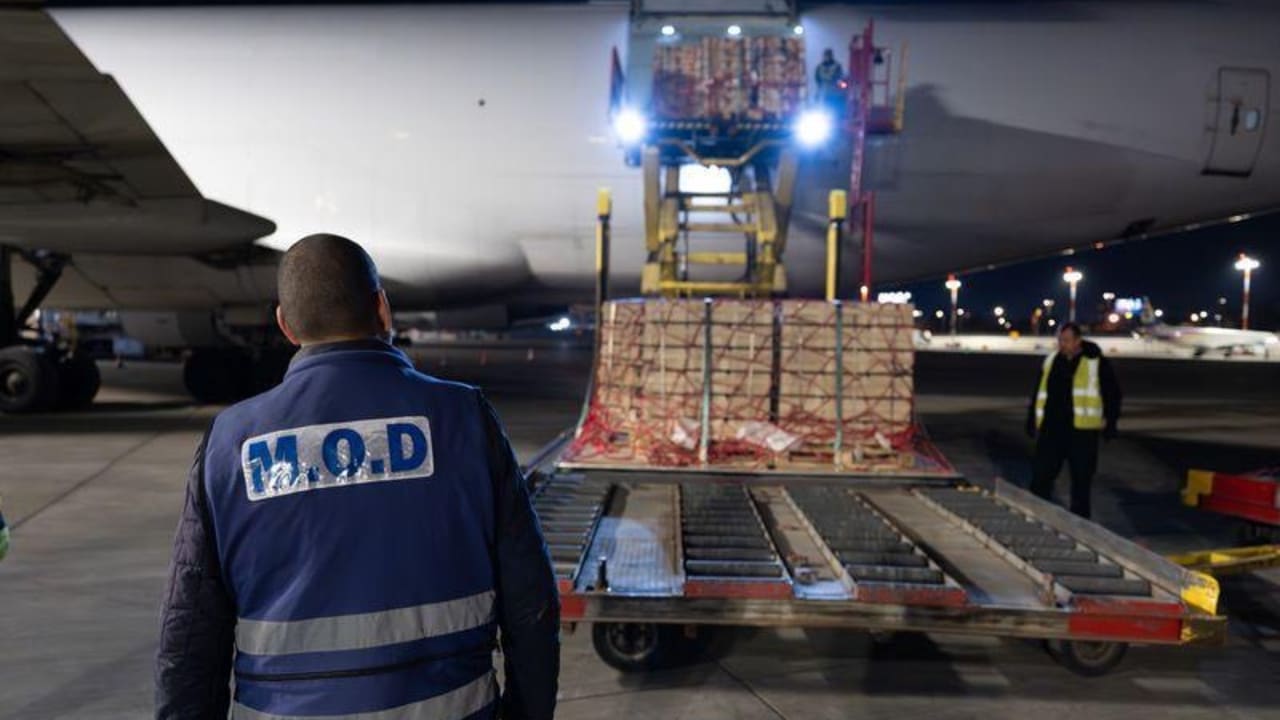
On Monday the IMoD said that approximately 50 cargo aircraft carrying over 1,000 tons of weaponry, military equipment, and various types of munitions have landed in Israel over the past ten days and have been transferred to the IDF.
“This is a large-scale shipping operation, conducted under fire and in parallel with the advancement of Operation Roaring Lion and preparations for the next phases of the campaign,” the IMoD said, adding that the airlift is expected to scale up in the coming period.
The airlift is led by the IMoD Defense Procurement Directorate (DPD), through its International Shipping Division, the IMoD Mission to US and Germany, and the IDF’s Planning Directorate. The Israel Airports Authority and the Israel Civil Aviation Authority are also partners in the operation.

Earlier in the week IMoD Director General, Maj.-Gen. (Res.) Amir Baram visited a space facility jointly operated by IAI – Israel Aerospace Industries, the Ministry’s Directorate of Defense Research and Development – DDR&D (MAFAT), and the IDF.
He was joined by IAI CEO Boaz Levy, the Head of the DDR&D’s Space Directorate Avi Berger, and other senior defense establishment officials.
According to a statement by the MoD, Baram visited an operational ground station serving a number of the defense establishment’s satellites, reviewed real-time operational satellite imagery from the fighting in Iran, and discussed the latest developments in the space domain and their direct contribution to IDF strikes in the current campaign.
“Israel’s space capabilities are producing groundbreaking combat achievements in intelligence for warfare and operations, target generation, and rapid operational cycles. Behind them stands a unique ecosystem of industry and DDR&D engineers working alongside the Unit 9900, the C4I and Cyber Directorate, and the Israel Air Force,” Baram said. “This partnership enables rapid learning and real-time implementation of technological developments, granting Israel superpower capabilities. Space is a first-order strategic national priority. We will continue to advance the buildup of space power by every means possible.”
Israel’s space capabilities play a key role in the Jewish state’s strategic military capabilities.
In an interview with Defense & Tech by The Jerusalem Post in December, Berger said that Israel had been developing new space‑based capabilities designed to give the country an edge in the next war with Iran.
“We knew right away that we had to build and create new surprises for the next war,” he said. “Whatever was deployed in June won’t be enough next time. The IDF now has new capabilities – and we can’t forget that the enemy will be different next time around, too.”
Last week Baram also held a security situational assessment with the CEOs of Israel’s major defense industries and senior Ministry officials.
During the meeting, Baram presented the industry leaders with an operational situational report along with the “required procurement and force build-up plans.” Baram also told the heads of the major defense industries to increase the production rate of “essential offensive and defense” systems as part of the preparations of continued IDF and Israel Air Force’s operational missions across multiple fronts.
While the IMoD statement did not say which platforms were discussed, the majority of Israel’s air weaponry are produced by the country’s three main defense companies- Tomer, Elbit Systems, Rafael Advanced Defense Systems and Israel Aerospace Industries-IAI.
A report by Calcalist said that the weapons discussed included air-to-ground bombs, glide bombs, advanced air-to-ground missiles, and interceptors for air-defense systems such as IAI’s Arrow 3 and Barak MX, as well as Rafael’s David’s Sling.
On Monday Baram visited Elbit and discussed “scaling up production rates” for defense requirements in support of the ongoing campaign in Iran and the potential for its expansion to additional fronts.
According to the Defense Ministry statement, Baram toured aerial munitions production lines that had increased productivity over the past year after learning lessons from over two years of war.
“The central focus of the Ministry of Defense, per the Minister of Defense’s directive, is aerial munitions. Months of preparation and early readiness have enabled the IDF to operate with virtually no constraints in Iran and Lebanon. At the same time, we are now working to replenish all munitions expended in order to be prepared for any scenario. The decisions we made to expand and accelerate production lines in Israel before the operation will now allow us to take production rates to the next level,” Baram was quoted as saying.
The visit was also attended by IMOD Deputy Director General and Head of the Planning Department, Itamar Graff; Deputy Director General and Head of the Defense Procurement Directorate (DPD), Ze’ev Landau; General Manager of Elbit Systems Land, Yehuda (Udi) Vered; and additional senior officials.