
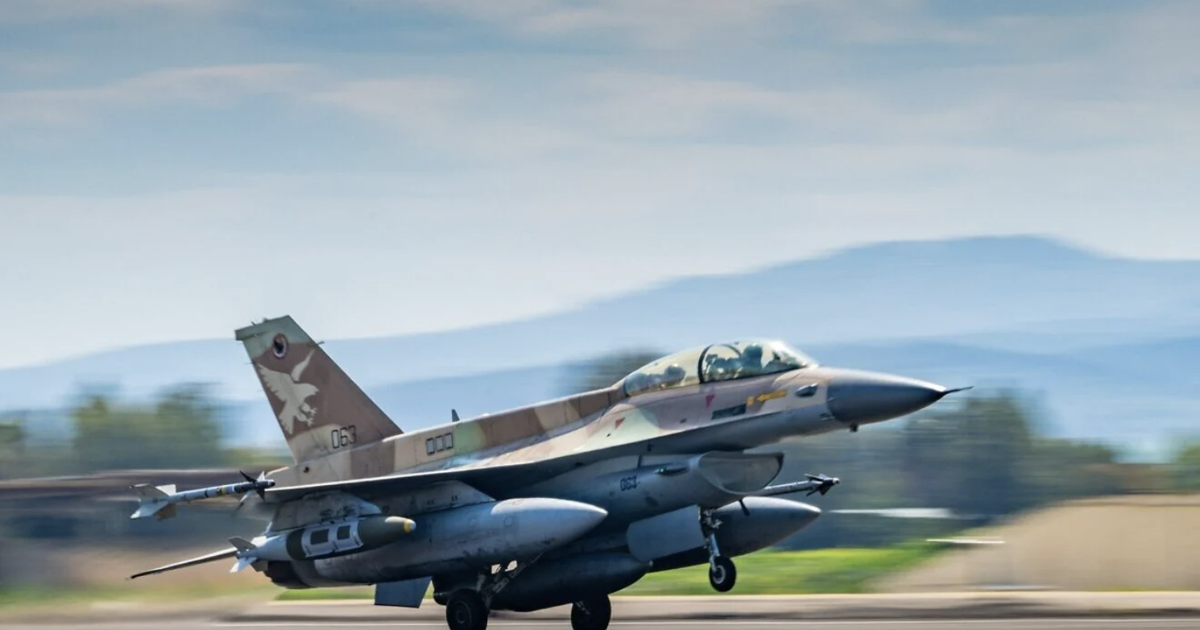
The Israeli Air Force attacked missile launch sites and Basij paramilitary militia and Internal Security Forces command centers as the IDF “continues to deepen the damage to all arrays and capabilities of the Iranian terror regime,” the military said on Monday morning.
The long-range ballistic missile launchers were ready to fire at Israel when they were struck, the IDF said, adding that a rocket engine production facility was also hit.
Among the targets, according to Israel’s military, were the Iranian regime’s regional corps headquarters, its Internal Security Forces command center in Isfahan, another base used by the Islamic Revolutionary Guard Corps and Basij, and the IRGC police headquarters.
“The Internal Security and Basij forces constitute part of the Iranian armed forces that are subject to the Iranian terror regime, and have for years advanced terror activity,” the statement continued. “The forces constitute a central arm in the repression of the Iranian civilian population and are responsible for the use of brutal and systematic violence against it.”
IDF begins ‘wide-scale wave of strikes’
The IDF announced on Monday afternoon that it had begun “a wide-scale wave of strikes against infrastructure of the Iranian terror regime across Tehran, Isfahan and southern Iran,” as the Israeli-American military campaign against the Iranian regime entered its ninth day.
Jerusalem and Washington have deployed their forces as part of operations “Roaring Lion” and “Epic Fury,” respectively, targeting air defenses, command-and-control networks, and Iran’s nuclear and ballistic missile programs.
IDF targets IRGC Air Force’s HQ
Israel’s military revealed on Sunday night that it attacked the IRGC’s Air Force headquarters during wide-scale strikes on dozens of regime targets.
“The site was the main command-and-control center used to direct the regime’s air force activity. The Iranian terror regime’s ballistic missile command, Unmanned Aerial Vehicle (UAV) array, and other air force units all operated in the headquarters,” the IDF said.
“The Air Force Headquarters was also responsible for producing a situational picture and for planning missile attacks on the State of Israel and the countries in the region,” it added.
“The strike on the Iranian terror regime’s air force is part of the concentrated effort to dismantle the Iranian ballistic missile array while impairing its ability to synchronize and coordinate attacks on the State of Israel,” the statement continued. “The IDF continues to strike Iranian regime targets in order to further dismantle the Iranian terror regime’s capabilities.”
IAF kills senior Iranian military official
The IDF said on Sunday that an Israeli airstrike in Tehran on Saturday killed Abu al-Qassem Baba’iyan, the head of the military office of Iran’s supreme leader and chief of staff of its emergency command headquarters.
Baba’iyan was responsible for coordinating operations between Iran’s military and its terror proxy forces against Israel, the IDF said.
His death follows a series of IDF strikes targeting senior Iranian military officials, including Mohammad Shirazi, the military chief of staff to Supreme Leader Ayatollah Ali Khamenei, earlier in the campaign. Khamenei was killed in the opening strike on Feb. 28 that targeted his fortified compound in Tehran.
CENTCOM warns Iranian civilians amid ongoing strikes
U.S. Central Command (CENTCOM) issued a safety warning to civilians in Iran on Sunday, cautioning that Tehran’s use of populated areas to launch drones and missiles could make those sites legitimate military targets under international law.
CENTCOM said Iranian regime forces have been operating from crowded cities including Dezful, Isfahan and Shiraz, endangering civilians as the regime continues missile and drone attacks across the region.
Adm. Brad Cooper, the command’s leader, accused Iran’s “terrorist regime” of “blatantly disregarding civilian lives” while targeting airports, hotels and residential neighborhoods in Gulf nations.
The U.S. military said it takes precautions to avoid civilian harm and urged Iranians to remain at home as fighting continues. CENTCOM said Iran has launched hundreds of ballistic missiles and thousands of attack drones since Feb. 28, though launch rates have “drastically declined” amid U.S. and partner counterstrikes.
In a Hebrew-language post, CENTCOM mocked Iranian claims that American “supernatural forces” diverted its missiles, calling the explanation “lies” and denouncing Tehran’s “reckless attempts” to strike civilian targets.
Iran’s president continues contradictory messaging
Iranian President Masoud Pezeshkian said in a video message on Sunday that the U.S. and Israel want “us and the Islamic countries to be at war,” calling neighboring countries “brothers” and advocating for good relations.
He attempted to justify the regime’s attacks on Arab Gulf states, which the Arab League strongly condemned in a virtual emergency session on Sunday as illegal, unprovoked and a grave threat to regional and international peace and security.
Pezeshkian said, “If from any country they attack our soil and carry out aggression, naturally we are obliged to respond to them,” arguing that the Iranian attacks do not mean “that we have a dispute with that country” or “upset the people there.”
Tehran has attacked Bahrain, Kuwait, Oman, Qatar, Saudi Arabia and the United Arab Emirates since the Feb. 28 launch of the joint Israeli-U.S. military operation against the Iranian regime. The missile and drone strikes have killed at least 14 people across the Arabian Gulf, including two army officers in Kuwait on Sunday.
IDF chief: Home Front Command vital to victory
IDF Chief of Staff Lt. Gen. Eyal Zamir thanked Home Front Command Search and Rescue Brigade troops on Sunday, telling them that their role is as “critical to the success of the war” as the IAF pilots striking Iranian regime targets in Tehran.
“We are now striking the most dangerous enemy we face, Iran. We went out to this campaign about eight months ago [in June’s ‘Operation Rising Lion’], and we are entering it once again after drawing lessons and learning,” Zamir said.
“We are determined to act more deeply and more forcefully, and to strike them so that we can remove the threat from Iran for the long term. Iran is not only Iran. Iran has also built the axis. It built Hezbollah, and in many respects it built Hamas and Islamic Jihad in Gaza. It is building networks and militias in various places, creating a regional system intended to harm us,” the general continued.
“Now we are going after the head of the snake,” Zamir said.