
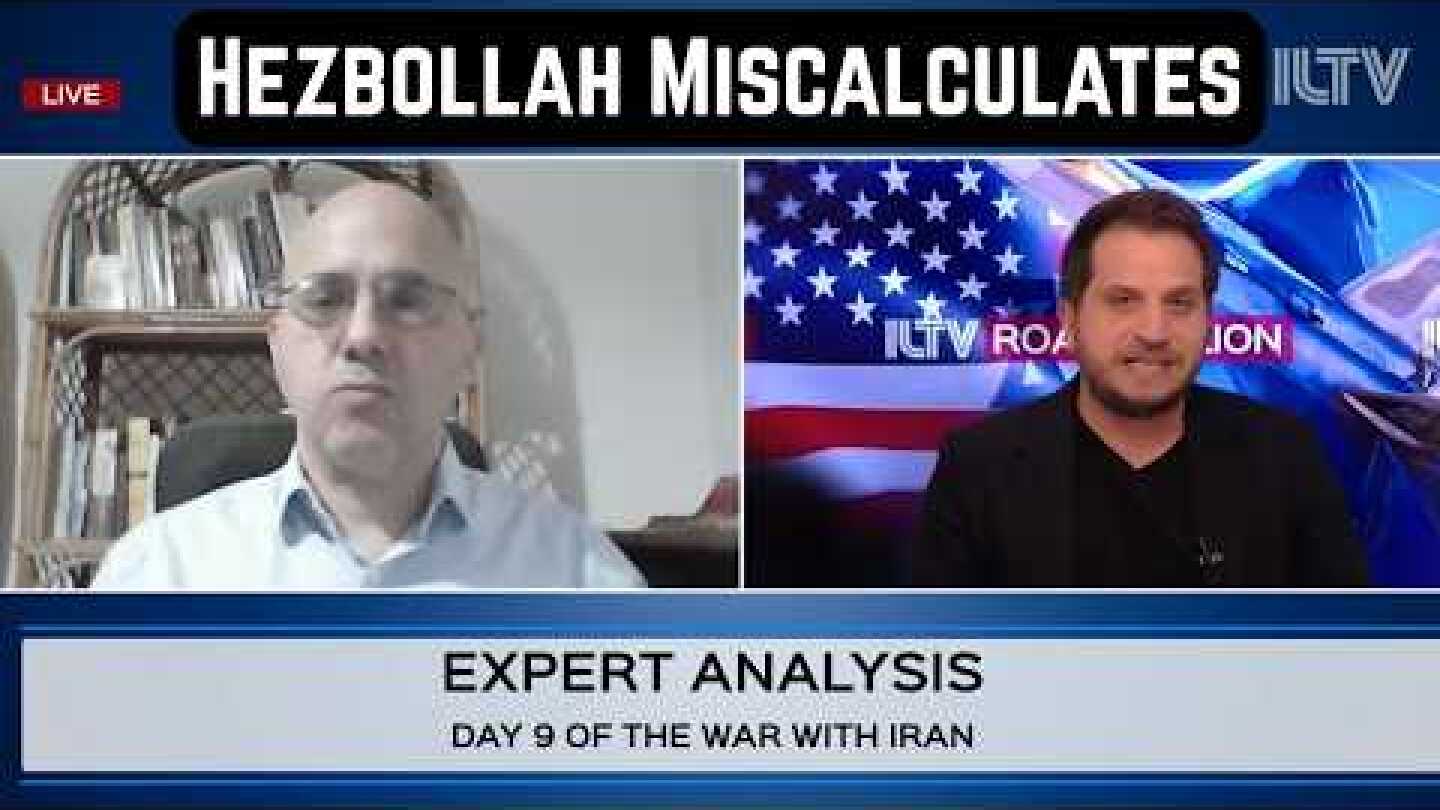
Middle East Forum Director of Research Jonathan Spyer spoke with ILTV News Flash about the intensifying fighting on Israel’s northern front and why Hezbollah continues to underestimate Israel’s response. He argued that Hezbollah’s recurring tactical mistakes reflect a deeper strategic misreading of Israel as fragile, while warning that although Israel can inflict severe damage, permanently dismantling Hezbollah remains difficult without either a major ground operation or the collapse of Iran’s regime. Spyer also noted a notable shift inside Lebanon, where criticism of Hezbollah – including from parts of the Shia community – is becoming increasingly visible.
HOST: Joining us now is Jonathan Spyer, director of research at the Middle East Forum, to discuss everything happening on the northern front and with Hezbollah, where the fighting seems to have intensified in recent days. Has it not?
SPYER: Very clearly so. What we are seeing is that the IDF has deployed, not very deeply into the field, but certainly to the first village line. There are at least two divisions now operating, so naturally this brings vulnerabilities. At the same time, we should bear in mind that Hezbollah fighters have also lost their lives, and we are also in a context of bold Israeli actions from the air and involving special forces reaching far beyond the border over the last 48 hours.
HOST: Right, and those rocket attacks have continued. At the beginning Hezbollah launched a very limited salvo at Israel, almost as if to say, “Look, we’re doing something for Iran,” but now it seems they have decided to commit to that a little more.
SPYER: Yes, I think so. There seems to be a recurring error that Hezbollah in Lebanon tends to make, going all the way back to the 2006 war, if you remember, with the kidnappings and murders of the soldiers that began that war, and also with their response on October 8, 2023, and now again.
That error is that they constantly underestimate the likely Israeli response to their attacks and then appear surprised at the extent and depth of that response. From the statement made by Naim Qassem, the current leader of Hezbollah, after their latest attack, there is a sense that they have done it again. They launch a small salvo and expect something small and proportionate in response. That is not how it works.
A salvo of missiles is an act of war, and one side does not get to define the extent or nature of the other side’s response. Israel clearly appears to have wanted in any case to deliver a serious series of blows to Hezbollah in the course of this war with Iran, and in a certain sense Hezbollah afforded Israel that possibility by choosing to enter the war with that relatively small salvo.
HOST: But is it really an error, as you say? Hezbollah knows Israel is more powerful than they are, and their goal essentially is an endless war of attrition that in the end may delegitimize Israel and weaken it. What have they really been trying to achieve all along?
SPYER: Your characterization of Hezbollah and Iran’s long-war strategy against Israel is accurate. The idea is to subject Israel to an endless series of attacks and instability with the notion, not entirely clear in mechanism, that eventually Israel will collapse.
The thing is, when I talk about Hezbollah’s tactical errors, they fit with this strategic error as well. Both stem from a fundamental misreading of Israel. Hezbollah has inherited from earlier Arab nationalist thinking the notion that Israel is inherently fragile and weak.
That conception runs deep. It also explains the tactical mistakes because Hezbollah believes Israel will be frightened to respond. Hassan Nasrallah, for example, on October 8, had no idea of the extent of the response he would receive from an Israel furious and wounded after October 7 because he was still operating according to that flawed conceptual map of Israel that Hezbollah, Iran, and their allies continue to use.
That is why they continue to make both tactical and strategic errors.
HOST: Israel has also changed the paradigm it is operating under. After 2006 there was an international agreement that Hezbollah had to remain disarmed south of the Litani, but they slowly encroached and broke that agreement, and Israel allowed it to happen. Now Israel seems determined not to allow that again.
SPYER: You are absolutely right. Resolution 1701 turned out, predictably – and many did predict it at the time – to be a dead letter because the forces supposed to enforce it, namely the Lebanese Armed Forces and the United Nations Interim Force in Lebanon, did not intend to do so and probably could not have done so even had they wished.
So there was nothing preventing Hezbollah from being rearmed by its Iranian patron, and that indeed took place.
Yes, there has been a profound change since October 2023 in the sense that Israel is no longer willing simply to deter forces like Hezbollah. It now wants to defeat and dismantle them.
Having said that, we should be clear that between intention and effect there may still be distance. Even though Israel is hitting Hezbollah much harder now than in the past, and that is certainly significant, it is still not clear what mechanism exists to permanently dismantle Hezbollah.
In my estimation, after this round ends Hezbollah may be severely damaged and hurting, but still in existence. It is difficult to see what instrument removes it entirely short of the fall of the Islamic Republic in Tehran. If that regime falls, Hezbollah will be finished. But short of that, and without a major Israeli ground action into Lebanon – which Israel does not want – it is hard to see what permanently dismantles Hezbollah.
HOST: For that to happen, it would seem to require the Lebanese state and other Lebanese actors, yet they do not seem to have either the means or the will to resist Hezbollah.
SPYER: You point to an important development. Prime Minister Nawaf Salam in recent days, following the Hezbollah attack on Israel, has for the first time declared Hezbollah’s armed activity illegal. He has effectively said words that should have been obvious and should perhaps have been said by Lebanese prime ministers long ago, but were not.
He has declared Hezbollah’s arms illegal. That sounds comprehensive, but what we are already seeing is that the mechanism he would need to enforce that declaration, namely the Lebanese Armed Forces, is simply not fit for purpose.
We have seen statements from the Lebanese Armed Forces chief suggesting he cannot carry out such actions while Israel continues its attacks. That is a weak excuse. The deeper reason is that the Lebanese Armed Forces are neither politically willing nor institutionally able to confront Hezbollah directly.
The army is estimated to consist of roughly 50 percent Shia soldiers in the ranks and around 30 percent Shia officers. If ordered to confront Hezbollah, it would almost certainly split, and the result would be civil war. Lebanon remains terrified of civil war and ready to avoid it at all costs.
As long as that remains true, it is an illusion to believe the Lebanese state will confront Hezbollah directly.
HOST: What about public opinion inside Lebanon? Civilians are repeatedly dragged into these wars by Hezbollah. Are attitudes changing?
SPYER: This is actually one of the most interesting developments. For the first time, at least that I can remember, the barrier of fear among the Lebanese Shia community regarding criticism of Hezbollah may be breaking.
It is not new to hear Christian or Sunni Lebanese criticize Hezbollah. Polling consistently shows those communities do not support Hezbollah and do not view it as representing them.
What is new is that within the Shia community, which historically either mobilized behind Hezbollah or maintained silence, that taboo now appears weakened.
There is considerable evidence on media and social media of Lebanese Shia civilians openly criticizing Hezbollah and blaming it for displacement from their homes.
Israel has been warning large populations in southern Lebanon and the Beirut suburbs before strikes, and some civilians are openly noting that while Israel warns them, Hezbollah launches attacks from populated areas without warning residents.
There is a growing sense that Hezbollah, badly damaged by Israel in late 2024, is now willing to mortgage the future and security of Lebanese civilians in order to recover lost prestige.
Many Lebanese no longer want to be part of that equation. They resent being displaced again, and they appear less intimidated than before about saying so openly.
That is a very notable development.